



Systems, not just skills, separate practices that thrive from those that fight fires. Therapists with excellent hands often fail when operations are chaotic; repeatable workflows are the reliable backbone for growth and retention.
A massage practice operations workflow should start at discovery and booking, then flow through intake, treatment, billing, and follow-up. When those touchpoints are connected, client experience and staff execution align; when they aren't, problems compound.
Without clear operational flow, a busy week becomes reactive: overlapping calls, room confusion, unanswered billing emails, and partial fixes that create tomorrow's issues. Each isolated interaction is a handoff risk; connected systems remove friction.
The booking-to-billing pipeline most practices get backwards
Many practices build operations from the treatment room outward. That makes sense clinically but creates a client experience disconnect. Start where the client starts—discovery and booking—then cascade rules and verifications downstream so every handoff carries the right information.
Why standard booking systems create operational bottlenecks
Generic scheduling tools treat all appointments the same. Massage workflows need richer rules and constraints so bookings don't silently create failures for therapists, rooms, insurance, and packages.
Never miss a booking or double-book again.
Masthera helps you schedule, confirm & manage every massage session with ease.
- Unified appointment management
- Automated client reminders
- Therapist calendar coordination
No credit card required
-
Room requirements (e.g., hot stone vs. standard table)
-
Therapist specializations, certifications, and restrictions
-
Client health conditions and contraindications needing flags
-
Insurance pre-authorizations and coverage checks
-
Package credits, memberships, and intake form expirations
14-Day Rapid Fix: Stop Double-Bookings
Double-booking usually stems from split calendars, unlocked rooms, and unclear override permissions. Execute this prioritized 14-day plan to eliminate scheduling conflicts quickly.
| Timeline | Role Owner | Concrete Actions & Calendar Settings | Acceptance Criteria |
|---|---|---|---|
| Days 1–2: Emergency Audit & Authority Freeze | Studio Manager | Establish the primary software as the sole source of truth; ban bookings via paper or direct therapist text. Remove manual override and force-book permissions. Audit next 14 days and resolve existing clashes. | Single master calendar active; zero unresolved overlaps for 14 days; only Studio Manager has override permissions. |
| Days 3–5: Calendar Rules & Technical Settings | Studio Manager & Booking Coordinator | Enable hard conflict detection requiring both a therapist and a treatment room. Set 10–15 minute buffers; enable multi-calendar availability checks and a minimum advance booking notice. | Booking engine declines or hides slots when therapist or room is busy; buffer times appear as blocked. |
| Days 6–9: Process Standardization & Intake Rules | Front Desk Lead | Require centralized intake verification before confirming slots. Standardize temporary holds with automatic release windows. Run twice-daily calendar sweeps to verify assignments. | Shift schedules locked; front desk completes daily checks with zero unassigned resources. |
| Days 10–14: Stress Testing & Acceptance Review | Entire Team (Led by Studio Manager) | Run multi-channel booking tests across web, phone, and reception to ensure concurrent attempts fail gracefully. Train therapists to update out-of-office blocks 14 days ahead. | Stress tests reject conflicting attempts; zero double-bookings logged over 4 consecutive operational days. |
Building intake that actually prepares your therapists
Digital intake is operational intelligence, not just paperwork. Well-structured intake creates predictable outcomes for treatment, risk management, and billing accuracy.
Treatment preparation: intake should surface preferences and restrictions so therapists arrive informed and avoid awkward in-session questioning.
Risk flagging: contraindications, recent surgeries, and medications should be visible before a client undresses so sessions are safe and compliant.
Billing accuracy: verify insurance needs, referrals, and authorizations during intake so claims don't stall later in the cycle.
Impact: paper intake costs therapists 7–10 minutes per session in admin time; structured digital intake commonly cuts that to under 2 minutes, freeing significant capacity across a team.
Session handoff failures that kill retention
The five minutes after a session determine if a client rebooks. Without a structured handoff, the front desk often lacks context to reinforce recommendations or schedule the correct follow-up.
-
Services actually delivered versus booked
-
Specific areas worked and pressure notes
-
Recommended frequency and focus areas
-
Products suggested during the session
-
Any concerns or observations to flag
Therapists need a reliable, quick method to pass this information forward—either a short template note in the EHR or a brief checkout card the front desk can read at reception.
Billing workflows that prevent revenue leakage
Small practices commonly lose 8–12% of revenue to preventable billing gaps: uncaptured service upgrades, package disputes, unsubmitted claims, and stale payment methods.
The remedy is clear stage ownership: define steps, owners, timelines, and escalation paths for each billing scenario so nothing falls between roles.
-
Verification at booking (coverage and authorization needs)
-
Documentation during service (CPT codes, modalities used)
-
Claim preparation within 24 hours (notes and superbill)
-
Submission and tracking (claim numbers and monitoring)
-
Denial management (analyze reason, appeal, resubmit)
Decision tables that remove front desk guesswork
Decision matrices codify consistent responses to common front-desk scenarios so new staff can act without constant manager input.
| Scenario | Condition | Action | Escalation |
|---|---|---|---|
| Late arrival | Under 10 minutes | Honor full appointment | None |
| Late arrival | 10–20 minutes | Shorten session, collect full payment | Note in file |
| Late arrival | Over 20 minutes | Reschedule required | Manager approval for exceptions |
| No-show | First occurrence | Charge 50%, allow rebooking | Send reminder email |
| No-show | Second occurrence | Charge 100%, require prepayment | Manager reviews account |
| Same-day cancellation | Medical/emergency | Waive fee once per year | Document reason |
| Same-day cancellation | Non-emergency | Apply cancellation fee | No exceptions |
| Package expiration | Within 30 days | Honor with warning | Update expiration tracking |
| Package expiration | Over 30 days expired | Require manager override | Consider partial credit |
The follow-up system that drives rebooking
Follow-up completes the service workflow and materially increases rebooking. It should be operationalized, not left to therapists' verbal reminders.
-
24-hour check-in
brief service/comfort follow-up via text or email
-
7-day touchpoint
personal note for new clients or insurance updates
-
Recare scheduling
automated reminders based on treatment type
-
Lapsed client recovery
re-engagement after 60 days without booking
Structured follow-up can raise immediate rebooking from about 40% to 65%, translating into substantial additional sessions without extra acquisition spend.
Mapping your complete operational flow
Your operational flow is circular with branches for insurance, packages, no-shows, and referrals. Mapping reveals gaps and handoff requirements you can improve incrementally.
-
Discovery
-
Booking
-
Pre-arrival
-
Check-in
-
Intake
-
Treatment
-
Checkout
-
Payment
-
Follow-up
-
Rebooking
For multi-therapist practices, document what information must transfer at each handoff, who owns it, what triggers the next step, and the escalation path when things break.
Role-level procedures that scale with growth
SOPs are simply precise answers to 'how we handle X'. Document role-level procedures so knowledge doesn't leave when people do.
Front desk SOPs:
-
Opening and closing checklists
-
Appointment booking standards
-
Payment processing steps
-
Insurance verification process
-
Package and membership management
-
Client communication scripts
Therapist SOPs:
-
Room preparation standards
-
Client consultation process
-
Session documentation requirements
-
Product recommendation guidelines
-
Handoff communication protocols
Manager SOPs:
-
Scheduling procedures and overrides
-
Inventory and supply management
-
Staff oversight and rostering
-
Financial reconciliation processes
-
Complaint escalation handling
Sample workflow diagrams for common scenarios
Common scenarios benefit from simple, repeatable flow diagrams that guide automation and staff actions.
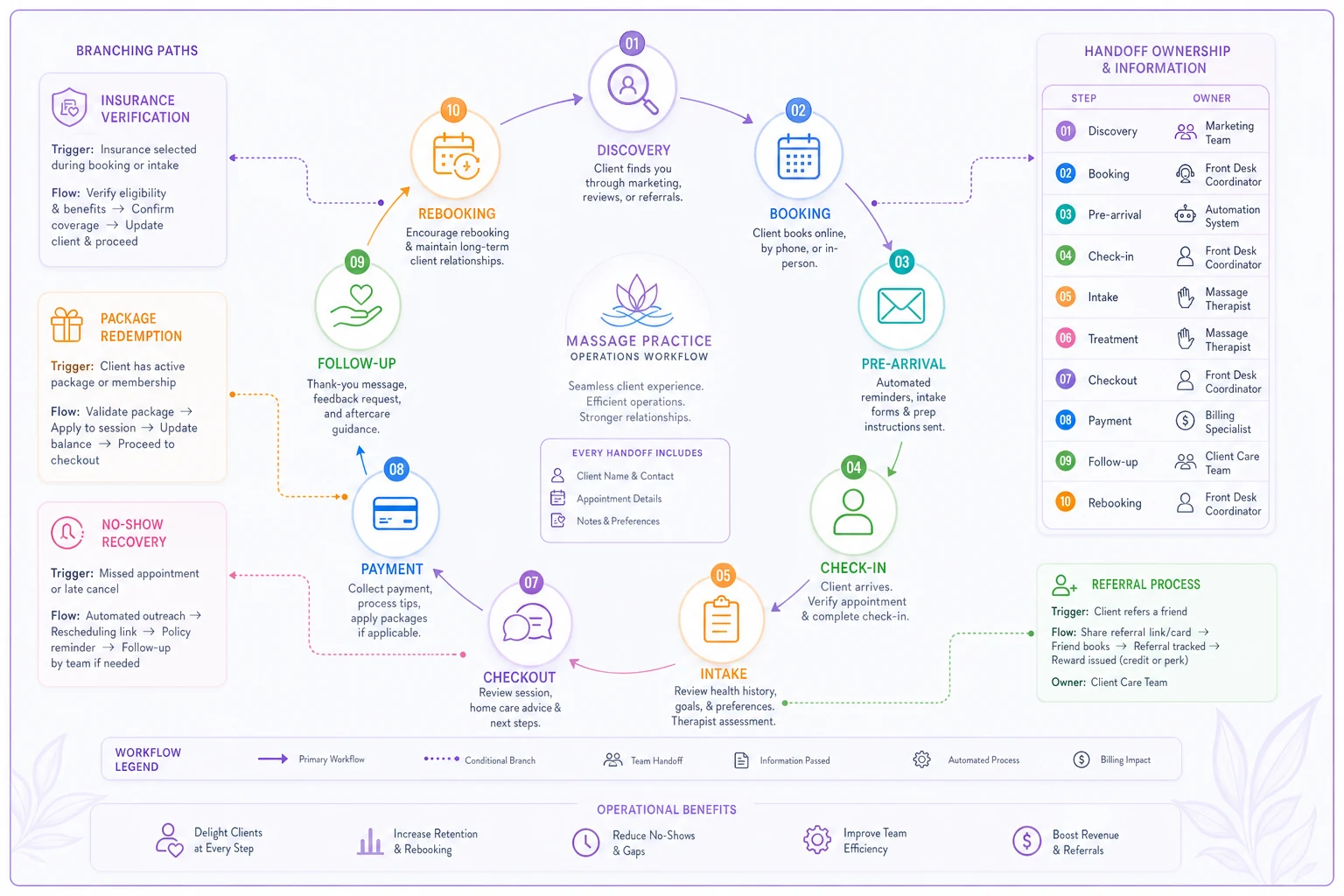
New client journey:
-
Books online and receives intake forms
-
Completes intake; system assigns therapist by needs
-
Receives confirmation with arrival details
-
Checks in; front desk verifies intake and payment method
-
Therapist reviews intake and adjusts plan
-
Session complete; therapist documents session
-
Checkout; front desk books follow-up and processes payment
-
Follow-up triggers (24-hour and 14-day reminders)
Insurance client workflow:
-
Initial inquiry
verify coverage before booking
-
Book and obtain authorization if required
-
Pre-arrival
confirm authorization still valid
-
Deliver service and document medical necessity and CPT codes
-
Prepare claim and superbill within 24 hours
-
Submit and track claim number and status
-
Follow-up on requests and apply payments
Package holder pathway:
-
Purchase and log credits with expiration alerts
-
Booking checks available credits before confirmation
-
Service deducts credit and displays remaining balance
-
Trigger low-balance alerts at two credits remaining
-
Send 30-day expiration warnings and renewal incentives
Technology layers that connect your workflows
Technology should amplify workflows, not create disconnected silos. Build a minimal stack with clear integration points.
-
Booking & scheduling with rules for rooms, therapists, and buffers
-
Client management (history, preferences, intake, notes)
-
Financial operations (POS, insurance billing, inventory, reporting)
The highest value comes when these layers communicate: bookings trigger intake, intake populates treatment notes, notes generate billing codes and follow-ups.
Measuring operational health through workflow metrics
Track workflow metrics weekly to find and fix issues before they compound. These metrics reveal process health rather than just outcomes.
-
Booking conversion
inquiry → confirmed appointment
-
Intake completion rate before arrival
-
On-time starts
sessions starting within 5 minutes
-
Rebooking rate at checkout
-
Payment collection at time of service
-
Documentation time
minutes to complete notes
Building redundancy into critical handoffs
Every handoff should include failsafes that catch missed information without duplicating work. Redundancy is layered checkpoints, not repeated tasks.
-
Morning huddle to review special requirements for the day
-
Intake forms that re-confirm key needs at check-in
-
Verbal check-in confirmation at reception for high-risk cases
-
Treatment room cards summarizing client essentials
The real cost of broken workflows
Operational gaps directly hit profitability: lost appointments, billing leakage, missed rebookings, and wasted staff hours all add up to thousands monthly.
Typical 4-therapist practices with broken workflows can lose 3–4 appointments weekly, 10–15% of revenue to billing inefficiencies, 20–25% of potential rebookings, and 5–8 staff hours weekly—roughly $3,000–5,000 monthly.
Starting your operational transformation
Don't rebuild everything at once. Start with the biggest pain—often booking to check-in—map current steps, identify gaps, and iterate with simple, testable changes.
-
Week one
document the current booking process step-by-step
-
Week two
identify the top three friction points
-
Week three
design practical solutions for those three points
-
Week four
implement changes and train the team
Within 90 days you can shift from reactive to proactive operations by tackling one segment at a time. The result: fewer fires, smoother days, and more capacity for client care.
Operational design—not harder work—is what enables consistent client experience and sustainable growth. Strong workflows let your team focus on care, not cleanup.
Start small, measure weekly, and document ownership. Build the skeleton your practice needs and it will support whatever growth you pursue.
Ready to elevate your massage therapy business?
Join hundreds of therapists using Masthera to save time, reduce scheduling conflicts, and enhance client satisfaction.