


Your massage membership program probably looks something like this: $89 monthly for one massage, maybe $129 for two. You set it up thinking steady revenue would smooth out the seasonal dips, but now you're watching members book their discounted sessions during your busiest weeks while going quiet during slow periods. The math isn't working.
The problem runs deeper than pricing. Most massage studios build their membership programs backwards—starting with what sounds good instead of what actually drives revenue. They copy what the franchise down the street does, slap a discount on services, call it a membership, and wonder why cash flow still swings wildly month to month.
After digging through membership data from dozens of independent massage practices, a pattern shows up consistently. The ones generating predictable revenue share something specific: they structure their programs around member behavior patterns, not arbitrary pricing tiers. They understand that a membership isn't just discounted services bundled together—it's an operational system that either amplifies or destroys your business economics.
The hidden economics of massage memberships
Consider what happens in a typical massage studio. Sarah runs a three-room practice with two other therapists. Her basic membership offers one 60-minute massage monthly for $79, a $20 discount off her regular $99 rate. Sounds reasonable until you track what actually happens.
Members book their included sessions during peak demand—Saturday mornings, weekday evenings after work. These are slots Sarah could fill at full price. Meanwhile, Tuesday afternoons sit empty because members already used their monthly credit. The membership created artificial scarcity during profitable hours while doing nothing to fill dead zones.
Billing creates another drain. Sarah loses roughly 8% of members monthly to failed payments. Each one requires three or four follow-up attempts, eating staff time. By the time someone updates their card, they've often decided to cancel anyway. The administrative burden grows as membership numbers increase, but revenue per member stays flat.
Then there's the usage pattern that quietly wrecks capacity planning. Members who pay $79 monthly but only book every six weeks. They're technically profitable, but their irregular bookings disrupt scheduling. You can't reliably fill their "unused" slots because they might suddenly book. You're holding phantom inventory.
Building revenue-first tier architecture
Studios seeing 40% of revenue from memberships structure their programs differently. They start with capacity optimization, not discount levels.
Never miss a booking or double-book again.
Masthera helps you schedule, confirm & manage every massage session with ease.
- Unified appointment management
- Automated client reminders
- Therapist calendar coordination
No credit card required
Take a 900-square-foot studio with three treatment rooms. Peak capacity hits around 320 sessions monthly, but average utilization hovers near 65%. That's roughly 110 empty slots eating overhead. The membership structure should fill those specific gaps, not cannibalize prime slots.
Here's what that looks like operationally:
Foundation Tier ($69/month)
-
One 30-minute targeted session
-
Off-peak booking only (Tuesday-Thursday, 10am-3pm)
-
Unused credits expire monthly
-
10% discount on additional services
Core Tier ($119/month)
-
One 60-minute full session
-
Expanded booking window (excludes only Saturday/Sunday before noon)
-
Credits roll over one month
-
15% discount on additional services
-
Guest pass quarterly
Premium Tier ($189/month)
-
One 90-minute session OR two 45-minute sessions
-
Full schedule access
-
Credits roll over two months
-
20% discount on additional services
-
Two guest passes quarterly
-
Priority booking for new therapists/services
Here's a quick visual of how the tier architecture aligns with capacity.
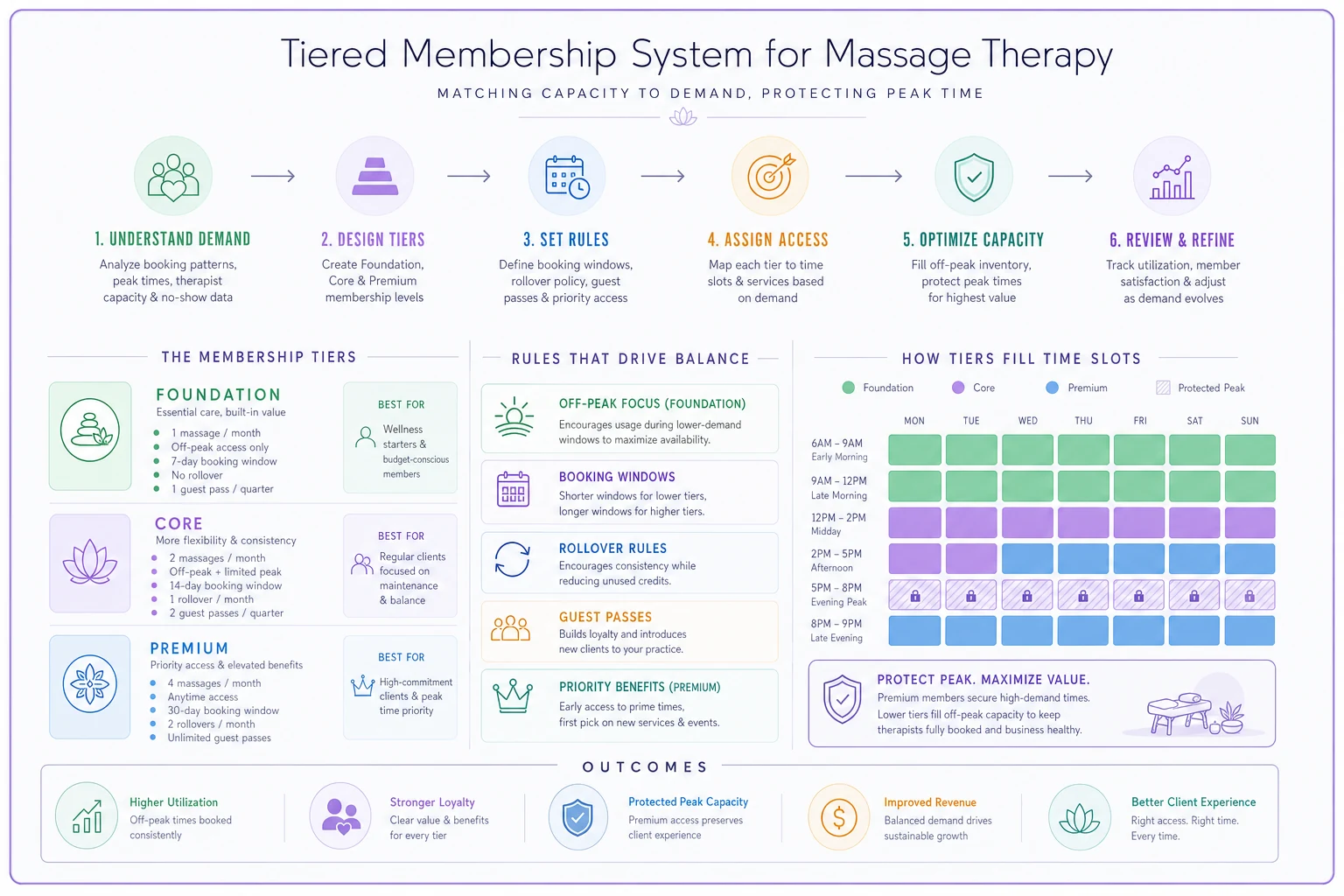
Notice what's different. The structure rewards higher tiers with flexibility, not just more services. The foundation tier specifically targets price-sensitive clients while protecting profitable time slots. Premium members get convenience benefits that cost nothing to deliver but feel valuable.
The onboarding sequence that reduces churn by 30%
Most studios treat membership onboarding like a transaction. Sign here, card on file, see you next month. Then they wonder why first-month cancellation rates spike above 15%.
Practices that keep members for 14+ months handle onboarding as an actual operational process. Member behavior in the first 45 days predicts whether someone sticks around for a year or cancels within three months—and they've built around that reality.
When someone joins, they immediately book their first session during the signup process. Not "whenever you want to schedule"—literally while sitting there with the payment form. This eliminates the psychological gap between paying and receiving value.
Within 24 hours, they get a welcome sequence explaining how to actually use their membership. Not marketing copy—operational details. How to book recurring appointments, which add-on services pair well with their tier, when off-peak times offer easier scheduling.
After their first session, the therapist documents preferences in the client record: pressure preferences, problem areas, scheduling patterns. When members feel their therapist remembers their specific needs, they're noticeably more likely to stay past the six-month mark.
Day 30 triggers a check-in from the front desk. Not a sales call—a simple touchpoint: are you able to book the times you want? Any questions about your benefits? This catches problems before they become cancellations.
Day 45 includes a quick value summary—what they've saved so far. For a Core tier member who added aromatherapy to their monthly session, that might be $32 already. Seeing tangible savings reinforces the membership before the third billing cycle, when cancellation risk peaks.
Billing cadence options that actually increase lifetime value
Here's something counterintuitive: pushing annual billing often decreases total membership revenue. The math seems obvious—12 months upfront beats monthly recurring. But the operational reality plays out differently.
Studios that push annual plans see members treat them like packages. They bulk-buy for the discount, hit their credits hard in the first few months, then become ghosts who've already paid. No upsell opportunity. No relationship. No referrals.
Quarterly billing as an option—not a push—tends to be the sweet spot. Position it as a "commitment reward" with a 5% discount. Members who choose quarterly stay 8-9 months on average versus 5-6 months for monthly billing. They've made enough commitment to stick around but haven't paid so far ahead that they mentally check out.
The billing mix that tends to optimize both cash flow and engagement: roughly 70% monthly, 25% quarterly, 5% annual. Monthly members provide predictable cash flow. Quarterly members boost retention. Annual members, kept small, provide occasional injections without degrading the membership culture.
On the processing side, the gap between manual billing and automated systems shows up clearly. Studios running membership billing manually through their standard point-of-sale lose around 12% of potential revenue to failed charges, delayed follow-ups, and administrative errors. Those using automated recurring billing platforms see failed payment rates below 4%.
Friction-reduction rules that keep members booking
The fastest way to kill a membership? Make it harder to use than paying regular prices. Yet most studios add friction without noticing.
Requiring phone calls to book membership sessions? Friction. Different booking windows for members versus regular clients? Friction. Making members "mention their membership" when booking? Unnecessary friction that embarrasses clients and frustrates staff.
Members should have a booking flow that automatically applies their benefits. When they log into your booking system, it should recognize their tier and show appropriate availability. Their included services should appear as credits, not require special codes.
One particularly effective friction reducer: automatic rebooking. When a member finishes their session, the front desk asks, "Should I book your next one for four weeks out, same day and time?" Around 60% say yes. Those who accept automatic rebooking stay members about 40% longer than those who book ad hoc.
Ask at checkout to auto-book the next session—about 60% accept and they stay around 40% longer.
For Premium tier members, consider a "membership concierge" option—a dedicated email or text line for booking. This costs almost nothing to implement but makes the value difference feel real. They skip phone queues and get responses within a couple hours during business days. The psychological impact far exceeds the operational cost.
Retention projection modeling that actually works
Massage studio owners love to calculate membership revenue by multiplying member count by monthly fee. That math ignores churn, usage patterns, and seasonal variation entirely.
Real retention modeling starts with cohort analysis. Track members by join month, not aggregate numbers. January joiners behave differently than September joiners. New Year resolution members churn at around 20% monthly for the first quarter. Back-to-school September joiners settle into routines, dropping to roughly 8% monthly churn after month two.
Build your model with these baseline assumptions:
-
Month 1-3
12% average monthly churn
-
Month 4-6
8% average monthly churn
-
Month 7-12
5% average monthly churn
-
Month 13+
3% average monthly churn
| Month Range | Average monthly churn |
|---|---|
| Month 1-3 | 12% average monthly churn |
| Month 4-6 | 8% average monthly churn |
| Month 7-12 | 5% average monthly churn |
| Month 13+ | 3% average monthly churn |
These numbers assume decent onboarding and basic retention efforts. Not optimistic, not pessimistic—just operational reality for a reasonably well-run program.
For a studio adding 20 members monthly, the steady-state membership base stabilizes around 165-180 active members after 18 months. At an average membership value of $115, that's $19,000-20,700 in predictable monthly revenue. But what most models miss is the add-on opportunity.
Members spend roughly 40% more than non-members on additional services. They're already in your ecosystem, trust your therapists, and have lower price sensitivity for upgrades. That 170-member base likely generates another $6,800 monthly in aromatherapy, hot stone upgrades, extended time, and retail—on top of base membership fees.
The tier ladder effect in practice
Watch what happens in a typical week at a studio with proper tier separation.
Foundation members cluster bookings in off-peak slots you'd struggle to fill otherwise. They're price-conscious but reliable, showing up for their Tuesday 2 PM appointments consistently.
Core members spread throughout the week but avoid premium weekend morning slots unless necessary. They book about 10 days out and maintain steady patterns. Predictable, profitable, and they refer friends.
Premium members book prime slots but also fill random gaps because they have full flexibility. They're less price-sensitive about add-ons, regularly adding cupping or aromatherapy. Their guest passes convert at around 30%.
The ladder works because people self-select into appropriate tiers based on their needs, not just their budget. A busy professional picks Premium for flexibility, not because they want two massages monthly. A retiree picks Foundation because Tuesday afternoons are genuinely convenient, not because they can't afford more.
This natural selection reduces operational friction. You're not dealing with Core members who can never book their preferred times or trying to force the same program onto people with completely different scheduling needs.
Software automation's role in membership operations
The operational complexity of running a sophisticated membership program is what breaks most massage studios. They start with good intentions, but tracking tier benefits, managing rollovers, processing billing, and monitoring retention becomes overwhelming. The usual result? They simplify back to basic discounting and wonder why revenue stays volatile.
This is where AI-powered operational software changes the economics—not by adding features, but by removing the operational burden. When your practice management system automatically handles tier recognition, applies benefits, manages rollovers, and flags retention risks, your staff focuses on delivering services instead of chasing down administrative tasks.
Modern platforms can now identify patterns in booking behavior, service preferences, and payment history to flag churn risk before it becomes a cancellation. A member who usually books monthly but hasn't scheduled in five weeks gets flagged for proactive outreach. Someone with three failed payment attempts gets an automated re-engagement sequence before they give up entirely.
The difference shows up in scale. Studios managing memberships manually typically max out around 120-140 active members before the administrative load becomes unsustainable. Those using integrated membership automation can run 250-300 members with the same staff. That's the difference between roughly $14,000 and $30,000 in predictable monthly revenue.
When tier ladders make sense (and when they don't)
Not every massage practice should implement complex tier structures. If you're a solo practitioner working 20 hours weekly, a simple two-tier system might serve you better. Managing multiple tiers, benefits, and billing options has real overhead—it can exceed the revenue benefit if the practice isn't big enough to absorb it.
Tier ladders work best when you have:
-
At least two treatment rooms
-
Multiple therapists or 40+ weekly treatment hours
-
Established client base of 200+ active clients
-
Clear peak and off-peak demand patterns
-
Administrative support or automation
They're typically the wrong move for:
-
Medical massage practices with insurance billing
-
Luxury spas where discounting damages brand perception
-
Practices with extremely limited availability
-
Businesses planning to sell within 12 months
The decision comes down to operational capacity and strategic intent. If predictable revenue and capacity optimization matter more than maximum per-session revenue, tiers make sense. If you're optimizing for simplicity or premium positioning, they probably don't.
The compound effect of proper membership architecture
A massage studio with properly structured membership tiers creates compounding operational advantages beyond just predictable revenue.
Capacity utilization improves from the typical 60-65% to 75-80% as off-peak slots fill with Foundation members. Better utilization means fixed costs—rent, insurance, utilities—spread across more revenue-generating sessions.
Staff scheduling becomes more predictable when 40% of appointments are membership-based with regular booking patterns. Therapists can plan their weeks. Front desk staff know which days need coverage. You can confidently adjust contractor hours based on actual member booking patterns rather than guessing.
Marketing costs drop when members refer at roughly 3x the rate of regular clients. Every Premium member with guest passes becomes a low-key advocate for your practice. Their friends experience your services at low risk and convert to members at higher rates than cold leads.
Service quality improves when therapists see the same people monthly. They learn bodies, preferences, and how someone responds to treatment over time. Members get increasingly personalized care, and that shows up in reviews—members consistently leave more positive feedback than one-off clients.
Cash flow stabilizes not just from membership fees but from predictable add-on patterns. When you know 170 members generate $115 base plus around $40 in additions monthly, you can make operational decisions with real confidence. Upgrade that treatment table. Invest in advanced training. Hire the additional therapist you've been hesitating on.
The whole thing becomes self-reinforcing. Better capacity utilization allows better therapist compensation. Better compensation attracts better therapists. Better therapists deliver better outcomes. Better outcomes increase retention. Higher retention improves economics. Improved economics fund growth.
That's what separates thriving massage practices from those stuck in feast-or-famine cycles. It's not about having a membership program—it's about building one that actually works with your operational reality instead of against it.
Your membership program is either a growth engine or an operational anchor. The tier structure you choose, the onboarding you build, the billing options you offer—these aren't marketing decisions. They're operational choices that determine whether you build something sustainable or stay trapped in the transaction-by-transaction scramble.
Studios that get this right see membership revenue grow from 15% to 40% of total revenue within 12 months. More importantly, their businesses stop feeling unpredictable. That shift—from volatile to stable—is worth more than any individual pricing tweak.
Ready to elevate your massage therapy business?
Join hundreds of therapists using Masthera to save time, reduce scheduling conflicts, and enhance client satisfaction.