


Most massage studios lose their first impression somewhere between the front desk and the treatment room. Not because the therapist is bad. Not because the space feels wrong. But because a new client is standing there with a clipboard, a leaky pen, and a two-page health history form while their appointment time ticks by.
That gap — the intake gap — is where a lot of small friction hides. And it isn't just about being polite or looking modern. It compounds. A first session that starts eight minutes late shortens actual hands-on time, pushes back the next client, and sets a slightly rushed tone for the whole afternoon. Multiply that across a week and you've got a scheduling problem disguised as a paperwork problem.
This post is about one thing: designing a massage intake form workflow that's mobile-first, splits into short and long versions, uses conditional triage questions, and handles consent and signatures before the client ever walks in. Not a broad onboarding guide — just the intake-to-check-in stretch, done right.
Why the intake clipboard breaks down
The clipboard model assumes every client needs the same form. That's the root mistake.
-
New clients feel interrogated and rush through the parts that actually matter — medications, injuries, contraindications.
-
Returning clients get annoyed re-filling things you already have on file.
-
Your therapist ends up transcribing handwriting into notes anyway, which doubles the work.
There's also a timing problem. Handing someone a health-history form in the waiting room is about the worst possible moment to ask about medications or recent surgeries. They're not thinking about it, they don't have their pill bottles, and they'll write "vitamins" or leave it blank. Information collected at check-in is almost always lower quality than what you'd get if they filled it out at home the night before, on their phone, without someone waiting on them.
Short form vs long form: the split that actually reduces friction
The single highest-leverage change is splitting intake into two paths based on what the appointment actually requires. Not everyone needs the full clinical history.
Never miss a booking or double-book again.
Masthera helps you schedule, confirm & manage every massage session with ease.
- Unified appointment management
- Automated client reminders
- Therapist calendar coordination
No credit card required
| Client / Booking Type | Form Path | What It Collects | Typical Completion Time |
|---|---|---|---|
| New client, therapeutic/deep-tissue | Long form | Full health history, injury detail, medication list, consent, triage branches | 4–6 min |
| New client, relaxation / gift card | Short form | Basic contact, allergies, pressure preference, consent | Under 2 min |
| Returning client, same service | Micro-confirm | "Anything changed since last visit?" + re-consent if needed | Under 30 sec |
| Returning client, new complaint | Short add-on | Just the new issue's triage branch | 1–2 min |
The pattern here is that the long form should be the exception, not the default. Most studios have it backwards — they run everyone through the full clinical intake because it feels safer. But a returning relaxation client answering 22 questions they already answered is friction with zero payoff.
The micro-confirm row matters more than people expect. A returning client who taps "nothing's changed" and re-signs is a five-second interaction. But if something has changed — new medication, a recent car accident, pregnancy — that one question surfaces it before the session instead of during it.
Conditional triage: ask the next question based on the last answer
Static forms ask everything. Conditional forms ask what's relevant. That's the difference between a form that feels long and one that feels smart.
-
"What's the main reason for today's visit?" — relaxation, pain/injury, stress, recovery, other.
-
If they pick pain/injury → "Where?" with a body-area selector.
-
If they select lower back → "How long? Any diagnosis? Any imaging done?"
-
"Are you currently taking any blood thinners or medications that affect bruising or circulation?" — this branch only appears if age or health flags warrant it.
-
If pregnant is flagged anywhere → automatically route to the pregnancy-safe consent language and pressure guidance.
A relaxation client never sees questions 3 through 5. They answer "relaxation," give a pressure preference, sign, and they're done. Meanwhile the injury client goes deeper exactly where it counts.
Across a lot of wellness practices, conditional logic doesn't just speed things up — it improves the quality of what therapists actually receive. When a form only asks about medications after someone flags a circulation issue, people answer more carefully because the question feels relevant, not like a generic legal checkbox.
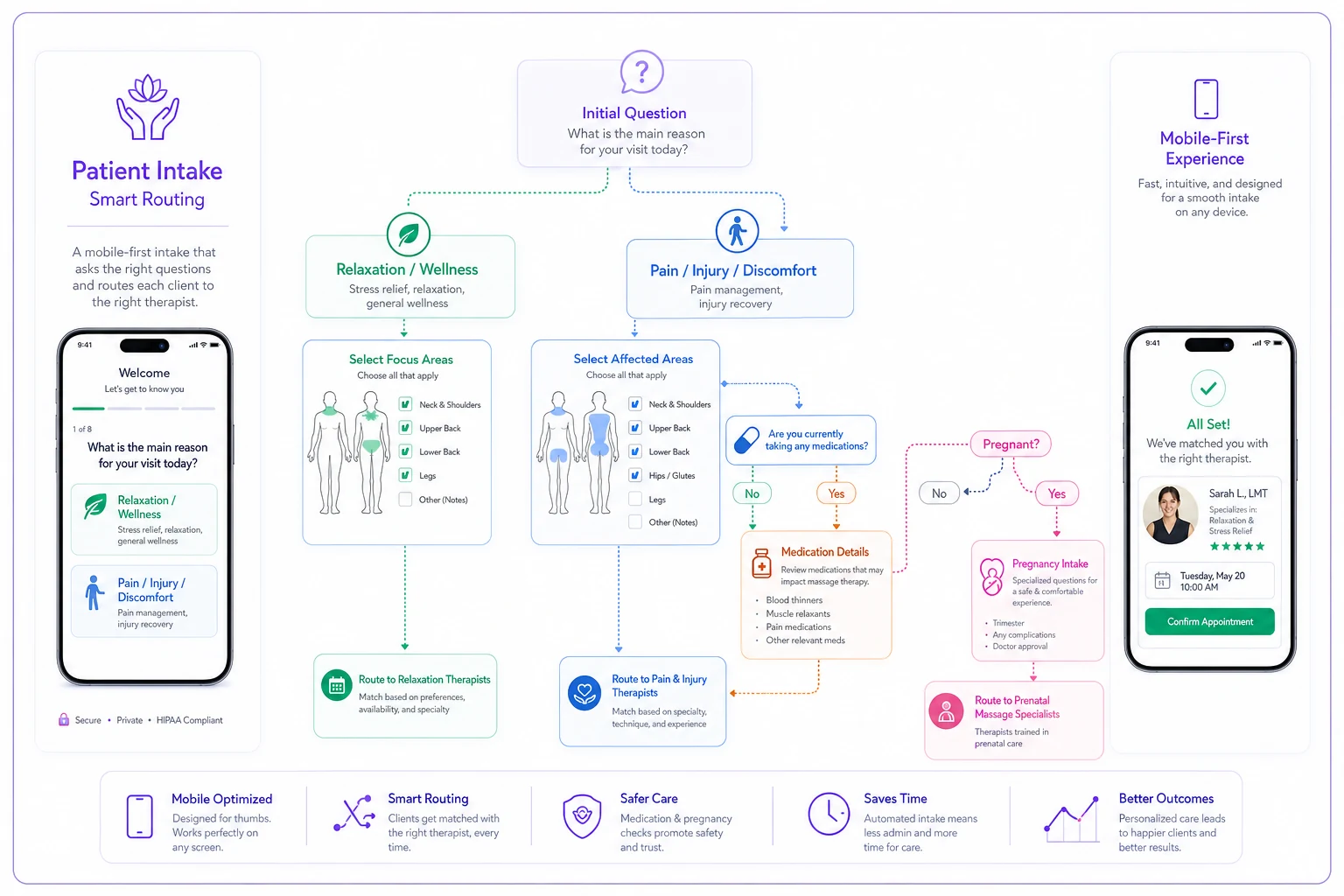
This diagram shows the conditional branching and routing described above.
The consent language bank nobody sets up (but everyone should)
Consent is where studios either over-lawyer or under-document, and both create problems.
-
General massage consent — the baseline for every session.
-
Deep-tissue / trigger-point — acknowledging discomfort and post-session soreness.
-
Pregnancy massage — positioning, trimester considerations, physician clearance if applicable.
-
Draping and boundaries — plain-language explanation of what to expect, which quietly cuts down on awkward misunderstandings later.
-
Cancellation and late policy re-acknowledgment — especially useful if you're tightening no-show behavior.
Clients actually read short, relevant blocks. A pregnant client seeing three sentences specifically about pregnancy massage is far more likely to absorb it than the same info buried in paragraph nine of a universal waiver. And from a documentation standpoint, you have a clean record of which consent version they agreed to, tied to the specific service they booked.
One thing worth flagging: don't let consent language drift across therapists or locations. Keep it centralized. When different branches of a multi-room studio are working off slightly different versions, you end up with clients who agreed to slightly different terms — which is exactly the kind of inconsistency that becomes a headache if there's ever a dispute.
Digital signatures without the awkward pause
The signature step is where a lot of otherwise-clean digital forms fall apart. If a client has to print, sign, scan, and email — you've reintroduced all the friction you just removed.
A mobile-first signature flow should let someone draw or type their signature on their phone, timestamp it, and lock the consent version they agreed to. For minors or dependents, the form branches to collect a guardian signature instead. For returning clients whose consent is still current, skip re-signing entirely unless the service or policy changed.
Ask for the signature after consent and triage so the signature is meaningful and timestamped.
The detail that actually matters here is when you ask for the signature. Asking for one at the very end — after the client has read the relevant consent blocks and answered triage — makes sense. Asking for a signature first, before they've read anything, is technically a signature but operationally useless. Order matters.
When mobile-first intake is a bad idea
This isn't universal. A few honest cases where the full mobile flow doesn't fit:
-
Older client base with low phone comfort. If a meaningful share of your clients don't use smartphones easily, a mobile-first form creates more friction at check-in, not less. Keep a clean tablet option at the desk as a fallback.
-
Walk-in heavy studios. If most of your traffic is spontaneous, you won't get pre-visit completion. Design for a fast in-lobby tablet flow instead of pre-arrival email links.
-
Clients with mobility or sensory needs who require a different intake approach entirely — that deserves its own tailored workflow rather than being pushed through the standard branching form.
The goal is reducing friction, not proving you're paperless. If mobile intake adds a step for your specific clients, it's the wrong tool.
A real scenario: the eight-minute check-in
A two-therapist wellness studio running roughly 320–360 sessions a month was averaging first-session starts about seven to nine minutes late. The cause was consistent: new clients filling out a three-page paper form in the lobby, followed by the therapist manually re-entering key details into notes before starting.
They restructured intake into three paths — short form, long form, and a returning-client micro-confirm — and moved completion to a pre-visit link sent at booking confirmation. Conditional logic meant relaxation clients answered five questions; injury clients got the deeper triage.
Within about six weeks, the majority of clients were arriving with intake already done. First sessions started closer to on-time, and therapists stopped transcribing forms by hand because the answers landed straight into the client record. Nothing dramatic on the revenue side — but recovering six or seven minutes per new client, across dozens of new clients a month, quietly gave back real treatment time and made the front desk feel noticeably calmer.
A quick build checklist
If you're setting this up, work through these in order:
-
[ ] Map which booking types need short vs long vs micro-confirm forms
-
[ ] Write the triage branches — start with your two most common complaints (lower back, neck/shoulders)
-
[ ] Build a modular consent bank tied to service type
-
[ ] Set signatures to lock the exact consent version and timestamp
-
[ ] Trigger the intake link automatically at booking confirmation
-
[ ] Add a desk-tablet fallback for clients who don't complete it beforehand
-
[ ] Route completed answers directly into the client record, not a separate inbox
You can run a version of this with a decent form builder and some discipline. But the friction usually comes back at the seams — the intake link that doesn't fire automatically, the returning-client form that asks everything again, the answers that live in one system while your notes live in another.
Where the software layer quietly helps
Operational platforms with built-in conditional intake and AI automation close those seams: they send the right form based on the booking, skip questions returning clients already answered, attach the correct consent version, and drop the finished data straight into the client's file. The value isn't the automation for its own sake — it's that the front desk stops being a bottleneck, and therapists walk into each session already knowing what they need to know.
Get the intake workflow right and check-in stops being the slow part of the visit. Less time on the clipboard, more time on the table.
Get the intake workflow right and check-in stops being the slow part of the visit. Less time on the clipboard, more time on the table.
Ready to elevate your massage therapy business?
Join hundreds of therapists using Masthera to save time, reduce scheduling conflicts, and enhance client satisfaction.