


Cancellations kill profit margins in massage practices. Not because of the lost appointment itself—that happens—but because of what follows. The scramble to fill the slot. The frantic texting. The dead hours that could've been revenue.
Most massage therapists handle cancellations wrong. They text their regular clients randomly, hoping someone needs an appointment. Meanwhile, three people who desperately wanted that exact time slot booked elsewhere yesterday because you were "full."
The fix isn't better cancellation policies. It's building operational systems that turn those empty slots into automatic revenue through waitlist monetization and same-day booking funnels.
The hidden math behind unfilled appointments
Empty appointment slots cost more than their face value. A $120 massage slot sitting empty doesn't just lose you $120—it costs you the overhead for that hour (rent, utilities, laundry), the opportunity cost of turning away other bookings, and the momentum loss when your schedule looks sparse to potential clients checking availability.
Run the actual numbers on a typical wellness center. Say you average four cancellations weekly at $120 per service. That's $480 in direct losses. Add overhead at roughly $35 per hour—another $140. Factor in the clients you turned away who then found other therapists—probably another two bookings worth $240. Weekly damage: around $860. Annual impact: pushing $45,000.
But what most operators miss is that those same cancellations, managed correctly, can generate premium revenue. Clients on waitlists often pay more for last-minute availability. They book longer sessions. They add services because they finally got in.
Why traditional waitlists fail operationally
Standard waitlists don't work because they're managed manually. A therapist gets a cancellation, checks a paper list or spreadsheet, starts calling people. First person can't make it. Second person needs more notice. Third already booked elsewhere. By the time someone accepts, you've burned 20 minutes on logistics instead of seeing clients.
Never miss a booking or double-book again.
Masthera helps you schedule, confirm & manage every massage session with ease.
- Unified appointment management
- Automated client reminders
- Therapist calendar coordination
No credit card required
The operational breakdown happens in three places:
Response timing gaps Someone cancels at 2 PM for a 5 PM appointment. You're with a client until 3:30. By the time you check messages and start contacting waitlist clients, it's 3:45. Most people can't rearrange their afternoon with an hour's notice.
Priority confusion Your waitlist has 15 names but no structure. Who gets called first? The person who asked longest ago? The one who tips best? The client with chronic pain who really needs it? Without clear rules, you waste time deciding.
Communication inefficiency Phone calls interrupt your work. Texts get buried. Emails go unread. Each method has different response rates and time requirements, but most practices use them randomly.
Building a monetized waitlist system that actually fills slots
Effective waitlist systems need three components working together: segmentation rules, automated triggers, and pricing strategies. Miss any piece and the whole thing breaks down.
Segmentation comes first
Not all waitlist spots are equal. A client wanting deep tissue for chronic pain has different urgency than someone booking a relaxation massage. Your system needs categories:
Priority 1: Medical/therapeutic needs Clients with prescriptions, chronic conditions, or post-surgery recovery. They get first notification of openings and often book immediately.
Priority 2: Premium members Membership clients or those on packages. They've already committed financially and fill slots reliably.
Priority 3: Same-day flexible Clients who explicitly said they can come with minimal notice. Usually retirees, remote workers, or people with genuinely flexible schedules.
Priority 4: General waitlist Everyone else, organized by request date.
Prune inactive entries quarterly so your priority lists stay responsive and realistic.
Trigger rules that maximize fill rates
Timing determines everything in waitlist conversion. Send notifications too early and clients aren't ready to commit. Too late and they can't rearrange.
Here's what works operationally:
24+ hours before: Wide net approach Send to all relevant segments. Normal pricing. Give a 2-hour response window.
4-24 hours before: Targeted outreach Priority 1 and 2 only. Offer 10% discount or a free add-on. 1-hour response window.
2-4 hours before: Urgent fill mode Priority 3 plus anyone marked "same-day available." 20% discount or a meaningful upgrade. 30-minute response.
Under 2 hours: Premium last-minute Same-day list only. You can actually charge a premium here—10-15% more for "emergency" availability.
Pricing psychology that drives action
Waitlist pricing isn't really about discounts—it's about perceived value and urgency. Clients pay more for convenience and availability, not less.
A massage therapist in Denver tested this. Standard 60-minute sessions at $110. Last-minute fills under three hours notice at $125. Her same-day availability list filled 85% of cancellations at the higher rate. Clients valued the convenience more than a discount would've moved them.
The key: position same-day availability as a premium service, not a desperation move.
Automation that handles the heavy lifting
Manual waitlist management eats hours weekly. Automation fixes this, but most practices automate wrong—blasting everyone simultaneously, which creates chaos when multiple people accept.
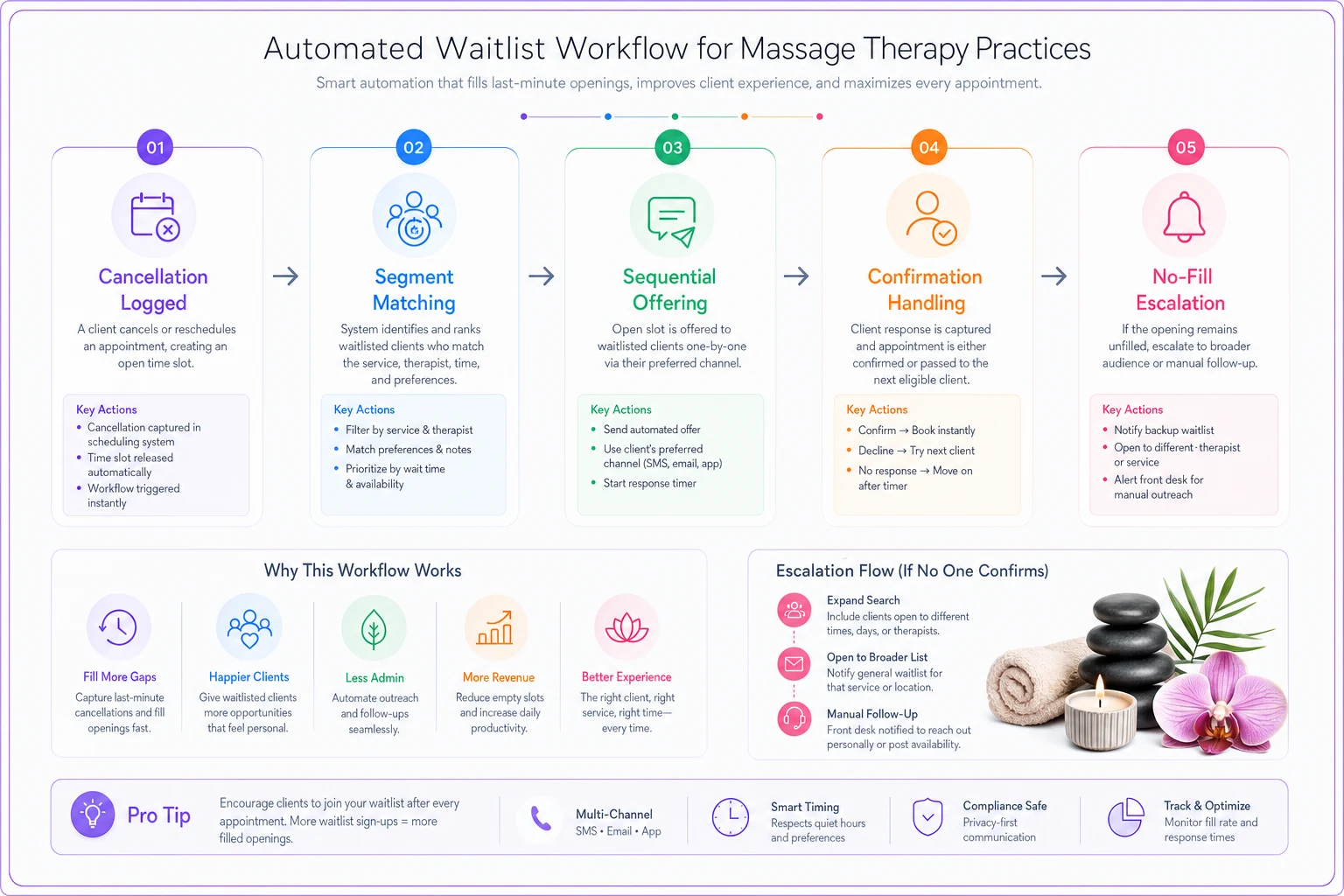
Smart automation follows decision trees:
Step 1: Cancellation logged System identifies the time slot, service type, and therapist.
Step 2: Segment matching Finds waitlist clients who match the service and timing.
Step 3: Sequential offering Sends to highest priority first. Waits for response timeout. Moves to next tier.
Step 4: Confirmation handling First acceptance gets automated confirmation. Others receive a "just filled, we'll keep you posted" message.
Step 5: No-fill escalation If unfilled after all tiers, triggers a same-day promotional post or offer.
Sequential offering prevents double-booking while maximizing fill probability. Simple concept, but most practices don't implement it properly.
Here's a simple workflow visualization.
Sequential offering prevents double-booking while maximizing fill probability. Simple concept, but most practices don't implement it properly.
Real-world execution: A wellness center case study
Mountain View Wellness in Colorado Springs struggled with cancellations. Four-therapist practice, averaging 320 monthly appointments. Roughly 25-30 cancellations monthly, mostly filling only 8-10 slots.
They built a structured waitlist system in phases:
Phase 1: Built segmented lists Surveyed existing clients about same-day availability. Found 47 clients—about 15% of their base—had flexible schedules. Created a medical-need category for 12 chronic pain clients.
Phase 2: Established pricing tiers
-
24+ hours notice
Standard rate
-
4-24 hours
Free aromatherapy upgrade ($15 value)
-
Under 4 hours
$10 surcharge for "priority booking"
Phase 3: Automated communications Set up text sequences through their booking system. Different messages for each tier and timing window.
Results after three months:
-
Fill rate jumped from 33% to 78%
-
Average revenue per filled cancellation
$118 (vs. $95 standard rate)
-
Monthly recovered revenue
roughly $2,100
-
Staff time on cancellation management
dropped from 6 hours to 45 minutes weekly
The premium pricing for last-minute bookings surprised them. Clients happily paid extra for the convenience.
Common mistakes that break waitlist systems
Even well-designed systems fail when implementation goes sideways. Watch for these:
Over-promising availability Telling everyone they're "next" creates disappointment. Be clear about priority levels and realistic timing expectations.
Ignoring preference patterns Some clients only want specific therapists. Others need certain rooms—ground floor, specific table type. Track these or waste time offering incompatible slots.
Failing to prune lists Waitlists go stale fast. Clients who never respond still receive messages. Quarterly cleanup keeps lists functional and response rates honest.
Not tracking conversion metrics Without data on fill rates by time period, segment, and offer type, you can't optimize anything. Track everything initially, then focus on what moves the needle.
When waitlist monetization doesn't make sense
Not every practice benefits from building this out. Skip it if:
You have under 50 monthly appointments The overhead isn't worth it. Just text your regulars.
Your cancellation rate is below 5% Lucky you. Focus energy elsewhere.
You're solo with no administrative support Complex systems need someone managing them. Start simple—just a same-day availability list.
Your clientele is strictly routine-based Clients with standing weekly appointments rarely adapt well to last-minute changes.
Staffing strategies for same-day fills
Filling slots requires available therapists. Most practices handle this wrong—either overstaffing (expensive) or scrambling to call people in (unreliable).
A layered compensation structure works better:
Tier 1: Guaranteed minimum One therapist per shift on modified guarantee. They get 50% of their normal rate for being available, 100% if called in. Works well for newer therapists building clientele.
Tier 2: Bonus structure Existing staff get bonuses for taking same-day fills. $20-30 per filled slot on top of regular commission. Incentivizes flexibility without requiring availability.
Tier 3: Contractor pool Maintain a small contractor pool for last-minute needs. They get higher percentage—around 70% vs. standard 50%—but no guaranteed hours.
This approach ensures coverage without bloated payroll.
Technology stack that makes it work
You don't need expensive custom software. A functional stack looks like this:
Booking platform with waitlist features Most modern booking systems include basic waitlist functionality. Look for sequential notification capability specifically.
Text automation service Something that handles scheduled messages and response tracking. Many booking platforms include this, or use a dedicated SMS tool.
Simple tracking spreadsheet Track fill rates, revenue, and patterns. Nothing fancy—just enough data to inform decisions.
Payment processing with variable pricing Your system needs easy price adjustments for last-minute premiums or discounts.
The integration between these tools matters more than the individual tools themselves. If they don't talk to each other, you're back to manual work.
Measuring what actually matters
Vanity metrics don't pay bills. Track these five:
| Track these five: |
|---|
| Fill rate by time bucket |
| Revenue per filled slot |
| Time to fill |
| Segment response rates |
| Therapist utilization improvement |
A simple dashboard showing these weekly is enough. More than that becomes noise.
The psychological side of same-day bookings
Clients on waitlists behave differently than regular bookings. They're often more grateful, tip better, and become loyal specifically because you "fit them in." But they need different communication.
Never make them feel like second-choice or gap-fillers. Language matters more than most operators realize:
Instead of: "We had a cancellation, want the slot?" Try: "A premium appointment just opened up—you're first on our priority list."
Instead of: "Can you come in 2 hours?" Try: "We're releasing a same-day priority slot—available until [time]."
The framing shifts from desperation to exclusivity. Clients feel special, not like they're doing you a favor.
Building the operational foundation
Start small. Don't build a complex system immediately. Follow this progression:
-
Week 1-2
Create basic same-day list
-
Week 3-4
Test manual outreach
-
Week 5-8
Add basic automation
-
Week 9-12
Introduce segmentation
-
Week 13+
Optimize and expand
This gradual build prevents overwhelming your team while proving the concept works for your specific practice.
Integration with existing operations
Waitlist systems can't exist in isolation. They need to mesh with your current scheduling, payment, and communication systems.
The handoff points that typically break:
Scheduling conflicts Waitlist fills sometimes clash with therapist preferences or room availability. Build clear override rules before launch.
Payment confusion Different prices for the same service confuse staff and clients. Clear labels and staff training prevent most problems.
Communication overlap Regular appointment reminders might conflict with waitlist notifications. Suppress standard messages for waitlist bookings.
Record keeping gaps Waitlist fills need separate tracking for analysis. Mark them clearly in your system from day one.
Map these integration points before launching. One broken handoff undermines the entire system.
Where AI-powered operational software fits
Manual waitlist management starts breaking down somewhere around 100 monthly appointments. Beyond that, human coordination becomes genuinely unsustainable. You need systems that handle the complexity automatically.
Modern operational platforms powered by AI automation do this well. They catch patterns humans miss—like which clients consistently accept Tuesday afternoon spots, or how weather affects same-day fill rates. The automation handles the tedious matching and notification sequencing while your team focuses on actual client service.
The value isn't really in the AI itself. It's in freeing your staff from logistics work so they can build client relationships. A receptionist spending 20 minutes filling a cancellation isn't greeting arriving clients properly. A therapist worried about empty afternoon slots isn't fully present with their current client.
The best platforms feel invisible. Cancellation happens, system triggers, slot fills, everyone gets notified. Your role shifts from coordinator to reviewer.
Transforming cancellations into opportunity
Empty slots don't have to mean lost revenue. With proper waitlist monetization, they become opportunities for premium pricing, deeper client relationships, and operational efficiency.
The key isn't complex technology or aggressive marketing. It's building systematic approaches to match supply and demand in real time. Set clear priorities. Establish timing triggers. Price strategically. Automate the repetitive parts.
Most importantly, stop treating cancellations as failures. They're inventory to be optimized—the same way retail stores handle returns or restaurants manage no-shows. The practices thriving despite high cancellation rates figured this out and turned a persistent weakness into a reliable revenue stream.
Start with a simple same-day list. Test what resonates with your specific clientele. Build gradually toward fuller automation. Within three months, those panic-inducing cancellation texts could become your most profitable appointments.
Empty slots don't have to mean lost revenue. With proper waitlist monetization, they become opportunities for premium pricing, deeper client relationships, and operational efficiency.
Start with a simple same-day list. Test what resonates with your specific clientele. Build gradually toward fuller automation. Within three months, those panic-inducing cancellation texts could become your most profitable appointments.
Ready to elevate your massage therapy business?
Join hundreds of therapists using Masthera to save time, reduce scheduling conflicts, and enhance client satisfaction.