


Most massage therapists think local SEO means stuffing keywords into their website and hoping Google notices. Meanwhile, their Google Business Profile sits there like a digital business card nobody picks up—technically visible but operationally useless.
The disconnect happens because massage therapy businesses track visibility instead of conversion. You check your GBP insights, see those view counts climbing, maybe celebrate hitting position three on "massage near me," but your actual booking rate stays flat somewhere around 2–3%.
What matters is turning profile interactions into booked appointments—and that requires specific conversion architecture that most wellness businesses completely miss.
Why Massage Therapists Struggle With Local Search Conversion
A typical massage practice losing bookings isn't losing them to competitors. They're losing them to friction. People who were ready to book gave up somewhere between finding you on Google and actually scheduling. They didn't decide against massage—they just hit one too many unclear steps and moved on.
Three operational failures drive most of this.
Your GBP listing functions as an information dump rather than a booking funnel. Potential clients land there, scan for hours and location, maybe check a few photos, then bounce to look at other options. No clear path from interest to commitment.
Review responses read like corporate thank-you notes. Each five-star review is a trust signal for future clients, but "Thanks for visiting!" wastes that moment entirely.
Then there's the multi-step friction problem. Someone finds you on Google, clicks to your website, hunts for the booking button, creates an account, fills out intake forms, and then discovers your availability doesn't match their schedule. That's four unnecessary steps between intent and booking—and most people drop off well before the end.
Converting Profile Views Requires Decision Architecture, Not SEO Tricks
Profile Optimization That Drives Action
Never miss a booking or double-book again.
Masthera helps you schedule, confirm & manage every massage session with ease.
- Unified appointment management
- Automated client reminders
- Therapist calendar coordination
No credit card required
"Same-day appointments available. Text 555-0100 to book now. Specializing in chronic pain relief and stress management. Evening slots open Tuesday–Thursday."
That format addresses three conversion blockers at once: availability uncertainty, booking complexity, and service clarity.
The services section shouldn't just list "Swedish Massage - 60 minutes." Frame each service around the problem it solves:
-
Chronic Back Pain Relief (60 min) – Targeted deep tissue work for desk workers
-
Stress Recovery Session (90 min) – Full-body relaxation for overwhelmed professionals
-
Prenatal Comfort Massage (45 min) – Safe positioning and gentle techniques
This framing does something subtle but important—it helps the person reading immediately recognize themselves in what you're offering, which is what actually moves someone from browsing to booking.
Review Generation That Compounds Trust
Generic review requests generate generic responses. Specific prompts create testimonials that actually sell for you.
24 hours post-appointment: "Hi Sarah, how's your back feeling today after yesterday's deep tissue work? If the pain has decreased, would you mind sharing that specific result in a quick Google review? Other people with similar pain need to know relief is possible."
One week follow-up for non-reviewers: "Quick check—has the shoulder mobility we worked on last week held up? If yes, a mention of that lasting improvement in a review helps others with frozen shoulder find the right help."
These prompts generate reviews mentioning specific conditions, results, and timeframes—exactly what prospects search for.
Response Strategies That Convert Lurkers
Every review response is public-facing. Generic responses waste that.
Transform this: "Thanks for the five stars! We appreciate your business!"
Into this: "Glad your lower back pain finally released after three sessions! For anyone reading this dealing with similar sciatic issues—yes, we keep evening appointments available for people who can't take time off work. Text us at 555-0100 for same-week booking."
Each response should include:
-
A reference to the specific condition or result mentioned
-
A booking invitation for similar prospects
-
An immediate action path (text/call)
Each response should include the elements above to convert lurkers into bookers.
The Multi-Location Complexity Most Practices Ignore
Running sessions from multiple locations—or managing therapists across different spaces—creates booking confusion that quietly kills conversions. Clients see your business listed in three neighborhoods but can't figure out availability or who specializes in what.
Single practitioners renting space at multiple wellness centers run into this constantly. Your main GBP shows the primary location, but Tuesdays and Thursdays you're across town. Clients book assuming daily availability, then cancel when the logistics fall apart.
Location-Specific Conversion Paths
Downtown location profile: "Monday/Wednesday/Friday only. Deep tissue and sports massage focus. Text 555-0100 with 'DOWNTOWN' for this location's availability."
Wellness center profile: "Tuesday/Thursday plus Saturday mornings. Prenatal and relaxation specialty. Text 555-0100 with 'WELLNESS' for this schedule."
Create location-specific service menus that reflect actual availability. The downtown location might offer 30-minute lunch sessions while the suburban wellness center focuses on 90-minute therapeutic work.
Review Distribution Strategy
Reviews naturally cluster at your primary location, leaving secondary profiles looking thin. Fix this with intentional distribution:
Post-appointment at a secondary location: "Since you came to our Wellness Center specifically for prenatal massage, would you mind leaving your review on that Google listing? It helps other expecting mothers find us there."
This builds social proof where you need it while staying authentic.
Booking Friction That Kills Conversions (and What Replaces It)
The standard massage booking flow involves too many decisions. Pick a service from twelve options, select a therapist from four profiles, choose an appointment type, create an account, fill out intake forms—by step three, a significant chunk of your prospects have already bailed.
The Two-Click Booking Architecture
Reduce choice paralysis through simplified pathways:
| Traditional Flow | Optimized Flow |
|---|---|
| View services list | "Book 60 or 90 minutes?" |
| Select specific massage type | "What hurts?" (3 options max) |
| Choose therapist | Auto-match based on issue |
| Pick date/time from calendar | "This week or next?" |
| Create account | Name + phone only |
| Fill intake forms | Post-booking email |
| Confirm booking | Text confirmation |
Cutting seven decisions down to two makes a real difference in how many people actually complete the booking.
Instant Booking via Text
Text-based booking outperforms web forms for massage practices. The interaction feels personal while staying efficient:
Client texts: "Need appointment" Auto-response: "Hi! For fastest booking, reply with: 1) This week or next? 2) Morning, afternoon, or evening preference? 3) Main area of pain/tension?"
Client: "This week, evening, lower back" Response: "Perfect. Thursday 6pm or Friday 7pm available with James who specializes in lower back work. Reply 1 or 2 to book."
That entire exchange takes under two minutes versus 5–10 minutes fighting through web forms.
Here's a simple visual of the optimized booking workflow.
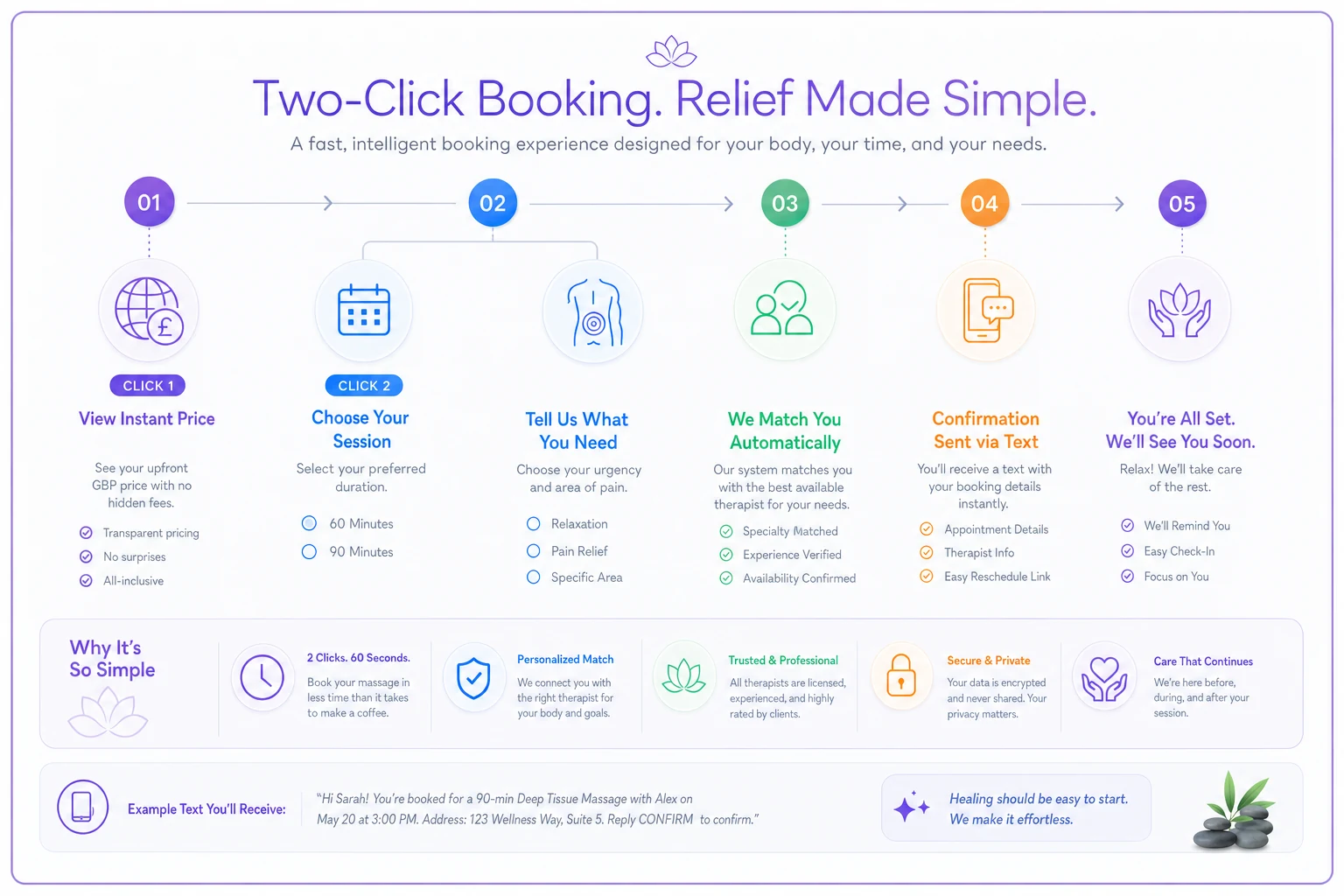
Use this to align staff and automate responses around the two-click path.
Managing Reviews When Things Go Sideways
Negative reviews on your GBP don't just hurt feelings—they directly block bookings. One visible complaint about scheduling, cleanliness, or pressure can quietly drag your conversion rate down.
Most therapists don't realize negative reviews can actually work in your favor when handled the right way.
Turning a Bad Review Into a Booking Signal
Bad review: "Therapist was 15 minutes late and seemed rushed. Waste of money."
Standard response: "We apologize for your experience. Please contact us to discuss."
Conversion-focused response: "You're absolutely right—running late destroyed the relaxation you came for. We've since added text alerts 30 minutes before each appointment and built 15-minute buffers between sessions to prevent rushing. For anyone reading this concerned about punctuality: we now guarantee on-time starts or your session is free. Text 555-0100 to book with confidence."
That response acknowledges the failure, shows a concrete fix, and gives nervous prospects a reason to book anyway. It's not spin—it's transparency that builds more trust than a perfect rating ever could.
The Hidden Metric That Actually Predicts Booking Success
Forget tracking profile views or website clicks. The metric that correlates most reliably with booking rates is response time to initial contact.
Practices responding within a few minutes book a noticeably higher percentage of inquiries than those taking two or more hours to reply. Speed beats quality in initial responses—consistently. This is one of those things that sounds obvious until you actually measure it.
The problem is structural. You're either in session or responding to leads, rarely both. The solution isn't hiring a receptionist. It's building response systems that work while you work.
Automated Qualifier Sequences
Immediate response: "Thanks for reaching out! To match you with the right appointment, quick question: Are you dealing with: 1) Specific pain/injury 2) General stress/tension 3) Pregnancy-related discomfort? Reply with your number."
-
Pain/injury → "Got it. Scale 1–10, how urgent is relief? Available slots this week..."
-
Stress → "Perfect timing. 60 or 90 minute relaxation session? This week we have..."
-
Pregnancy → "Congratulations! How far along? (We adjust positioning after 20 weeks)..."
These sequences keep people engaged while you finish current sessions. The goal isn't to fully automate the conversation—it's to stop the prospect from moving on before you can get back to them.
Route pregnancy-related inquiries directly to therapists experienced with prenatal care to speed up matching.
The goal is to keep interest warm, not to replace human follow-up.
Operational Software That Handles Conversion Mechanics
Most massage practices try managing all these moving parts through sticky notes, spreadsheets, and memory. That works—until it doesn't. And it usually breaks at the worst possible time, like during a fully booked Saturday when an inquiry falls through the cracks and never gets followed up.
Modern operational platforms built for wellness practices can handle a lot of this automatically. GBP updates stay in sync with real availability. Review requests fire based on service type and session timing. Multi-location schedules stay coordinated without someone manually checking everything.
Where AI automation actually helps here isn't through some fancy chatbot—it's through context-aware routing. A system that recognizes someone asking about prenatal massage handles that differently than someone describing post-surgery rehab, and routes each to the right therapist and appropriate response. That's the kind of background coordination that removes friction without requiring you to be available 24/7.
Practices using integrated booking and review management tend to convert a higher share of GBP views into actual appointments—not because the software is magic, but because it closes the gaps where bookings used to quietly disappear.
Start With One Conversion Fix This Week
If you're getting views but no calls: Rewrite your GBP description with immediate booking language and text-to-book options.
If you get inquiries but lose bookings: Implement the two-click booking architecture or set up automated qualifier sequences.
If you have multiple locations: Create location-specific response templates and a deliberate review distribution strategy.
If reviews are hurting your conversion: Draft conversion recovery responses for your negative reviews—specific, transparent, and action-oriented.
The path from Google search to booked appointment shouldn't require a GPS. Every additional step, decision, or moment of uncertainty costs you clients who were ready to book.
Your real competition isn't other massage therapists—it's the friction between a person in pain and getting relief. Remove that friction, and those GBP views start converting into actual appointments.
The practices doing well with local SEO don't necessarily have better keywords or more reviews. They've built systems that guide stressed, hurting people from search results to the massage table with as little effort as possible—and that's not really about ranking at all, it's about making the booking easy enough that people actually follow through.
Ready to elevate your massage therapy business?
Join hundreds of therapists using Masthera to save time, reduce scheduling conflicts, and enhance client satisfaction.