

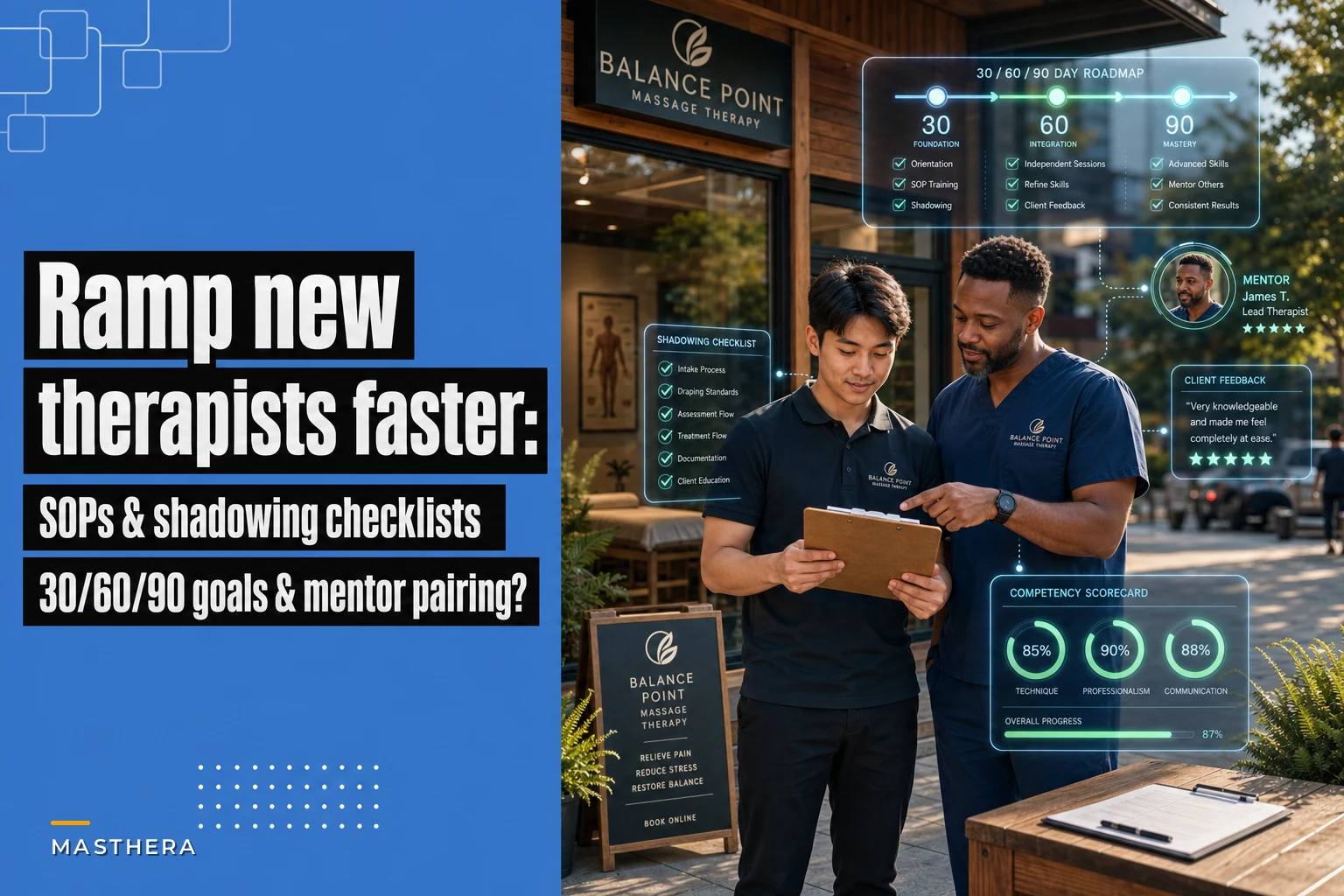

The gap between hiring a licensed massage therapist and having them deliver consistent, revenue-generating sessions usually stretches 8–12 weeks in most clinics. That's two to three months where you're paying full wages for partial productivity, dealing with nervous first sessions, and hoping they don't accidentally violate your intake protocols or pressure preferences.
Most wellness centers handle onboarding like this: hand the new therapist a binder of policies, have them shadow someone for a few days, then throw them on the schedule and hope for the best. No competency checkpoints. No structured feedback loops. No clear milestones that tell you whether someone's actually ready for solo sessions or quietly about to damage your reputation.
The real cost hits harder than just training wages. A therapist who starts taking clients before mastering your specific techniques and protocols creates cascading problems. Clients request different therapists. Rebooking rates drop from around 65% to 40% for that therapist's slots. Online reviews start mentioning inconsistent experiences. Other therapists get pulled into damage control. Eventually, either the new hire quits from frustration or you're stuck having an awkward performance conversation that better onboarding structure would've prevented.
Why standard onboarding fails in hands-on service businesses
The massage therapy industry has onboarding challenges that generic HR templates completely miss. Unlike retail or office roles where mistakes mean slow customer service or data entry errors, a poorly onboarded therapist creates immediate physical and emotional impacts on clients.
Think about what actually needs to transfer during onboarding. Technical competency varies wildly between massage schools, so you can't assume baseline skills. Each clinic has specific pressure scales, draping protocols, and contraindication assessments that might contradict what someone learned elsewhere. Client communication styles differ too — some clinics emphasize clinical language while others focus on relaxation terminology.
Then there's the unwritten operational knowledge. How to handle a client who falls asleep and needs extra time to dress. When to flag potential medical issues versus normal soreness feedback. The exact way you want therapists to transition between modalities mid-session. Which clients have sensory sensitivities requiring adjusted lighting or music volume.
Traditional shadowing makes these problems worse, not better. The new therapist watches someone with five years of muscle memory perform tasks that look effortless but involve dozens of micro-decisions. They see the outcome but miss the reasoning. After three days of observation, they're suddenly expected to replicate everything perfectly while managing their own anxiety about working on paying clients.
The competency-first onboarding framework
A proper massage therapist onboarding SOP starts with competency mapping before the first day. List every skill, protocol, and decision point a therapist needs to master — not just "Swedish massage technique" but specifics like "identifies and adjusts pressure for clients with fibromyalgia" or "performs proper bolstering for prenatal positioning."
Never miss a booking or double-book again.
Masthera helps you schedule, confirm & manage every massage session with ease.
- Unified appointment management
- Automated client reminders
- Therapist calendar coordination
No credit card required
Break these competencies into three tiers. Foundation skills they must demonstrate before touching any client. Intermediate abilities required before working solo. Advanced capabilities they'll develop over the first 90 days. This creates natural checkpoints instead of arbitrary time-based progression.
For a 60-minute relaxation massage, your foundation checklist might include:
-
Demonstrates all five basic Swedish strokes at three pressure levels
-
Maintains proper draping throughout position changes
-
Completes full-body routine within a 58–62 minute window
-
Identifies and documents three contraindication scenarios correctly
-
Uses intake form to adjust technique for two different health conditions
Each item should be observable and measurable. "Understands clinic policies" becomes "correctly processes a membership discount, package redemption, and cash tip in our POS system."
The intermediate tier covers situational handling. Can they adjust when a client requests focus work mid-session? Do they maintain professionalism when clients make inappropriate comments? Have they demonstrated proper incident documentation for a reaction or injury concern?
Advanced competencies include efficiency metrics and client relationship skills — building rebooking habits, upselling appropriate add-ons, managing back-to-back bookings without rushing. These develop gradually but need tracking from day one.
Structured shadowing that actually transfers skills
Replace passive observation with active shadowing milestones. Week one isn't just following someone around — it's specific observation assignments with documentation requirements.
Days 1–2: The new therapist shadows intake procedures while completing a checklist for each observed session. Did the senior therapist review medications? How did they handle a client who arrived late? What exact words did they use to explain the undressing process? They document five different client interactions with notes on variation.
Days 3–4: Shadow actual massage sessions with focus areas. First session, they're tracking body mechanics and table positioning. Second session, they're observing transition techniques and draping. Third session, they're noting time management and pressure adjustments. Each observation has a corresponding self-assessment where they practice the same techniques on a practice client or staff member.
Day 5: Reverse shadowing begins. The new therapist performs intake and setup while the mentor observes. They complete a 30-minute massage routine with the mentor providing real-time feedback. Session length and complexity increase as they demonstrate competency.
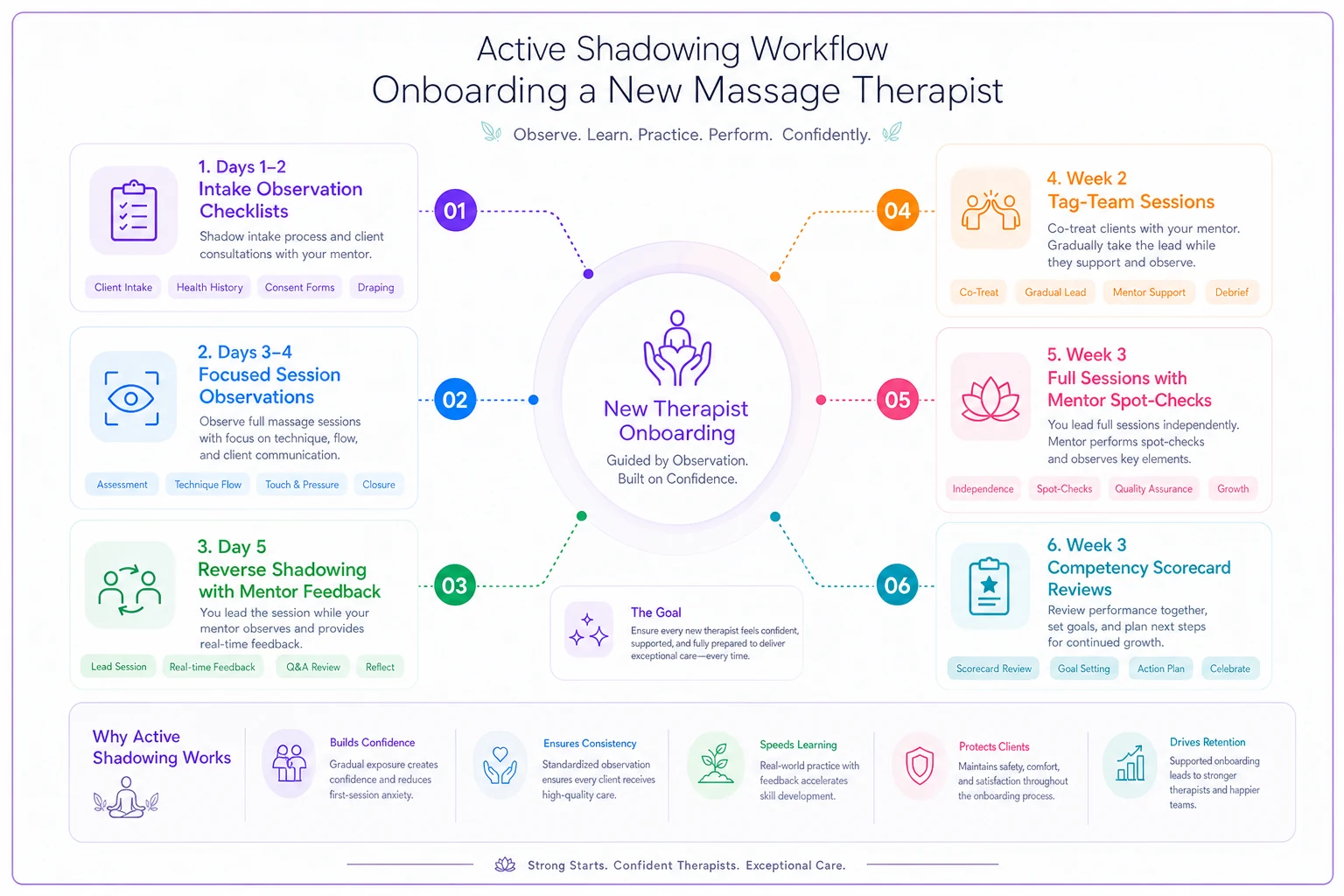
Week 2 introduces tag-team sessions. The new therapist handles specific portions while the mentor completes the rest — maybe they do all the prone work while the mentor handles supine, or they manage the full session while the mentor stays in the room for support. This builds confidence without abandoning them entirely.
By week 3, they're performing full sessions with the mentor doing spot-checks. Pop in during a transition. Observe the last 10 minutes. Review their SOAP notes afterward. The mentor fills out a competency scorecard after each check, noting strengths and areas needing work.
30-60-90 day progression markers
Clear milestone tracking replaces vague "probationary periods" with measurable progress indicators. Each phase has specific goals, required achievements, and evaluation criteria.
30-Day Markers: The first month focuses on technical proficiency and basic operations. By day 30, your new therapist should complete 20 supervised sessions with acceptable scorecards on at least 18. They've demonstrated all foundational competencies without prompting. Client feedback forms show satisfaction ratings above 4.2 out of 5. They're managing 60-minute sessions within the allocated time. Documentation meets compliance standards without corrections needed.
Also track leading indicators of struggle. Are they staying late to complete notes? Asking the same questions repeatedly? Avoiding certain types of bookings? These patterns predict future problems before they impact client experience.
60-Day Targets: Month two shifts toward independence and consistency. The therapist now handles a 75% full schedule without mentor oversight. They've successfully managed at least three challenging situations — a complaint, a medical concern, a scheduling conflict. Their rebooking rate hits 50% or better. They're contributing to team meetings with observations or suggestions, which signals real integration beyond task completion.
Quality consistency becomes measurable here. Compare feedback scores across different client types. Do their relaxation massages score higher than therapeutic work? Are certain client groups requesting different therapists? This granular data guides focused improvements.
90-Day Expectations: By three months, they're functionally equivalent to established staff. Full schedule capacity. Rebooking rates within 10% of studio average. No compliance issues or documentation gaps. They've completed advanced training in at least one specialty modality. Clients are specifically requesting them for return visits.
The 90-day review includes self-assessment compared to mentor evaluation. Where do they feel strongest? What still causes anxiety? Which clients or conditions do they prefer to avoid? This conversation shapes ongoing development and identifies potential specialization paths.
Building mentor partnerships beyond basic training
Effective mentor pairing goes beyond assigning your most senior therapist to train newcomers. Consider personality matching, communication styles, and schedule alignment. An anxious new graduate might need a calm, methodical mentor. Someone with previous spa experience might benefit from a mentor who understands the clinical transition.
Create structured mentor responsibilities with protected time. Mentors need 30 minutes of prep time before shadowing sessions to explain what the new therapist should observe. Fifteen minutes afterward for debrief and questions. Weekly planning sessions to review competency checklists and adjust upcoming training focus.
Give mentors 30 minutes of prep time before shadowing sessions to set clear observation goals.
Compensate mentors appropriately. This isn't a favor — it's skilled work that directly impacts retention and quality. A mentor premium of $50–100 per week during active training periods is reasonable. Some clinics offer reduced booking quotas, counting mentor hours as billable time. Others tie bonuses to new therapist success metrics at 90 days.
The mentor relationship evolves through distinct phases. Weeks 1–2 are intensive oversight. Weeks 3–4 shift to collaborative problem-solving. Weeks 5–8 become check-ins and confidence building. Weeks 9–12 transition to peer support. This gradual reduction prevents abrupt abandonment while building independence.
Document mentor feedback specifically. Not just "doing well" or "needs improvement" but actual observations: "Struggled with proper body mechanics during deep tissue work on larger clients — recommended additional training on table height adjustment and leverage techniques." This creates an improvement roadmap and legal documentation if performance issues arise.
Client feedback loops calibrated for new therapists
Standard satisfaction surveys don't capture the nuanced feedback needed during onboarding. New therapists need specific data about their performance, but you also need to protect them from harsh criticism while they're still building confidence.
Design a modified feedback system for the first 30 sessions. Instead of open-ended reviews, use structured questions:
| Question | Options |
|---|---|
| Pressure level was: | too light / perfect / too firm |
| Session pacing felt: | rushed / comfortable / too slow |
| Therapist communication was: | minimal / appropriate / excessive |
| Would you book with this therapist again: | yes / maybe / prefer someone else |
Route this feedback through the mentor first, not directly to the new therapist. The mentor can identify patterns and frame coaching constructively. If three clients mention feeling rushed, that's a systematic training issue — not individual criticism to pile on someone already nervous.
After 30 sessions, introduce standard feedback forms but maintain mentor filtering through the first 60 days. Look for trajectory rather than absolute scores. A therapist improving from 3.8 to 4.3 shows better potential than someone stuck at 4.0.
Create recovery protocols for negative feedback. If a client marks "prefer someone else," the mentor should review that session's notes, discuss with the therapist, and potentially observe their next similar booking. Sometimes it's mismatched expectations. Sometimes it's a skill gap. Sometimes it's just personality fit. The response varies but needs to happen quickly.
Consider incentivizing constructive feedback during the onboarding period. Offer clients who complete detailed surveys a small credit or add-on upgrade. A new therapist getting three responses per week provides better training insights than one monthly average.
Skill verification beyond basic licensing
State licensing proves minimum competency, not readiness for your specific clinic environment. Build verification protocols that test real-world application of skills in your operational context.
Create practical examinations for critical techniques. Don't just ask about contraindications for prenatal massage — present a fake intake form for a second-trimester client with sciatica and have them demonstrate the full decision process. Watch them position the client, explain modifications, and perform appropriate techniques.
Test operational scenarios through role-play. The mentor poses as a client who arrives intoxicated. Another staff member pretends their credit card declined after the session. Stage a fake scheduling conflict where they're double-booked. These simulations reveal decision-making patterns before real situations occur.
Document proficiency with video review when appropriate. Record practice sessions (with consent) to review body mechanics, timing, and technique consistency. A therapist might not realize they're speeding through neck work or spending disproportionate time on backs until they see themselves on video.
Verify documentation accuracy through audit cycles. Review their first 20 SOAP notes for completeness, clinical accuracy, and compliance requirements. Check their retail inventory counts. Examine their cash handling reconciliation. These administrative skills matter as much as hands-on technique for operational success.
Some clinics implement peer verification alongside mentor assessment. After the new therapist feels confident, have them work on other staff members who provide structured feedback. Builds team relationships while gathering diverse perspectives on readiness.
Common onboarding failures that trigger turnover
The fastest way to lose a new therapist is overwhelming them with unsupported responsibility. Scheduling them for five deep tissue sessions on day 10 because you're short-staffed guarantees burnout or injury. They'll either hurt themselves trying to meet expectations or develop bad body mechanics that become permanent habits.
Information overload creates similar problems. Dumping every policy, procedure, and preference in week one means they retain nothing. A therapist trying to remember 47 different protocols while managing new-job anxiety will make mistakes that damage confidence. Spread non-essential information across the full 90 days.
Inconsistent standards between trainers confuse and frustrate new hires. When the mentor says one thing about draping protocol but another therapist contradicts it during a casual conversation, the new person doesn't know what's actually expected. Document standard procedures explicitly and make sure all senior staff follow them during training periods.
Isolation after initial training causes gradual disengagement. Once the intensive mentor period ends, new therapists often feel abandoned — not comfortable enough for casual staff friendships but no longer with dedicated support. Schedule regular check-ins through month six, even if just 15-minute conversations about how things are going.
Mismatched client assignments accelerate turnover. Giving new therapists all the difficult clients because senior staff don't want them guarantees poor outcomes. Same with booking them only with discount-seekers or people other therapists avoid. Protect their early schedule with appropriate clients who match their developing skills.
Technology and systems for consistent onboarding
Manual tracking of competencies, shadowing sessions, and feedback becomes impossible with multiple new hires or locations. The gap between intention and execution widens when mentors rely on memory or paper checklists that get lost or forgotten.
Modern operational software can systematize the entire massage therapist onboarding SOP. Competency checklists become digital forms that automatically calculate readiness scores. Shadowing schedules sync with booking systems to ensure protected mentor time. Feedback routes through automated workflows that compile patterns and flag concerns.
AI automation helps identify training gaps by analyzing documentation patterns. If every new therapist struggles with specific intake scenarios, the system surfaces curriculum adjustments needed. When feedback scores correlate with certain session types, it suggests modified client matching during ramp periods.
The sophistication doesn't require complexity. A well-designed platform feels like a natural extension of existing operations — mentors get daily prompts about what to observe, new therapists see their progress through competency tracking, managers receive alerts when milestones are missed or concerning patterns emerge.
Integration matters more than features. Your onboarding system needs to connect with scheduling software to manage shadow sessions, link to your POS for tracking retail training, and route client feedback appropriately based on therapist experience level. HR documentation requirements should be captured alongside performance data rather than living in a separate system nobody checks.
Measuring real onboarding ROI
Track metrics that connect onboarding quality to actual business outcomes. The obvious ones — time to productivity, 90-day retention, client satisfaction scores — tell part of the story. But deeper analysis reveals the true impact of structured onboarding.
Calculate revenue per therapist hour at 30, 60, and 90 days compared to established staff. A properly onboarded therapist might generate 70% of veteran revenue by day 30, while rushed onboarding shows closer to 45% productivity that climbs slowly. That gap multiplied across multiple hires equals real money left on the table.
Monitor rebooking rates as a quality indicator. New therapists with strong onboarding tend to achieve around 55% rebooking by day 60. Those without structured training hover closer to 35%. Each lost rebooking means marketing costs to replace that client plus potential reputation damage if they share negative experiences.
Evaluate training time investment honestly. A mentor spending three hours daily for two weeks seems expensive until you compare it to recruiting and retraining replacement therapists who quit after six weeks. Factor in client loss from inconsistent experiences and the investment pays for itself through retention alone.
Watch for downstream indicators like retail sales and service upgrades. Properly trained therapists confidently recommend products and add-ons because they understand the value. They're generating a few hundred dollars monthly in additional revenue by month three, while undertrained staff barely mention retail options.
Consider the impact on existing staff too. Strong onboarding means senior therapists aren't constantly covering mistakes or fielding complaints about new team members. Team stability improves when everyone trusts that new hires will actually meet standards.
Making onboarding sustainable as you scale
The massage therapist onboarding SOP that works for hiring one person quarterly might collapse when you're bringing on multiple therapists monthly across several locations. Build scalability into the foundation rather than retrofitting later.
Create modular training components that stack based on role requirements. Every therapist needs foundation modules. Therapeutic specialists add clinical assessment training. Spa therapists include aromatherapy and hot stone protocols. This prevents redundant training while ensuring comprehensive coverage.
Develop mentor certification programs that build a pipeline of trainers. Your best therapists can complete additional coaching and competency assessment training, earn mentor credentials and premium pay, while you gain training capacity beyond one senior person.
Standardize documentation but allow location customization. Each site might have slightly different equipment, room layouts, or client demographics. The core competency framework stays consistent while specific applications adjust. A downtown clinical location emphasizes therapeutic techniques while the suburban spa focuses on relaxation and retail.
If you operate multiple sites, build feedback loops between locations. A therapist struggling with prenatal positioning at one location might benefit from shadowing a specialist at another. When one location discovers a better way to teach efficiency, share it across sites rather than letting it stay siloed.
Plan for remote or hybrid training components. Not everything requires in-person observation. Policy review, documentation training, and theoretical knowledge can happen through digital platforms. This preserves precious in-person time for hands-on skill development and relationship building.
The investment in systematic onboarding compounds over time. Each well-trained therapist becomes a future mentor. Every refined process makes the next hire smoother. Strong early experiences create people who refer other quality candidates. What starts as operational necessity becomes competitive advantage when you build a reputation for professional development that actually attracts good therapists rather than just warm bodies.
A massage therapist onboarding SOP isn't just about filling schedule slots or checking compliance boxes. It's about creating sustainable quality that clients notice and therapists appreciate. The clinics that thrive long-term don't just hire licensed bodies — they build professionals through intentional development systems that protect standards while accelerating readiness. That transformation from nervous new hire to confident practitioner doesn't happen by accident. It happens through structured support, measured progress, and systems that ensure nothing important gets missed while someone finds their rhythm in your specific operational environment.
Ready to elevate your massage therapy business?
Join hundreds of therapists using Masthera to save time, reduce scheduling conflicts, and enhance client satisfaction.