

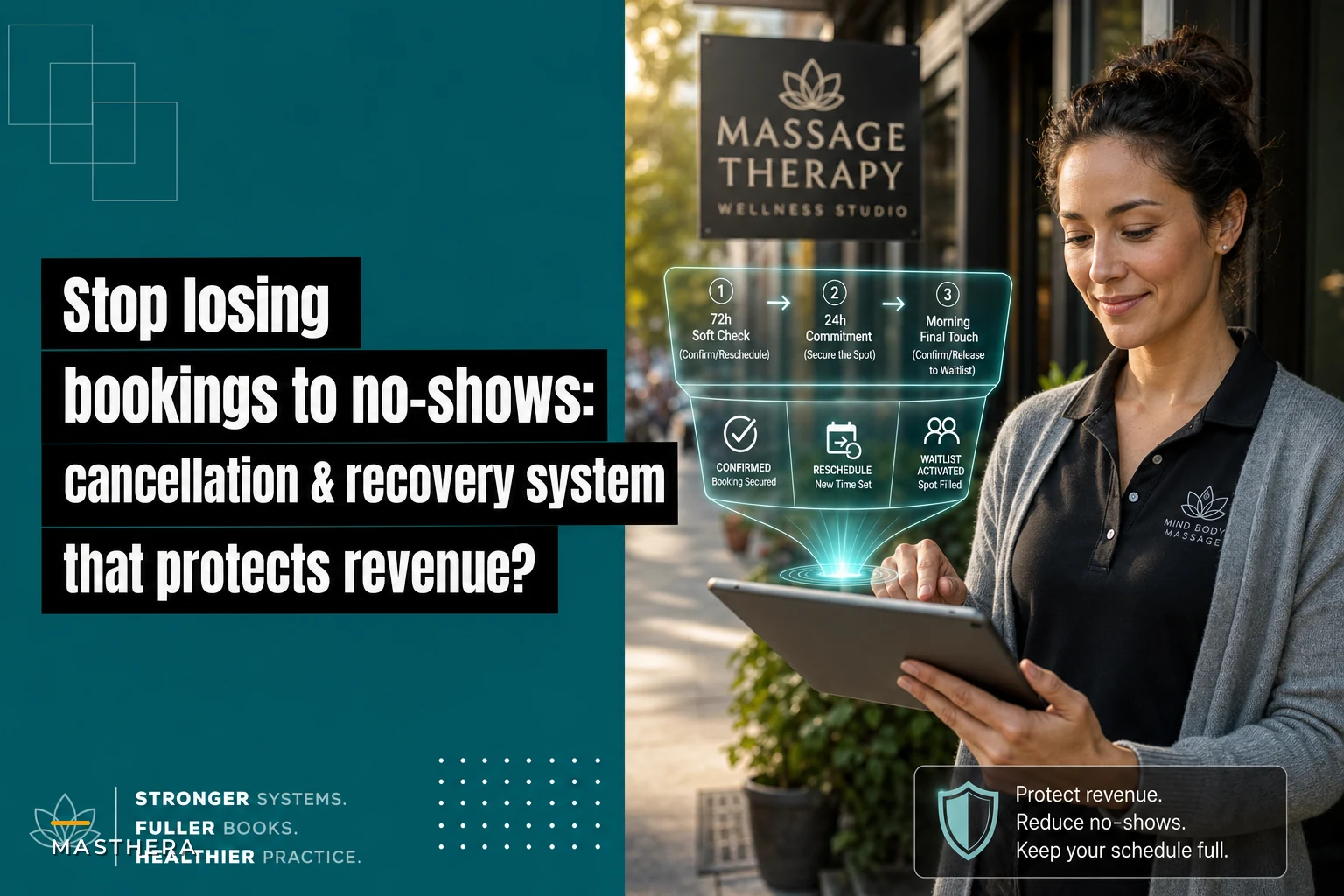

The notification hits at 7:42am. Your 9am client just canceled. Then another one texts about their 11:30. By noon, you're staring at a half-empty schedule that was fully booked yesterday.
Most massage therapists handle this wrong. They wait too long to fill spots, send weak follow-ups, and watch revenue disappear. The difference between practices that stay booked and those with chronic gaps usually comes down to one thing — having an actual recovery system, not just hoping clients reschedule on their own.
The real cost hiding in your appointment book
Empty slots hurt more than just today's income. A single no-show can create a small cascade of problems that compound quietly over months.
Say you charge $120 per session and see around 80 clients a month. If 8% cancel last-minute — which is pretty typical — that's roughly 6 or 7 lost appointments. Direct loss? Close to $780 a month. But the damage runs deeper than that.
Those empty slots push your overhead per actual session higher. A $2,400 monthly lease divided across 73 sessions instead of 80 bumps your per-session cost from $30 to about $33. That sounds minor until you do the annual math.
There's also a mental cost that doesn't show up in any spreadsheet. When you're constantly checking your phone wondering if more cancellations are coming, that anxiety bleeds into the sessions you do complete.
And then there's the slow client drift. One therapist discovered her "loyal" Tuesday morning client had been booking with someone else for three months — not because of any falling out, just because her schedule was too unpredictable to rely on.
Why standard cancellation policies fail
Posting a cancellation policy on your website means very little if you enforce it inconsistently. Most practices have something like "24-hour notice required" buried in an intake form. Clients sign it once and forget it exists.
Never miss a booking or double-book again.
Masthera helps you schedule, confirm & manage every massage session with ease.
- Unified appointment management
- Automated client reminders
- Therapist calendar coordination
No credit card required
The breakdown happens in a few predictable places.
Unclear consequences. "24 hours notice required" doesn't tell anyone what happens if they cancel at hour 23. Or hour 2. Without a specific outcome attached, policies become suggestions.
Inconsistent application. You hold new clients to the policy but let regulars slide. Someone has a "good excuse" and you waive the fee. Before long, everyone expects an exception.
No recovery mechanism. Most policies focus entirely on consequences — late fees, charges — rather than on actually filling the spot. A $50 fee doesn't help when you're sitting in an empty room that should have generated $120.
The psychology matters too. People cancel for completely different reasons: genuine emergencies, forgetting, anxiety about the appointment, financial stress. A single rigid policy applied to everyone misses real opportunities to save bookings.
Building a recovery funnel that actually fills spots
Effective cancellation management isn't really about stricter rules. It's about creating multiple chances to catch the problem before the appointment is gone.
Start with reconfirmation triggers. Instead of one reminder the day before, build a short sequence that surfaces problems early.
72-hour soft check: "Looking forward to seeing you Thursday at 2pm. Reply YES to confirm or call if you need to adjust timing."
This gives clients who are already second-guessing an easy, low-stakes way to reschedule. Roughly 15% of potential cancellations get caught here and quietly moved.
24-hour commitment point: "Tomorrow at 2pm is reserved for you. Please confirm by 8pm tonight or we'll need to release the spot to our waitlist."
That's not a threat — it's just explaining how the business works. The scarcity is real.
Morning-of final touch: "See you at 2pm today! Door code is 4521. Text if you're running behind — we can usually work with up to 15 minutes."
This prevents no-shows from clients who wake up late, assume they've missed their window, and just don't bother coming.
The three-step sequence matters in order. Skipping straight to a same-day message misses the window where most preventable cancellations actually happen.
Here's a quick visual of the three-step confirmation sequence.
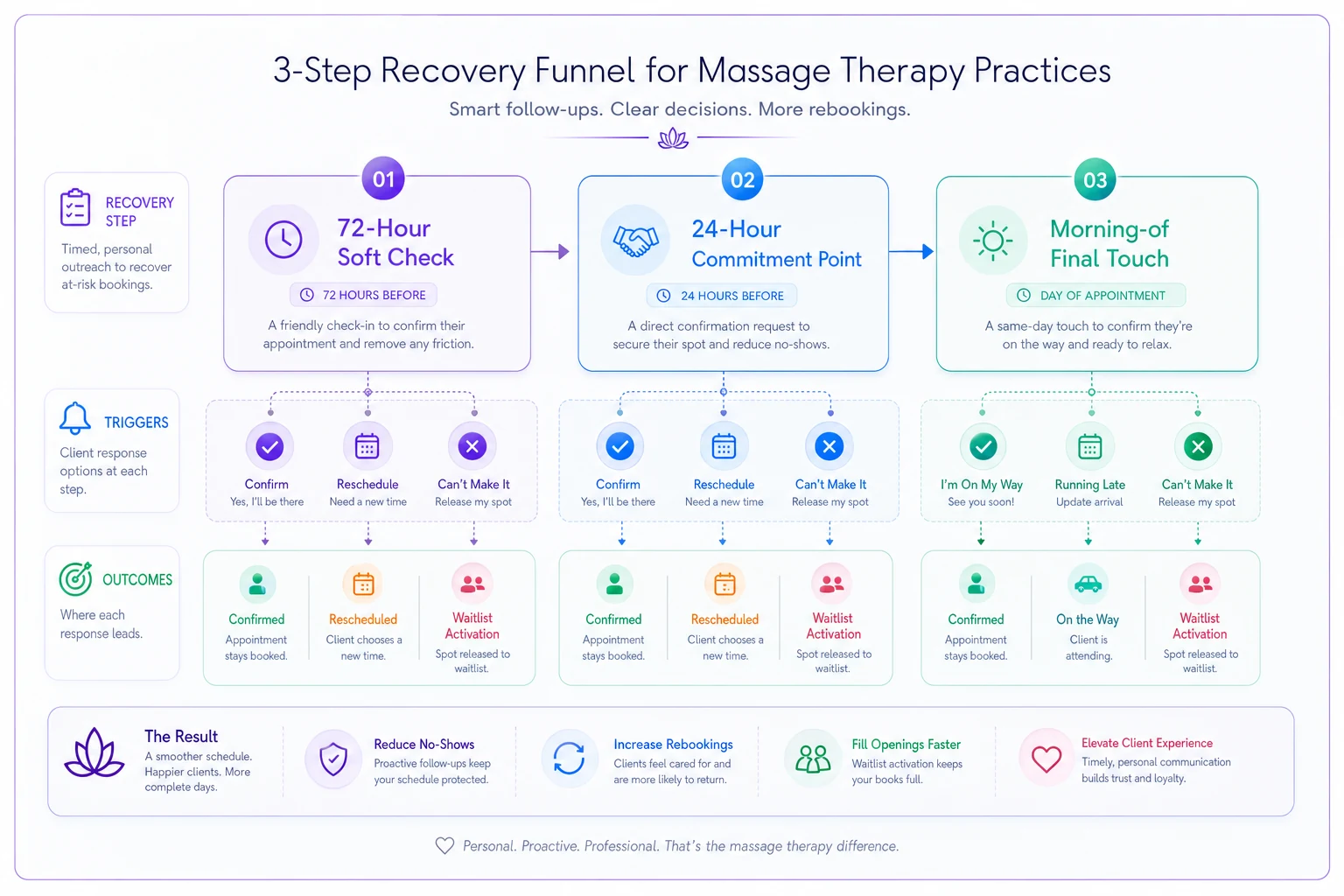
The sequence shows where reschedules are most likely to be captured and when to trigger waitlist outreach.
The waitlist conversion system
Empty spots don't have to stay empty if you keep an active waitlist. Not a notebook with random names — an organized, tiered system built for speed.
Hot leads (same-day fills): Clients who've told you they'll take last-minute openings. Usually 8 to 12 people who work nearby or have genuinely flexible schedules.
Warm prospects (24-hour fills): Regular clients who book monthly but would come more often if something opened up. Maybe 20 to 30 people.
Cold outreach (48-hour fills): Past clients who haven't booked in a while. Could be 50 or more people who'd appreciate a simple "we have an opening" message.
Speed is everything here. When someone cancels, the sequence should go immediately:
-
Text hot leads with the specific slot
-
Set a 30-minute response window
-
Move to warm prospects if no one bites
-
Send cold outreach as a last resort
One practice found that nearly three-quarters of last-minute cancellations could be filled from hot leads alone — but only if they were contacted within 10 minutes of the cancellation coming in. That 10-minute window is the difference between a filled slot and a lost one.
Scripts that convert cancellations to reschedules
What you say when someone cancels determines whether they rebook or quietly disappear. Most therapists land in one of two failure modes: frustration ("This is the third time!") or total accommodation ("Oh no worries at all!"). Neither one actually helps.
When someone cancels last-minute:
"I understand things come up. Since this is short notice, our cancellation policy does apply. That said, if you can rebook this week, I'll waive the fee and apply it toward your next session. I have Thursday at 3pm or Friday at 11am if either works."
You've acknowledged the situation, mentioned the policy without being punitive, and immediately given them a path forward. Around 60% take the rebooking offer when it's framed this way.
For repeat cancelers:
"I've noticed scheduling has been tricky lately — would a different time work better for you long-term? I have some early morning and evening slots that might fit your routine more reliably."
You're addressing the pattern without making them feel bad about it. Chronic cancelers often just booked the wrong time to begin with.
For no-call no-shows:
"Missed you today — hope everything's okay. If you'd like to reschedule, I'm holding Tuesday at your usual time until noon tomorrow."
Concern rather than irritation. A deadline. Easy path to rebook. That combination works better than anything that sounds even slightly accusatory.
Automation that handles the heavy lifting
Manually chasing every cancellation eats hours you don't have. The right operational software handles the repetitive parts automatically, so you can focus on the cases that actually need a personal touch.
| Cancellation Window | Automatic Response | Manual Follow-up |
|---|---|---|
| 48+ hours out | Confirmation received, rescheduling link sent | None needed |
| 24–48 hours | Policy reminder, fee notice, rebooking incentive | Check if rescheduled within 2 hours |
| Less than 24 hours | Fee applied, waitlist notified, urgent rebooking offer | Personal call for high-value clients |
| No-show | Fee charged, concern check, limited rebooking window | Always requires personal response |
The automation handles the immediate, repeatable responses. You handle the exceptions that actually need judgment. A good platform also tracks patterns over time — flagging clients who cancel repeatedly so you can address what's actually going on before it becomes a habit.
Integrate scheduling with payment processing to automate fee collection and keep enforcement consistent.
Some practices integrate their scheduling software directly with payment processing to automate fee collection. It removes the awkwardness of bringing it up manually and keeps enforcement consistent without any extra effort on your part.
Waitlist notifications can run the same way. When a spot opens, the system texts your hot leads simultaneously with a "first response gets it" message. Urgency built in, no manual work required.
Setting reserves and boundaries
Not every empty slot needs to be filled. That's worth saying plainly.
-
One admin block for catch-up work
-
Friday afternoons for same-week reschedules
-
Protected time for your most reliable recurring clients
These buffers matter when things break down. When someone cancels on Monday, you have a real option to offer them instead of pushing them out two weeks.
Sometimes a cancellation is just a break you didn't know you needed. If you've already seen six clients and someone cancels the seventh, filling that slot out of obligation rarely serves anyone well. A sustainable practice accounts for that reality.
Measuring what matters
Three numbers are enough to know whether your system is working.
Fill rate: What percentage of canceled slots actually get filled? Above 50% is solid. Above 70% is genuinely impressive.
Rebook rate: How many people who cancel schedule another appointment within a week? Should be at least 65%.
Chronic canceler percentage: What share of your client base cancels more than twice per quarter? Keep that under 10%.
One studio tracking these found that Thursday evening slots had a 40% cancellation rate. Turned out a weekly farmers market had made parking a nightmare. They shifted those appointments and cut that cancellation rate by 75%. You'd never catch that pattern without actually looking at the data.
You don't need to track everything. These three numbers give you what you need without drowning you in data.
Moving from reactive to proactive
Once recovery is working, turn your attention upstream.
Book at sustainable intervals. If you're running low by appointment six, stop scheduling a seventh. Clients notice depleted energy, even when they can't articulate what felt off.
Consider packages. A client who's pre-paid for four sessions shows up more consistently than someone booking week to week. Commitment goes both ways.
Pay attention to patterns. If multiple clients cancel Thursday afternoons, something changed in their world — traffic, schedules, something seasonal. Address the root cause rather than managing the symptom indefinitely.
The compound effect of consistency
A functioning recovery system changes more than just how you handle individual cancellations.
When clients know the policy is real and enforced consistently, they commit more seriously to their appointments. Your schedule stays fuller, which creates genuine scarcity, which makes people value their slots more. You stop losing mental energy to schedule anxiety.
More importantly, predictable revenue lets you plan. You can take time off without your practice collapsing. You can invest in training. You can raise rates because demand holds steady.
Your cancellation rate will never hit zero — that's not the point. The point is turning inevitable cancellations from revenue emergencies into minor scheduling adjustments. With the right recovery system in place, a 9am cancellation becomes a 9am waitlist fill, and the day keeps moving.
Start with one piece. Better confirmation messages, or a simple tiered waitlist. Run it for two weeks and see what happens. Then add another layer.
The tools to make most of this automatic already exist — the strategies have been tested across enough practices to know they work. What's left is just actually putting them in place.
Ready to elevate your massage therapy business?
Join hundreds of therapists using Masthera to save time, reduce scheduling conflicts, and enhance client satisfaction.