



You know that sinking feeling when you realize you're working 40 hours but barely clearing enough to cover rent? I watched a therapist in Denver discover she was actually losing $3 on every 30-minute session after factoring in laundry, supplies, and credit card fees. She'd been matching the studio down the street at $55 for months.
The massage therapist pricing model most practitioners follow goes something like this: check what others charge, pick something in the middle, hope it works out. Meanwhile, your actual costs per session fluctuate based on therapist pay structure, room rental arrangements, supply usage, and a dozen other variables nobody tracks.
After building operational software for wellness practices across the country, one pattern keeps showing up—profitable studios understand their per-session economics down to the dollar, while struggling ones guess at pricing and wonder why margins disappear.
The hidden math behind every massage session
What actually happens financially during a single appointment goes deeper than rent divided by appointments. The real operational costs compound into margin problems most owners don't see until it's too late.
Start with therapist compensation. Most practices default to percentage splits without calculating the downstream impact. A 50% split on a $120 session means $60 to the therapist—simple enough. But that same structure on a $70 session drops therapist pay to $35, which might push them below their acceptable hourly rate once you factor in setup and documentation time.
Then layer in the variable costs everyone forgets. Credit card processing eats 2.9% plus 30 cents per transaction—that's $3.78 on your $120 session. Laundry runs about $2.50 per set when you include detergent, utilities, and replacement linens. Massage oil and lotions average around $1.80 per session with quality products. Table paper, sanitizer, and disposables add another $1.20.
Before touching fixed costs, you're already at $69.28 in direct expenses on that $120 session with a 50% therapist split. That leaves $50.72 for everything else—rent, insurance, booking software, marketing, utilities, owner pay.
The economics shift dramatically based on your model. Independent contractors typically take 60-70% of session revenue but cover their own supplies and taxes. Employees cost less per session in direct pay but add payroll taxes, workers comp, and benefit obligations that can push total compensation to 65% of revenue even at a 45% base split.
Room renters present different math entirely. They pay a fixed monthly amount regardless of utilization. Your only variable costs become utilities and common area supplies. But you lose control over pricing, service quality, and client relationships.
Building your per-session profit worksheet
A functional unit economics model doesn't require complex spreadsheets. Start with this basic framework that tracks real costs against revenue bands.
Never miss a booking or double-book again.
Masthera helps you schedule, confirm & manage every massage session with ease.
- Unified appointment management
- Automated client reminders
- Therapist calendar coordination
No credit card required
Revenue Inputs:
-
Base service price (60-minute standard)
-
Add-on pricing (hot stones, aromatherapy, etc.)
-
Average tips per session
-
Package/membership discount percentage
Direct Variable Costs:
-
Therapist compensation (percentage or hourly)
-
Payroll taxes if W2 (roughly 7.65% of wages)
-
Payment processing fees
-
Supplies per session
-
Laundry/linen costs
Allocated Fixed Costs:
-
Rent per treatment room per day
-
Insurance per session (liability divided by monthly volume)
-
Software/booking fees per appointment
-
Utilities per room hour
Most worksheets fail because they treat all sessions equally. Your 90-minute deep tissue with hot stones has completely different economics than a 30-minute chair massage. Track each service type separately.
A practice in Austin discovered their "premium" 90-minute sessions actually generated lower margins than basic 60-minute appointments. Longer room occupation meant fewer daily bookings, while therapist overtime rates kicked in after 6 hours. They restructured to incentivize 60-minute bookings with strategic add-ons instead.
The worksheet becomes genuinely useful when you can answer questions like: "If I raise prices by $10, how many clients can I lose before profits shrink?" or "Should I pay therapists hourly or percentage-based if my average ticket is $95?" Those aren't theoretical questions—they're decisions you'll face within the first year.
This flow visualizes the steps you'll follow to calculate per-session profitability.
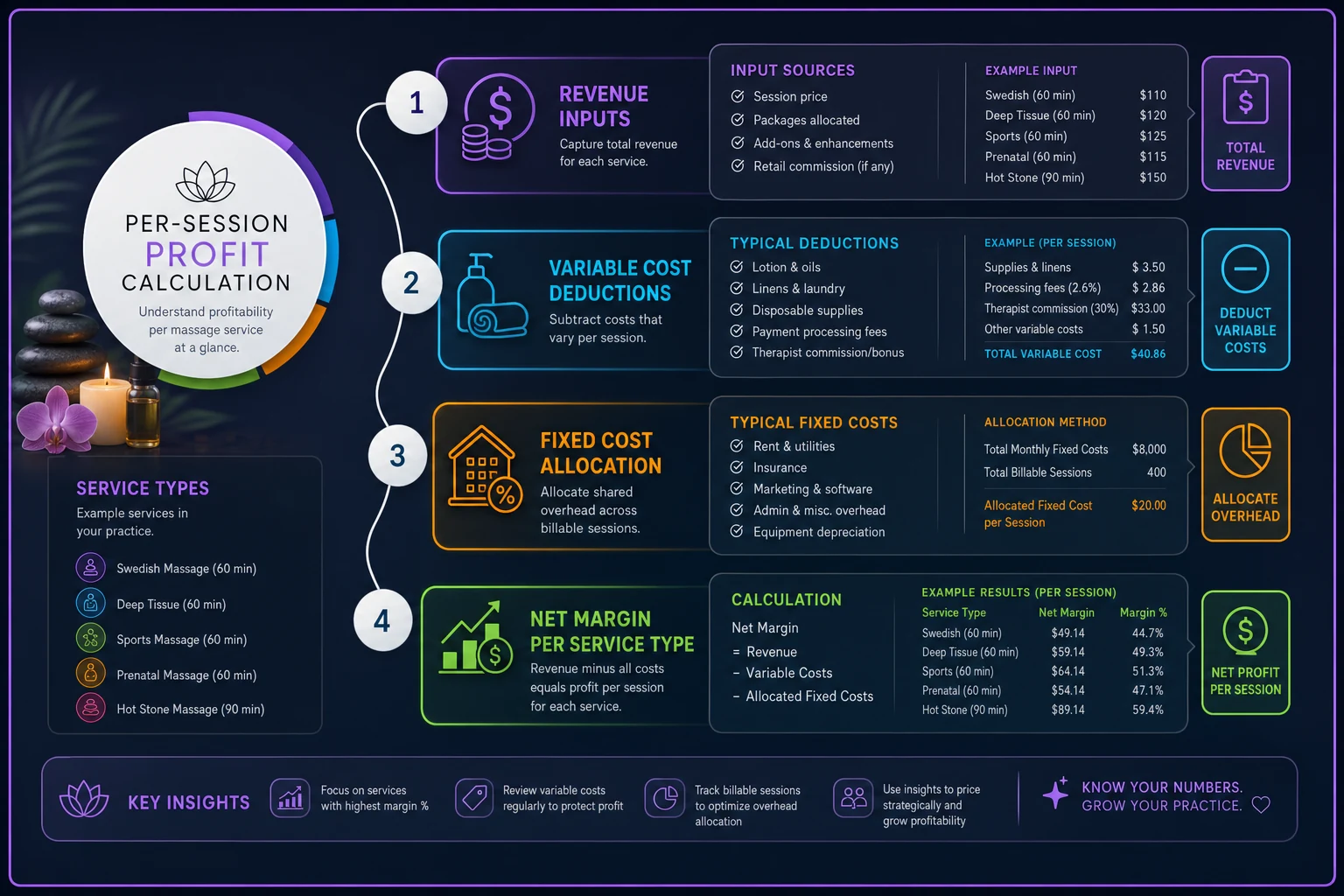
Use this flow to ensure you're capturing each input and deduction for every service type; it's the backbone of the worksheet.
Therapist pay structures and their margin impact
The compensation model you choose fundamentally alters your pricing flexibility and profit potential.
Percentage splits create aligned incentives—therapists want higher prices and more add-ons since they earn more per session. But this model locks your margins. If you pay 55% commission, your gross margin can never exceed 45% minus direct costs. Raising prices helps both parties proportionally, but you can't improve margins through operational efficiency alone.
Hourly pay provides predictable costs and protects margins on premium services. A therapist earning $40/hour costs the same whether the client pays $80 or $120. The downside is that hourly models remove upsell incentives and can encourage a slower work pace since income doesn't vary with productivity.
Hybrid structures blend base hourly with commission on add-ons or tips. A common version pays $30/hour base plus 20% of add-on revenue. This ensures minimum earnings while incentivizing revenue growth. One Phoenix studio switched to hybrid pay and saw add-on sales jump from around 15% to 35% of sessions within a couple months.
Consider this comparison for a $100 session:
| Pay Model | Therapist Cost | Other Direct Costs | Gross Margin |
|---|---|---|---|
| 50% Commission | $50 | $9.20 | $40.80 |
| $35/hour | $35 | $9.20 | $55.80 |
| $30/hr + 20% add-ons | $34* | $9.20 | $56.80 |
*Assumes $20 average add-on revenue
The hourly model generates noticeably higher margins on the same session price. But commission-based therapists often produce higher revenue through better client retention and rebooking rates, since their income depends on building steady clientele. Neither structure wins automatically—it depends on what your therapists actually respond to.
Price bands and when each makes sense
Your market position determines sustainable price bands, but unit economics should drive specific price points within those bands.
Budget tier ($50-70/hour) only works with specific cost structures. You need either independent contractors taking 60% splits, high-volume room utilization of 8+ sessions daily, or minimal overhead through home-based or sublease arrangements. Practices at this tier survive on volume, not margins.
Standard tier ($80-100/hour) is the operational sweet spot for most markets. At $90/session with 50% therapist costs and $10 variable expenses, you net $35 toward fixed costs and profit. With 20 sessions weekly per room, that's $2,800 monthly per room contribution. Subtract $800 rent, $200 insurance, $150 utilities, and you clear roughly $1,650 per room.
Premium tier ($110-150/hour) requires exceptional service delivery and typically works only in affluent areas or with specialized modalities. Margin dollars improve—a $130 session might net $55-60 after direct costs—but volume often drops. Premium practices tend to average around 60-70% utilization versus 75-85% for standard tier.
Luxury tier ($170+/hour) operates on completely different economics. These practices often include extensive amenities, longer appointment slots, and higher therapist wages. A $200 session might only yield 30% margins after all costs, but clients expect and accept premium pricing for the full experience.
The trap is pricing in one tier while operating with another tier's cost structure. A studio charging $75/session can't afford premium linens, extensive training, or top-tier therapists. Meanwhile, a $140/session practice running bare-bones operations will face client retention problems when the experience doesn't match the price.
Add-on economics versus base price increases
Raise base rates or push add-ons? The math tells a different story than intuition suggests.
Raising base price from $90 to $100 increases revenue by $10 per session. With 50% therapist commission, you net $5 extra. If you lose more than 10% of volume to price sensitivity, you're worse off—and most practices see somewhere between 5-15% client loss with a 10% price increase.
Add-ons work differently. A $20 aromatherapy upgrade costs maybe $2 in supplies. Even paying therapists 30% commission on add-ons leaves you $12 net—more than double what a $10 base price increase yields. Plus, add-ons don't trigger the same price resistance since clients choose them actively.
The operational challenge is execution consistency. Therapists need training on presenting options without seeming pushy. Your booking system needs to track preferences. Inventory management gets more complex with multiple enhancement options.
Smart practices layer both strategies. Annual 3-5% base price increases keep pace with inflation while aggressive add-on programs drive margin expansion. A Milwaukee practice kept base prices flat for three years while growing add-on revenue from 8% to around 40% of total sales through systematic training and incentives.
Some add-ons make more economic sense than others:
High-margin add-ons:
-
Aromatherapy ($15-20 charge, $2 cost)
-
CBD oil ($25-30 charge, $5 cost)
-
Foot scrubs ($20 charge, $3 cost)
Low-margin add-ons:
-
Hot stones ($25 charge, $15 labor + heating costs)
-
Extended time (+30 min for $40, full therapist cost)
-
Cupping ($20 charge, $15 in extra time/training)
Without granular tracking per service combination, you might push hot stone add-ons that actually reduce per-hour profitability versus just booking another client in that slot.
Decision rules for different business models
Your ownership structure and growth goals should drive specific pricing and compensation decisions.
Solo practitioners should maximize price per session since capacity is fixed. Better to work 25 hours at $120/session than 40 hours at $75. Use premium pricing to filter for clients who value your expertise. Add-ons matter less here—focus on base price optimization and package sales for committed clients.
Small group practices (2-5 therapists) need to balance therapist satisfaction with sustainable margins. Percentage-based pay usually works best since it shares risk and reward. Price in the middle-upper range of your market and differentiate through consistency and availability rather than competing on price.
Larger studios (6+ therapists) require more sophisticated modeling. Mixed pay structures often emerge—senior therapists on higher percentages, newer staff on hourly. These operations benefit most from aggressive add-on programs since infrastructure exists to train and track performance. Premium pricing becomes harder to sustain with staff variability.
Franchise/multi-location operations need standardized pricing that works across different cost structures. This usually means conservative base pricing with heavy emphasis on memberships and packages to lock in recurring revenue. Unit economics must account for franchise fees and corporate overhead allocation.
Room rental models operate outside traditional frameworks. You're essentially a commercial landlord who rents to massage therapists. Price based on market room rates and occupancy targets, not massage session economics. Your only variable becomes utilization—better to rent 5 rooms at $800/month than 3 rooms at $1,200.
Testing and adjusting your model
Pricing changes feel risky because client reaction seems unpredictable. Systematic testing takes some of that guesswork out.
Start with add-on testing before touching base prices. Introduce one new enhancement at different price points across therapists. Track uptake rates and margin impact for 30 days. A $25 add-on with 20% uptake generates $5 average revenue per session—equivalent to a 5% base price increase without the sticker shock.
For base pricing, test with new clients first. They don't know your old prices. Raise rates for new bookings only and monitor conversion rates. If bookings hold steady after 60 days, extend to existing clients with proper notice.
Key metrics to track during price testing:
-
Booking conversion rate (inquiries to appointments)
-
Client retention rate (percentage who rebook)
-
Average sessions per client per quarter
-
Therapist satisfaction scores
-
Actual margin per session type
One Portland practice found through testing that clients readily paid $15 more for sessions after 5pm or on weekends. Rather than across-the-board increases, they implemented time-based pricing that improved margins on high-demand slots while keeping standard hours accessible.
Pilot add-on offers with a few therapists first and track uptake before rolling out studio-wide.
Package pricing needs different testing methodology. Try offering the same discount at different commitment levels—10% off 5 sessions versus 15% off 10 sessions. Track not just sales but completion rates. A package that doesn't get used frontloads revenue but damages lifetime value.
AI-powered booking platforms can automate parts of this testing by presenting different prices or packages to measure conversion impact. But even manual tracking with spreadsheets beats guessing based on what competitors charge.
Common unit economics mistakes
Ignoring customer acquisition cost (CAC) destroys margins even with solid session-level economics. If you spend $50 acquiring a client who books twice at $30 margin, you're losing money. Factor CAC into first-visit pricing or minimum package requirements.
Forgetting overhead allocation makes every session look profitable on paper. That $40 gross margin per session becomes $15 after real overhead costs. Practices often discover they lose money on Thursday mornings but never knew because they only tracked direct costs.
Missing therapist utilization reality leads to overoptimistic projections. Therapists rarely exceed 75% billable time after documentation, cleaning, breaks, and no-shows. Building a model on 90% utilization guarantees disappointment.
Underestimating price elasticity causes panicked retreats after increases. Some client loss is normal and often healthy—losing unprofitable clients can actually improve overall margins. A practice might see 10% volume drop but 15% profit increase.
Ignoring competitive dynamics while focusing purely on internal economics creates positioning problems. If everyone charges $100 and you charge $140 based on your costs, you need real differentiation to sustain it.
Using industry averages instead of actual data might be the biggest mistake of all. The "standard" 50% commission might not work with your rent and overhead structure. Track your real numbers, not what forums say everyone else does.
Bringing it together
Unit economics isn't about complex financial modeling—it's about understanding what actually drives profitability in your specific situation. Know your real costs, understand your constraints, price accordingly, and test systematically.
The practices thriving in competitive markets don't necessarily charge the most or pay therapists the least. They understand their economics well enough to make informed tradeoffs. Maybe that means higher base prices with lower commission percentages. Or premium add-ons with generous therapist splits. Or membership models that trade margin for predictability.
Your massage therapist pricing model becomes sustainable when every decision connects back to per-session profitability. Not revenue, not bookings—actual profit after all costs. A busy practice bleeding money won't survive, while a selective practice with strong margins can reinvest in growth, training, and service quality that builds lasting competitive advantage.
Start with the worksheet. Track real sessions for a month. Calculate true margins. Then adjust based on what the numbers show, not what feels comfortable or what competitors charge. That discipline is what separates professional operations from ones that stay stuck guessing, regardless of practice size or market.
Ready to elevate your massage therapy business?
Join hundreds of therapists using Masthera to save time, reduce scheduling conflicts, and enhance client satisfaction.