

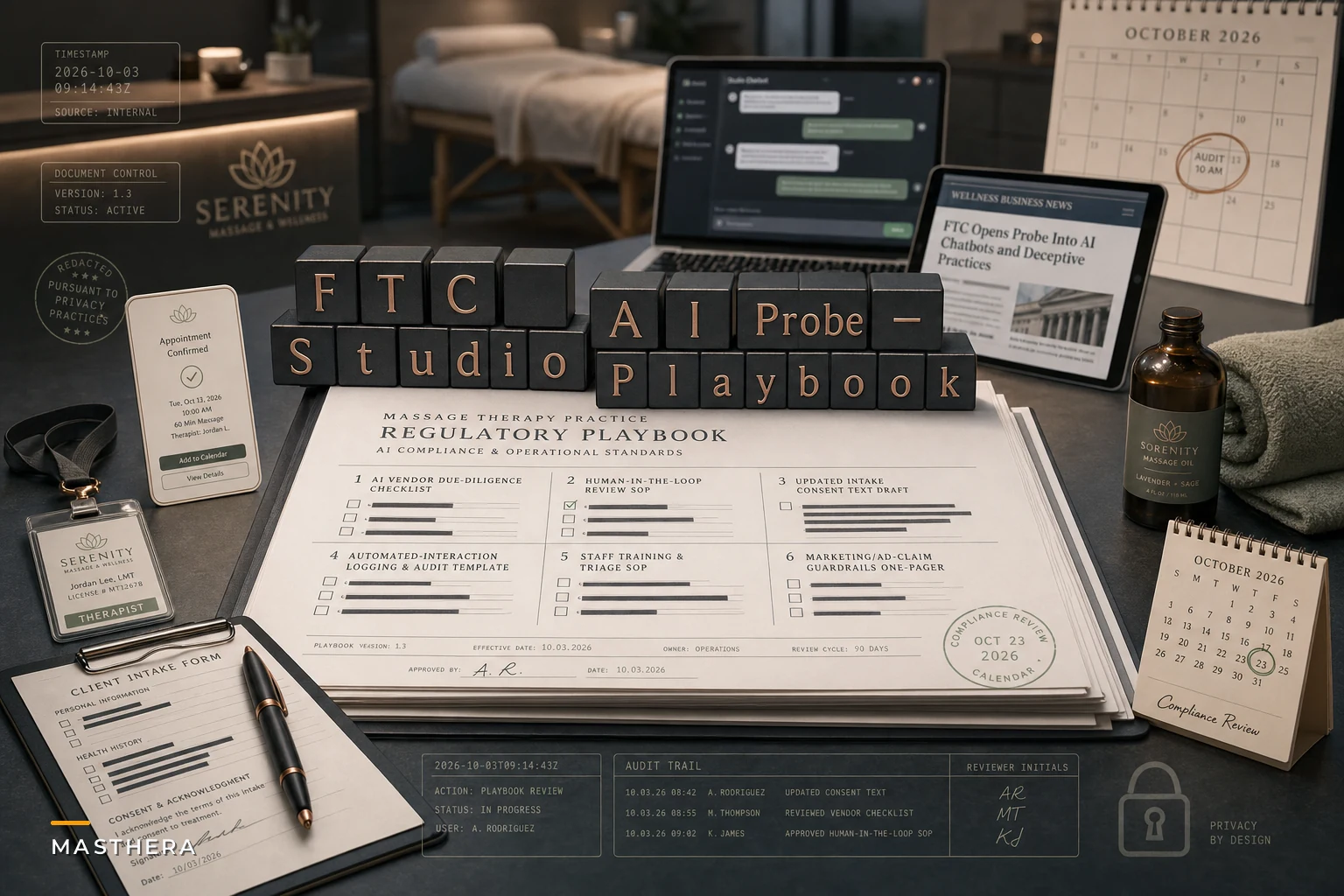

The Federal Trade Commission opened formal information requests into major AI developers at the end of September 2026, including OpenAI and Anthropic, over potential consumer-protection risks. Reuters reported that the probe focuses on how these systems interact with consumers, what claims get made, and how automated decisions might harm people who don't realize they're talking to a machine.
If you run a massage practice and your first reaction was "this doesn't affect me, I'm not building AI," slow down. The probe targets the big labs, yes. But the FTC's position — laid out plainly on its own AI guidance page — is that existing consumer-protection law already covers any business using these tools. That includes your booking chatbot, your automated reminder flows, and whatever AI you're using to write marketing copy or screen new clients.
The enforcement risk doesn't live at OpenAI. It lives with the businesses deploying these tools in front of real customers. A solo therapist running a Facebook Messenger bot that answers "is this covered by insurance?" is squarely in scope.
Why a probe into AI labs becomes your problem
Most studio owners miss this part. When the FTC signals it's scrutinizing AI consumer interactions, it's setting the tone for what "reasonable oversight" looks like across the board. The companies under investigation have legal teams. You have a front desk and a scheduling app.
That gap is exactly where small businesses get caught. Regulators rarely go after the solo practitioner first — but the standards being established right now become the baseline everyone gets measured against when a complaint lands.
And complaints do land. The most common ones for wellness practices aren't dramatic. They look like:
-
A chatbot tells a prospective client the studio "treats" a medical condition it isn't licensed to treat
-
An automated marketing email implies results the practice can't actually deliver
-
A booking bot collects health information without ever disclosing how it's stored or who sees it
-
A client later claims they never consented to the data handling an AI tool performed in the background
None of those require a bad actor. They happen because the tool was deployed quickly, nobody reviewed the outputs, and the consent language never got updated to reflect what the software actually does.
The underlying problem: you're liable for words you didn't write
When you adopt a chatbot or AI-driven messaging, you become responsible for statements a system generates on your behalf — statements you may never read. That's the real shift.
Never miss a booking or double-book again.
Masthera helps you schedule, confirm & manage every massage session with ease.
- Unified appointment management
- Automated client reminders
- Therapist calendar coordination
No credit card required
A New York Times analysis of the investigation framed the core regulatory concern as automated systems producing misleading or harmful outputs at scale. For a massage studio, "at scale" might just mean fifty conversations a week. The principle is the same either way: if your bot says it, you own it.
A typical example: a studio installs a chatbot with a generic health-and-wellness template. A prospective client asks, "Can massage fix my sciatica?" The bot, trying to be helpful, responds with something like "Yes, our deep tissue sessions are great for resolving sciatica." That single sentence is a medical claim the practice can't substantiate — and nobody on staff approved it, because nobody knew it was being said.
Multiply that across every unreviewed automated interaction and the exposure starts to add up. The problem isn't AI. The problem is AI operating without a review layer.
What "AI chatbots compliance massage studio" actually requires
Compliance here isn't a document you file once. It's an operational habit.
Break it into four moving parts: vendor oversight, consent, output review, and data handling.
1. Vet the vendor like you'd vet a therapist
You wouldn't hire someone to touch clients without checking credentials. Apply the same scrutiny to any tool that touches client conversations or data. Before you commit, get clear answers:
-
Where is client data stored, and for how long?
-
Is conversation data used to train the vendor's models?
-
Can you export and delete client records on request?
-
Does the tool let you set guardrails on what it can and can't say?
-
Who is liable if the tool makes a false claim — you, or them?
If a vendor can't answer the training-data question in writing, that's your answer. Walk.
2. Rewrite your intake consent to reflect automation
Most intake forms were written for a world where a human took the information. If an AI tool now collects, routes, or summarizes health intake, your consent language has to say so plainly.
At minimum, clients should know:
-
They may be interacting with an automated system, not a person
-
What health information is being collected and why
-
How that information is stored and who can access it
-
How to reach a human if they prefer
Don't bury this in legal boilerplate at the bottom. Say it where clients actually see it — at the start of the chat, on the intake screen, in the booking confirmation.
3. Build a human-review layer
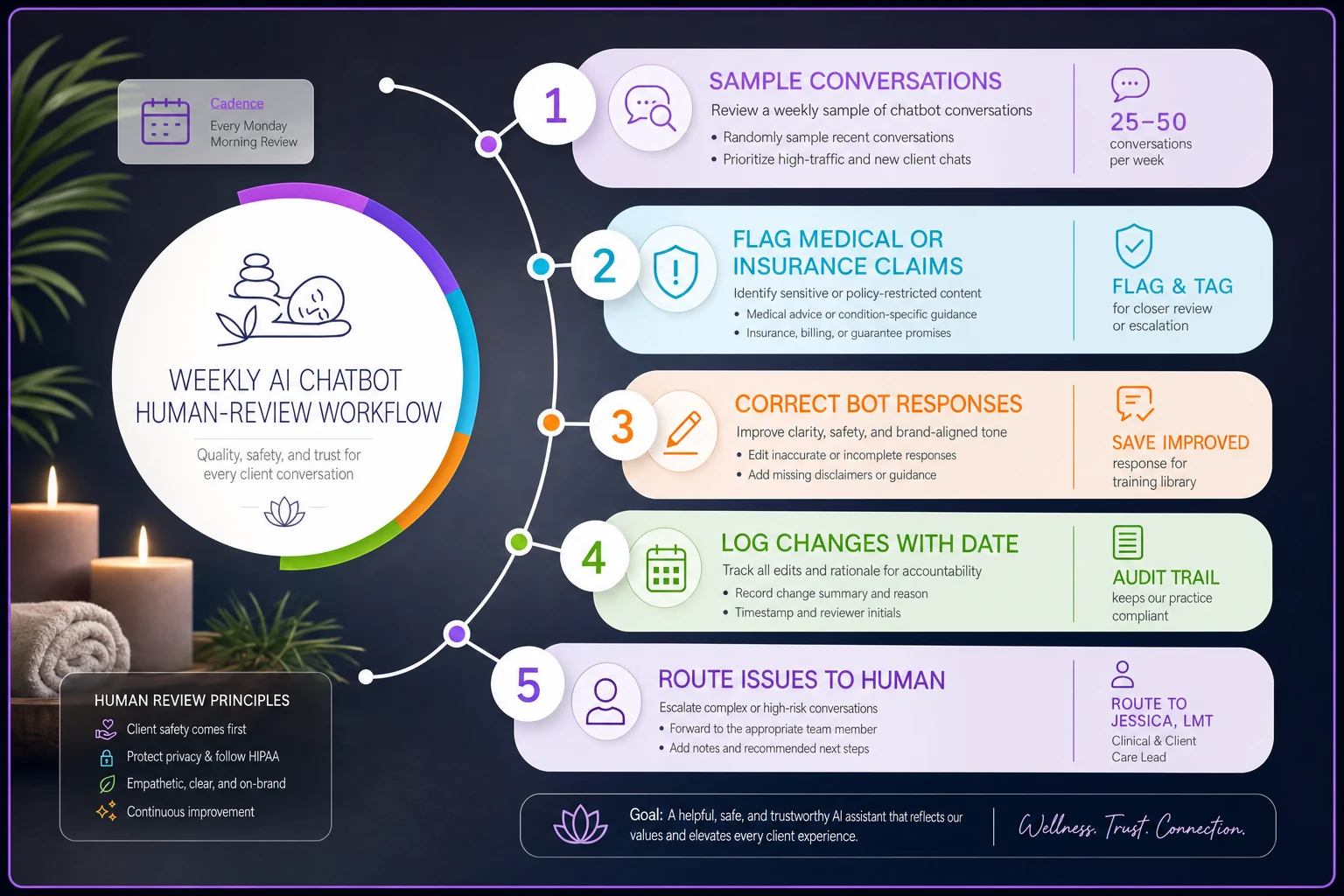
Automation without review is where the risk concentrates. You don't need to read every message, but you do need a sampling and escalation process.
A workable weekly routine:
-
Pull a sample of 15–20 chatbot conversations from the week
-
Flag anything that made a claim about treatment outcomes or insurance coverage
-
Correct the bot's instructions or canned responses for any flagged pattern
-
Log what you reviewed and what you changed, with the date
-
Route medical or complaint-related questions to a named human every time
That log matters more than it looks.
If a complaint ever surfaces, "we review outputs weekly and here's the record" is a completely different conversation than "we had no idea what it was saying."
Here's the weekly review workflow visualized.
If a complaint ever surfaces, "we review outputs weekly and here's the record" is a completely different conversation than "we had no idea what it was saying."
4. Lock down the data path
Every automated tool creates a new door into your client records. Reminder systems, booking bots, marketing platforms — each one holds or passes health-adjacent data. Map where that data lives and who can access it. This is the same discipline covered in the incident-response and privacy playbook for small studios, and the AI layer just adds urgency: more tools, more doors, more places a breach or unauthorized disclosure can start.
The data mapping exercise doesn't need to be elaborate. A simple spreadsheet listing each tool, what data it touches, and who has login access is enough to catch most gaps.
A quick comparison: where studios usually stand
Most practices fall into one of three postures. Find yours honestly.
| Posture | What it looks like | Risk level |
|---|---|---|
| Deployed and forgotten | Chatbot installed from a template, never reviewed, consent unchanged | High |
| Partially managed | Some canned responses edited, consent mentions "automated tools" vaguely | Medium |
| Actively governed | Vendor vetted in writing, consent explicit, weekly output review logged, data map maintained | Low |
The jump from the first row to the third isn't expensive. It's mostly a few hours of setup and a recurring 30-minute weekly habit. The studios that get burned are almost always sitting in row one, often without realizing it.
When AI client communication actually makes sense
Not every automation is worth the compliance overhead. A reminder bot that only sends appointment times and asks for a yes/no confirmation carries almost no claim risk — it's not making medical statements, and the data is minimal. That's a reasonable fit.
A chatbot fielding open-ended questions about conditions, outcomes, and insurance is a different animal. It generates exactly the kind of statements regulators care about. If you run one, it needs the full review layer. If you can't commit to that, use a simpler tool with fixed-response menus rather than free-form generation.
When it's a bad idea
Skip open-ended AI chat entirely if:
-
You're a solo practitioner with no bandwidth to review outputs
-
You handle a lot of insurer-directed or medically referred clients, where claim precision matters
-
You can't get straight answers from the vendor on data handling
In those cases, a well-built FAQ page and a structured booking form will serve you better and expose you to far less.
A real scenario
A two-therapist wellness studio added a Messenger chatbot to catch after-hours inquiries. It worked — bookings from evening messages climbed noticeably over a couple of months. Then a client complained that the bot had told her a prenatal massage was "completely safe at any stage," which isn't something the studio should be saying unprompted.
They pulled the logs. Out of roughly 180 conversations over six weeks, the bot had made unapproved health or safety claims in about a dozen of them. Not malicious — just a template doing its best to sound reassuring.
The fix took an afternoon. They replaced free-form medical answers with a fixed response that redirected anything clinical to a human: "That's a great question for one of our therapists — let me get you booked for a quick call." They updated the intake disclosure to state that clients might be chatting with an automated assistant. And they set a Friday review habit.
Six months on, the bot still drives after-hours bookings, but it no longer says anything nobody approved. Same bookings. Less exposure.
Where to start this week
If you only do three things before the regulatory temperature rises further:
-
Read your own bot. Spend 30 minutes asking it the questions clients actually ask — about conditions, pregnancy, insurance, pricing — and see what it says in your name.
-
Fix the consent language so it plainly names automation and data handling, placed where clients will actually see it.
-
Set one recurring review slot and keep a simple log of what you checked and changed.
The FTC probe into the big labs isn't a headline to scroll past.
It's an early signal of the standards every business using these tools will eventually be held to.
The practices that treat AI-assisted communication as something to govern — not just install — are the ones that get the upside without inheriting the liability.
The words your systems say to clients are your words now. Make sure you'd be comfortable standing behind every one of them.
Ready to elevate your massage therapy business?
Join hundreds of therapists using Masthera to save time, reduce scheduling conflicts, and enhance client satisfaction.