
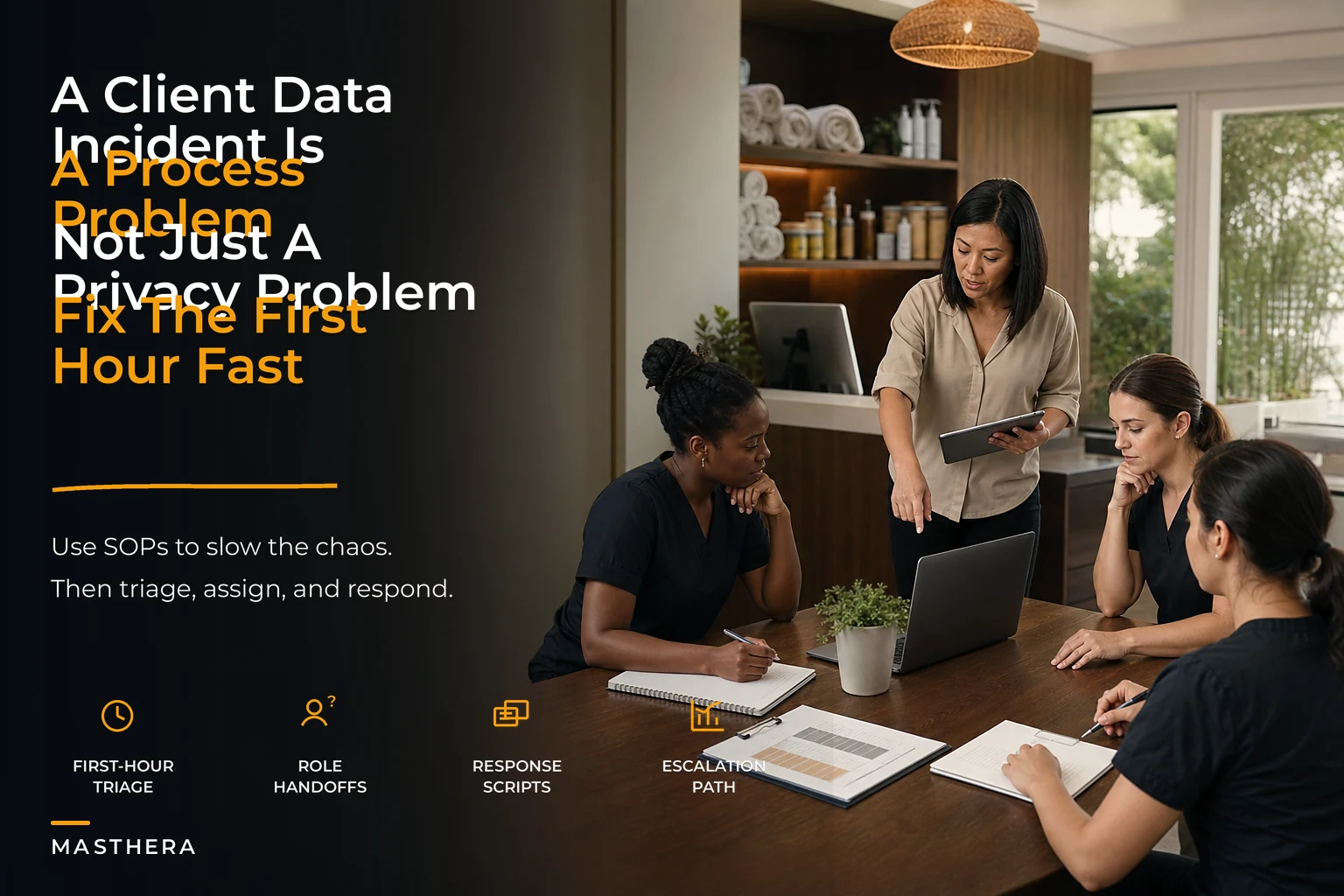

Most massage studios treat data privacy as a paperwork problem. You sign a form when you switch software, you tell clients their information is "secure," and then you move on. That works fine—until something actually goes wrong. An intake form left open on a shared iPad. A therapist forwarding SOAP notes to their personal Gmail. A bookkeeper's laptop stolen from a car with a spreadsheet of client names and conditions sitting right on the desktop.
Studios that have a plan spend a stressful afternoon. The ones that don't spend three weeks guessing what to tell clients and losing sleep over what they're legally required to do versus what they actually did.
This isn't a legal guide—talk to a lawyer for that part. What this covers is the operational side: the SOPs, the triage checklist, who does what, and the actual scripts you use to talk to clients when something goes wrong. In a small studio, the difference between a contained incident and a reputation-damaging mess usually comes down to whether anyone knew what to do in the first ten minutes.
Why massage studios are quietly high-risk
A massage practice sits on some of the most sensitive data a small business can hold. Names, contact info, payment details—fine, every business has that. But you also have health histories, injury records, medication lists, sometimes notes about trauma, pregnancy, chronic conditions, disabilities. That's health data. It's exactly the kind of information people expect to stay private.
And yet the average studio handles it with the informality of a coffee shop loyalty program.
-
Intake forms filled out on a front-desk tablet that never locks
-
Client files shared over text or email between therapists "just to coordinate"
-
A former contractor who still has login access six months after they left
-
Paper intake forms sitting in an open tray at reception
-
One shared password taped under the front desk
None of these feel like a breach when they happen. They feel like normal daily operations. That's exactly the problem. Risk grows silently as a practice grows—more staff, more devices, more logins, more places data can leak—without anyone consciously deciding to take on more exposure.
The four ways it actually breaks
If you want to build a system that holds up, you need to understand the real failure points. They fall into four buckets.
Never miss a booking or double-book again.
Masthera helps you schedule, confirm & manage every massage session with ease.
- Unified appointment management
- Automated client reminders
- Therapist calendar coordination
No credit card required
People. A therapist or front-desk staffer does something careless or well-intentioned but wrong. Forwarding a note. Talking about a client's condition where others can hear. Screenshotting a form to send to a colleague.
Devices. A phone, tablet, or laptop with client data on it gets lost, stolen, or accessed by someone in the household. Far more common than the movie-style hacker scenario.
Access. Old accounts that never got shut off. Shared logins nobody can trace. A cleaning service or landlord with keys to a room full of paper files.
Vendors. Your booking software, your payment processor, your email tool. When one of them has a breach, your client data is part of it—and you're the one who has to explain it to clients.
| Failure point | Typical trigger | What it exposes | How often it's the real cause |
|---|---|---|---|
| People | Convenience shortcuts, poor training | Health notes, contact info | Very common |
| Devices | Lost/stolen hardware, no encryption | Whatever's stored locally | Common |
| Access | Offboarding gaps, shared logins | Full client database | Underestimated |
| Vendors | Third-party breach | Everything you've uploaded | Rare but high-impact |
Most studio owners assume vendors are the big risk. In practice, the people and access buckets cause far more incidents—and they're the ones you actually control.
What breaks specifically as you scale
A solo therapist with 40 regular clients has a manageable risk surface. You know every file, every device is yours, and there's no one else touching the data. At that stage your biggest risk is honestly just your own phone.
The trouble starts when you add a second or third person and begin splitting responsibilities.
A typical example: a studio grows to four therapists and a part-time front-desk person. Booking, intake, and notes are spread across a practice-management tool, a couple of personal phones, and some leftover paper forms from before they went digital. Nobody's in charge of privacy specifically—it's just assumed everyone's being careful. Then a therapist leaves on bad terms, and the owner realizes that person still has full access to every client record, with no log of what they looked at or downloaded before they went.
That's the scale problem in a nutshell: coordination outruns control. More hands touch the data, but nobody owns the responsibility for protecting it. Workflows that felt fine at two people quietly become liabilities at five.
If you've already built solid documentation habits—like a proper SOAP-notes system for small wellness practices—you're ahead of most, because the same discipline that keeps clinical notes clean is what keeps them contained. But documentation and protection aren't the same thing. You can have beautiful notes and still leak them.
Building the incident-response system
The goal isn't to prevent every incident—you can't. The goal is to make sure that when something happens, the response is fast, consistent, and doesn't depend on whoever happens to be at the desk that day panicking correctly.
There are three layers to get right.
Layer 1: Policies people can actually follow
Skip the 20-page policy document. Nobody reads it and nobody follows it. What works in a small studio is a short set of concrete rules that fit on a page or two.
-
What counts as client data (spell it out
names + any health info = protected)
-
Where it's allowed to live (approved software only; no personal email, no texting notes, no screenshots)
-
Who can access what (front desk sees booking and contact info; therapists see their own clients' health notes)
-
Device rules (screen locks on, no client data on personal phones, log out at end of shift)
-
What to do if something goes wrong (the triage steps below)
The trick is tying each rule to a real behavior. "Don't share client data insecurely" means nothing. "Never text or email a client's health notes—use the shared record in the software" means something a person can actually do.
Layer 2: The breach triage checklist
This is the part most studios don't have and desperately need. When something happens, you don't want people improvising. You want a checklist taped somewhere findable and saved where staff can pull it up in seconds.
-
INCIDENT TRIAGE — FIRST HOUR [STEP 1] STOP THE BLEEDING → Open account / active session / logged-in device out of your control? → Change password or revoke login immediately → Remote-wipe the device if that's an option
-
[STEP 2] WRITE IT DOWN (do this before memories blur) → Time and date → What happened → What data was involved → Who is affected or might be
-
[STEP 3] CONTAIN — DON'T CLEAN UP → Don't delete anything to make it look neater → Preserve the full picture so you can understand scope
-
[STEP 4] ASSESS SCOPE → How many clients? → What kind of data — just names, or health details too? → One record or the whole database?
-
[STEP 5] NOTIFY THE RIGHT INTERNAL PERSON → One clear escalation path (usually the owner) → Not a group chat guessing session
-
[STEP 6] DECIDE ON CLIENT NOTIFICATION → Loop in legal or compliance contact here → Have the client list and the facts ready → Requirements vary by location and what leaked
-
[STEP 7] CLOSE THE GAP → Identify the actual cause — old account, unlocked device, bad habit → Fix it so it doesn't repeat
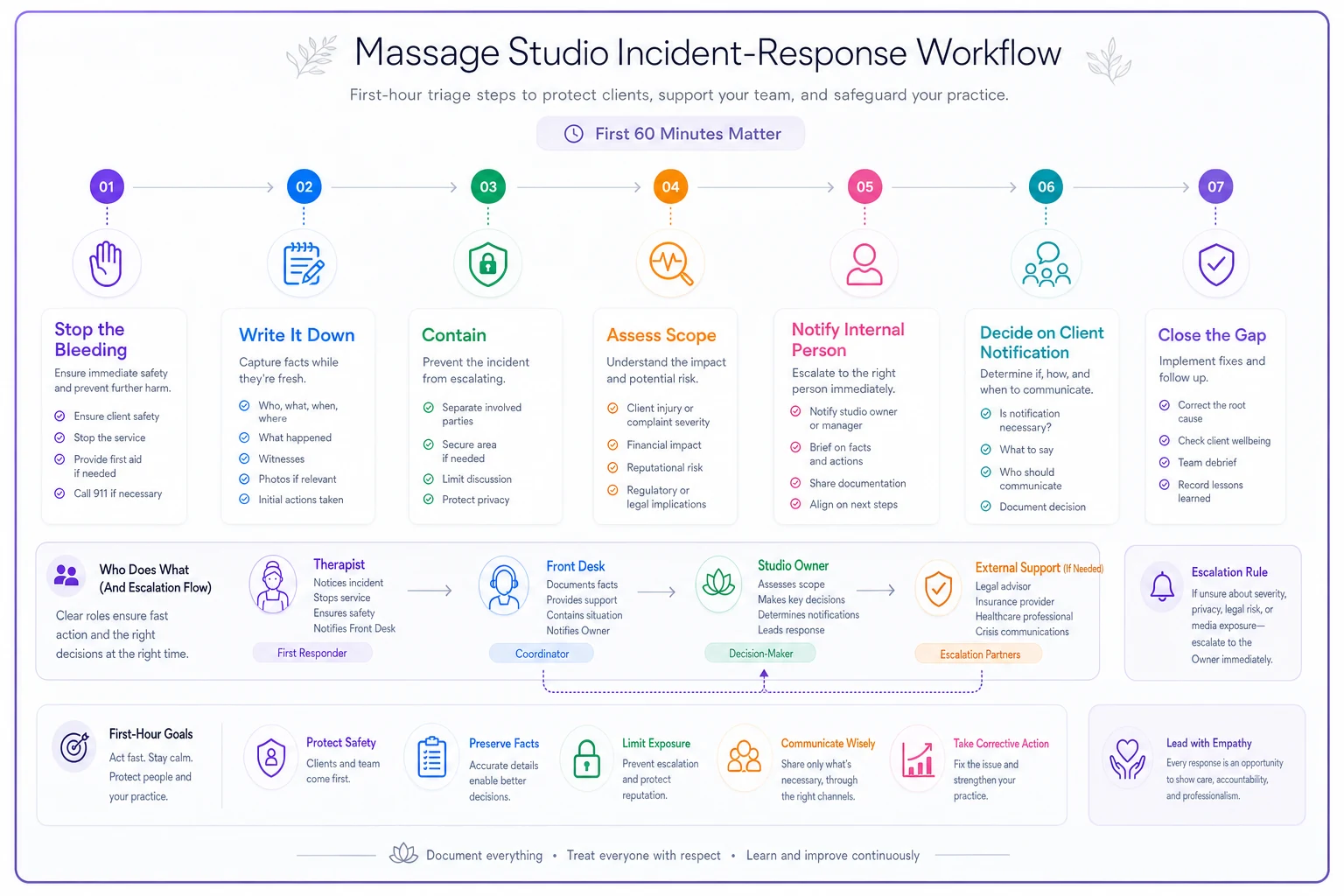
A quick workflow to follow in the first hour.
Keep a printed triage checklist taped at the front desk and a digital copy in staff files so it's reachable immediately.
The single biggest mistake studios make is skipping step two. When you can't clearly describe what happened, you either over-notify and alarm everyone, or under-notify and get caught later. A clear log keeps the response proportional and keeps you honest.
Layer 3: Role-based responsibilities
Everyone touching data should know their specific job in a privacy incident. Vague shared responsibility tends to mean no responsibility.
-
Owner / manager Owns the response. Makes the notification call (with legal input). Keeps the incident log. Handles vendor and client communication.
-
Front desk First to notice front-of-house issues—open devices, misplaced paper forms, wrong client info sent somewhere. Knows to escalate immediately, not quietly fix it and move on.
-
Therapists Responsible for their own client notes staying in approved systems. Report anything suspicious—no blame culture, because fear of blame is what makes people hide mistakes.
-
Bookkeeper / external help Handles the least data possible, and only what they need. If they must have access, it's logged and time-limited.
The pattern worth internalizing: the person who notices is almost never the person who decides. Your job is to make the path from noticing to the right person deciding as short and blame-free as possible.
The client-facing scripts
When you do need to tell a client something happened, how you say it determines whether they stay. Long, defensive, jargon-heavy messages read as guilt. Short, honest, specific ones read as competence.
> "We want to let you know about a data issue that may have involved your information. Here's what happened, here's what was affected, and here's what we've done about it. If you have questions, you can reach me directly at [contact]."
Fill in each blank plainly. If a therapist's phone was stolen and it contained appointment info but no health notes, say that. If health details may have been exposed, say that too—don't soften it into meaninglessness. Clients handle honesty far better than they handle discovering later that you downplayed it.
For internal staff communication during an incident, keep it equally tight: what happened, what we're doing, what I need from you, and a clear reminder not to discuss it externally until there's an agreed message. Mixed signals from staff can cause almost as much damage as the breach itself.
Where technology actually helps
You don't fix a privacy problem by buying software. You fix it with clear rules and consistent habits. But the right operational setup removes a lot of the human friction that causes incidents in the first place.
The practical wins come from centralizing where data lives and controlling who can reach it. When intake, notes, booking, and client history all sit in one managed system with proper per-user logins, several failure points shrink at once—there's no reason to text a note, no shared password floating around, and offboarding a staff member is one click instead of a scavenger hunt through six different tools.
Where AI-assisted operational platforms genuinely earn their place is in the boring, easy-to-forget stuff: flagging accounts that haven't logged in for months, prompting you to revoke access when someone's marked as departed, spotting when client data is being exported in unusual volume, and keeping an automatic access log so that when you hit step two of the triage checklist, half your answers are already recorded. That's the difference between reconstructing an incident from memory and pulling up exactly what happened.
The point isn't automation for its own sake. It's that a small studio doesn't have a dedicated IT or compliance person, so the system itself has to quietly handle the vigilance a larger operation would hire someone for.
When to build this out—and when not to bother
When it makes sense: The moment you have more than one person touching client data, or more than one device storing it, you need at least the triage checklist and role definitions. That's non-negotiable.
When you can keep it light: A true solo practitioner with one device and no staff can run a much simpler version—strong device security, one approved place for data, and a basic plan for a lost phone. You don't need role-based responsibilities when there's only one role.
Who tends to over-engineer this: Studios that write elaborate policies nobody reads and then feel protected. A 30-page binder in a drawer is worse than a one-page checklist on the wall, because it creates false confidence. Depth of documentation is not the same as readiness.
A real scenario
A three-therapist wellness studio with around 300 active clients had been coordinating client notes partly through personal text messages—"the client coming in at 4 has a shoulder thing, here's what I did last time." Convenient, and completely uncontrolled.
One therapist's phone got left at a café. It wasn't locked. Nobody could say for certain what was on it or who saw it. The owner spent close to two weeks anxiously deciding what to tell clients, with no log, no clear scope, and no way of knowing which text threads had contained health details.
-
all client communication moved into their practice-management system
-
personal devices were banned for anything containing client info
-
they wrote a one-page triage checklist and taped it inside the front desk
About four months later, a front-desk tablet was briefly left logged in and unattended in the lobby. The response took maybe fifteen minutes—log out, note what happened, confirm nothing was accessed, done. No spiral, no guessing.
Nothing about the second incident was more secure by luck. The difference was entirely the system.
The bigger picture
Privacy in a small studio isn't a document you file and forget—it's a set of habits distributed across everyone who touches client information. It connects directly to how you run intake, how you write and store notes, how you onboard and offboard staff, and how you handle sensitive situations in general. The same care that goes into your de-escalation and incident documentation practices is the care that keeps client data contained—both come down to knowing, in advance, exactly what to do when something difficult arrives.
Start with the triage checklist. That one page does more real protective work than any policy binder. Then tighten where your data lives and who can reach it. You won't prevent every incident, but you'll make sure the next one is a fifteen-minute problem instead of a three-week one—and for a business this size, that's the whole game.
Start with the triage checklist. That one page does more real protective work than any policy binder. Then tighten where your data lives and who can reach it. You won't prevent every incident, but you'll make sure the next one is a fifteen-minute problem instead of a three-week one—and for a business this size, that's the whole game.
Ready to elevate your massage therapy business?
Join hundreds of therapists using Masthera to save time, reduce scheduling conflicts, and enhance client satisfaction.