

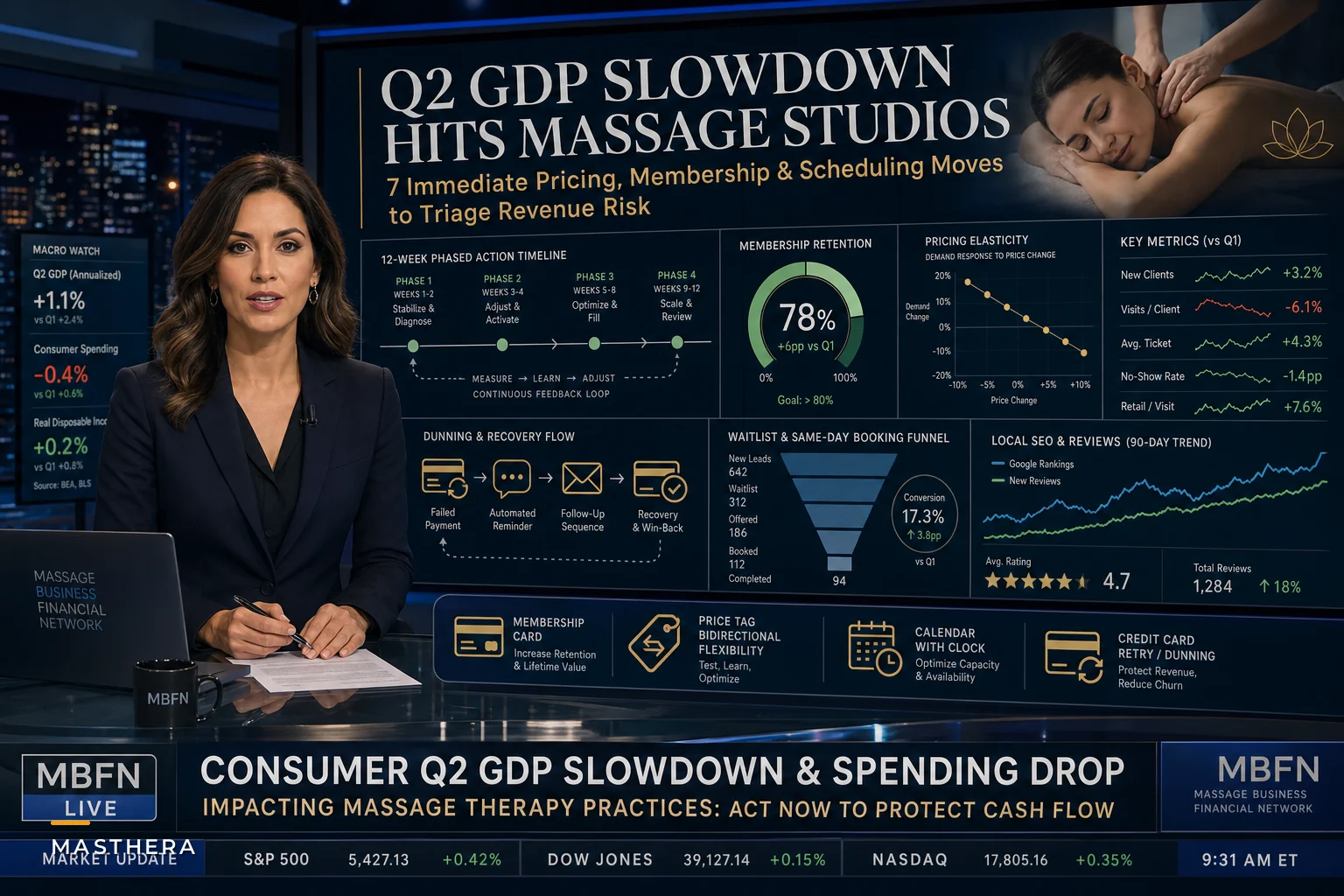

The Q2 GDP numbers just dropped, and they're telling a story every massage studio owner needs to hear. According to the BEA's advance estimate, the economy grew just 1.5% annualized—well below what economists expected. For massage therapists and wellness centers, this kind of slowdown hits differently than it does for other businesses.
Your clients book massages with discretionary income. When that income feels less secure, monthly membership charges start looking optional. The 90-minute deep tissue becomes a 60-minute Swedish. Weekly becomes biweekly. Then monthly. Then nothing.
What most studio owners miss is that actual booking cancellations lag the economic signals by about 8-12 weeks. Your books might still look full right now, memberships haven't churned yet, and you have a real window to make operational adjustments before things get ugly. That window closes faster than most people expect.
The membership paradox during economic uncertainty
Economic slowdowns create a strange dynamic for massage studio pricing. Clients get more price-sensitive and start auditing every recurring charge—but they're also looking for value and spending predictability. A well-structured membership actually speaks to both of those things at once.
Studios that survive downturns aren't the ones that slash prices or freeze up. They restructure their offerings to match the new reality. A $149/month unlimited membership might have worked when clients felt flush. Now you need options that feel accessible without wrecking your unit economics.
Think about creating what I'd call "recession bridges"—temporary membership tiers that let clients stay connected without the full financial commitment. A $49/month tier with one 30-minute session plus 20% off additional bookings keeps them in your ecosystem. That's a lot better than losing them to the $35 Groupon place down the street.
The math is worth running. If you normally charge $90 for a 60-minute session and your therapist takes 45% commission, you're netting roughly $49-50 per session after room costs and supplies. A $49 membership built around a 30-minute session might net you $28, plus whatever they book on top. Not exciting margins, but if it stops them from churning entirely, you're protecting lifetime value that would've otherwise walked out the door.
Move 1: Implement surge-protection pricing
Most studios price like it's 2019—flat rates, maybe a package discount, done. When consumer spending tightens, you need actual flexibility in your pricing structure.
Never miss a booking or double-book again.
Masthera helps you schedule, confirm & manage every massage session with ease.
- Unified appointment management
- Automated client reminders
- Therapist calendar coordination
No credit card required
Start with time-based tiers. Tuesday at 2pm shouldn't cost the same as Saturday at 10am. Your overhead is identical, but demand isn't. Price off-peak slots 15-25% lower than prime time. This isn't discounting—it's demand management, and there's a difference.
| Tier | Time Slots | Discount |
|---|---|---|
| Peak hours | Weekends, evenings | Full price |
| Standard hours | Weekday late morning / early afternoon | 10% off |
| Off-peak | Tuesday–Thursday, slow slots | 20% off |
Position it as "smart booking" rather than desperation pricing. Clients who can flex their schedule get rewarded. You fill dead slots. One studio went from 62% midweek utilization to 78% just by doing this—no advertising, no discounting on prime time, just better demand distribution.
Move 2: Create payment flexibility without destroying cashflow
When money gets tight, a $300 four-session package becomes a real barrier—even if it's technically the better deal. But opening up unlimited payment plans will wreck your cashflow.
Offer a two-payment option for packages over $200 with a small convenience fee, maybe $15. For larger packages, three payments with a $25 fee. You're not a bank, and that fee covers the administrative friction and cashflow cost honestly.
The critical piece: automate the payment collection. Manual follow-up on payment plans during a recession is a slow disaster. Require a card on file, set up auto-charges at booking, and make the terms completely clear upfront. Once you're chasing payments manually, you've already lost money—it just hasn't shown up in your books yet.
Move 3: Restructure your membership pause policies
Standard pause policies were built for normal times. "Pause up to 60 days per year" made sense for vacations or injuries. In a slowdown, people pause because they're evaluating expenses—and a completely dormant membership is one step away from a cancellation.
Try a "maintenance pause" instead of a free pause. Charge $15/month, include one 15-minute chair massage or a 20% discount on any service. They're still paying something, still connected to your studio, and far more likely to unpause when their situation improves.
The psychology matters more than the dollar amount. A fully paused membership feels like something they've already quit. A maintenance pause feels like they're still a member, just taking a breather. That distinction—even if it seems minor—affects whether they come back.
Move 4: Build a same-week booking bonus system
Advance bookings help with planning, but in uncertain times, clients hesitate to commit three weeks out. They're not sure about the money, the schedule, or their mood. So they don't book at all—they just keep meaning to.
Create structured incentives for booking within the next seven days. A free aromatherapy upgrade, an extra 10 minutes, a $10 product credit. The cost to you is minimal, but you're capturing revenue from clients who would otherwise drift indefinitely.
Also worth tracking: your average booking window. If clients used to book 12 days out and now it's down to 6, that tells you something useful. They're still interested but being cautious. Work with that behavior instead of ignoring it.
Move 5: Launch a treatment downgrade protection program
Clients who normally book 90-minute deep tissue will start eyeing 60-minute Swedish sessions when money gets tight. You're going to lose that revenue difference either way—the question is whether you lose it cleanly or strategically.
Offer a "session bank" for downgrades. Client usually books a $120 deep tissue but wants to switch to an $80 Swedish? Fine—the $40 difference goes into their account as credit, expiring in 60 days.
You're still taking a $40 revenue hit in the short term, but you're creating a future obligation that brings them back. And in practice, somewhere around 30% of banked credits expire unused. More importantly, you're preventing clients from mentally resetting their "normal" to the cheaper service level—which is the real long-term risk here.
Move 6: Activate your dormant client list strategically
Every studio has clients who used to come regularly but haven't booked in three to six months. During a slowdown, they're actually your best quick revenue opportunity—but most studios approach the win-back completely wrong.
Don't blast them with discount offers. Segment by their last service type and spending level, then build specific campaigns. High-value clients who used to book weekly? Try a "we've held your favorite Wednesday 4pm slot" message with a one-time welcome back offer. Occasional clients? Offer a simplicity package—three 30-minute sessions at a flat rate, no commitment needed.
The messaging matters more than the offer itself. "We miss you, here's 20% off" reads as desperate. "We've made some changes to make scheduling easier" reads as useful. Frame every outreach around solving a problem, not discounting your services.
Move 7: Implement defensive scheduling blocks
When demand softens, the instinct is to open up more availability. That's usually the wrong move. Instead, create some artificial scarcity while keeping flexibility in reserve. Block certain slots as "member-only" or "request-only" times.
This does two things: it makes your regular availability feel more valuable, and it gives you room to accommodate clients who need something specific. If someone really needs that Tuesday 3pm you've blocked, you can "open it specially" for them—which feels like personal service. If nobody needs it, you've lost nothing since demand was soft anyway.
A wide-open calendar doesn't create urgency. Limited availability does.
Automation becomes critical when margins shrink
During good times, operational inefficiency is annoying but survivable. When consumer spending drops and margins compress, those same inefficiencies become actual threats. A studio spending three hours a week manually sending appointment reminders simply can't compete with one that automated that process months ago.
This is where AI-powered operational software shifts from nice-to-have to genuinely necessary—not the "AI will transform everything" variety, but practical automation handling the repetitive tasks that eat time without generating revenue. Booking confirmations, payment processing, membership management, follow-up sequences. The stuff that keeps a studio running but doesn't directly grow it.
Automate reminders and payment collection first—those tend to have the highest immediate ROI and reduce churn risk.
Studios that come through slowdowns well are usually the ones that looked at their operations honestly beforehand—found where manual work created bottlenecks, where human error was costing money, where better coordination could reduce friction. They built systems that handle volume fluctuations without adding staff or degrading service quality. That's less about technology for its own sake and more about not letting avoidable inefficiency eat what little margin you have left during a tough stretch.
The three-month action window
Reuters reported that domestic demand remains relatively robust despite the GDP slowdown, which means there's time—but not much. Wellness spending typically lags GDP changes by roughly one quarter. That's about 12 weeks before the full impact starts showing up in your booking calendar.
Here's a practical sequencing for that window:
-
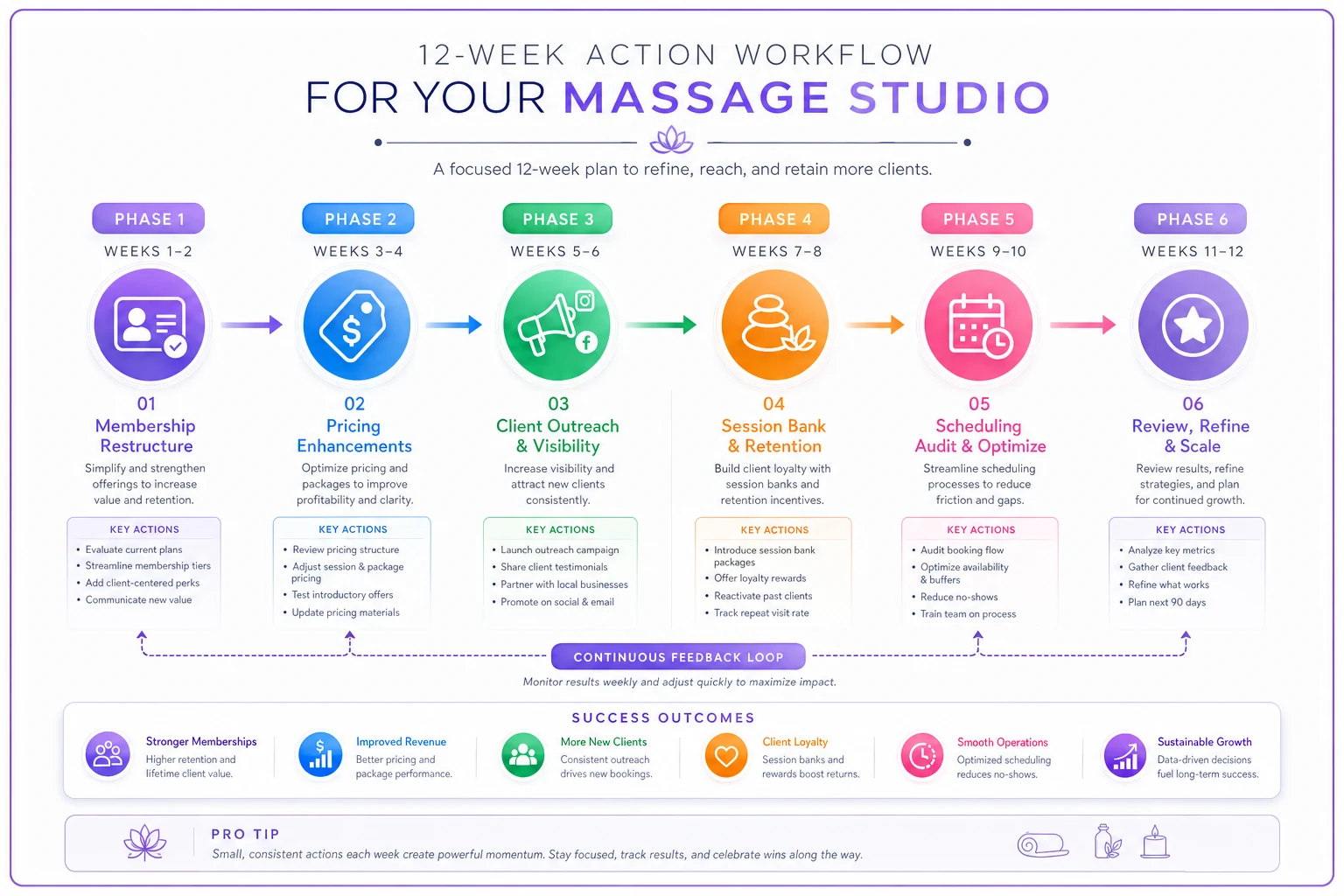
Weeks 1-2 — Restructure your membership tiers and pause policies before clients start asking to cancel
-
Weeks 3-4 — Implement time-based pricing and same-week booking incentives; update your booking system to reflect new tiers
-
Weeks 5-6 — Segment and contact your dormant client list with targeted campaigns, not blanket discounts
-
Weeks 7-8 — Introduce the session bank system and payment flexibility for packages
-
Weeks 9-10 — Audit your scheduling blocks and adjust availability strategy based on booking pattern data
-
Weeks 11-12 — Review what's working, double down on the moves that moved the needle, cut the ones that didn't
Here's a simple visual workflow to help you sequence these moves over 12 weeks.
Don't panic-slash prices or spend that window in analysis paralysis. Pick three of these moves that fit your studio's actual situation and implement them properly. A well-executed membership restructure beats seven half-hearted initiatives every time.
Studios that struggled in previous downturns waited until their books were empty to react. By then, clients had already formed new habits, found cheaper alternatives, or just adjusted to life without regular massages. The ones that came through it saw the signals early and changed their operations before the crisis arrived.
Your massage studio pricing and membership recession strategy starts now—not when the calendar starts looking empty. These seven moves aren't just about surviving a slowdown. They're about building operational resilience that serves you regardless of what the economy does. The GDP report is just a catalyst for improvements that were probably overdue anyway.
Track what works. Be ready to adjust. Your clients still need what you provide—they just need different pathways to access it when their financial confidence wavers. Give them those pathways before they stop looking for them.
Want to build more systematic stability into your studio operations? Check out our guide on how to design memberships that stabilize cashflow and boost retention for a detailed framework on creating recession-resistant membership structures that keep revenue flowing even when individual bookings slow.
Ready to elevate your massage therapy business?
Join hundreds of therapists using Masthera to save time, reduce scheduling conflicts, and enhance client satisfaction.