

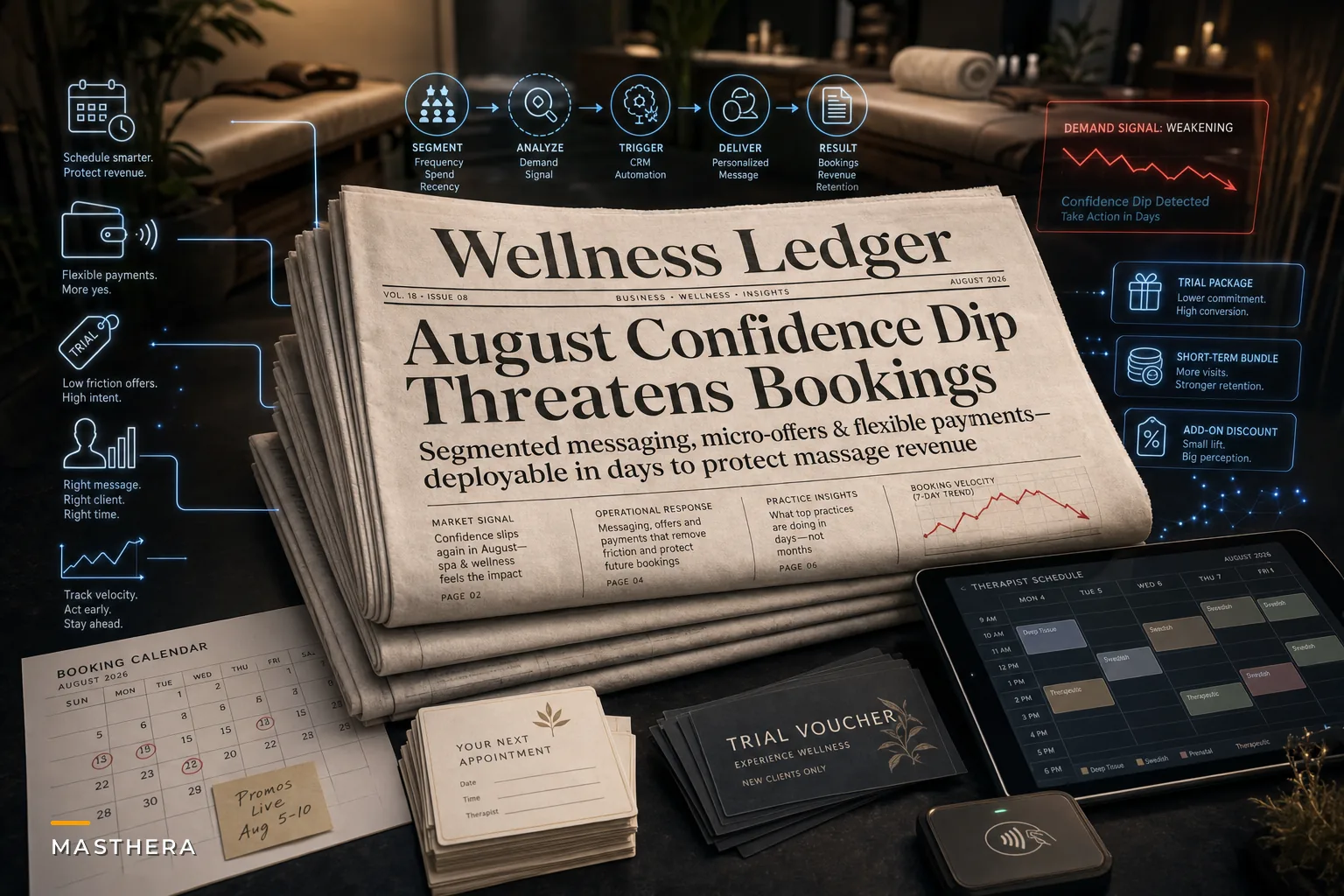

The Conference Board's August read came in soft: the headline index slipped to 89.4, but the more telling number was the Expectations sub-index, which dropped sharply as people got more nervous about income and jobs over the next six months. The Conference Board's own release framed it as pessimism about short-term prospects, and Reuters coverage of the report noted the same shift toward caution on spending.
That matters more for massage than it does for, say, a grocery store. Massage sits squarely in the "I'll book it next month" category when someone feels uncertain. Nobody cancels their electric bill. Plenty of people quietly skip their monthly deep tissue and tell themselves they'll come back when things settle down. That gap between "loyal client" and "loyal client who's stretching the interval from four weeks to seven weeks" is where studio revenue leaks — slowly, invisibly, usually before you notice it in the numbers.
This isn't about panic-discounting your whole menu. It's about a handful of targeted, low-cost moves that reduce the friction to rebook without teaching your clients that your prices are negotiable.
The thing that breaks first isn't bookings — it's interval
Most owners watch total bookings. That's the wrong early-warning metric right now.
When sentiment softens, your regulars don't disappear. They stretch. The client who came every three weeks starts coming every five. The couple who did monthly 90-minute sessions drops to 60 minutes, or one of them "sits this one out." None of that shows up as a cancellation. It shows up as a schedule that feels a little emptier than it should, three or four weeks later, with no obvious cause.
This usually happens quietly enough that owners blame it on "a slow month" and wait it out. By the time it shows in the revenue line, you've already lost momentum that's hard to rebuild.
So the first move is measuring the right thing:
-
Average days between visits for your top 40–50 clients
-
What percentage of last month's clients had rebooked before leaving
-
How many "lapsed but not gone" clients — last visit somewhere between 45 and 90 days ago — are sitting in your system
That third bucket is your cheapest revenue. These people already like you. They haven't churned, they've drifted. Winning them back costs a text message, not an ad budget.
Message the value, not the discount
The instinct during a downturn is to slash prices. That's usually a mistake.
Never miss a booking or double-book again.
Masthera helps you schedule, confirm & manage every massage session with ease.
- Unified appointment management
- Automated client reminders
- Therapist calendar coordination
No credit card required
A price cut trains your best clients — the ones who would've paid full price anyway — to expect the lower number permanently. You give up margin from people who were never leaving, in exchange for a small bump from people who might've come regardless. It's a bad trade and hard to unwind once regulars anchor to the discounted rate.
What works better is reframing the same price around outcomes people are more sensitive to when they're stressed. When someone feels financially anxious, they're often physically wound up too — tension headaches, bad sleep, tight shoulders from clenching over money stress. That's not a discount conversation. That's a "this is the thing that helps you function" conversation.
A quick comparison of what tends to land versus what backfires:
| Approach | What it signals | Typical result |
|---|---|---|
| "20% off all massages this month" | Our prices were inflated | Margin loss, regulars re-anchor low |
| "Stress-relief focus session, same price" | We understand what you need now | Full price, higher rebook |
| "Buy 3, get flexible scheduling" | Value + reduced commitment risk | Prepaid cashflow, locked interval |
| Silent price hold + better messaging | Stability, trust | Retained regulars, no margin hit |
The messaging shift costs nothing. You're not changing the service or the price — you're changing which benefit you lead with.
Micro-offers: small, specific, and time-boxed
Blanket discounts are blunt. Micro-offers are surgical, and they're the right tool when you want to protect margin while still lowering the barrier for hesitant clients.
The idea is to give a small concession tied to behavior you actually want — filling a slow slot, prepaying, shortening the interval — rather than a general price drop available to everyone.
A few that tend to work:
-
Off-peak micro-offer. A modest add-on (a 10-minute scalp or foot focus) included free for Tuesday–Thursday midday slots only. Fills your dead hours without touching prime-time pricing.
-
Rebook-before-you-leave incentive. Book your next session at checkout and get a small perk on that visit. This directly attacks the interval-stretching problem before it starts.
-
Prepay bundles with a soft edge. Three sessions prepaid, with the flexibility to reschedule freely and one transferable session. The flexibility is the selling point, not the price.
-
Lapsed-client nudge. A specific, warm message to that 45–90 day bucket — "It's been a while, we saved a Thursday for you" — with a small reason to come back this week.
The mistake owners make is running too many offers at once, so nothing feels special and clients start waiting for the next deal. Pick one or two, time-box them, and let them expire for real.
When micro-offers are a bad idea
If your calendar is already full, skip this entirely. You'd just be giving away margin on demand you already have. Micro-offers are for filling soft capacity and re-engaging drifting clients — not for busy studios or peak slots that book themselves.
Flexible payments reduce the "not right now" reflex
A lot of skipped bookings aren't really about total cost. They're about the timing of the hit. Someone mid-month, watching their bank balance, doesn't want a $110 charge this week even if they can technically afford it.
Flexible payment options quietly remove that objection. This can be as simple as:
-
Offering to split a package across two charges
-
Letting membership clients pause for a month instead of canceling outright
-
Accepting pay-later options for larger bundles
That pause option matters more than people realize. When a member feels squeezed, their two choices are usually "keep paying" or "cancel." Cancellation is permanent friction — they have to decide to come back, re-enter card details, re-commit. A one-month pause keeps them in the system and usually keeps them coming back. You trade one month of revenue to retain the relationship instead of losing it entirely.
The operational catch is real though: flexible payments only help if the tracking behind them is clean. Split charges, paused memberships, and pay-later balances create edge cases that get messy fast if you're managing them in your head or on a spreadsheet. If you can't clearly see who's paused, who owes a second installment, and who's due to resume, the goodwill gesture turns into lost money.
Track paused memberships and split-payment statuses in your booking system so pauses don't become lost revenue.
This is one of those areas where AI-powered operational software earns its keep — not by doing anything flashy, but by making sure nothing falls through the cracks when your payment arrangements get complicated.
Aim the offers — don't spray them
This is where most of it either works or falls apart: who gets which message.
Sending the same "come back" nudge to everyone is how you annoy your best clients and waste offers on people who'd never return regardless. The lapsed-but-loyal client needs a warm re-engagement. The price-sensitive newcomer needs a value reframe. The steady monthly regular needs nothing except maybe a rebook reminder — don't hand them a discount they never asked for.
This is why a rule-based approach to grouping clients pays off during a downturn. If you've set up even simple segments — by visit frequency, spend level, or days since last visit — you can route the right message to the right group without a big campaign or a lot of manual sorting. If you haven't built that yet, this walkthrough on client segmentation for small studios is the natural place to start, because it turns "who do I message?" from a guessing game into a set of rules that run themselves.
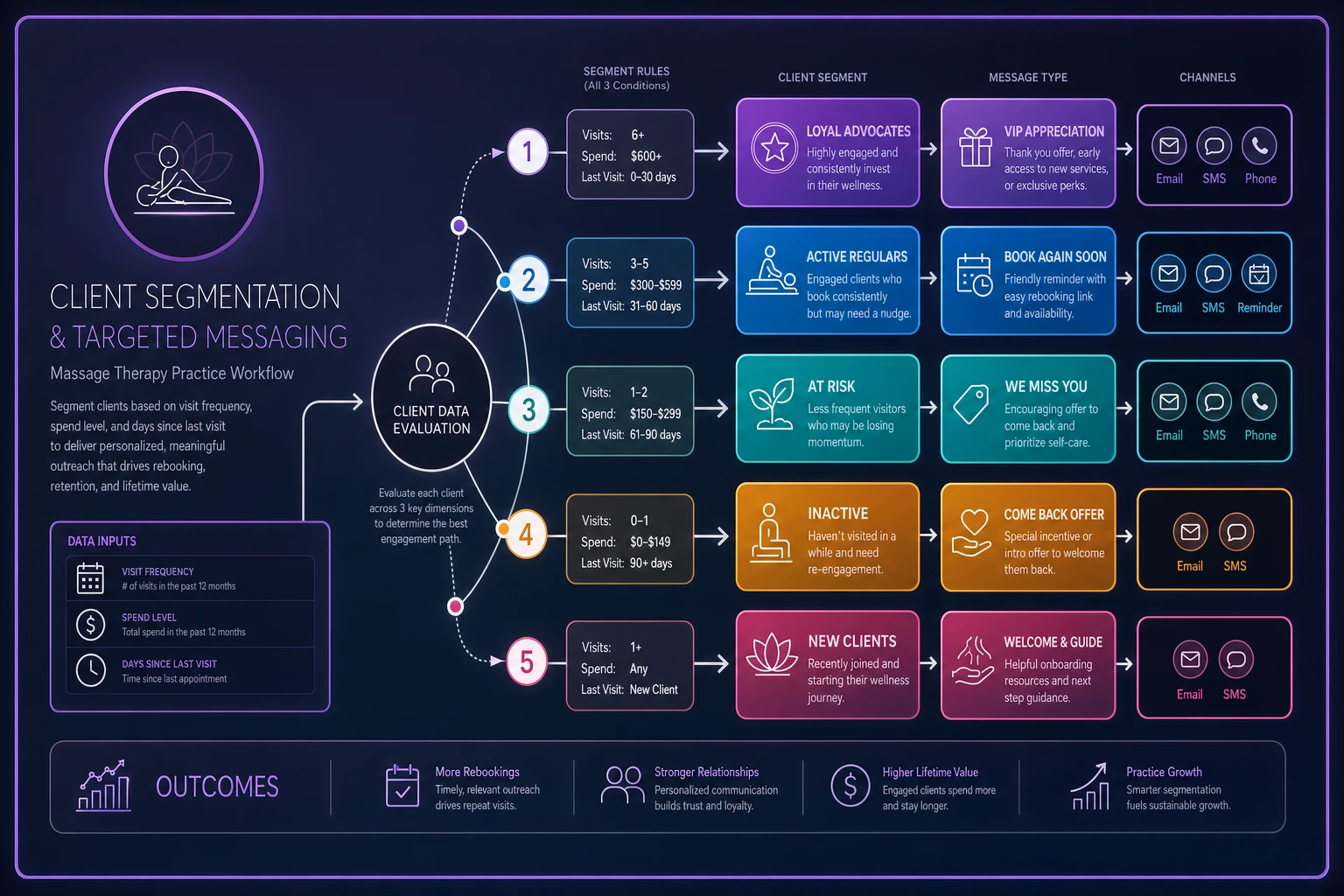
A simple workflow like this makes it easy to send different incentives to different groups without manual sorting.
The practical version: a client whose last visit was 60 days ago and who used to come monthly gets the warm win-back. A member who just failed a payment gets a pause offer, not a hard cancellation. A brand-new client gets a value-forward second-visit nudge. Same effort, much better targeting.
A quick real scenario
A two-therapist studio — roughly 320–340 monthly appointments in a normal month — noticed bookings dipping around 12% over a few weeks with no cancellation spike. Digging in, the owner found the average interval on their top clients had crept from about four weeks to closer to six.
Instead of discounting, they did three things: added a free 10-minute focus add-on to slow midday slots, sent a targeted win-back to their 45–90 day lapsed group (around 40 people), and offered a one-month pause to two members who'd asked to cancel.
Over the next six weeks, a dozen or so lapsed clients came back, both wavering members stayed via the pause, and the midday slots filled more consistently. Revenue didn't skyrocket — it stabilized, which was the actual goal. No margin was given away on peak hours, and the regulars paying full price never saw a discount at all.
What to actually do this week
If you only touch a few things, make it these:
-
Pull your top 40–50 clients and check their current visit interval against a few months ago
-
Identify your 45–90 day lapsed bucket and write one warm, specific win-back message
-
Pick one micro-offer aimed at a soft slot or a specific segment — not a blanket discount
-
Add a pause option for members before they hit the cancel button
-
Hold your prices and change what benefit your messaging leads with
None of this requires a big budget or a rebrand. Softening consumer sentiment doesn't kill a massage practice — drift does. The studios that come through a cautious stretch in decent shape are the ones that catch the interval stretching early, message value instead of cutting price, and make it just a little easier for a hesitant client to say yes this week instead of "maybe next month."
None of this requires a big budget or a rebrand. Softening consumer sentiment doesn't kill a massage practice — drift does. The studios that come through a cautious stretch in decent shape are the ones that catch the interval stretching early, message value instead of cutting price, and make it just a little easier for a hesitant client to say yes this week instead of "maybe next month."
Ready to elevate your massage therapy business?
Join hundreds of therapists using Masthera to save time, reduce scheduling conflicts, and enhance client satisfaction.