
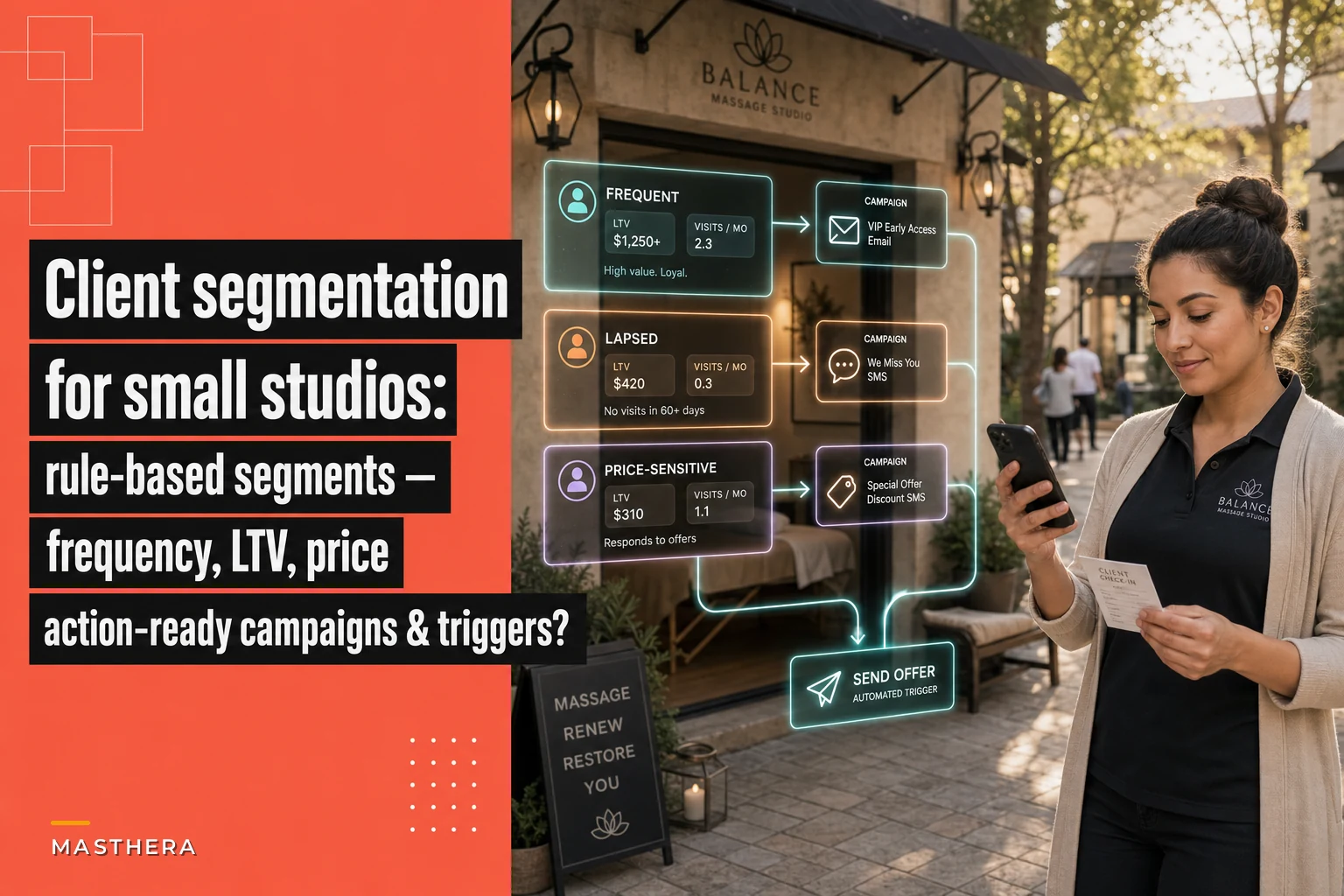

Most massage studios treat their entire client base the same way. Same emails, same reminders, same offers. Meanwhile, the chronic pain client who books weekly deep tissue is getting the same "try our relaxation package" email as someone who came in once on a birthday gift certificate six months ago.
The operational cost adds up fast. You're spending marketing budget on people who won't convert while ignoring clients who are actually ready to spend more. And you're slowly training your best clients to tune out your emails because nothing ever feels relevant to them.
Most software marketed to wellness businesses offers basic demographic splits—age, gender, ZIP code. These miss how clients actually behave. A 35-year-old woman in 98102 tells you nothing about whether she needs therapeutic work for tech neck, wants prenatal sessions, or only comes in for couples massages twice a year.
Why basic segmentation fails in wellness businesses
Massage client segmentation breaks differently than retail or restaurant segmentation. The personal nature of bodywork creates patterns that generic marketing frameworks just miss.
A clothing store can segment by purchase amount and call it a day. In massage therapy, a client spending $120 monthly on a single session might be more valuable long-term than someone who drops $300 quarterly on packages they barely use. Booking patterns, rebooking behavior, service preferences, price sensitivity, package usage—these create complexity that simple spend-based grouping can't capture.
What drives studio revenue is behavioral data: booking frequency, cancellation patterns, service preferences, price sensitivity, package usage. Most studios have this data scattered across booking software, payment systems, and paper intake forms but never connect it into anything actionable.
The five segments that actually matter operationally
Five behavioral segments consistently drive the bulk of revenue decisions across different studio types. These aren't demographic buckets—they're operational groups built on actual booking and spending behavior.
Never miss a booking or double-book again.
Masthera helps you schedule, confirm & manage every massage session with ease.
- Unified appointment management
- Automated client reminders
- Therapist calendar coordination
No credit card required
Regulars (25-30% of active base) Book at least twice monthly, rarely cancel, often on consistent schedules. These clients have made massage part of their routine. They know their therapist preferences, book the same service types, and represent predictable revenue. The challenge isn't selling to them—it's protecting their booking slots and preventing churn from scheduling conflicts or therapist changes.
Occasionals (35-40% of active base) Book every 2-3 months, usually around specific triggers—stress spikes, pain flare-ups, seasonal changes. They value massage but haven't made it routine. Their lifetime value depends almost entirely on how well you time your reminders. Miss their booking window and they disappear for another six months.
Package holders (15-20% of active base) Bought a package or membership, but usage varies wildly. Some burn through five-session packages in six weeks, others let them expire after using two. This segment needs the most operational attention because they've already paid—your margin depends on managing their usage patterns and renewal likelihood.
Gift receivers (10-15% of active base) Came in through gift certificates, often first-timers. Conversion to paying clients usually sits somewhere around 20-25% without targeted follow-up. With the right sequence, you can push that closer to 40%. Timing matters more than anything here—too early feels pushy, too late and they've forgotten the experience.
Churned but reachable (20-25% of database) Haven't booked in 4-6 months but haven't unsubscribed. They didn't have a bad experience—life got in the way. These have the highest reactivation ROI because they already know your studio and have payment info on file.
Each segment needs completely different messaging, timing, and offers. Sending your "we miss you" email to weekly regulars or pushing membership upgrades to gift certificate recipients wastes money and erodes trust.
Building rule-based triggers without enterprise tools
You don't need a $500/month marketing platform to make behavioral segmentation work. Most booking software can export basic data that feeds simple automation rules. The trick is knowing which rules actually move revenue versus which ones just create complexity.
Frequency rules:
-
If last booking was 30+ days ago AND previous pattern was monthly → trigger "maintenance reminder"
-
If 3+ bookings in the last 60 days → flag as "regular" for schedule protection
-
If no booking in 90-120 days → trigger reactivation sequence
Spend pattern rules:
-
If average booking value drops 20% → trigger service upgrade education
-
If client only books during discount periods → flag as price-sensitive for testing
-
If package usage is under 50% with 30 days until expiry → trigger usage reminder
Service preference rules:
-
If only books one service type → exclude from promotions for other services
-
If books therapeutic only → prioritize pain management content
-
If varies services → test combination packages
Timing rules:
-
If books the same day and time consistently → priority waitlist for that slot
-
If always books 2+ weeks out → early bird offer eligible
-
If mostly books last-minute → same-day availability alerts
Implementation doesn't require complex tech. Export your booking data monthly, run it through these rules in a spreadsheet, and load the segments into whatever email tool you use. Even manual segmentation beats no segmentation.
Campaign frameworks for each segment
Generic "book now" campaigns waste money. Each segment needs messaging that addresses their actual situation and the real barriers between them and their next booking.
Regular client campaigns
These clients don't need convincing—they need convenience and consistency. Focus on:
Schedule protection alerts: "Your usual Thursday 2pm slot has an opening next month" Therapist availability updates: "Sarah added evening appointments starting November" Service expansion education: "Adding cupping to your deep tissue routine"
Don't discount this segment. They're already committed. Test convenience add-ons instead—priority booking, extended sessions, package upgrades that save time rather than money.
Occasional client triggers
Occasionals book when something reminds them they need a massage. Your job is to be that reminder at the right moment.
Seasonal triggers: "Autumn marathon training starting? Book your recovery sessions now" Pain point content: "Three stretches for desk workers (plus when massage actually helps more)" Behavioral nudges: "It's been 67 days since your last session—your shoulders probably notice"
Test different timing windows. Some occasionals respond at 45 days, others need 75 before they're ready to act. Track which timing converts your specific client base.
Package holder optimization
Package holders already paid you. Every unused session is margin sitting idle—but letting packages expire silently creates refund requests and bad reviews.
| Package Status | Days Until Expiry | Campaign Type | Message Focus |
|---|---|---|---|
| High usage (70%+) | Any | Renewal prep | "2 sessions left—renew to lock rate" |
| Medium usage (40-70%) | 60+ | Steady pace | "On track to use package—book ahead" |
| Low usage (<40%) | 45-60 | Urgency build | "4 sessions to use by [date]" |
| Low usage (<40%) | <30 | Recovery mode | "Book double sessions this week" |
Proactive communication here prevents disputes even when clients don't end up using everything.
Gift certificate conversion
Gift recipients didn't choose you—someone else did. The conversion sequence should educate, not sell.
Week 1 after redemption: "What to expect at your next massage" (education) Week 2: "The difference between relaxation and therapeutic" (preference discovery) Week 3: "Your therapist recommended..." (personalized follow-up) Week 4: "Gift yourself the same experience—exclusive rate inside"
Keep offers time-limited but not aggressive. "Gift recipient special: 20% off your next booking in the next 10 days" outperforms both generic discounts and no discount at all.
Reactivation sequences
Churned clients need different messages depending on their previous behavior. A lapsed regular needs different framing than someone who came twice last year.
Lapsed regulars (previously monthly+): "We saved your preferred appointment slot—ready to restart?" Focus on continuity and making the return easy. Lapsed occasionals (previously quarterly): "Spring stress building? Your last massage was in November..." Focus on seasonal relevance and specific triggers. Lapsed package holders: "You had 2 sessions left on your expired package—here's a credit toward your next booking" Focus on value recovery.
Don't send more than three reactivation attempts in a 60-day window. After that, move them to quarterly win-back campaigns with deeper discounts or different service offerings.
Measuring segment performance
Most studios track overall revenue and stop there. Segment-level metrics reveal which groups actually drive profitability and which ones drain resources.
Revenue metrics:
-
Average booking value by segment
-
Total segment revenue contribution
-
Package and membership penetration rates
Behavioral metrics:
-
Rebooking rate within 30 days
-
No-show and late cancel rates
-
Average days between bookings
Campaign metrics:
-
Open rate by segment and campaign type
-
Booking rate from campaigns
-
Unsubscribe rate by segment
Patterns show up fast. Maybe regulars have high lifetime value but also the highest cancellation rate around the holidays. Or gift recipients convert better from SMS than email. These insights let you adjust operations—requiring deposits from certain segments, shifting communication channels, adjusting offer types.
Common segmentation mistakes that kill margins
Studios that implement segmentation often make a few mistakes that wipe out the efficiency gains.
Over-segmentation without the operational capacity Creating 15 micro-segments sounds thorough but becomes unmanageable quickly. If you can't build unique campaigns for each segment monthly, you've over-segmented. Start with five core groups and only add complexity after you've maxed out performance on the basics.
Discounting the wrong segments Offering deeper discounts to price-sensitive clients while keeping regulars at full price seems logical but trains your entire base to wait for sales. Non-monetary incentives for loyal segments—priority booking, longer sessions—tend to perform better than price cuts. Reserve discounts for acquisition and reactivation.
Static segments with no graduation rules Clients change. That occasional booker might become a regular after starting marathon training. Without rules to move clients between segments based on behavior changes, your targeting degrades over time. Review segment assignments quarterly and adjust rules based on what you're actually seeing.
Automation setup using basic tools
You don't need enterprise software to automate segment campaigns. Here's a practical setup using tools most studios already have.
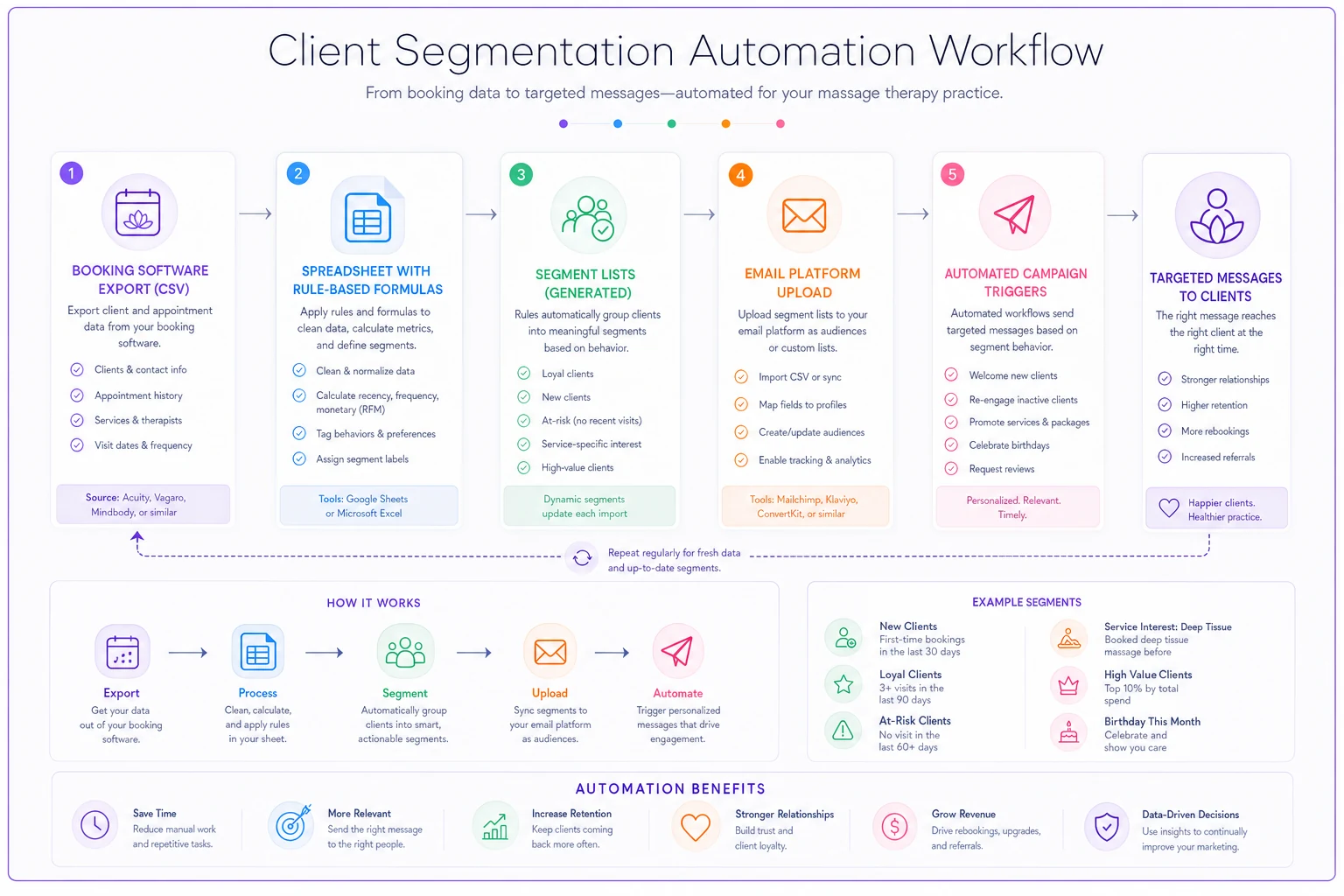
Data foundation: Export booking data from your scheduling software monthly. Include: client name, email, phone, last booking date, total bookings, services booked, total spend, package status. Takes about 10 minutes.
Segmentation process: Import into Google Sheets or Excel. Create formulas for each segment:
-
Regulars
=IF(AND(BookingsLast60Days>=2, TotalBookings>=6), "Regular", "")
-
Churned
=IF(DaysSinceLastBooking>90, "Churned", "")
Campaign execution: Upload segments to Mailchimp, Constant Contact, or whatever email service you're already using. Create automated campaigns triggered by segment membership.
Here's a simple flow showing how data moves from bookings to segments to campaign triggers.
Performance tracking: Add UTM tags to campaign links to track which segments and campaigns drive bookings. Your booking software should show source attribution, letting you calculate ROI by segment.
Add UTM tags to campaign links to track which segments and campaigns drive bookings.
Once the process is established, it takes maybe 3 hours monthly. Compare that to the revenue impact of targeted campaigns versus blasting everyone the same email.
For studios ready to move beyond manual processes, operational platforms can automate the entire flow—data sync, segment calculation, campaign triggers—updating in real time based on actual behavior rather than monthly exports. Membership-based models particularly benefit from automated segmentation since member behavior patterns directly affect profitability.
When segmentation makes sense (and when it's overkill)
Not every studio needs complex segmentation. The overhead might outweigh the benefits depending on your client base size and business model.
-
You have 200+ active clients (booked in the last 6 months)
-
Your services vary significantly in price or type
-
You run both membership and walk-in models
-
Booking patterns show clear behavioral clusters
-
You have capacity to create 3-5 unique campaigns monthly
Skip it if you have under 100 active clients—just know them personally. Same goes if you only offer 1-2 service types, clients all book roughly the same frequency, you don't have time for monthly campaign creation, or your booking software can't export client data.
Studios under 150 clients often get better ROI from personal outreach than automated segments. Pick up the phone, send a personal text, remember what someone mentioned last time. Technology helps scale personal touch—it doesn't replace it.
Implementation roadmap for immediate impact
A practical 30-day plan to implement basic segmentation without overwhelming your operations.
Week 1: Data audit and export Pull your client data for the last 12 months. Clean obvious errors—duplicate emails, test bookings, staff appointments. Calculate basic metrics: average days between bookings, lifetime value, service preferences. This baseline shows you exactly where you're starting.
Week 2: Define 3 core segments Start simple. Pick three segments with clear behavioral differences—your regulars (monthly+ bookers), your occasionals (quarterly bookers), and your inactive clients (no booking in 90+ days). Create rules for each and assign all clients. Don't overthink it—you'll refine based on results.
Week 3: Create one campaign per segment Write three campaigns that speak to each segment's actual situation. Regulars get convenience or loyalty focus. Occasionals get reminder or trigger-based messaging. Inactive clients get reactivation with an incentive. Keep messages short, test subject lines, and include clear calls-to-action.
Week 4: Launch and measure Send mid-week—Tuesday through Thursday tends to perform best for wellness businesses. Track opens, clicks, and most importantly, actual bookings. Calculate revenue per segment to establish your ROI baseline.
After 30 days, you'll have real data showing which segments respond to which messages. Refine rules, adjust campaigns, and add complexity gradually as results come in.
The compound effect of behavioral targeting
Segmentation isn't about perfection—it's about progression. Even basic behavioral segments outperform blast campaigns by 2-3x in booking conversion. But the real value builds over time.
As you refine segment rules based on actual performance, targeting improves. Response rates go up. Client lifetime values extend. Acquisition costs drop because you're reaching the right people with relevant messages at the right moment.
A studio running basic frequency-based segmentation can typically see a meaningful revenue lift within 90 days—not from working harder, but from sending fewer, better-targeted campaigns that actually respect how different clients use your services.
The wellness industry's relationship-based nature makes this particularly powerful. Unlike retail where transactions are mostly one-off, massage therapy builds ongoing therapeutic relationships. Segmentation lets you nurture those relationships at scale while keeping the personal feel clients expect.
When you get it right, regulars stay longer because they feel like priorities. Occasionals book more frequently because reminders land at the right time. Package holders use their sessions because you're paying attention to their usage. Gift recipients convert because your follow-up educates rather than pressures.
The operational overhead of monthly segmentation pays for itself in efficiency alone. You stop wasting time and budget on campaigns that don't convert. Staff can focus on serving clients rather than managing booking chaos and same-day scheduling scrambles. Marketing spend generates measurable ROI because you know which segments and campaigns actually drive revenue.
The tools and rules outlined here work at any studio size. Start with basic exports and spreadsheet rules. As you grow, operational platforms can automate the process—updating segments in real time, calculating optimal send times, triggering campaigns automatically. But automation is the means, not the goal. Understanding your clients is the goal. Technology just helps you act on that understanding at scale, turning behavioral data into something that actually improves how your studio runs.
Ready to elevate your massage therapy business?
Join hundreds of therapists using Masthera to save time, reduce scheduling conflicts, and enhance client satisfaction.