

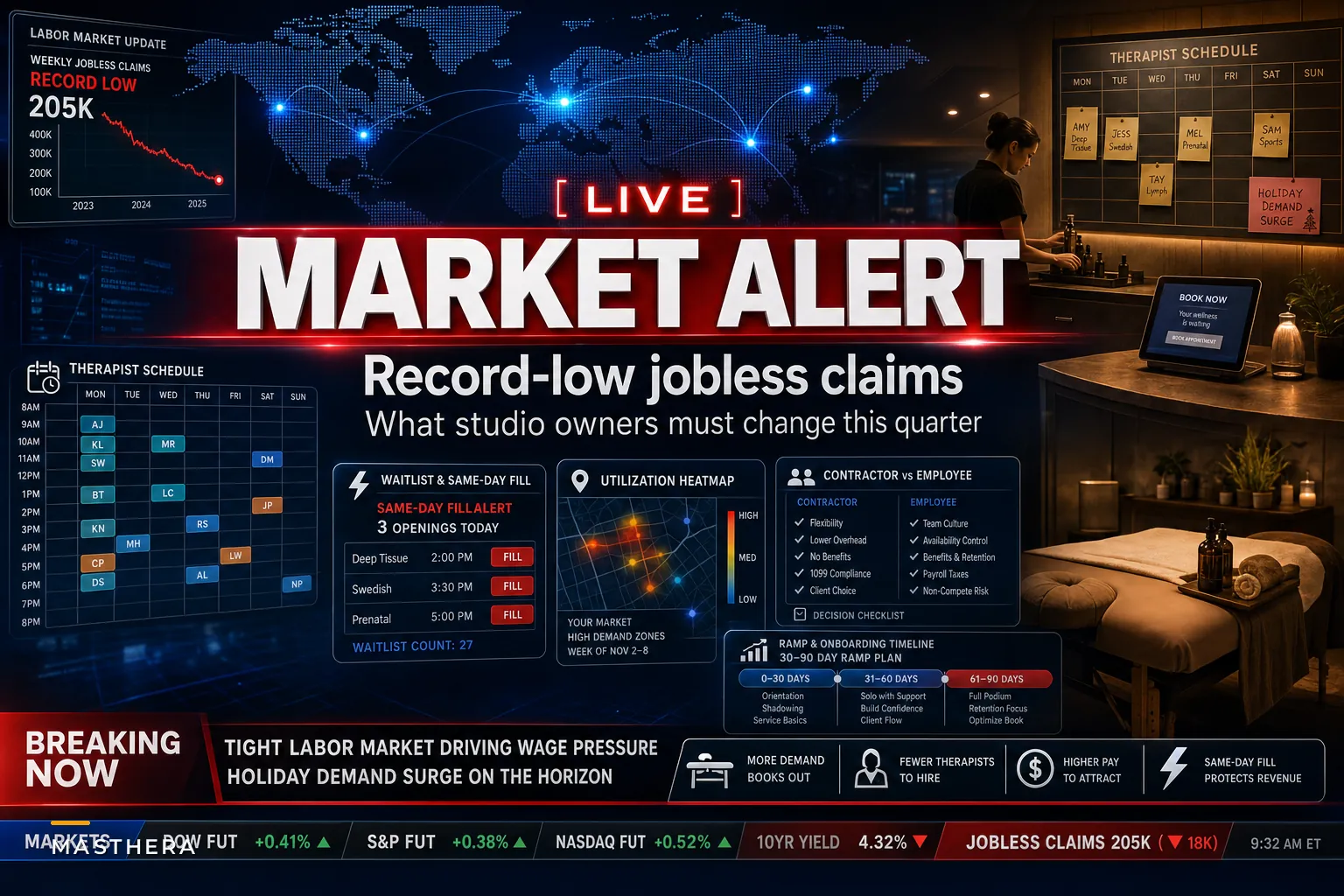

Initial jobless claims dropped to around 194,000 for the week ending October 24, 2026—close to the lowest readings since the late 1960s. CNBC covered the drop as part of what analysts are calling a "low-fire" labor pattern: employers aren't letting people go, which also means very few good candidates are out there looking for work.
For a massage studio, the headline number doesn't mean much on its own. What matters is the second-order effect. When nobody's getting laid off, nobody's job-hunting—and the licensed therapist you want to hire in November already has a full book somewhere else. You're not really competing against other spas. You're competing against the fact that your target hire has zero reason to move.
That changes the math on everything—what you pay, how you roster, and how much revenue quietly leaks every week through a schedule that can't flex.
The real problem a tight labor market exposes in studios
Most single-location studios run with almost no slack in their staffing model. Three or four therapists, each carrying a near-full book, and the whole thing holds together right up until someone leaves or gets sick. No bench. No backup.
In a normal labor market, that's a manageable risk—you can replace a therapist in a few weeks. In a tight market, that timeline stretches to two or three months, sometimes longer for specialized modalities like prenatal, lymphatic, or sports work. And the whole time that chair sits empty, you're not just missing one person's wages. You're losing their entire revenue contribution.
Owners tend to underestimate how fast that hole gets expensive. A therapist running 25 billable sessions a week at an average ticket of $95 is generating roughly $2,300–$2,400 in weekly revenue. Lose them for ten weeks while you recruit, and that's north of $23k gone—against maybe $9k–$10k in wages you saved. The empty chair costs more than double what the person did.
The tight market didn't create this fragility. It just made the recovery slower and the hole deeper.
Rework your pay bands before you post the next job
If you haven't touched your pay structure in 18 months, your offer is probably below market and you don't know it yet. Therapists talk. They know what the studio two neighborhoods over is paying per session, and a tight market means they have real options to act on that information.
Never miss a booking or double-book again.
Masthera helps you schedule, confirm & manage every massage session with ease.
- Unified appointment management
- Automated client reminders
- Therapist calendar coordination
No credit card required
The mistake isn't just underpaying—it's paying in a way that's invisible to the therapist. A flat hourly rate or a vague "commission split" tells a candidate nothing about what they'll actually take home on a good week. The studios winning hires right now can show a therapist a concrete weekly number tied to a realistic book.
-
Move to tiered per-session pay so therapists see their earnings climb as they fill their book, rather than hitting a ceiling that kills motivation.
-
Add premium-hour pay for the slots you struggle to staff—early mornings, Sunday evenings, the week between Christmas and New Year.
-
Build a retention bump at 6 and 12 months, which is cheaper than recruiting cold in a market like this.
-
Separate base from performance clearly, so a therapist can model their own paycheck without doing mental gymnastics.
This is also a governance issue. You need a documented structure that applies evenly across the team, or you end up with the quiet resentment that comes from two therapists finding out they're paid differently for the same work. We've written more on building that out in people operations and pay governance for small studios—and the tight-market pressure makes getting it right more urgent, not less.
Show candidates a sample weekly pay projection during interviews so they can see realistic take-home earnings rather than just a per-session rate.
The tight-market pressure makes getting pay transparency and governance right more urgent, not less.
Compare the three staffing paths you actually have
When you can't hire fast enough, you have three realistic levers. Most studios reach for the wrong one first.
| Lever | What it costs | How fast it works | Best for |
|---|---|---|---|
| Hire a new W-2 therapist | Full wages + 8–12 week ramp + recruiting time | Slow | Stable, long-term capacity |
| Bring on contract therapists for peak blocks | Higher per-session rate, no benefits | Fast | Holiday surges, coverage gaps |
| Protect utilization with existing staff | Minimal cash cost, risk of burnout | Immediate | Short-term pressure, strong team |
The instinct in a tight market is to chase the first row—post the job, interview, hire. But that's the slowest and most expensive path exactly when you need speed. Studios that handle this quarter well lean on rows two and three first, and treat full-time hiring as something they do calmly over the next few months rather than in a panic next week.
Contract therapists deserve a serious look right now. A per-diem contractor covering your December Saturdays costs more per session, but carries no ramp cost, no benefits, and no long-term commitment if demand normalizes in January. The tradeoff is control and consistency—so your contractor agreements and onboarding need to be sorted before you need them, not scrambled together the week of.
Tighten rostering so the therapists you have aren't bleeding capacity
Before spending anything on hiring or premium pay, most studios have 10–15% of their existing capacity leaking out through sloppy rostering. In a tight market, plugging that leak is the cheapest capacity you can find.
A typical pattern: four therapists, but the books are unevenly loaded. One is slammed and turning clients away while another has two open afternoon slots that never get filled because the front desk doesn't actively route bookings to balance the board. The studio feels fully booked and starts recruiting—when it actually has open capacity it isn't using.
-
Map actual utilization per therapist, not perceived. Pull the last eight weeks and look at billable hours against available hours for each person.
-
Identify your structurally soft slots—the recurring open windows—and decide whether to fill them with demand-shifting or stop offering them entirely.
-
Set same-day fill rules so a cancellation at 2pm becomes a booked slot by 2:40 instead of dead air.
-
Build a standing waitlist your front desk can pull from the moment a gap opens, rather than hoping someone calls in.
-
Shift demand toward your gaps with light nudges—a small incentive for midweek mornings if that's where your empty slots live.
That last point matters more in a tight labor market than a loose one. When you can't easily add supply, your only other lever is reshaping demand to fit the supply you have. A studio that gets good at steering bookings into its soft slots effectively creates capacity without adding a single person.
Here's a simple workflow to implement the rostering changes.
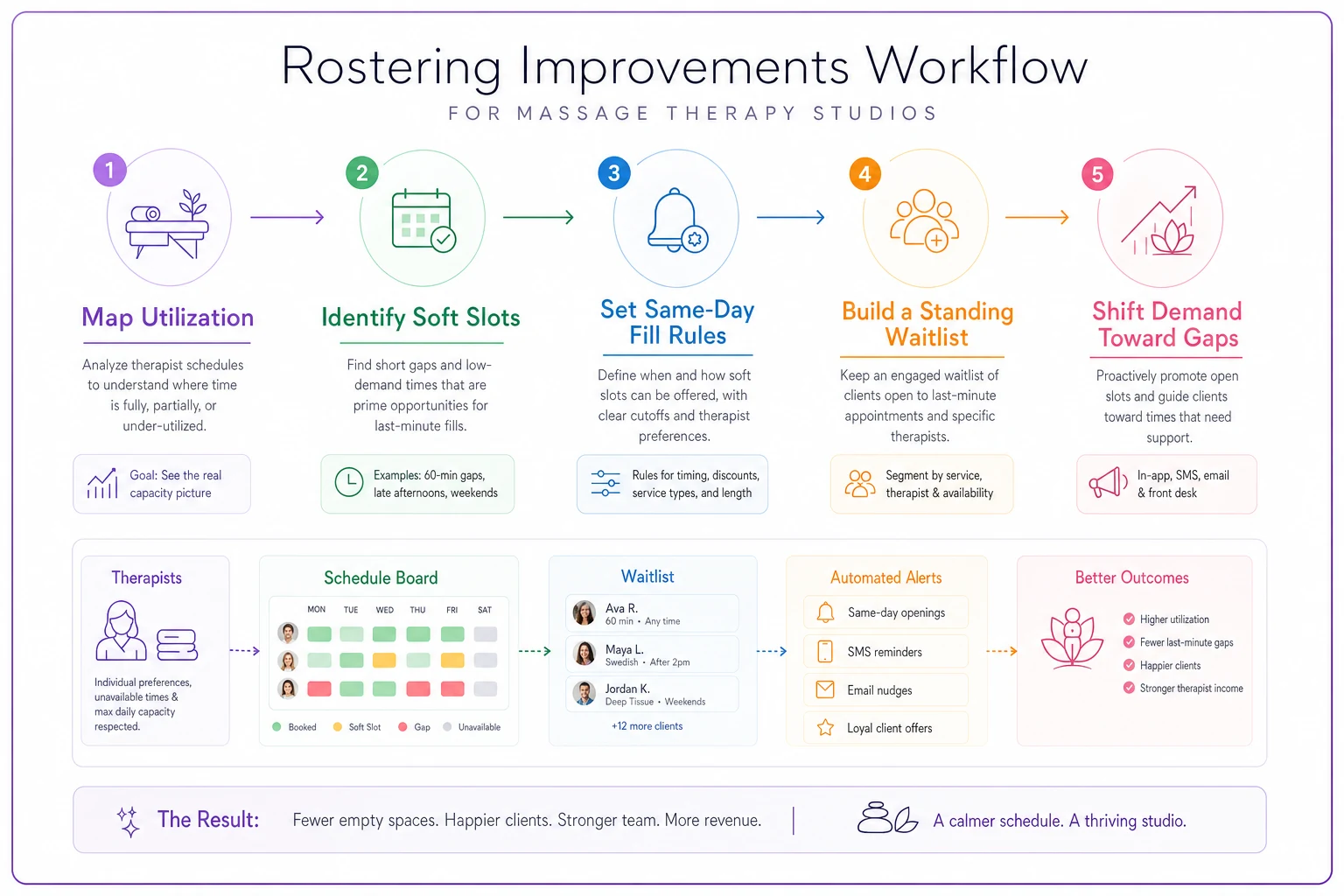
Use this workflow as a quick checklist when you run your rostering review.
A real scenario: the three-room studio that stopped panic-hiring
A three-therapist setup—roughly 330 billable sessions a month at peak—lost a therapist in early November last year and immediately posted two job listings. Six weeks in, zero viable candidates, and they were turning away weekend clients.
Instead of waiting out the hire, they did three things. They brought in a contract therapist for Friday–Sunday blocks at a higher per-session rate. They rebalanced the remaining two therapists' books so neither hit burnout. And they turned on a real waitlist and same-day fill process at the front desk, which had previously been running on sticky notes and memory.
The contractor cost more per session—but the weekend chair went from empty to roughly 85% booked within two weeks. Over the holiday stretch, those rostering and waitlist fixes recovered an estimated $4k–$5k in bookings that would've otherwise vanished. They still hired a full-time therapist eventually, in late January, when they could do it without pressure. The difference was they protected revenue during the gap instead of bleeding it out over six weeks.
The lesson wasn't "use contractors." It was that the fast, cheap levers—rostering, waitlists, demand-shifting—carried the quarter while the slow, expensive lever resolved itself in the background.
When premium-hour pricing makes sense—and when it backfires
Premium pricing for high-demand slots gets recommended a lot, and in a tight market it's tempting because it raises revenue and helps fund the higher per-session rates you need for contract coverage. But it's not always the right call.
It makes sense when you have genuine excess demand—a real waitlist for Saturday mornings, clients regularly asking for slots you can't give them. Charging a modest premium there is just pricing to reality.
It's a bad idea when demand is soft or price-sensitive and you're using premium pricing to paper over a utilization problem. If your weekends aren't actually full, a surcharge just suppresses the demand you do have.
Who should skip it entirely: studios in a trust-rebuilding phase, or those competing heavily on membership value. A surprise peak surcharge can read as nickel-and-diming to a loyal client base, and the goodwill cost usually outweighs the marginal revenue.
Keeping the staff you have is cheaper than winning a bidding war
The quiet truth of a tight labor market is that retention beats recruitment on every dimension—cost, speed, and client experience. Your clients rebook with the therapist they know. Lose that therapist and you don't just lose the labor; you lose a slice of the book that followed them.
Retention in this environment isn't only about pay. What keeps therapists from testing the market is usually operational: a schedule that respects their energy, a book that stays full without constant churn, a front desk that doesn't drop problems in their lap, and a studio that feels organized rather than perpetually chaotic. The U.S. Department of Labor's weekly claims data suggests this tightness isn't going away next month—so a studio that invests in being a genuinely good place to work right now compounds that advantage over the months ahead.
-
Are my best therapists' books full and balanced, or are they worn down by uneven days?
-
Does my pay structure reward loyalty, or does it treat a two-year therapist the same as someone who started last month?
-
Is the day-to-day operation smooth enough that a competitor's slightly higher rate wouldn't be worth the disruption?
-
Have I actually asked my team what would make them stay?
That last one is the question owners most often skip—and it's usually the cheapest fix available.
The bottom line for this quarter
Record-low jobless claims aren't an abstraction for a massage studio. They show up as an empty chair you can't refill fast enough, right when December demand is at its heaviest. The studios that get through this quarter cleanly won't be the ones who outbid everyone on wages. They'll be the ones who treated rostering, waitlists, and contract coverage as their first moves, kept their existing team stable enough to stay, and did their full-time hiring calmly in the background instead of in a panic.
Tight markets punish fragile staffing models and reward operational discipline. If your studio has no bench, no documented pay structure, and a schedule held together by memory and sticky notes, this is the quarter to fix it—because the cost of an unfilled chair is only going up.
Ready to elevate your massage therapy business?
Join hundreds of therapists using Masthera to save time, reduce scheduling conflicts, and enhance client satisfaction.