


Most studio owners think they have a "people problem" when what they actually have is a governance problem. The therapist who quit wasn't lazy. The one arguing about their last paycheck isn't greedy. And the front desk lead who feels stuck isn't ungrateful. In almost every case, the friction traces back to the same thing: nobody wrote down how roles, pay, promotions, and reviews actually work — so the rules get invented on the spot, differently, every time.
That's the core of people operations pay governance for a massage studio. It's the boring infrastructure sitting underneath your schedule and your P&L. When it's missing, you don't notice at first. Then you hit four or five therapists, add a couple of front desk staff, maybe a second room or a second location, and suddenly every payroll cycle is a negotiation and every promotion blindsides somebody.
This piece is about building that infrastructure before it breaks — role families, pay-rule matrices, promotion ladders, incentive design, and a quarterly audit cadence that ties back to how the business is actually performing.
Why pay governance quietly falls apart as studios grow
At one or two therapists, you don't need governance. You know everyone's rate because you set it in a text message. Cancellation splits get sorted verbally. Everyone trusts you because you're standing right there.
The trouble starts around the third or fourth hire. Now you've got a therapist you brought on at $38 a session, another at 45% of service revenue, and a third who's technically a contractor but treats the place like a job. Nobody remembers exactly what was promised. When a client cancels late, one therapist assumes they get paid, another assumes they don't, and you're the tiebreaker in a dispute with no written answer.
The breakdown almost never comes from bad intent. It comes from undefined edge cases:
-
A client no-shows — does the therapist get anything?
-
A 90-minute session gets cut to 60 because the client was late — full pay or prorated?
-
A therapist covers a room and also runs the front desk that shift — one rate or two?
-
A membership session gets redeemed — is the therapist paid on the discounted rate or the full menu rate?
Every one of these is a tiny decision. Made once, verbally, it's fine. Made forty times a month across five people with no written rule, it becomes the reason someone updates their resume. The dispute isn't really about $22. It's about feeling like the rules shift depending on who's asking.
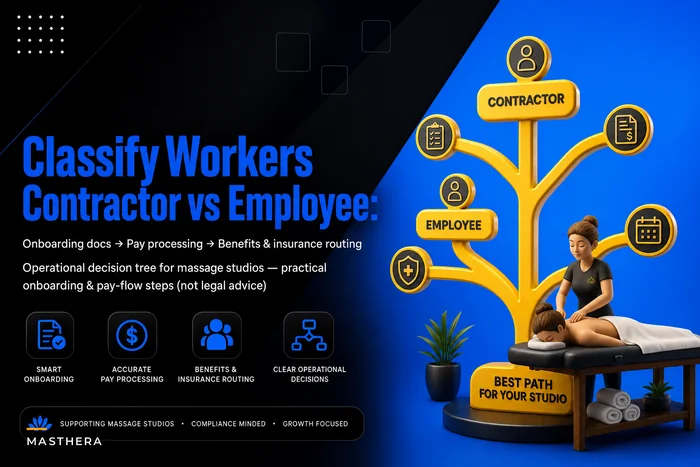
If you're still sorting out whether people should even be employees or contractors, that decision changes almost everything downstream — worth reading the contractor vs employee decision tree for studios before you lock in any pay structure, because the governance layer looks different for each.
Start with role families, not job titles
The first mistake owners make is treating every hire as a one-off. Someone's a "massage therapist," someone's "front desk," someone's a "lead," and the definitions live only in the owner's head. Role families fix this by grouping people into tiers with clear expectations, so you're not reinventing the wheel with every hire.
Never miss a booking or double-book again.
Masthera helps you schedule, confirm & manage every massage session with ease.
- Unified appointment management
- Automated client reminders
- Therapist calendar coordination
No credit card required
A workable structure for most small studios looks like three families:
-
Clinical (hands-on) therapists delivering sessions. Sub-tiers by experience, modality range, and rebooking performance.
-
Front-of-house reception, scheduling, retail, intake support. Sub-tiers by autonomy and responsibility.
-
Lead/hybrid people who do clinical or front-of-house work and carry supervisory or admin duties.
The reason this matters operationally: pay rules, promotion paths, and incentives all attach to the family, not the person. When you hire your sixth therapist, they slot into an existing tier with a known rate and known expectations. You stop negotiating from scratch — and stop accidentally paying two people doing identical work wildly different amounts because you were in different moods the weeks you hired them.
One pattern worth flagging: the "lead/hybrid" family is where most pay disputes hide. A therapist who also opens the studio, handles restocking, and trains new hires is doing three jobs. If your pay rule only covers "session delivered," you're underpaying them for real work they can feel, and they know it. Define the hybrid role explicitly or watch your most reliable person burn out quietly.
The pay-rule matrix: where the actual disputes get solved
This is the centerpiece. A pay-rule matrix is a single document that answers every "what happens when…" question before it comes up. The goal is that any staff member could look at it and predict their own paycheck without asking you.
Here's a simplified version of what a matrix looks like for a small multi-therapist studio:
| Scenario | Employee therapist (hourly + commission) | Commission-only therapist | Hybrid (clinical + admin) |
|---|---|---|---|
| Standard session completed | Base hourly + 15% of service | 45% of service revenue | Session rate + admin hourly for non-clinical time |
| Late cancellation (<24h) | Base hourly retained, no commission | 50% of session rate paid | Same as clinical tier |
| No-show | Base hourly retained, no commission | 25% of session rate paid | Same as clinical tier |
| Client late — session shortened | Commission on actual time delivered | Commission on actual time delivered | Prorated on delivered time |
| Membership/discounted session | Commission on menu rate, not discounted rate | Commission on menu rate | Menu rate |
| Covering front desk during shift | Admin hourly for covered hours | Flat shift stipend | Already covered by hybrid rate |
| Double-booked / overtime coverage | 1.5x commission for the extra slot | +10% on the covered session | Negotiated per event, documented |
-
Protect the therapist on cancellations that aren't their fault. Paying something on late cancels and no-shows — even a partial rate — signals you're on their side against the client's flakiness, not passing the loss down to them.
-
Pay on menu rate for discounted sessions when you can afford it. If a therapist earns less because you ran a membership promotion, they resent the promotion. Absorb the discount at the business level, not the labor level.
-
Make dual-role pay explicit. If someone touches admin work, there's a rate for it. Full stop.
The specific numbers matter less than the fact that they exist and are consistent. Whatever you decide, write it, share it, and don't override it quietly for one person. The moment you make a silent exception, you've created a precedent someone else will eventually cite.
This diagram shows how the pay-rule matrix gets applied to session events and payroll.
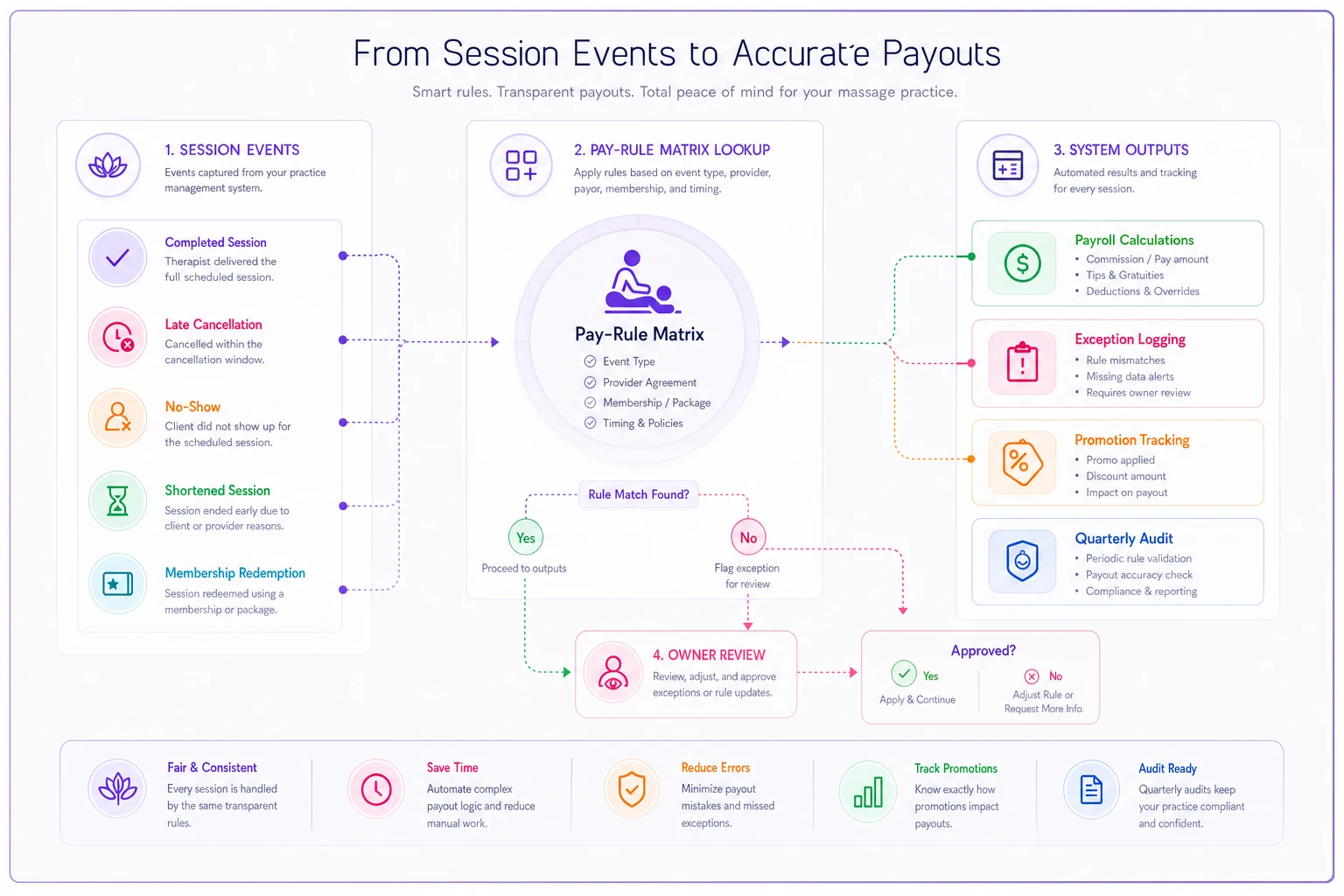
When you make an exception, document it and add it to the matrix so it doesn't become an unspoken precedent.
Whatever you decide, write it, share it, and don't override it quietly for one person. The moment you make a silent exception, you've created a precedent someone else will eventually cite.
Dispute-reduction scripts that actually calm things down
Even with a clean matrix, disputes happen. Somebody misreads a scenario or feels a specific case was handled unfairly. What reduces churn here isn't being "right" — it's handling the moment so the person feels heard and the rule stays intact.
A structure that works:
-
Acknowledge before explaining. "I hear you — let me pull up exactly how this one is handled so we're both looking at the same thing."
-
Point to the written rule, not your opinion. "On membership sessions, the matrix pays you on the full menu rate, so this one should've been $X. Let me check if it was calculated right." This reframes it as both of you checking against a possible error, not you against them.
-
If the rule genuinely produced a bad outcome, say so — and fix the rule, not just the paycheck. "You're right, that edge case isn't covered well. I'm going to add it to the matrix so it never happens again, and I'll make this one right."
That last move is what owners consistently skip. When a dispute reveals a gap, patching only the individual paycheck means the same fight recurs with the next person. Patching the matrix means you actually get more stable over time instead of relitigating the same edge cases forever.
Promotion ladders: the retention lever nobody builds
A quiet churn driver: a strong therapist hits month 14, is fully booked, generates great rebooking numbers, and has no idea what "next" looks like. No title above them, no rate bump they can see coming, no clarity on what would earn it. So they start assuming the ceiling is where they're standing. Then a competitor offers them a "senior" title and 3% more, and they leave.
A promotion ladder makes advancement visible and earnable. It doesn't need to be elaborate — it needs to be concrete. Vague ladders ("show leadership," "be a team player") are worse than none, because they let you move the goalposts and give staff legitimate reason to feel cheated.
A simple promotion checklist for moving a therapist from mid-tier to senior might read:
-
- [ ] 12+ months tenure, or equivalent demonstrated skill
-
- [ ] Rebooking rate at or above studio target for two consecutive quarters
-
- [ ] Trained or shadowed at least one new hire successfully
-
- [ ] Consistently complete, compliant session notes (spot-checked)
-
- [ ] No unresolved client complaints in the review window
-
- [ ] Comfortable across the core modality set the studio offers
Attach a specific outcome to hitting the list — a rate increase, a title, priority scheduling, whatever you're actually willing to give. The therapist can look at the checklist and self-assess. When advancement is a checklist instead of a mood, people stop guessing and start working toward something real.
This ladder also connects directly to onboarding. If your senior-tier criteria include mentoring, then your ramp process for new hires needs to be structured enough that a senior therapist can actually run it. The way you ramp new therapists with SOPs, shadowing checklists and 30-60-90 goals is what makes the "trained a new hire" promotion box achievable rather than chaotic.
Incentive design that doesn't accidentally wreck your operation
Incentives are where good intentions cause the most damage, because people optimize for exactly what you pay them for — including the parts you didn't think through.
Pay purely on session volume and therapists rush, skip proper intake, and overbook themselves into burnout. Pay purely on retail add-ons and clients start feeling upsold every visit. Pay purely on rebooking and you might get pushy scripts that annoy the exact clients you want to keep.
The fix is tying incentives to a small set of balanced metrics rather than a single number. A modest bonus pool split across two or three indicators that pull in different directions tends to work better than chasing one:
-
Rebooking rate (rewards client relationship quality)
-
Client satisfaction / low complaint rate (guards against the rush-and-burn behavior volume incentives cause)
-
Notes and compliance completeness (protects you on the operational and legal side)
Choosing which metrics to reward is where a clear KPI foundation matters. If you haven't defined the numbers that actually drive your studio, the minimal KPI dashboard with the 8 metrics and decision rules is the right place to anchor your incentive design — otherwise you risk paying bonuses on numbers that don't move anything real.
When incentives are a bad idea: if you can't measure the metric cleanly, don't attach money to it. A bonus tied to a number people can game or dispute creates more payroll conflict, not less. And if your studio is small enough that everyone already sees the whole picture, a heavy incentive structure can feel like surveillance. Sometimes a fair base rate and a clear ladder beat a complicated bonus scheme.
The quarterly audit and coaching cadence
Governance isn't a document you write once and file away. It drifts. Rates get set for new hires that don't match the matrix, exceptions pile up, promotion criteria get informally waived. The way you catch drift is a quarterly rhythm that ties people ops back to studio performance.
-
Pay reconciliation pass. Pull a sample of pay periods and check actual payouts against the matrix. Flag every mismatch. You're looking for silent exceptions and calculation errors — both erode trust.
-
Rate-drift check. List every person's current rate next to their role family's defined rate. Anyone off the standard should have a documented reason.
-
Promotion-readiness review. Run each therapist against the promotion checklist. Anyone quietly meeting the criteria without a conversation is a flight risk — get ahead of it.
-
Dispute log review. Look at every pay question or complaint from the quarter. Which ones exposed a gap in the matrix? Patch the matrix, not just the incidents.
-
KPI tie-back. Connect the people picture to the numbers — did rebooking, utilization, and complaint rates move with your incentive design, or did nothing change?
-
Coaching conversations. Use the review to actually talk to people. Where they stand on the ladder, what's next, what's blocking them.
That last step is what turns an audit from a policing exercise into a retention tool. Most therapists have never had a manager sit down and say clearly, "Here's where you are, here's what's next, here's exactly what it takes." Doing that four times a year, tied to a fair and visible system, is one of the cheapest churn reducers available.
A real scenario: the four-therapist studio that stopped losing people
Consider a suburban wellness studio running four therapists and two front desk staff, doing somewhere around 320–360 sessions a month. Over roughly eight months they'd lost two therapists. Exit conversations kept surfacing the same theme — the pay felt unpredictable and there was "nowhere to grow."
Digging in, the owner found the mess you'd expect. Three different commission arrangements with no written record. Late-cancellation pay handled case by case, which meant one therapist had been quietly eating the loss on cancels for months while another always got paid. No promotion path. A "lead" therapist doing open/close and restocking for free.
The fix wasn't complicated, just deliberate. They defined three role families, built a one-page pay matrix covering cancellations, proration, discounted sessions, and dual-role work, and wrote a single promotion checklist. The lead therapist got an admin hourly rate for the non-clinical hours she'd been donating — a couple hundred dollars a month she'd effectively been working for free.
Over the next two quarters payroll disputes dropped to nearly zero, and the reconciliation errors that surfaced every cycle mostly disappeared once the rules were written and checked consistently. The less measurable but more important result — the remaining therapists stopped treating the studio as a temporary stop. When someone could finally see the next rung, they started reaching for it instead of scanning job listings.
Where the software layer actually helps
None of this requires software to design — you can build role families and a pay matrix on a single page. Where tooling earns its place is in keeping the system honest at scale. Once rules exist, the operational challenge becomes applying them consistently across dozens of sessions a week without manual errors.
An AI-assisted operational platform helps here in unglamorous ways: automatically applying the right pay rule to each session based on whether it completed, cancelled late, or ran short; flagging when a payout doesn't match the role family's defined rate; surfacing which therapists are quietly hitting promotion criteria; and pulling the quarterly audit numbers so you're not reconstructing them by hand every three months. The value isn't automation for its own sake — it's that consistency stops depending on you remembering every edge case at 9pm on payroll night.
The pattern worth keeping in mind: the software enforces the governance you designed. It doesn't design it for you, and it can't fix rules that were never written down. Get the role families, the matrix, and the ladder right first — then let the platform handle the repetitive application so the rules stay consistent even as you add rooms, staff, and locations.
The bigger point
Pay disputes and therapist churn feel like people problems in the moment — this person is difficult, that one is disloyal. But scale a studio past a handful of staff and the same friction shows up regardless of who's on the roster. That's the tell that it's structural. When the rules for pay, roles, promotion, and review are written, consistent, and reviewed on a rhythm, most of the drama stops having anywhere to start. Build the governance layer while you're small enough to build it calmly, and you won't be improvising it during a payroll argument when you're too big to afford one.
Ready to elevate your massage therapy business?
Join hundreds of therapists using Masthera to save time, reduce scheduling conflicts, and enhance client satisfaction.