

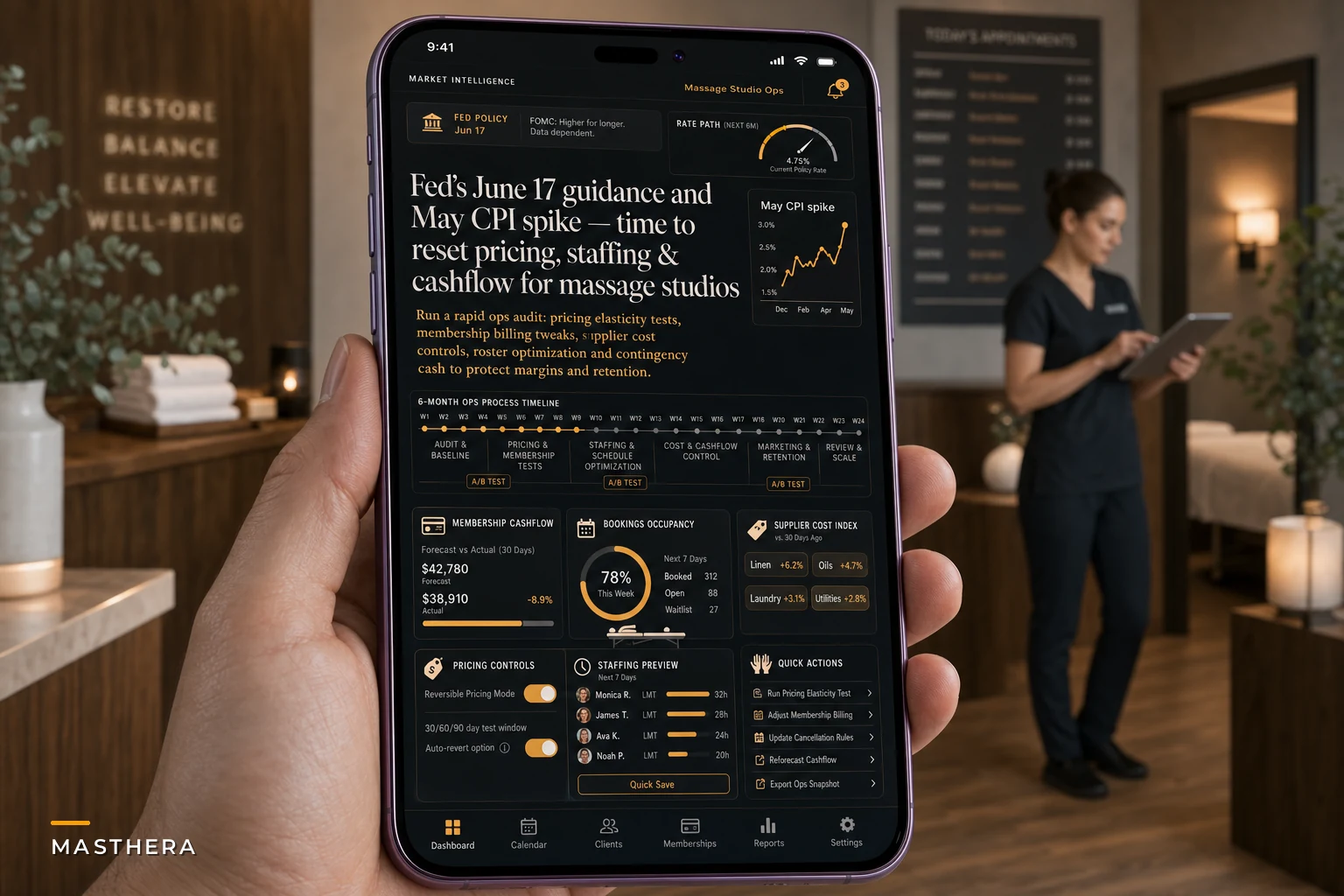

The Fed held rates at 3.50-3.75% last week while signaling they might need to raise them again before year-end. Meanwhile, May's inflation numbers came in at 4.2% annually. For massage studios and wellness centers, this isn't just background noise — it's already showing up in your P&L.
I've watched this exact squeeze play out before. Not the same Fed decisions, but the same pattern. Costs climbing from every direction while clients quietly pull back. The studios that come out the other side don't just tough it out — they make specific operational adjustments, usually earlier than feels necessary.
The real inflation impact on massage studios isn't what you think
Everyone fixates on the obvious: supplies cost more, utilities are up, rent increases. Those matter. But the actual damage happens through a different mechanism.
When inflation hits 4.2% like CNBC reported in the May data, your middle-income clients don't immediately stop booking. They stretch out their intervals first. The client who came every three weeks moves to monthly. The monthly client shifts to every six weeks.
This creates a cascade that's easy to miss early on. Your schedule looks full two weeks out, so everything seems fine. But total monthly sessions drop 15-20%. Therapist hours get trimmed. Your best people start picking up shifts at competitors. Now you're understaffed during peak times and overstaffed during slow ones.
The math deteriorates fast. A studio running around 340 sessions monthly at a $95 average ticket drops to 290 sessions. That's $4,750 less revenue while fixed costs actually went up. You're looking at a $6,000-7,000 monthly swing in the wrong direction before you've even reacted.
Stop treating inflation like a pricing problem
The first instinct is usually "raise prices." That's the wrong move at the wrong moment.
Never miss a booking or double-book again.
Masthera helps you schedule, confirm & manage every massage session with ease.
- Unified appointment management
- Automated client reminders
- Therapist calendar coordination
No credit card required
Raising prices when clients are already spacing out appointments speeds up the problem. You might hold revenue temporarily, but you're training clients to see massage as increasingly optional. Once someone goes from monthly to quarterly visits, they almost never return to monthly — even after their finances recover.
The real fix is rethinking your service mix. When disposable income tightens, clients don't stop valuing pain relief or stress management. They just recategorize massage from "regular self-care" to "only when really necessary."
Most studios fight this shift. The smarter move is to lean into it. A 30-minute targeted neck and shoulder session at $45 gives a stressed client genuine relief without the $95+ commitment. Package these into membership tiers that feel manageable rather than indulgent.
Position 30-minute targeted sessions as practical pain relief options rather than discounted or lesser services.
One studio I looked at closely made this adjustment during similar conditions last year. They added 30-minute slots at $45 and something unexpected happened — total revenue went up. They fit more sessions per day, clients booked more frequently at the lower price point, and therapists saw six to eight clients instead of four or five in the same hours.
The staffing trap nobody talks about
When revenue dips, cutting therapist hours feels like the logical response. It's also one of the fastest ways to hollow out your business.
Good massage therapists have options. The moment hours drop below 25-30 per week, they start interviewing. But they don't quit immediately — they take shifts elsewhere while keeping partial hours with you. Now you've got therapists juggling multiple schedules, showing up tired, and mentally halfway out the door.
The fix isn't complicated, but it costs something upfront. Convert your core therapists to a guaranteed base plus commission structure instead of pure commission. Yes, that increases fixed costs when you're already squeezed. But it keeps the people you actually need.
The structure that tends to work: guarantee $400-500 weekly for 25 hours of availability, then commission kicks in above a threshold. Therapists get stability, you get reliability. Studios that go pure commission or cut everyone to part-time during inflation lose their best people first, and that's a hole that's hard to dig out of.
Cashflow gymnastics for the next 12 months
Standard massage studio cashflow assumes reasonably predictable monthly revenue. That assumption breaks during inflationary periods.
Start by shortening your cash collection cycle. If you're not already running membership programs that bill monthly, you're leaving money on the table. Beyond that, consider billing on the 1st and 15th instead of just once monthly. It smooths out payment failures and gives you two collection windows instead of one.
Package sales become critical, but the positioning matters. Drop the "buy 5 get 1 free" approach — that's just discounting with extra steps. Instead, frame packages as rate protection. Clients lock in current pricing for 6-12 months of services. You're helping them hedge against future price increases, not running a promotion.
A wellness center near Denver did this well. They offered "2026 Rate Lock" packages in June — pay for eight sessions now, use them anytime in the next 12 months at today's price regardless of any rate increases. They sold 47 packages in two weeks, pulling in roughly $35,000 in immediate cashflow while locking in future visits.
Your utility and supply costs are lying to you
The electric bill going up 15% is visible. What's harder to see is the compounding across everything. Laundry service raises rates 10%. The massage oil supplier adds a fuel surcharge. The credit card processor bumps rates by 0.3%. None of it feels catastrophic on its own.
But here's the operational trap most studios fall into: bulk buying. Inflation hits and the instinct is to stock up on supplies to save money. Now you've got $3,000 in massage oil sitting in storage while payroll feels tight.
Run supplies closer to just-in-time, even if unit costs are slightly higher. The extra $40 monthly in higher unit costs is worth having $2,000 available for operations. Cash flexibility matters more than bulk discounts when margins are thin.
| Metric | Value |
|---|---|
| Assumed cost per session | $12-15 |
| Actual cost per session | $18-24 |
Also worth doing: calculate your actual cost per session, not just supplies. Factor in laundry, utilities allocated per room hour, and payment processing. Most studios find their true cost per session lands between $18-24, not the $12-15 they assumed. That gap changes which services you should be promoting and which you should quietly phase out.
Marketing efficiency when every dollar counts
Standard massage studio marketing — Google Ads, Facebook posts, some Instagram — gets less efficient during inflation because everyone's competing for the same shrinking pool of discretionary spending.
The shift that actually works: stop chasing new clients and go deep on reactivation. Your dormant client list is one of the most underused assets you have. These people already trust you. They just need a reason and a lower barrier to come back.
Don't send a generic "we miss you" blast. Segment by last visit date and service type. Clients who haven't come in 3-6 months get a different message than someone who's been gone 12+ months.
The message itself matters more than the discount. "We know things are tight — here's a shorter session option that fits your budget right now" outperforms "30% off comeback special" consistently. One acknowledges their reality. The other just looks like you need the booking.
The technology piece
Running a massage studio on spreadsheets and appointment books when margins are this thin is a liability. Not because of booking convenience — but because you lose visibility into problems until they've already compounded.
When you can see that Tuesday afternoons are consistently slow, you can adjust staffing before it bleeds out for another month. When you notice certain therapists have dramatically higher rebook rates, you can actually ask what they're doing differently.
AI-powered scheduling and operations platforms now handle the complex puzzle of fitting shortened sessions, managing therapist preferences, and optimizing room utilization without someone manually reworking the schedule every week. They also surface patterns that are easy to miss — clients who reliably cancel their third appointment, or scheduling gaps where two additional 30-minute sessions could fit without adding hours.
The resistance usually comes from assuming it's too complicated or not worth the cost. But one missed optimization — not noticing you could fit five 30-minute sessions where you're currently running three 60-minute ones — can cost several hundred dollars monthly. The inefficiency is usually more expensive than the software.
Making decisions with imperfect information
Nobody tells you this part: you'll never have all the information you want. The Fed might raise rates again, or they might not. Inflation could moderate, or it could push higher. Competitors might slash prices or raise them.
The studios that get through inflationary periods aren't the ones with the best predictions. They're the ones making rapid, reversible decisions instead of waiting for clarity that isn't coming.
Test the 30-minute session format on Tuesday afternoons only. Try the new membership structure with new clients before rolling it to everyone. Adjust compensation for one therapist first. Small tests, quick iterations, constant adjustment. That's the opposite of how most massage studios operate — where changes happen annually if at all. But inflation doesn't run on your planning calendar.
Track three numbers weekly rather than monthly: total sessions, average ticket, and therapist utilization. If any of them drops 10% from baseline, that's your signal to act. Not panic — just move. Have your contingency responses ready so you're not making reactive decisions under pressure.
The six-month roadmap
These changes need to happen in sequence. Trying to do everything at once is how you break things that were working.
-
Weeks 1-2 Audit your real per-session costs including every hidden expense. You can't make good decisions with numbers that aren't accurate.
-
Weeks 3-4 Design and test shorter session formats. Start with two or three time slots to gauge demand before disrupting your whole schedule.
-
Weeks 5-6 Restructure at least one therapist's compensation to include a base. Learn what actually works before expanding.
-
Weeks 7-8 Launch rate-lock packages to generate immediate cashflow. Start with your most loyal clients — they're most likely to buy.
-
Weeks 9-12 Run reactivation campaigns for dormant clients, segmented by last visit date. Track response rates carefully.
Here's a visual workflow of that six-month test-and-iterate process.
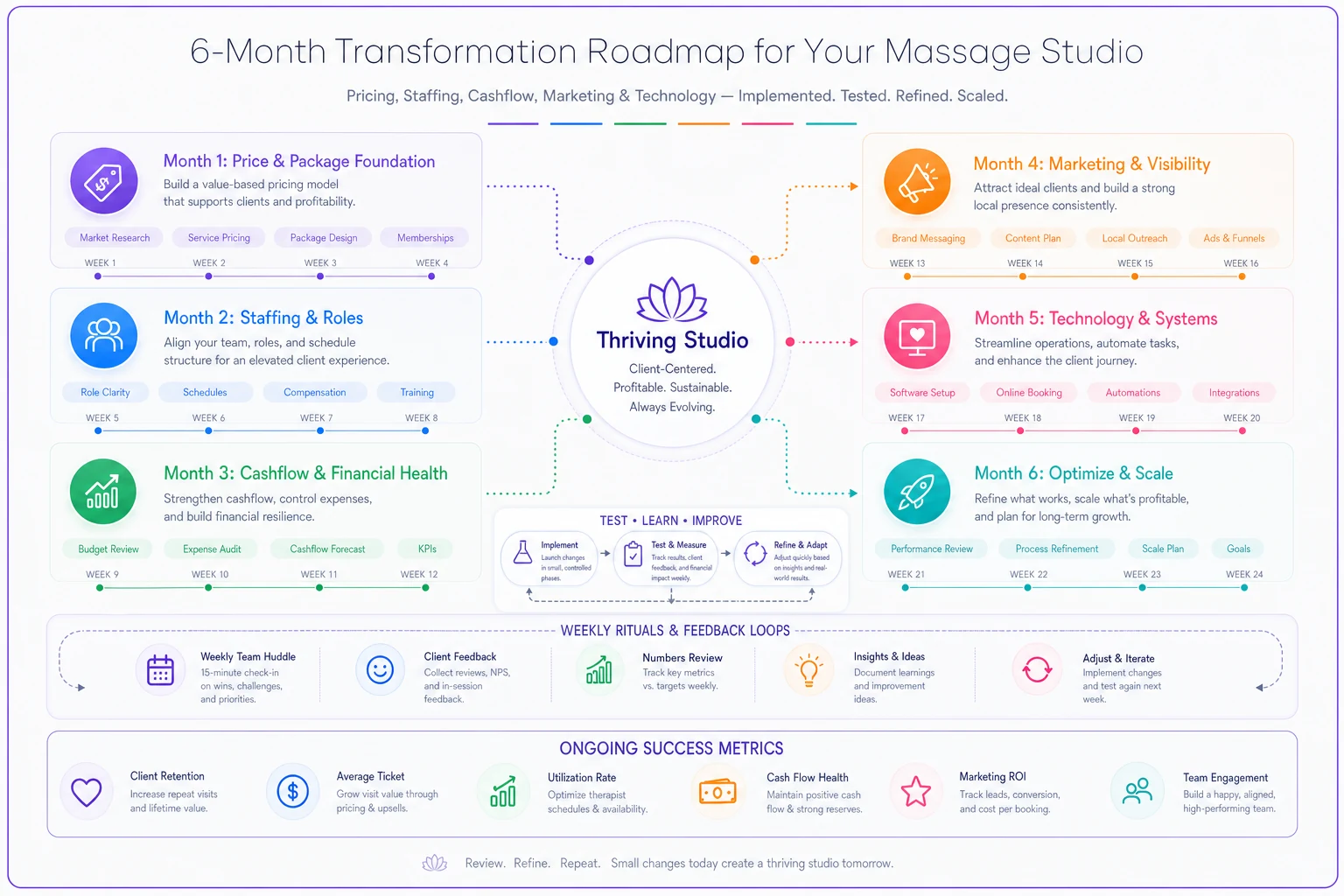
Months 4-6: Double down on whatever's working. If 30-minute sessions are filling up, expand the hours. If packages sold well, create new variations. If reactivation drove bookings, go deeper into your database.
What actually matters right now
The inflation impact on massage studios isn't really about managing higher costs. It's about recognizing that client behavior shifts before spending stops entirely. Studios that keep running their traditional model while hoping this passes are the ones calling around in six months asking about their options.
The changes required are uncomfortable. Shorter sessions feel like a step down. Guaranteed base pay feels risky when cash is tight. Package sales can feel pushy. But watching your studio slowly bleed out while costs rise and bookings drift lower is worse.
The Fed's signal about potentially raising rates again means this environment could extend into 2027. That's too long to wait out. The operational adjustments that feel optional today tend to become urgent when you're 60 days from real trouble.
Your studio can get through this. But not by doing what's always worked, just harder. The business model needs tactical adjustment — and the studios making those changes now, while they still have some cushion, are the ones that will be picking up competitor clients in 12 months when others can't hold on.
Inflation forces adaptation. The question is whether you do it on your terms or under pressure.
Ready to elevate your massage therapy business?
Join hundreds of therapists using Masthera to save time, reduce scheduling conflicts, and enhance client satisfaction.