

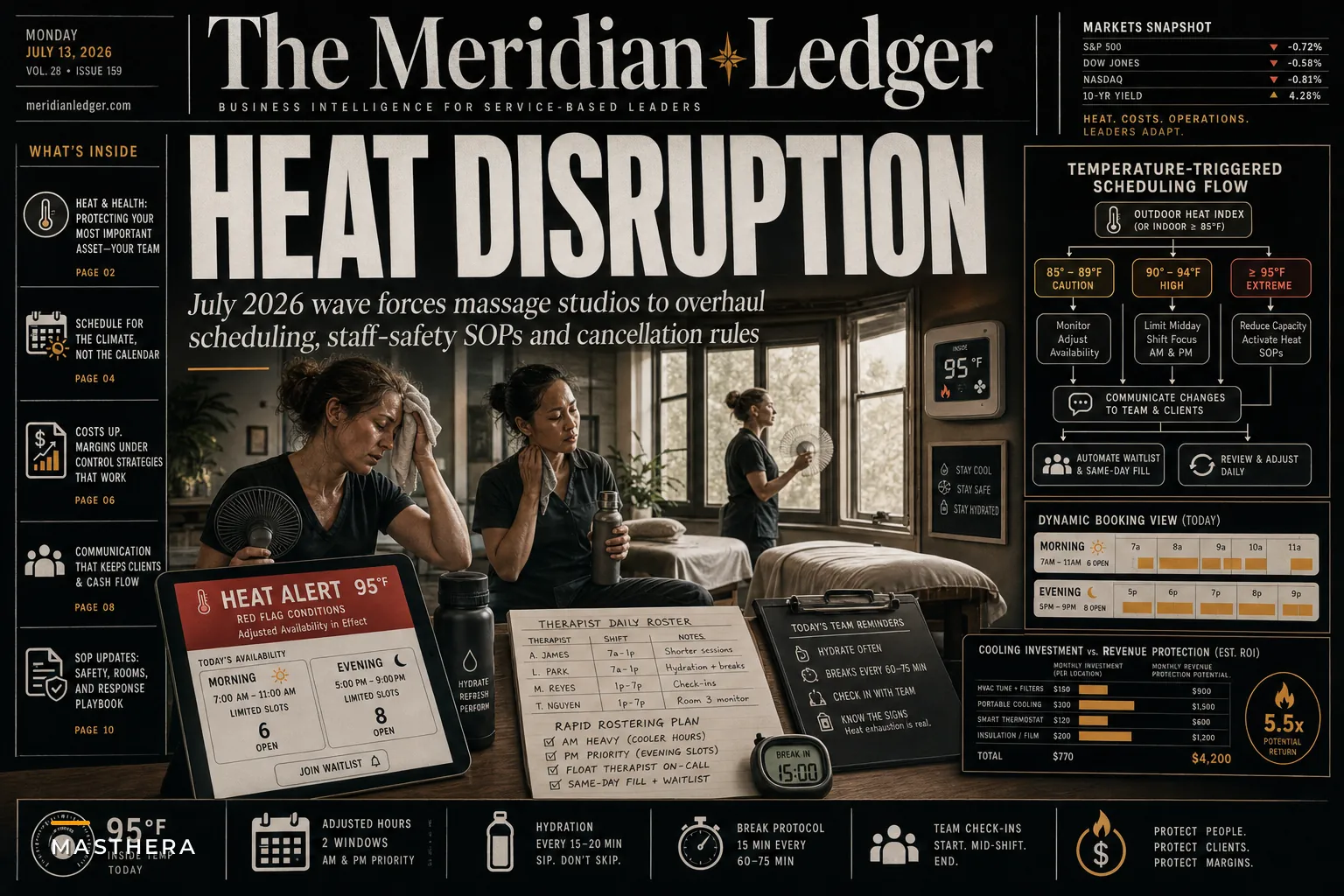

The late June heat wave that swept across the U.S. pushed temperatures past 105°F in places that rarely see triple digits. Kansas City hit 108°F. Philadelphia broke records at 104°F. Even upstate New York saw readings above 100°F, according to Reuters' coverage of the historic heat event.
For massage studios and wellness centers, these aren't just uncomfortable numbers—they're operational nightmares that most owners haven't planned for.
Last Tuesday, a wellness center owner in Phoenix texted me at 9pm: "Lost 18 appointments today. AC couldn't keep treatment rooms below 82 degrees. Had to send two therapists home with heat exhaustion. This is the third day like this."
The problem isn't the heat itself. It's that most massage studios operate on such tight margins that a few days of weather-related disruption can wreck an entire month's profitability. When your business model depends on bodies showing up at specific times in specific rooms with specific therapists, extreme weather exposes every weak point in your operations.
The domino effect nobody calculates
Most studio owners think heat waves mean a few extra cancellations. The actual impact runs deeper.
Your 2pm Tuesday regular who drives 25 minutes? She's not coming when her car thermometer reads 108°F. The elderly client with the 4pm slot? His doctor told him to stay inside during heat advisories. Your therapist who bikes to work? She called out after nearly passing out on the way in.
Then there's the cascade. When your 2pm cancels at noon, you can't fill that slot on short notice. Your therapist still gets paid. Your fixed costs don't move. But your revenue drops by $95-120 per missed appointment.
Run those numbers across a four-day heat wave hitting 30% of your appointments and you're looking at $2,800-3,600 in lost revenue for a small studio. That's before you factor in extra utility costs from running AC at maximum capacity, which can add another $400-600 to your monthly overhead during extreme heat periods.
But the real damage happens inside your treatment rooms.
Treatment room physics nobody talks about
Here's what actually happens in a massage room during extreme heat: bodies generate roughly 100 watts of heat at rest. During a session, between the therapist's physical output and the client's metabolic response, you're adding 200-300 watts of heat to a small, enclosed space. Stack that with poor ventilation, undersized AC, and outside temps above 100°F, and your treatment rooms turn into saunas.
Never miss a booking or double-book again.
Masthera helps you schedule, confirm & manage every massage session with ease.
- Unified appointment management
- Automated client reminders
- Therapist calendar coordination
No credit card required
I watched a therapist take room readings last summer. Her 10x12 room started at 74°F. After three back-to-back sessions, it hit 83°F. She had a portable unit running constantly and it couldn't keep up. By her fourth client, she was dizzy and her hands were cramping.
That's not just uncomfortable—it's dangerous. The CDC's heat stress guidance for workers puts moderate-to-heavy physical work in 80°F+ environments squarely in the danger zone for heat-related illness. Most massage work qualifies as moderate physical labor, especially deep tissue and therapeutic work.
Yet most studios have no heat safety protocols. No maximum room temperatures. No mandatory break schedules. No defined threshold for when it's simply too hot to work.
Three operational changes that actually work
After watching dozens of studios struggle through heat waves, some clear patterns emerge about what works.
Temperature-triggered scheduling adjustments
-
Block the hottest hours (typically 1pm-5pm) for breaks or admin work
-
Push morning hours earlier when possible (7am starts instead of 9am)
-
Add 15-minute buffers between appointments for room cooling
-
Pull deep tissue and hot stone services from the menu during peak heat
One studio in Austin built this directly into their booking system. When temperatures exceed set thresholds, certain time slots and service types become unavailable online automatically. Therapists can override it, but the default protects both staff and service quality without requiring anyone to make judgment calls mid-crisis.
Graduated cancellation policies
-
During official heat advisories (check //heat.gov/" target="_blank" rel="noopener noreferrer">Heat.gov for current advisories), cancellation windows drop to 2 hours
-
No penalties for elderly clients (65+) or those with documented health conditions
-
Credits instead of refunds keep cash in the business
-
Rescheduling prioritized over straight cancellations
A massage clinic in Scottsdale tested this during their last heat wave. They had 47 heat-related cancellations. By offering immediate rescheduling with no penalties, they recovered 34 of those appointments within the same week. Without the flexible policy, most would have been total losses—plus angry clients who felt penalized for protecting their health.
Room-specific safety protocols
-
Assign your most heat-sensitive therapists to cooler rooms
-
Rotate therapists through hot rooms rather than stacking consecutive bookings
-
Put thermometers in each room with clear maximum limits (78°F for client comfort, 80°F for therapist safety)
-
Create actual cooling stations where therapists can recover between sessions
Some studios now use a simple green/yellow/red card system on room doors. Green means normal operations. Yellow means shortened sessions or extra breaks. Red means the room is offline until temperatures drop.
Offer immediate rescheduling with no penalties to recover appointments during heat events.
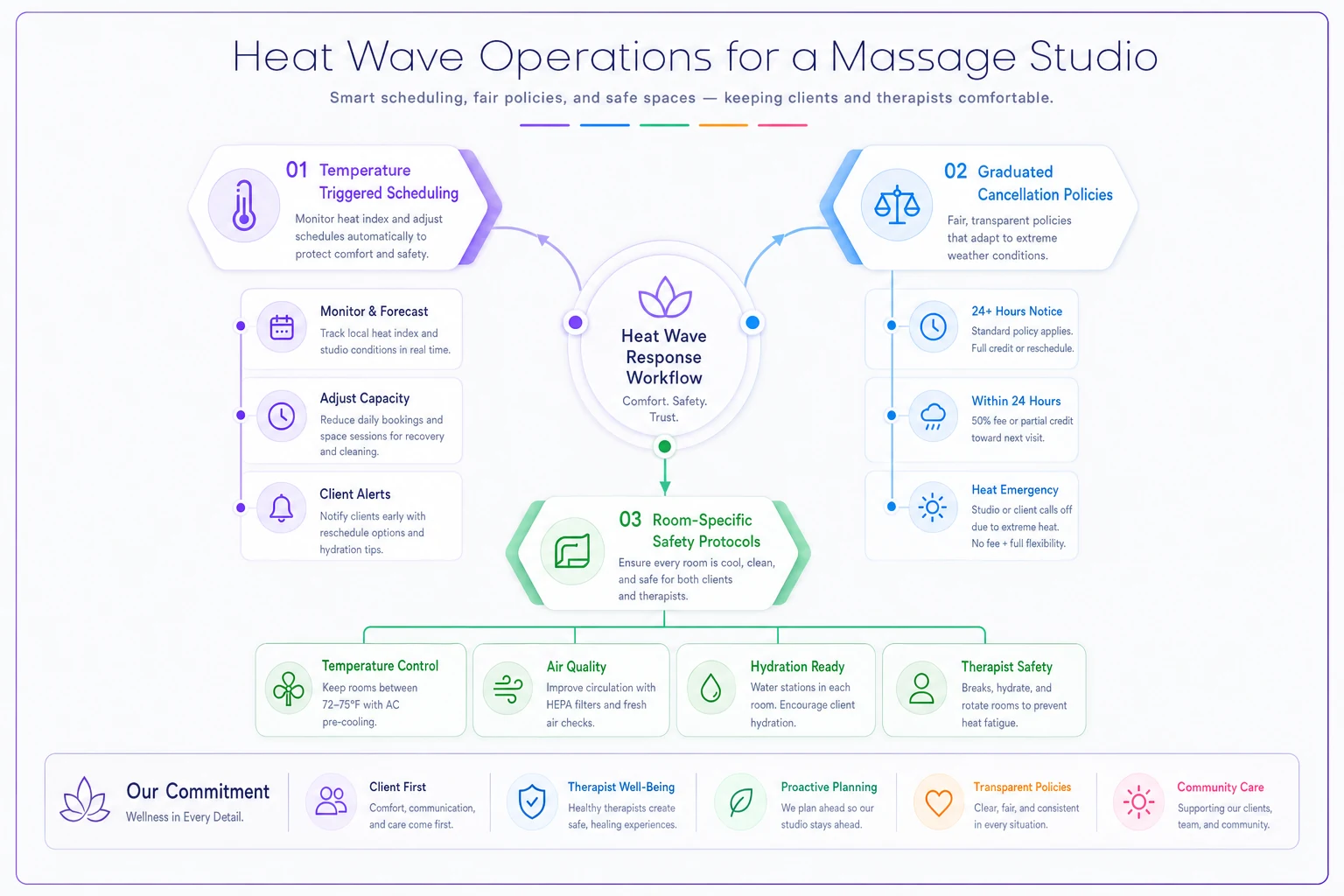
Here's a simple visual of how those three changes fit together.
Why manual systems fail when it matters most
During normal operations, making these adjustments manually is manageable. During a heat emergency—when you're getting slammed with cancellations, managing worried therapists, and dealing with uncomfortable clients all at the same time—manual systems fall apart fast.
This is where operational software earns its keep. Not fancy predictions, just solid automation that handles the chaos:
-
Schedule adjustments triggered by weather conditions
-
Bulk rescheduling tools for weather disruptions
-
Graduated cancellation rules that apply without manual intervention
-
Waitlist systems that fill heat-related gaps automatically
-
Proactive client communication when conditions change
The difference between studios that hold up during extreme weather and those that spiral comes down to having systematic responses versus scrambling. When your policies and schedules adjust based on conditions automatically, you can stay focused on what actually matters—keeping your team safe and your clients taken care of.
Building heat resilience into standard operations
The July 2026 heat wave won't be the last. Climate patterns show increasing frequency and intensity of extreme heat events. Studios that treat this as a one-time disruption will get caught again.
Start with your capacity planning and seasonal rostering systems. Build heat contingencies directly into your scheduling assumptions:
| Summer scheduling assumptions |
|---|
| 20% capacity reduction during peak heat hours |
| 30% higher cancellation rate on 95°F+ days |
| 15% increase in therapist call-outs during extended heat waves |
| Demand shifting toward morning and evening slots |
Revenue protection strategies:
-
Membership pause options during extreme weather
-
Package extensions for weather-affected periods
-
Premium pricing for climate-controlled rooms
-
Group meditation or gentle movement alternatives when massage isn't safe
Staff protection investments:
-
Portable AC units for each treatment room ($300-500 each)
-
Cooling vests for therapists ($50-150 each)
-
Paid heat breaks built into the schedule
-
Hydration stations in therapist areas
A wellness center in Tucson spent around $3,200 on cooling equipment and policy changes last year. During this recent heat wave, they lost about 8% of appointments. Their neighbor lost 35%. The investment paid for itself in one week.
The cancellation conversation nobody wants to have
Traditional cancellation policies assume clients are making choices. During extreme weather, they're responding to safety concerns. Penalizing someone for not coming in during a heat advisory destroys trust fast—and that trust is hard to rebuild.
You still need revenue protection. The answer isn't removing policies; it's creating weather-specific frameworks:
For regular clients: "During heat advisories, we'll hold your regular slot for one week. Use it when you're safe to come in, and we'll release it to the waitlist if not."
For package holders: "Heat cancellations don't count against your package. Sessions extend by one week per weather event."
For new clients: "First-time appointments cancelled due to extreme heat can reschedule with priority booking."
These protect your business while acknowledging what clients are actually dealing with. People remember businesses that showed flexibility when things got hard.
What the next heat wave will cost
If you don't change anything, here's the likely breakdown for the next major heat event:
-
Days 1-2
15-20% cancellations, manageable with effort
-
Days 3-4
25-35% cancellations, therapist fatigue building
-
Days 5+
40%+ cancellations, call-outs, client complaints
-
Post-event
2-3 weeks of rescheduling chaos and reputation recovery
Total impact for a 4-therapist studio: $8,000-12,000 in lost revenue, plus overhead and potential therapist turnover.
With proper heat protocols in place:
-
Proactive schedule adjustments keep peak cancellations around 15-20%
-
Automated rescheduling recovers 60-70% of cancelled appointments
-
Safety measures prevent therapist call-outs
-
Clear communication maintains client trust
Total impact: $2,000-3,500 in temporarily displaced revenue, mostly recovered within two weeks.
Making the operational shift
The massage and wellness industry built its operating model around predictability. Same clients, same times, same rooms, same therapists. Extreme weather dismantles that model quickly.
Studios clinging to rigid operations will take the same hit every time temperatures spike. Those building flexibility into their scheduling, policies, and safety protocols will come out ahead—often capturing clients from competitors who can't adapt.
Start with simple changes. Add weather triggers to your scheduling system. Write heat-specific cancellation rules. Put thermometers in your treatment rooms. Build these adjustments into your standard operations now, while you have time to test and refine before the next event.
Because when the next heat wave hits—and it will—you'll either have systematic responses ready, or you'll be sending apologetic texts to clients while your therapists call out sick and your revenue disappears.
That choice happens now, not when the thermometer hits triple digits.
Ready to elevate your massage therapy business?
Join hundreds of therapists using Masthera to save time, reduce scheduling conflicts, and enhance client satisfaction.