


Running a massage studio with 6+ therapists is a bit like conducting an orchestra where half the musicians show up at random times. Your booking software shows 85% capacity for next Tuesday, yet three therapists have two-hour gaps while another is double-booked at 2pm. The front desk is texting contractors about schedule changes, your lead therapist is buried in a spreadsheet adjusting the roster, and somehow you're still turning away walk-ins during peak hours while paying other therapists to scroll their phones during dead zones.
Multi-therapist capacity planning breaks most wellness studios because owners treat scheduling like a calendar problem instead of a demand-mapping exercise. You end up with what looks like efficient booking on paper but operates like chaos in practice — therapists arriving for shifts that don't match actual demand, contractors frustrated with inconsistent hours, and revenue leaking through scheduling gaps that only compound as you grow.
The scheduling death spiral that starts around therapist number four
Small massage practices run fine with basic scheduling tools until they hit roughly four therapists. That's when the "first available" booking approach creates real gridlock. Morning therapists sit empty while afternoon slots overbook. Contractors want consistent hours but client demand swings wildly. The receptionist spends half their day handling last-minute schedule changes instead of booking new clients.
The real problem? Most studios respond by adding more communication — WhatsApp groups, scheduling meetings, color-coded calendars. But layering communication onto a broken capacity system just creates organized chaos. Therapists still show up at the wrong times, just with better documentation of the mess.
Multi-therapist studios deal with what you could call demand clustering. Clients don't book evenly across all available slots. They cluster around specific times, specific therapists, and specific service types. A studio with eight therapists might see 70% of bookings concentrated in just 30% of available time slots. Without mapping that demand pattern, you're essentially throwing therapist hours at the wall.
Slot-level demand mapping beats availability-based scheduling
Traditional scheduling starts with therapist availability and tries to fill those hours. Demand-driven rostering flips this — you map when clients actually want appointments, then build therapist schedules around those patterns.
Never miss a booking or double-book again.
Masthera helps you schedule, confirm & manage every massage session with ease.
- Unified appointment management
- Automated client reminders
- Therapist calendar coordination
No credit card required
Here's what slot-level mapping looks like in practice. A 12-therapist wellness center in suburban Phoenix stopped asking therapists when they could work and instead tracked three months of booking data:
Peak demand windows:
-
Tuesday–Thursday, 11am–2pm
92% booking rate
-
Weekday evenings, 5–8pm
88% booking rate
-
Saturday mornings, 9am–1pm
94% booking rate
Dead zones:
-
Monday mornings
31% booking rate
-
Wednesday 3–5pm
28% booking rate
-
Friday afternoons
42% booking rate
This visual shows the workflow for mapping slot-level demand to rosters.
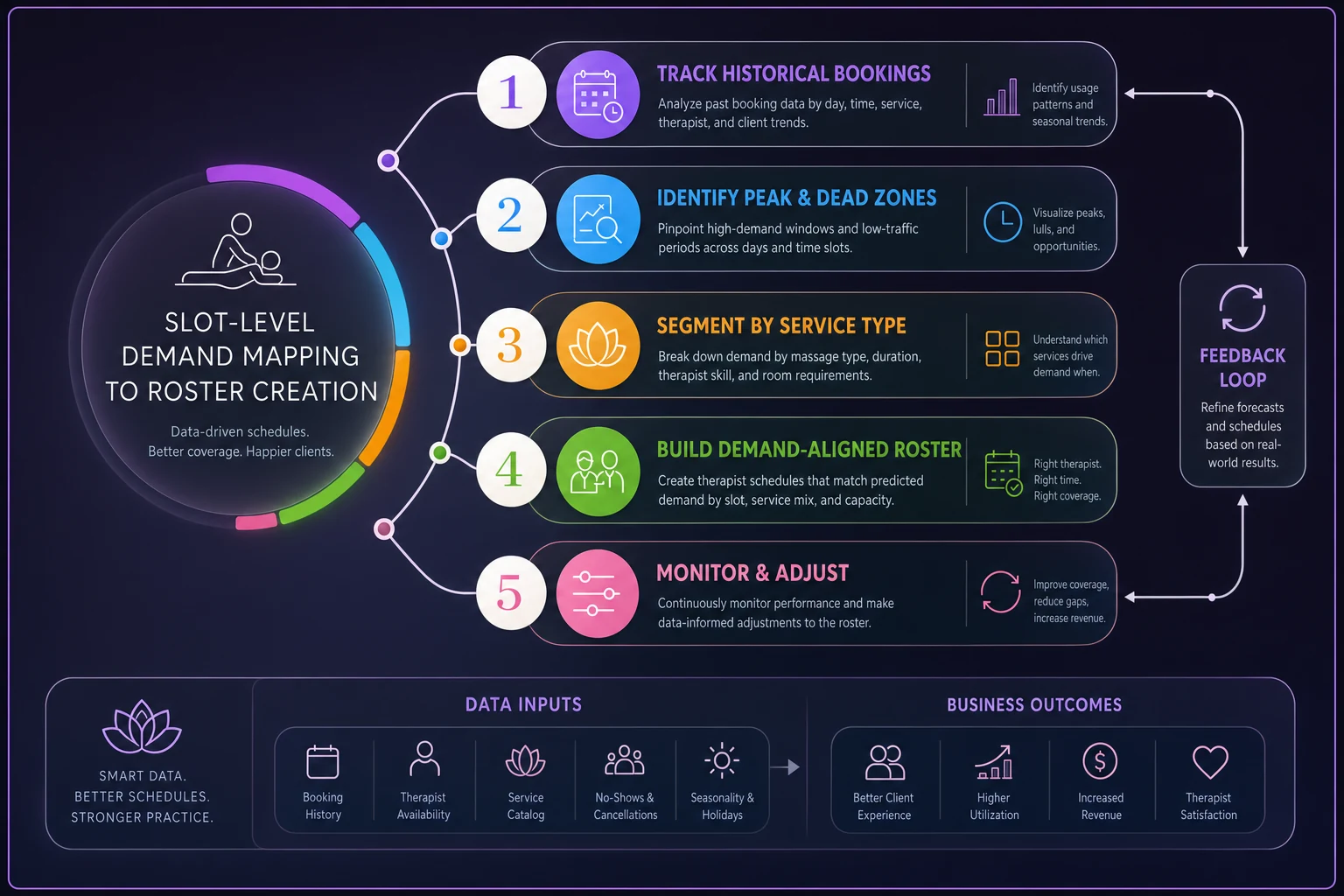
With that data, they rebuilt the roster entirely. Instead of traditional shifts, they created demand-aligned schedules. Busiest practitioners work Tuesday through Thursday middays. Part-time contractors cover evening rushes. Monday mornings get one therapist — enough to handle the handful of regulars who actually prefer that slot.
The results were pretty immediate. Therapist utilization jumped from around 65% to 81%, and they reduced total scheduled hours by 15% while handling the same client volume.
Target utilization rates that protect profitability without burning out staff
Most studios chase 100% utilization because it feels efficient. But maxed-out scheduling creates cascading problems — no buffer for running late, no time for room turnover, stressed therapists who burn out within months.
The sustainable sweet spot for massage studio utilization is somewhere between 75-85%, depending on your service mix. At 75% utilization, a therapist working an 8-hour shift performs about 6 hours of hands-on work, leaving room for client intake, room setup, documentation, and short breaks. Push past 85% consistently and quality drops, injuries become more frequent, and turnover accelerates.
Utilization targets also need to vary by therapist type and service category:
Utilization by role:
-
Deep tissue specialists
70-75% (more physically demanding)
-
Relaxation massage
80-85% (less intensive)
-
Chair massage contractors
85-90% (shorter sessions, less setup)
-
Senior therapists
65-75% (often handle more complex cases)
A studio near Atlanta learned this the hard way. They pushed all therapists to 90% utilization during busy season to maximize revenue. Within three months, four of their seven full-time therapists had developed repetitive strain injuries. Two treatment rooms closed for six weeks during recruiting, costing roughly $28,000 in lost revenue — far more than the short-term utilization gains were worth.
Seasonal roster templates prevent holiday chaos and summer dead zones
Wellness studios deal with predictable seasonal swings that standard scheduling simply wasn't built for. December brings around 40% more bookings as clients use year-end benefits and buy gift certificates. January floods with new-year motivation. July and August often crater as people take vacations.
Studios that handle this well build seasonal roster templates instead of scrambling each time demand shifts. A massage practice in Denver maps their year into five distinct roster seasons:
Holiday surge (Nov 15–Dec 31):
-
Add 3 contract therapists
-
Extend weekday hours to 9pm
-
Open Sundays 12–5pm
-
All staff guaranteed minimum hours
January reset (Jan 1–Feb 15):
-
Full roster, standard hours
-
Extra availability for new member consultations
-
Membership onboarding slots blocked in schedule
Spring steady (Feb 16–May 31):
-
Core roster only
-
Standard hours
-
One floater for sick coverage
Summer slowdown (Jun 1–Aug 31):
-
Reduced to 60% roster
-
Therapists rotate vacation weeks
-
Shortened weekend hours
Fall ramp (Sep 1–Nov 14):
-
Return to full roster
-
Begin recruiting holiday contractors
-
Extended Saturday hours
Each template includes specific therapist assignments, target hours, and service mix priorities. When seasons shift, they swap templates rather than rebuilding from scratch. That predictability helps contractors plan their income and removes the scheduling chaos that typically hits during seasonal transitions.
Decision rules that link promotions to contractor scheduling
The fastest way to blow up multi-therapist capacity planning is launching a promotion without adjusting your roster. A wellness center in Austin found this out after their "50% off deep tissue" deal brought in 200 new bookings in five days. They had to turn away roughly half because they hadn't scheduled additional contractors. The clients they did see got rushed service from overworked therapists. Most never came back.
Effective studios create decision rules that automatically trigger roster adjustments when promotions go live:
| Promotion Type | Roster Adjustment | Lead Time |
|---|---|---|
| Flash sale (24-48 hours) | Add 2 on-call contractors | Same day |
| Weekly special | Increase target utilization by 10% | 3 days before |
| Groupon/major discount | Add 30% more therapist hours | 1 week before |
| Membership drive | Block assessment slots | 2 weeks before |
| Gift certificate season | Activate holiday roster template | November 1 |
These rules remove the guesswork. Your booking coordinator knows exactly when to call in contractors based on promotional activity, not last-minute panic.
A concrete example: a studio running a "Bring a Friend" promotion knows from experience it generates roughly 80 extra bookings per week. Their decision rule says add one contractor for every 30 additional weekly bookings. So they automatically schedule three extra contractors that week, preventing the usual scenario where regular clients can't get in because all slots filled with discounted appointments.
Connecting demand data to daily operations
Having demand data and actually using it for scheduling decisions are two different things. Studios collect booking patterns, build reports, then still schedule therapists the same old way because nobody connects the data to day-to-day choices.
Here's how successful studios make demand-driven scheduling a real operational habit:
-
Monday planning ritual Review the previous week's actual vs. scheduled utilization. If any therapist fell below 70% for two consecutive weeks, shift their hours to higher-demand windows. If anyone consistently exceeded 85%, they get first choice of additional hours or a rate conversation.
-
Thursday contractor communication Send next week's demand forecast to all contractors. Include specific coverage gaps and expected booking volume. Contractors can claim additional shifts through a simple priority system based on reliability and client ratings.
-
Daily 4pm adjustment Check tomorrow's schedule for gaps and clusters. If any therapist has more than 90 minutes of idle time between bookings, offer to shift their start time or consolidate clients into a continuous block. Most therapists would rather work five straight hours than seven hours with dead gaps scattered throughout.
-
Monthly pattern review Compare actual demand against the roster template. If Tuesday 2pm slots consistently fill below 50%, stop scheduling them. If Saturday afternoons now hit 85%, add another therapist to that window.
This rhythm turns capacity planning from a theoretical exercise into something that actually affects daily decisions.
The technology layer that makes complex rostering manageable
Manual roster management works until you have about five therapists. Beyond that, you need systems that can handle the complexity without burning out a scheduling coordinator.
The minimum viable tech stack for multi-therapist capacity planning includes booking software with utilization tracking, automated contractor communication, and demand forecasting based on historical patterns. Most studios cobble together consumer tools instead — Google Calendar for scheduling, WhatsApp for coordination, Excel for tracking utilization. It sort of works until it doesn't.
Prioritize automating contractor communications first — it frees the most scheduler time and reduces last-minute scramble.
The problem compounds when you're coordinating multiple part-time contractors, tracking different utilization targets by service type, and adjusting for seasonal shifts while trying to maintain service quality. Scheduling coordinators end up spending 15-20 hours per week just wrestling with the roster puzzle.
Modern operational platforms built for wellness businesses automate a lot of this complexity. They track demand patterns automatically, suggest optimal roster configurations based on historical booking data, and flag managers when utilization drops below targets or when a promotion requires additional staffing. Some platforms handle contractor communication too — sending automated shift availability requests based on predicted demand and managing waitlists to fill last-minute gaps.
The real value isn't automation for its own sake. It's freeing your team to focus on actually delivering good service instead of spending their day texting therapists about schedule changes.
When capacity planning actually makes things worse
Not every wellness studio needs complex capacity planning. If you're running three or fewer therapists in a neighborhood practice with stable, predictable demand, sophisticated rostering might create more friction than it eliminates.
Demand-driven scheduling tends to fall apart when:
-
Your client base is too small to show meaningful patterns (under 200 monthly appointments)
-
You only work with independent contractors who set their own schedules
-
Your services vary too widely in duration and intensity to create standard utilization targets
-
Therapist availability in your market is more limiting than actual client demand
A boutique studio with two therapists who've worked together for years probably runs better with simple, consistent schedules than complex demand mapping. They know their regulars, understand the rhythm of the practice, and can adjust on the fly without formal systems.
The complexity threshold typically hits somewhere around four to six therapists or 400+ monthly appointments. That's when informal coordination breaks down and you actually need systematic capacity planning.
Measuring whether your roster changes actually work
Studios often overhaul their scheduling approach and assume it's working better without measuring anything concrete. You need specific metrics to know if demand-driven rostering is actually an improvement:
-
Therapist utilization rate Total hands-on hours divided by total scheduled hours. Should increase by 10-20% with proper demand mapping.
-
Gap time per therapist Average idle time between appointments. Should drop below 45 minutes per shift.
-
Schedule stability score How often you change therapist schedules with less than 48 hours notice. Should decrease by at least 50%.
-
Contractor satisfaction Survey contractors monthly about schedule predictability and hour consistency. Scores should improve within two months of implementing seasonal templates.
-
Revenue per scheduled hour Total service revenue divided by total therapist hours scheduled. This is the real efficiency metric — it should increase by 15-25% with optimized rostering.
A wellness center in Portland tracked these metrics through their rostering overhaul. Utilization jumped from 62% to 78%, but more importantly, therapists reported feeling less stressed despite handling more clients. Reduced gap time meant therapists worked fewer total hours while earning more, and predictable seasonal templates helped contractors plan their finances months in advance.
Building capacity planning into your growth strategy
Multi-therapist capacity planning isn't just about filling today's schedule efficiently. It's the operational foundation that determines whether you can scale beyond a handful of therapists without drowning in complexity.
Studios that get demand-driven rostering right can add therapists strategically — they know exactly when they need more Tuesday afternoon coverage versus Saturday morning capacity. They can run promotions without panic, knowing their decision rules will trigger the right staffing adjustments. They can offer contractors predictable seasonal schedules that actually reduce turnover.
The alternative — sticking with availability-based scheduling as you grow — follows a predictable pattern. Scheduling complexity increases exponentially with each new therapist. Your coordinator gets overwhelmed. Therapists get frustrated with inconsistent hours. Clients face longer waits despite seeing empty treatment rooms. Eventually you hit a growth ceiling not because of market demand but because your operational systems can't handle more moving parts.
Start simple. Track when bookings actually happen versus when you're staffed for just one week. Find the biggest gap between therapist availability and client demand. Fix that one misalignment before moving on to seasonal templates or comprehensive decision rules.
Small improvements in capacity planning compound fast in multi-therapist studios. Even a 10% bump in utilization can translate to an extra $3,000-4,000 in monthly revenue without adding therapists or extending hours. More importantly, it builds the operational foundation for sustainable growth — the kind that gets you past the chaos threshold that stops most wellness studios from ever scaling.
The studios thriving with 10, 15, or 20 therapists aren't just lucky or in better locations. They've built systematic capacity planning that turns scheduling from a daily firefight into a predictable operational rhythm. Your booking calendar should be a revenue optimization tool, not just a schedule tracker.
Ready to elevate your massage therapy business?
Join hundreds of therapists using Masthera to save time, reduce scheduling conflicts, and enhance client satisfaction.