


Most owners of a single-location, three-room wellness center don't fail at buying software because they picked a "bad" platform. They fail because they evaluated eleven of them, got decision fatigue around vendor six, and then signed with whoever had the pushiest sales rep or the cleanest demo screen that afternoon.
The problem with a three-room center is that you sit in an awkward middle. You're too big for a solo-practitioner calendar app—you've got multiple therapists, overlapping rooms, and real POS volume—but you're nowhere near the scale where enterprise, multi-site reporting suites make sense. If you want that side of the picture, the practical data and reporting strategy for small wellness chains post covers chain-level analytics. This guide stays out of that lane entirely. Here we're focused on getting you to a vendor-ready shortlist of three, with scoring criteria, a demo checklist, and the exact questions that expose weak products.
Build the shortlist by elimination, not by feature-chasing.
The only four jobs this software has to nail
The feature list vendors throw at you is 80% noise. Strip it down. There are four jobs that, if any one of them is weak, will cost you money and sanity every single week:
-
Unified appointment management — one calendar that shows all three rooms, all therapists, and all service durations without double-booking a room or a person.
-
Therapist rostering — the ability to set who works when, who does what service, and have the booking calendar respect those rules automatically.
-
Automated reminders — SMS and email that fire without someone remembering to send them.
-
A simple POS — tap-to-pay, tips, packages, and a receipt, without a 14-step checkout.
Everything else—marketing suites, loyalty gamification, AI-written review responses—is a "nice later." If a vendor can't demo all four of these cleanly in 20 minutes, they drop off the list.
One pattern worth knowing: the products that market hardest on add-on features are often hiding a clumsy core calendar. In real operations, the calendar is the thing your front desk touches 200 times a day. A gorgeous marketing module you open twice a month is not where your money is made or lost.
Why three-room centers break standard calendars
The single biggest reason generic scheduling tools fall apart in a three-room center is the room-as-a-resource problem.
Never miss a booking or double-book again.
Masthera helps you schedule, confirm & manage every massage session with ease.
- Unified appointment management
- Automated client reminders
- Therapist calendar coordination
No credit card required
A solo app only tracks one dimension: the therapist's time. In your space, a booking consumes two resources at once—a therapist and a room. A 90-minute deep tissue needs Maria free and Room 2 free and the hot-stone warmer that lives in Room 2. If the software only checks therapist availability, you get the nightmare scenario: two therapists both "available" at 3:00, both auto-assigned to the only room with a table heater.
A typical example looks like this: a center runs couples massage in Rooms 1 and 2, but Room 3 is a smaller single. The online booking widget happily sells two couples sessions at the same slot because it only counted therapists, not rooms. Four clients, two usable rooms, and a front desk apologizing on a Saturday.
The real test isn't "does it have a calendar." It's whether the calendar enforces multiple resource constraints simultaneously. Put this at the top of your scoring sheet. Most cheap tools fail it.
How to get from a crowded market to three vendors
You don't need to research 15 platforms. Use these elimination gates in order. Each one kills a chunk of the market fast.
Gate 1 — Room + therapist double-resource support. If it can't block a room and a person simultaneously, it's out. This alone removes most solo-oriented apps.
Gate 2 — Per-therapist service rules. Can you say "James does sports massage but not prenatal," and have the online booker hide prenatal from James automatically? If staff capabilities aren't baked into availability, your front desk becomes a human filter forever.
Gate 3 — Native SMS reminders included, not a paid bolt-on through a third party. Email-only reminders are a non-starter for massage no-shows. If SMS costs extra per message with no cap, model the monthly cost before you fall in love with the platform.
Gate 4 — Integrated POS with tips and packages. If checkout lives in a separate Square account you reconcile by hand every night, you've bought two systems, not one.
Gate 5 — Reasonable monthly cost for a single location. Anything priced in a way that assumes multi-site should be cut unless the single-site tier is genuinely sane.
Run every candidate through those five gates and you'll naturally land on three or four. That's your shortlist—not because they're the best brands, but because they're the only ones that survived.
A quick structural note on your shortlist mix
-
One "booking-first" platform — built around scheduling, strong calendar, decent POS.
-
One "POS-first / spa suite" platform — strong checkout and retail, scheduling slightly heavier to learn.
-
One "modern lightweight" platform — clean mobile experience, fewer features but faster to run day-to-day.
If all three finalists are the same type, you're comparing shades of the same thing and won't discover your real preference.
A simple visual of the elimination flow can make this process easier to follow.
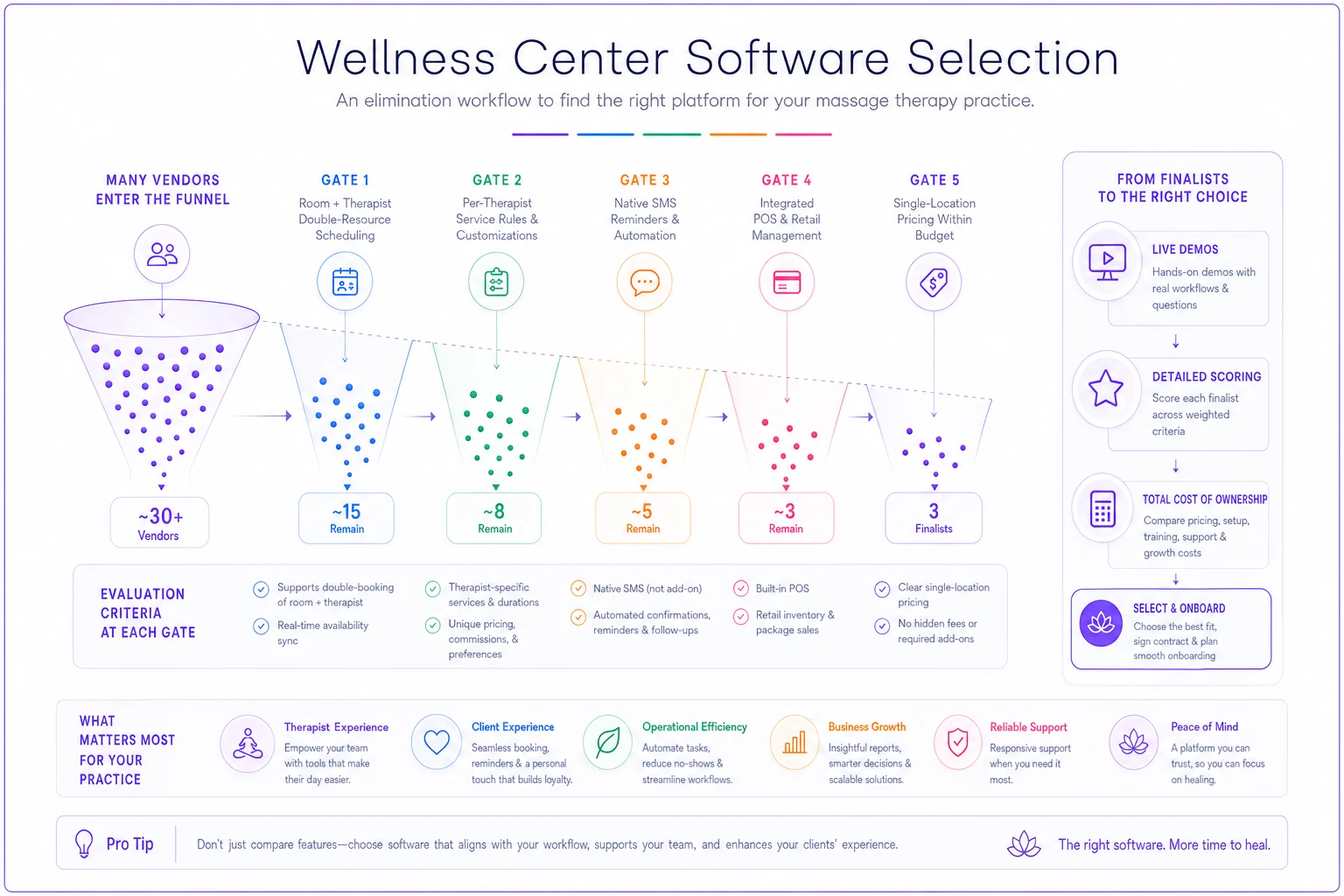
A quick structural note: aim for variety across your three so the demos actually teach you something.
The scoring template (steal this)
Score each vendor 1–5 on every row. Weight the rows that match how your center actually runs. Rebuild this in a spreadsheet so you can total the columns.
| Criteria | Weight | Vendor A | Vendor B | Vendor C |
|---|---|---|---|---|
| Room + therapist dual-resource booking | ×3 | |||
| Per-therapist service/skill rules | ×3 | |||
| Online booking widget (client-facing flow) | ×2 | |||
| SMS + email reminders (included, customizable) | ×3 | |||
| No-show / cancellation policy enforcement | ×2 | |||
| POS: tips, packages, gift cards, receipts | ×3 | |||
| Speed of checkout (clicks to complete sale) | ×2 | |||
| Reporting basics (daily totals, who's booked) | ×1 | |||
| Ease for a non-technical front desk | ×2 | |||
| Monthly all-in cost (incl. SMS + processing) | ×2 | |||
| Data export / migration if you leave | ×2 | |||
| Support responsiveness during trial | ×1 |
Multiply each score by the weight, total the columns, and you've got a defensible decision instead of a gut call.
One honest warning: don't let a single flashy feature inflate a whole column. A vendor with a beautiful reporting screen but a weak calendar will feel impressive in a demo and hurt you daily. The weights above intentionally put the heaviest emphasis on the four core jobs, not the shiny extras.
The demo checklist: what to make them do live
Vendors will try to drive the demo. Don't let them. Hand them this list and ask them to perform each task on screen. Watching them do it—or fumble it—tells you more than any brochure.
-
Book a 90-minute session that assigns a specific therapist and a specific room, then try to double-book that same room at the same time and confirm the system blocks you.
-
Hide a service from one therapist. Make a therapist unqualified for prenatal, then show that prenatal disappears from that therapist's online availability.
-
Fire a reminder. Trigger an SMS to a real phone during the demo. If they "can't do that right now," write it down.
-
Run a full checkout with a service, a retail product, a tip, and a package redemption—count the clicks.
-
Apply a late-cancel fee to a booking and show where that money shows up.
-
Pull today's schedule across all three rooms on one screen.
-
Export client data to CSV. If they stall here, take it seriously—it predicts how painful leaving will be.
Insist they trigger a live SMS to a real phone during the demo; if they can't, treat it as a red flag.
A good rule: if a rep says "that's on the roadmap" to more than one of these, they're selling you a future, not a product.
Sample vendor questions that expose weak products
Generic questions get generic answers. These are pointed enough to catch vendors off guard, which is the whole point.
-
"When a client books online, does the system reserve both the therapist and the treatment room, or just the therapist?" (Tests the core resource problem.)
-
"Are SMS reminders included in my plan, or priced per message? What's my realistic monthly SMS bill at around 300–400 appointments?" (Surfaces hidden costs.)
-
"If a therapist calls out sick, how many steps does it take to reassign their day's bookings to another room or therapist?" (Tests real-world chaos handling.)
-
"Can two clients book the last available slot at the exact same second online, and what happens?" (Tests overbooking protection.)
-
"What happens to my client data, notes, and gift-card balances if I cancel? Can I export everything myself?" (Tests lock-in.)
-
"Is the POS fully integrated, or does it push to a separate payment processor I reconcile manually?"
-
"Can the front desk override the system to squeeze in a walk-in, and does that override respect room availability?"
-
"What's the actual contract term, and what's the price after any intro discount ends?"
That last one matters more than people expect. A common pattern: a center signs at an attractive first-year rate, then renewal lands 30–40% higher. Ask for the standard rate in writing, not the promo.
A real scenario: what weak rostering actually costs
A three-room center—three therapists, somewhere around 330–360 appointments a month—was running a solo-oriented calendar app plus a separate card reader.
Because the app only tracked therapist time, the owner manually "protected" rooms by leaving fake buffer appointments. Front desk forgot to add them during busy stretches. The result was two or three room conflicts a week, each one meaning a rushed room flip, a downgraded service, or a comped session to keep the client happy. Once you added lost retail and the occasional refund, those comped and shuffled sessions were quietly running somewhere in the $400–$600 a month range.
Reminders were email-only. No-shows ran high enough that a few empty slots a week were just accepted as normal—lost revenue that never showed up as a line item because an empty slot doesn't generate a receipt.
After moving to a platform that enforced room-plus-therapist booking and sent SMS reminders automatically, the double-booking problem basically disappeared because the system wouldn't allow it. No-shows dropped noticeably once texts went out by default. Nothing dramatic—just the software refusing to let the two most expensive mistakes happen. The owner's own description was that Saturdays stopped feeling like damage control.
The exact dollars aren't really the point. The costs of the wrong tool are invisible on a P&L—they hide inside comps, empty slots, and front-desk stress—so owners consistently underestimate how much the right core features are actually worth.
When this shortlist approach makes sense (and when it doesn't)
When it makes sense: You run one location, two to five therapists, a handful of rooms, and you want to stop evaluating and start operating. The four-job filter and the three-vendor cap are built for exactly this. You don't need advanced analytics, multi-site governance, or franchise tooling right now, and buying for those needs means paying for complexity you'll never touch.
When it's a bad idea: If you're actively planning a second location in the next 6–12 months, don't optimize purely for single-site simplicity. You'll want to think ahead about how data and operational standards carry across sites so you don't end up migrating twice.
Who should skip this entirely: True solo practitioners with one room. You don't have the dual-resource problem, so most of the weighting here doesn't apply to you. A simpler calendar app is genuinely fine, and these platforms will feel like overkill you're paying for every month.
Bringing it together
The reason three-vendor shortlisting beats open-ended research is that it forces you to decide what matters before salespeople decide for you. Lock the four core jobs. Run every candidate through the five elimination gates. Score with weighted criteria that favor the calendar and POS over the shiny extras. Then make each finalist perform the demo tasks live instead of narrating a slideshow.
If you do only one thing from this guide, make it this: during every demo, try to double-book a room on purpose. The platform that won't let you is probably the one worth signing with—and that single test will tell you more than an hour of feature talk ever could.
If you do only one thing from this guide, make it this: during every demo, try to double-book a room on purpose. The platform that won't let you is probably the one worth signing with—and that single test will tell you more than an hour of feature talk ever could.
Ready to elevate your massage therapy business?
Join hundreds of therapists using Masthera to save time, reduce scheduling conflicts, and enhance client satisfaction.