



Most multi-location wellness owners don't have a data problem. They have a reconciliation problem. The calendar says one thing, the POS says another, the payment processor shows a third number, and by the time someone tries to build a monthly report, nobody's sure which one is real. So the report gets built anyway, gets presented in a manager meeting, and everyone quietly stops trusting it.
That's the actual failure mode of data reporting in small wellness chains — not missing data, but conflicting data with no agreement on who owns the source of truth. It gets worse with every location you add, because each new studio brings its own version of "how we log things."
This article is about building a reporting system that survives growth: a lean set of metrics, a clear map of where each number comes from, simple ways to make the systems agree, and a one-page governance sheet that assigns a human owner to every field. Nothing fancy. Just a structure that doesn't collapse when you go from two studios to five.
Why the numbers stop agreeing as you scale
At one location, the owner is the reconciliation layer. They know Tuesday's cash drawer was short because a client paid half in gift card, they remember the therapist who forgot to close out a session, they can eyeball the deposit and know it's roughly right. That mental bookkeeping works fine until it doesn't.
Add a second studio and suddenly you're relying on someone else's habits. One front desk closes appointments as "completed" the moment the client walks in. Another marks them completed only after payment. Now your utilization numbers are measuring two different things and you don't even know it. Roll that up into a chain-wide report and the totals are technically accurate and completely meaningless.
What shows up across a lot of these operations is that the breakage almost never comes from the big financial systems. Payments are usually clean — Stripe or Square reconcile to the penny. The mess lives in the soft edges: how appointments get statused, how packages get decremented, how a comped session or a staff massage gets recorded. Those are the fields humans touch, and humans improvise.
The other thing that breaks is time. Your calendar thinks in appointment slots. Your POS thinks in transactions. Your payment processor thinks in settlement batches that clear a day or two later. When you try to answer a simple question like "how much did the Riverside location make last Thursday," you're stitching together three different clocks. Without a rule for which date wins, two people pulling the "same" report get different answers.
Start with a metrics taxonomy that's small on purpose
The instinct when you get serious about data is to track everything. Resist it. Every metric you add is a field someone has to keep clean, and dirty metrics are worse than missing ones because they get used anyway.
Never miss a booking or double-book again.
Masthera helps you schedule, confirm & manage every massage session with ease.
- Unified appointment management
- Automated client reminders
- Therapist calendar coordination
No credit card required
Aim for 8 to 12 KPIs total, grouped so each one answers a decision you actually make. If you already run a single-studio dashboard, this is the multi-location extension of that thinking — and it pairs well with the logic in our minimal KPI dashboard for massage practices, which covers the decision rules behind the metrics themselves.
Here's a taxonomy that holds up across most small chains:
| KPI | What it answers | Primary source system |
|---|---|---|
| Booked utilization % | Are we filling available hours? | Calendar |
| Completed vs. booked ratio | Are booked slots turning into revenue? | Calendar + POS |
| Revenue per available hour | Are we pricing/filling profitably? | POS + Calendar |
| Average ticket | Is upsell/add-on working? | POS |
| New vs. returning client mix | Are we retaining or churning? | POS / booking |
| Rebooking rate | Are clients coming back? | Calendar |
| Package/membership liability | How much prepaid service do we owe? | POS + payments |
| Net revenue (post-refund/discount) | What did we actually keep? | Payments |
| No-show / late-cancel rate | How much capacity are we losing? | Calendar |
| Payroll as % of location revenue | Is each studio staffed sanely? | Payroll + POS |
| Collected vs. earned | Are we chasing unpaid balances? | Payments + POS |
That's eleven. Most chains don't need a twelfth. The discipline here is that each metric maps to a single primary source — the system that owns the truth for that number — even when other systems touch it. That distinction is the whole game.
One rule that prevents half your disputes
Pick a revenue recognition date and write it down. Either revenue counts on the service date or on the payment settlement date — not "whichever is convenient." Service-date works better for operational reporting because it matches the therapist's day. Settlement-date matches your bank. Most wellness chains should report operations on service date and reconcile cash on settlement date, and never mix the two in one report.
Map your source systems before you touch a spreadsheet
You can't build reliable reports until you know exactly where each number is born and where it gets mangled. In a typical small chain, four systems feed everything:
-
Calendar / booking system — owns appointments, statuses, therapist assignment, no-shows.
-
POS — owns what was sold, add-ons, discounts, packages, tips.
-
Payment processor — owns money that actually moved, refunds, chargebacks, settlement timing.
-
SOAP notes / clinical records — owns whether a session actually happened and what was delivered.
Most owners forget that SOAP notes are a data source, not just a compliance file. When a completed appointment has no note attached, that's a signal — either the session didn't happen the way the calendar says, or documentation is slipping. A missing note on a "completed, paid" appointment is one of the cleanest error detectors you have, and it costs nothing to check. If your notes system is shaky, tightening it alongside the compliance reasons is worthwhile from a reporting standpoint too.
Here's a workflow worth running before you trust any report. Take a single appointment and follow it across all four systems:
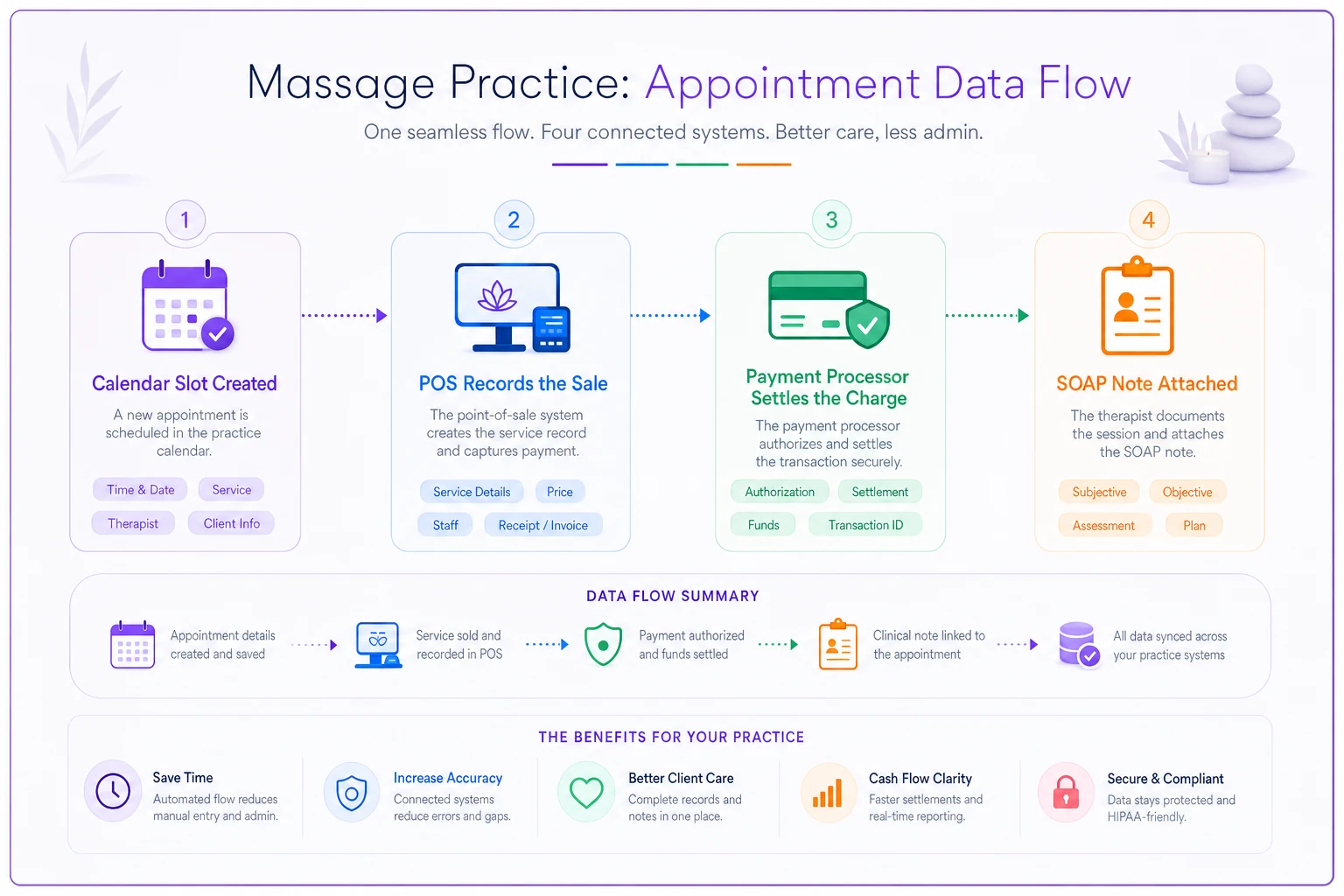
If those four don't line up for one appointment, they won't line up for three thousand. Walk five random appointments per location this way. You'll find your break points in about twenty minutes.
Lightweight reconciliation that a non-technical owner can run
"ETL" sounds like something that needs an engineer. For a wellness chain, it just means: pull the data out, line it up, check that it agrees. You can do the whole thing with exports and a spreadsheet — the important part is the pattern, not the tooling.
The core reconciliation runs as a three-way match, per location, per period:
-
Extract — export the same date range from calendar, POS, and payments. Same start and end date, same timezone, no exceptions.
-
Key it — every appointment needs a shared identifier. Most systems expose an appointment ID or a client+date+therapist combo you can match on. If you can't join records across systems, that's your first fix.
-
Match completed → sold → settled — for each completed appointment, confirm there's a matching sale and a matching (or pending) settlement.
-
Flag the gaps, which fall into a few predictable buckets
The goal isn't zero gaps. It's a known and explained gap list. A healthy small chain might see a handful of unmatched items per location per week — comps, product sales, timing lags. What you're actually hunting for is the pattern that repeats: the front desk that always shows completed-no-sale, the therapist whose notes are consistently three days behind.
Standardize an appointment ID (or a reliable client+date+therapist combo) early so joining exports is a simple spreadsheet VLOOKUP or merge.
Run this monthly at minimum, weekly once you're past three locations. It slots naturally into your existing close process — if you've built out a month-end checklist with forecasting and reconciliation, this three-way match is the data layer that feeds it.
-
Completed appointment, no sale → comped, forgotten checkout, or mis-status
-
Sale, no completed appointment → walk-in not booked, or product-only sale
-
Sale, no settlement → unpaid balance, failed card, or timing lag
-
Completed + paid, no SOAP note → documentation gap
The goal isn't zero gaps. It's a known and explained gap list. A healthy small chain might see a handful of unmatched items per location per week — comps, product sales, timing lags. What you're actually hunting for is the pattern that repeats: the front desk that always shows completed-no-sale, the therapist whose notes are consistently three days behind.
The one-page governance checklist
This is the piece almost everyone skips, and it's the piece that makes everything else hold together. Governance here just means: for every metric, one named human owns keeping the source clean. Not a department. A person.
-
Appointment statusing standard — one written definition of "completed," same at every location. Owner: [name]
-
Revenue recognition date — service date vs. settlement date, decided and documented. Owner: [name]
-
Discount & comp logging — every free or discounted session gets a reason code. Owner: [name]
-
Package/membership decrementing — sessions come off the balance at delivery, not at booking. Owner: [name]
-
SOAP note completion window — notes attached within X hours of session. Owner: [name]
-
Refund & chargeback handling — where refunds get recorded so net revenue stays honest. Owner: [name]
-
Payroll % mapping — hours tied to the correct location. Owner: [name]
-
Weekly reconciliation run — who runs the three-way match and reviews the exception list. Owner: [name]
-
Cross-location definitions review — quarterly check that all studios still measure the same way. Owner: [name]
Owner-by-field is the whole trick. When a number looks wrong in the chain report, you don't launch an investigation — you look at the field, find the owner, and ask one person. That's the difference between a reporting system that scales and one that turns every discrepancy into a meeting.
Sample report cadence
You don't need daily dashboards for a wellness chain. You need the right number at the right rhythm:
-
Weekly — utilization, no-show rate, reconciliation exception list. Fast operational signals, per location.
-
Monthly — full KPI set, net revenue, package liability, payroll %. This is your real business review.
-
Quarterly — trend view across locations, definitions audit, and a check on whether any studio has drifted from the standard.
Resist the urge to report everything weekly. Metrics viewed too often invite over-reaction to noise — one bad week isn't a trend, and owners who stare at daily revenue tend to make jumpy decisions. The cadence above is deliberately conservative for that reason.
A real scenario
A three-location wellness group — massage plus facials and stretch therapy — kept getting different revenue totals depending on who pulled the report. The bookkeeper used bank settlements, the operations manager used the POS, and the two never matched. The monthly gap ran a few thousand dollars, sometimes more, and nobody could explain it clearly enough to fix it. Eventually the founder had basically stopped trusting the reports and was managing on gut.
The fix wasn't new software — it was definitions. They locked service-date as the reporting standard, wrote one status definition, and started a weekly three-way match. Within the first two runs they found the culprits: one location was comping "friends and family" sessions with no reason code, so they showed as completed-no-sale. Package sessions were being decremented at booking rather than delivery, which quietly overstated used inventory.
Once those were tightened and an exception-based reconciliation replaced the full manual matching, the monthly discrepancy dropped to near zero — the only gaps left were explainable timing lags. More importantly, the founder started using the numbers to make staffing calls again. Nothing about the revenue changed. What changed was that the reports became trustworthy, and a trustworthy report you actually use is worth far more than a perfect one sitting ignored.
When this level of rigor makes sense — and when it doesn't
Do this if you're running two or more locations, if different people are entering data, or if you've ever had two "correct" reports disagree. The reconciliation and governance layer pays for itself the moment you can't personally verify every number.
Don't over-build this if you're a solo practitioner or single studio where you touch every transaction yourself. You'll get most of the value from a clean status definition and a simple monthly check — building nine governance owners for a two-person shop is just ceremony.
Be careful if you're mid-migration between practice-management systems. Standardize your definitions and clean up your reconciliation before you move, not during. Moving messy data just gives you fast, clean access to the wrong numbers. If a system change is on the horizon, our practice-management selection and migration runbook is worth reading first, because migration is exactly when definition drift sneaks in.
The point of all this
A reporting strategy for a small wellness chain isn't about dashboards or fancy analytics. It's about getting a handful of systems that were never designed to talk to each other to agree on what happened, and assigning a human to keep each of them honest.
Eight to twelve metrics, one source of truth per metric, a repeatable three-way match, and a one-page sheet with a name next to every field. Get that skeleton right and growth stops breaking your numbers. Skip it, and every new location adds another version of the truth until you're managing a chain on instinct — which works right up until the day it very expensively doesn't.
Eight to twelve metrics, one source of truth per metric, a repeatable three-way match, and a one-page sheet with a name next to every field. Get that skeleton right and growth stops breaking your numbers. Skip it, and every new location adds another version of the truth until you're managing a chain on instinct — which works right up until the day it very expensively doesn't.
Ready to elevate your massage therapy business?
Join hundreds of therapists using Masthera to save time, reduce scheduling conflicts, and enhance client satisfaction.