
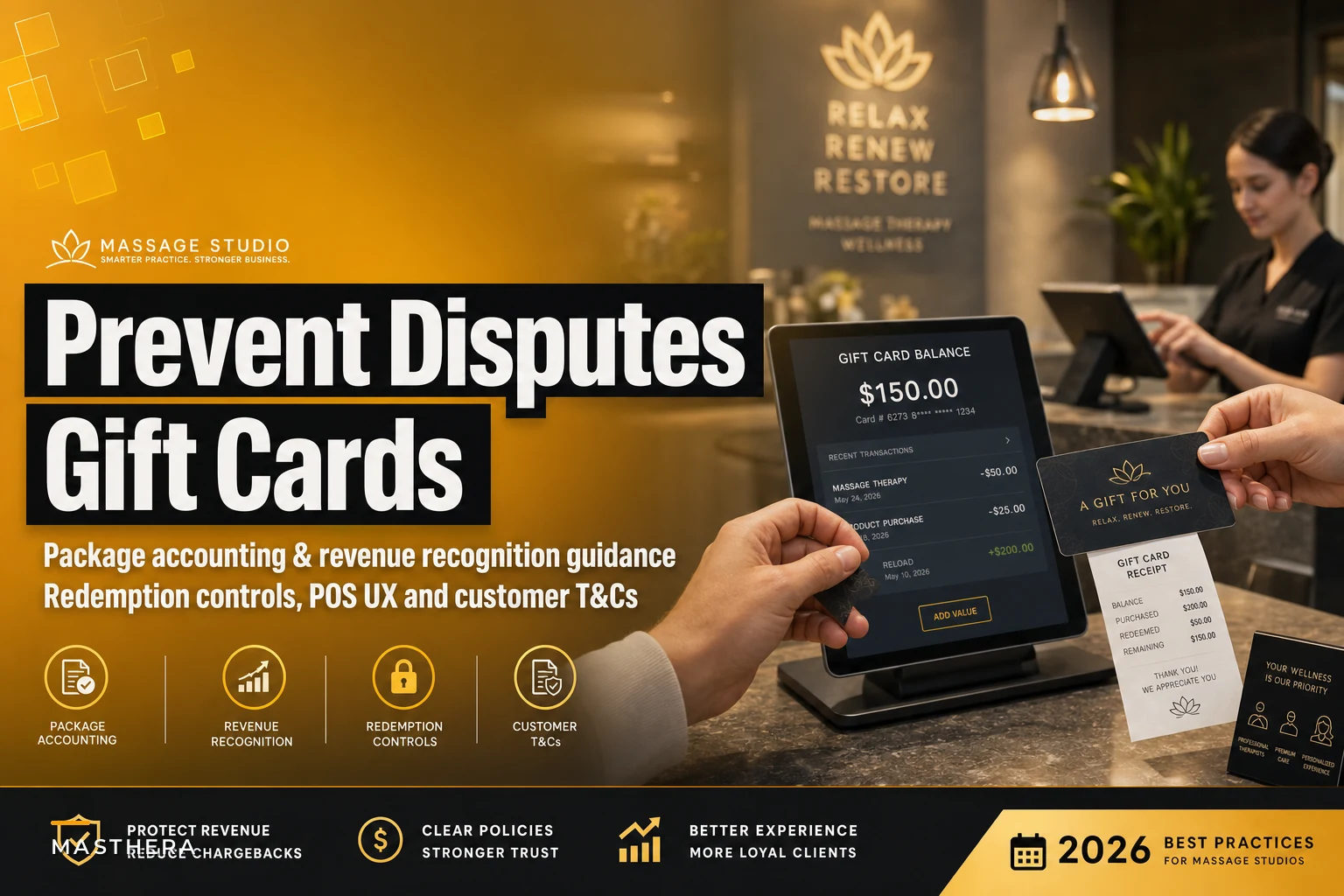

Gift cards seem straightforward until a customer walks in six months later claiming their $200 certificate should still have $150 left, while your system shows $50. Or worse, they show up with a two-year-old gift card you sold before switching booking software, and now you're stuck between honoring it blindly or risking a bad review.
Gift cards create genuinely weird operational headaches for massage studios. Unlike retail where products walk out the door, service-based gift cards exist in this strange limbo—sold today, redeemed months later, partially used across multiple visits, sometimes transferred between people, occasionally disputed when the balance runs low.
Most disputes happen because studios treat gift certificates like simple prepaid credits instead of the complex financial instruments they actually are. The accounting gets murky, redemption tracking breaks down, and before long you're manually checking spreadsheets trying to figure out if that frustrated customer is actually right about their remaining balance.
Why gift card disputes hit massage studios harder than retail
The complexity comes down to timing mismatches and service variability. When someone buys a $150 gift certificate for "any massage service," you've essentially created a floating liability that could be redeemed for your $95 Swedish or your $180 deep tissue session. Add in tip expectations, product add-ons, and package deals, and that simple gift card suddenly touches every part of your operation.
Consider what happens in practice: a client purchases a $200 gift card in December as a holiday gift. The recipient books in February, uses $120 for a 90-minute massage. They return in May thinking they have $80 left, but your front desk shows $65 because someone incorrectly logged the February tip as coming from the certificate. Now you're digging through transaction records while other clients wait.
The accounting side creates its own problems. That $200 you collected in December isn't revenue yet—it's deferred income that only becomes real when services get delivered. But a lot of studio owners just deposit the cash and figure they'll sort it out later. Then tax season arrives and your accountant asks about $8,000 in unredeemed gift cards that you've already spent on January rent.
Studios using basic booking software—or worse, paper tracking—often discover their gift card liabilities don't match their redemption records. Maybe you switched systems last year and manually transferred balances. Maybe different staff members record partial redemptions differently. Sometimes certificates get forgotten in desk drawers until an annoyed customer shows up with a crumpled receipt two years later.
The hidden cost of gift card chaos
Beyond the obvious customer service problems, poorly managed gift cards create cascading issues. Staff waste time hunting down purchase records and calculating remaining balances. Owners lose sleep wondering about outstanding liabilities. The whole studio develops anxiety around gift card redemptions because everyone knows the process is broken.
Never miss a booking or double-book again.
Masthera helps you schedule, confirm & manage every massage session with ease.
- Unified appointment management
- Automated client reminders
- Therapist calendar coordination
No credit card required
Financial planning becomes nearly impossible when you can't accurately track deferred revenue. A studio might show $12,000 in gift card sales for December and feel flush with cash—not realizing that money is already spoken for. Come March, when those certificates start getting redeemed, you're essentially delivering free services while wondering why cash flow feels tight despite being "busy."
Some studios try to sidestep these issues by setting aggressive expiration dates, but state laws increasingly restrict or prohibit that entirely. California bans expiration on paid value outright. Other states require minimum five-year terms. Even where it's legal, short expiration periods generate complaints and discourage gift purchases in the first place.
The reputation damage from mishandled gift cards also spreads fast. One frustrated customer posting about their "stolen" balance reaches hundreds of potential clients. People considering gift purchases for Mother's Day or the holidays might just choose a competitor who seems more organized—and the studio that should be benefiting from essentially interest-free customer loans ends up treating gift cards like operational landmines.
Building a bulletproof gift card tracking system
The solution starts with treating gift cards as what they are: financial products requiring proper tracking, clear policies, and consistent processes. Every certificate sold needs a unique identifier, purchase date, original value, and complete redemption history. This isn't optional bookkeeping—it's the foundation for avoiding disputes.
Here's the basic tracking framework that works:
Initial Recording
-
Unique gift card number (GC-2024-0847)
-
Purchase date and payment method
-
Purchaser name and contact
-
Recipient name (if different)
-
Original value
-
Any special terms or restrictions
Redemption Tracking
-
Date of each use
-
Service provided
-
Service value
-
Amount deducted from certificate
-
Remaining balance
-
Staff member who processed
Balance Management
-
Current balance clearly visible in booking system
-
Automatic balance updates after each use
-
Email confirmations showing remaining value
-
Periodic balance reminders for unused certificates
The tracking system needs to integrate with your booking platform. Manual spreadsheets break down quickly—one missed entry or formula error creates cascading problems. Booking software with an integrated gift card module eliminates most of these headaches, automatically calculating balances and maintaining full redemption histories.
Sample packages that reduce accounting complexity
Rather than selling open-ended gift certificates that create variable liabilities, many successful studios now offer specific package products. It simplifies tracking and sets clearer expectations on both sides.
| Package Type | Price | What's Included | Accounting Benefit |
|---|---|---|---|
| Relaxation Package | $150 | 60-min Swedish massage + aromatherapy | Fixed service value, clear redemption |
| Couples Retreat | $280 | Two 60-min massages, same appointment | Single redemption event |
| Monthly Wellness | $95/month x 3 | Three prepaid monthly sessions | Staged revenue recognition |
| New Client Special | $179 | 90-min massage + consultation + product sample | One-time use, no partials |
| Prenatal Series | $340 | Four 45-min prenatal sessions | Clear session count |
Package-based gift cards eliminate the "how much is left?" problem because they're either used or they're not. The Couples Retreat can't be partially redeemed—both services happen together or not at all. The Prenatal Series tracks sessions rather than dollars, which makes any balance conversation straightforward.
This also improves cash flow predictability. When someone buys the Monthly Wellness package, you know exactly when that deferred revenue converts: one-third each month for three months. No guessing whether that $285 gift card will be redeemed tomorrow or next spring. That kind of visibility actually matters when you're trying to staff appropriately and manage expenses.
Revenue recognition rules that prevent tax surprises
The accounting treatment of gift card sales trips up studio owners every tax season. That $200 certificate sold in December isn't December revenue—it's a liability until the service gets delivered. Getting this wrong means paying taxes on money you haven't actually earned yet.
Track gift card sales separately from service revenue. Create distinct categories:
-
Gift Card Sales (liability account)
-
Gift Card Redemptions (reducing liability)
-
Service Revenue from Gift Cards (actual income)
-
Expired/Forfeited Gift Cards (if applicable in your state)
Monthly reconciliation keeps everything clean. Total outstanding gift card liability should match the sum of all unredeemed certificate balances. If these numbers drift apart, you've got a tracking problem worth investigating before it compounds.
For package-based certificates, recognize revenue as services get delivered. The four-session Prenatal Series means recognizing 25% of revenue with each appointment. This matches income to service delivery and keeps your books accurate.
Some studios using AI-powered operational platforms automate this entire process—tracking sales, monitoring redemptions, and categorizing revenue without manual journal entries. Come tax time, you've got clean reports showing exactly how much deferred revenue is sitting in gift cards versus what's been earned through actual service delivery.
Redemption controls that eliminate disputes
Clear redemption rules prevent most gift card conflicts before they start. But those rules need to be communicated upfront, built into your systems, and consistently enforced by all staff—not just whoever happens to be working that day.
Verification Requirements
-
Physical certificate or digital code
-
Photo ID matching certificate name
-
Original purchase email (for lost certificates)
Partial Redemption Rules
-
Remaining balance must exceed $10 to stay active
-
Balances under $10 convert to account credit
-
Tips cannot be charged to gift certificates
-
Product purchases require separate payment
Transfer and Combination Policies
-
Certificates can be transferred once with written notice
-
Multiple certificates cannot be combined in a single transaction
-
Family members can use with written authorization
Build these controls into your booking system. When someone tries to use a gift certificate for a tip, the system should block it automatically. If they're trying to combine three different certificates, staff should see a clear policy reminder. This removes the burden of enforcement from your team while keeping things consistent.
POS workflows that prevent front-desk confusion
Even with solid policies, redemption breaks down at the point of sale if your team doesn't have a clear workflow. Every staff member needs the same process for checking balances and processing partial redemptions—not their own improvised version of it.
The basic workflow looks like this:
-
Customer presents certificate - Verify certificate number in system - Confirm current balance - Match customer name or verify transfer
-
Service selection - Confirm service price fits within balance - Explain any restrictions (no tips, products separate) - Note remaining balance after service
-
Check-out process - Apply certificate to service charge - Process any additional payment needed - Print or email receipt showing remaining balance - Update certificate record immediately
-
Documentation - Log redemption in system - Note any special circumstances - File physical certificate if applicable
Here's a quick visual of the POS workflow.
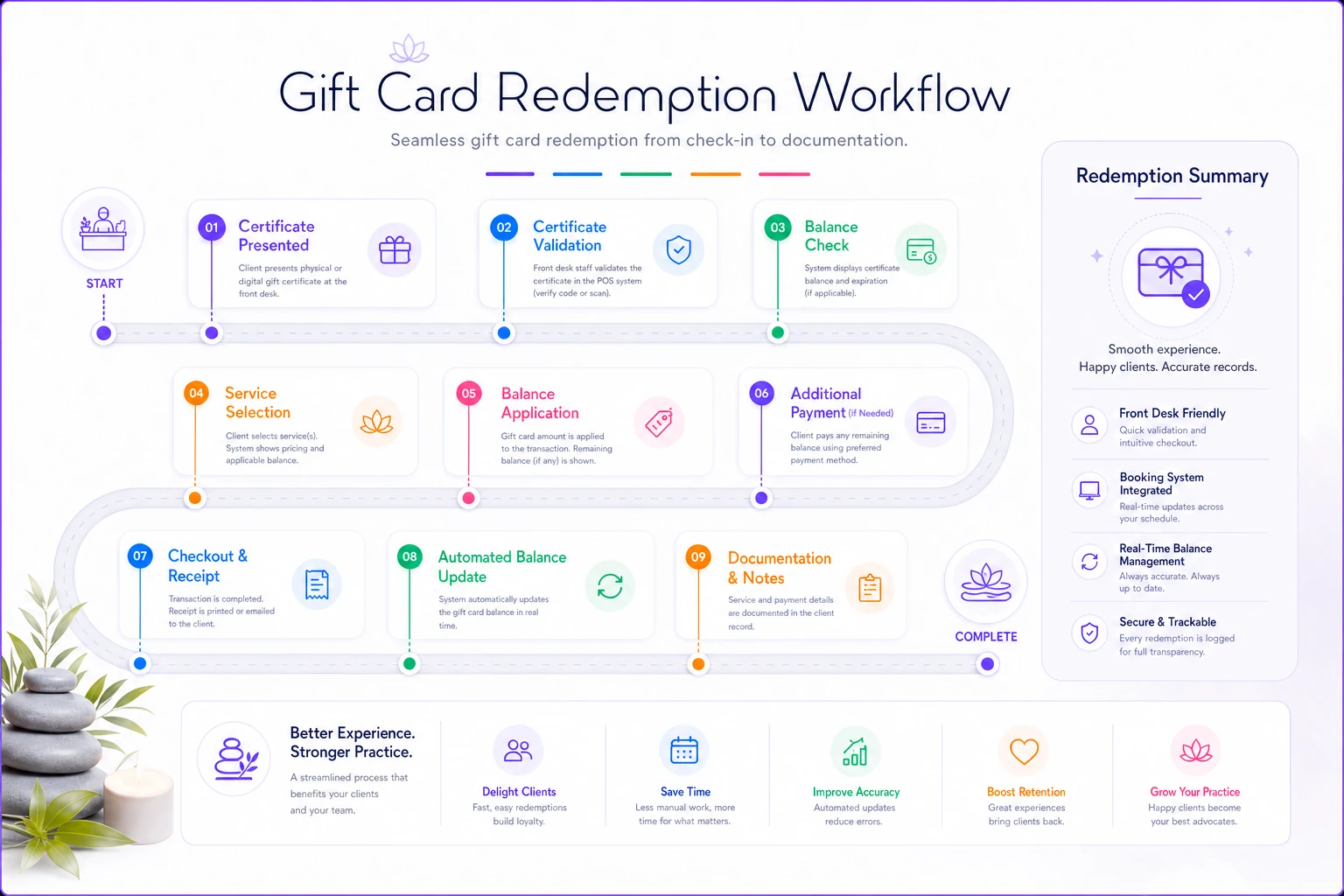
Modern POS systems with integrated gift card modules handle most of this automatically—scan the certificate, system shows the balance, apply to transaction, done. The receipt shows remaining value automatically, and the customer gets an email confirmation without anyone having to remember to send one.
For studios still on manual processes, a simple checklist at the front desk goes a long way.
For studios still on manual processes, a simple checklist at the front desk goes a long way. Every gift card redemption follows the same steps every time, regardless of who's working. That consistency is what eliminates the "Sarah does it differently than Marcus" problem that quietly creates disputes.
Customer terms that protect both parties
Well-written terms and conditions prevent disputes while staying customer-friendly. The goal isn't creating legal fortresses—it's setting clear expectations that reasonable people can understand before they buy.
Valid Use
-
Services covered (massage, add-ons, packages)
-
Services excluded (products, tips, memberships)
-
Booking requirements (24-hour notice, based on availability)
Expiration and Fees
-
No expiration on paid value (per state law)
-
Promotional value expires after 12 months
-
No maintenance or dormancy fees
Balance and Redemption
-
Partial redemption allowed
-
No cash refunds for unused balances
-
Balance inquiries available via phone or email
Lost Certificates
-
Replacement available with proof of purchase
-
$10 replacement fee for physical certificates
-
Digital certificates can be re-sent to original email
Transfers and Disputes
-
One transfer allowed with written notice
-
Disputes resolved based on system records
-
Final sale, no refunds after purchase
Present these terms clearly at purchase—not buried in fine print. Include them on the certificate itself, in purchase confirmation emails, and on your website. When customers know the rules upfront, they're much less likely to dispute them six months later.
For online sales, require active acknowledgment before purchase. A simple checkbox saying "I have read and agree to the gift certificate terms" creates a clear record of acceptance. Small friction point, significant downstream protection.
Common disputes and resolution scripts
Despite your best efforts, disputes will happen. Having clear resolution scripts helps staff handle conflicts consistently without putting anyone in an awkward position.
"The balance should be higher"
Resolution: "Let me pull up the complete history for this certificate. I show it was purchased for $200 on [date], used for $85 on [date] for [service], and $65 on [date] for [service], leaving $50. Would you like me to email you this transaction history?"
"It shouldn't expire"
Resolution: "You're absolutely right that the paid value never expires. The $150 you paid is always good here. The promotional bonus value of $50 expired after one year, which was noted in the terms when purchased. You can still use the full $150 for any service."
"I lost the certificate"
Resolution: "No problem, we can look it up. I'll need the purchaser's name and approximate purchase date. Once I verify the certificate and confirm it hasn't been redeemed, I can reissue it with a $10 replacement fee—or waive that if you'd like to book today."
"I want a refund"
Resolution: "I understand your situation. While our certificates are non-refundable as noted in the terms, I can offer to transfer this to someone else, or convert it to account credit that never expires. Would either of those work for you?"
Train your entire team on these scripts. Role-play common scenarios during staff meetings. The goal is confident, consistent responses that feel helpful rather than defensive.
When gift card programs actually make sense (and when they don't)
Gift cards aren't a universal win for every massage studio. The operational overhead might outweigh the benefits depending on how your business is structured.
Good fit for gift cards:
-
Established studios with steady traffic
-
Multiple therapists and service options
-
Operational software that tracks certificates
-
Clear policies and trained staff
-
Primarily local clientele
Poor fit for gift cards:
-
Solo practitioners with irregular schedules
-
Mobile massage services with limited availability
-
Studios using paper scheduling
-
High staff turnover situations
-
Tourist-heavy locations with transient clients
If you're constantly dealing with gift card headaches, it's worth reconsidering the program altogether. Some successful studios have moved away from traditional gift cards in favor of membership programs that provide predictable revenue without the accounting complexity.
Technology that automates gift card operations
Manual gift card tracking inevitably fails as volume grows. A studio selling 20 to 30 certificates monthly needs automated systems to maintain accuracy and prevent disputes.
Modern operational platforms built for wellness businesses integrate gift card management directly into booking and payment workflows. When someone purchases a certificate online, the system automatically generates a unique code, sends confirmation emails, and creates the liability record. During redemption, entering the code instantly shows the balance, and completing the transaction updates all records without anyone touching a spreadsheet.
The better systems also handle the edge cases that cause the most headaches. Partial redemptions calculate correctly. Expired promotional values separate from paid values per state law. Lost certificate lookups take seconds. Balance inquiry emails go out automatically when certificates approach expiration.
This automation extends to accounting integration as well. Gift card sales record as deferred revenue. Redemptions convert liability to earned income automatically. Month-end reports show outstanding balances, aging analyses, and redemption patterns. What used to require hours of manual reconciliation just happens in the background.
For studios already managing complex documentation requirements, integrated gift card tracking adds another layer of operational control. Every transaction is logged, time-stamped, and connected to client records. If a dispute surfaces months later, the complete history is immediately accessible.
How one studio turned gift card chaos into a reliable revenue stream
Serene Wellness in Denver was losing money through gift card mismanagement. With around 45 certificates selling monthly—mostly around holidays—their paper tracking system completely broke down. The owner, Jennifer, estimated they were losing somewhere between $600 and $800 monthly through tracking errors, duplicate redemptions, and disputed balances.
The breaking point came during Mother's Day week when three different customers claimed higher balances than the spreadsheet showed. Jennifer spent six hours reconstructing transaction histories from appointment books and credit card records, ultimately honoring all three claims to avoid negative reviews. She knew the problem would only get worse.
They implemented a structured system with a few key changes:
-
Moved to sequential numbered certificates (GC-2024-XXXX format)
-
Switched to package-based offerings instead of open dollar amounts
-
Integrated certificate tracking into their booking software
-
Trained all staff on a standard redemption workflow
-
Published clear terms on the website and printed on certificates
Six months later, gift card disputes had dropped to nearly zero. Revenue recognition became automatic instead of a quarterly nightmare. Gift card sales also increased by around 30% because customers trusted the process and staff felt confident selling them.
The studio now treats gift certificates as a marketing tool rather than an operational burden—running targeted campaigns for holidays, offering bonus values during slow periods, and using expiring promotional values to drive bookings during quieter weeks.
Moving forward with confidence
Gift card disputes don't have to be a regular part of running a massage studio. With proper tracking, clear policies, and consistent processes, certificates can generate solid upfront cash flow without creating downstream headaches.
Start by auditing your current situation. How many outstanding certificates exist? What's your total liability? Can you track individual balances accurately? If the answers are unclear or vague, you need better systems before selling another certificate.
Get the basics right first: unique numbering, complete tracking, clear terms. Then layer in package products that simplify redemption. Train your team on consistent workflows. Set up automated balance tracking and accounting integration.
Studios that handle gift cards well treat them like financial products requiring the same attention as cash handling or credit card processing. It's not about making policies more restrictive—it's about making operations more reliable. When customers trust your gift card process, they buy more of them. When staff understand the workflows, they sell with confidence. And when the accounting runs automatically in the background, you can stay focused on delivering great services instead of untangling financial knots every quarter. Gift cards should be an asset—and with the right operational foundation, that's exactly what they become.
Studios that handle gift cards well treat them like financial products requiring the same attention as cash handling or credit card processing. It's not about making policies more restrictive—it's about making operations more reliable. When customers trust your gift card process, they buy more of them. When staff understand the workflows, they sell with confidence. And when the accounting runs automatically in the background, you can stay focused on delivering great services instead of untangling financial knots every quarter. Gift cards should be an asset—and with the right operational foundation, that's exactly what they become.
Ready to elevate your massage therapy business?
Join hundreds of therapists using Masthera to save time, reduce scheduling conflicts, and enhance client satisfaction.