

Corporate massage work looks great on paper. A tech company books chair massage every other Friday, an HR team orders wellness days for 40 employees, a hotel wants weekly spa services for VIP guests. The revenue is steady, the volume is real, and one signed contract can be worth more than a dozen individual clients.
Then the payment terms hit you.
Net-30 turns into net-52. The accounts payable person you emailed left the company. Someone in finance flags your invoice because "the hours don't match what we approved." Now you're spending Tuesday afternoon digging through your calendar trying to prove your therapist was on-site for three hours on the 14th.
This is a different animal than chasing a walk-in client for a $95 no-show fee. Corporate collections aren't about persistence — they're about paperwork that survives audit. If your invoice can't answer AP's questions before they ask them, it goes to the bottom of the pile.
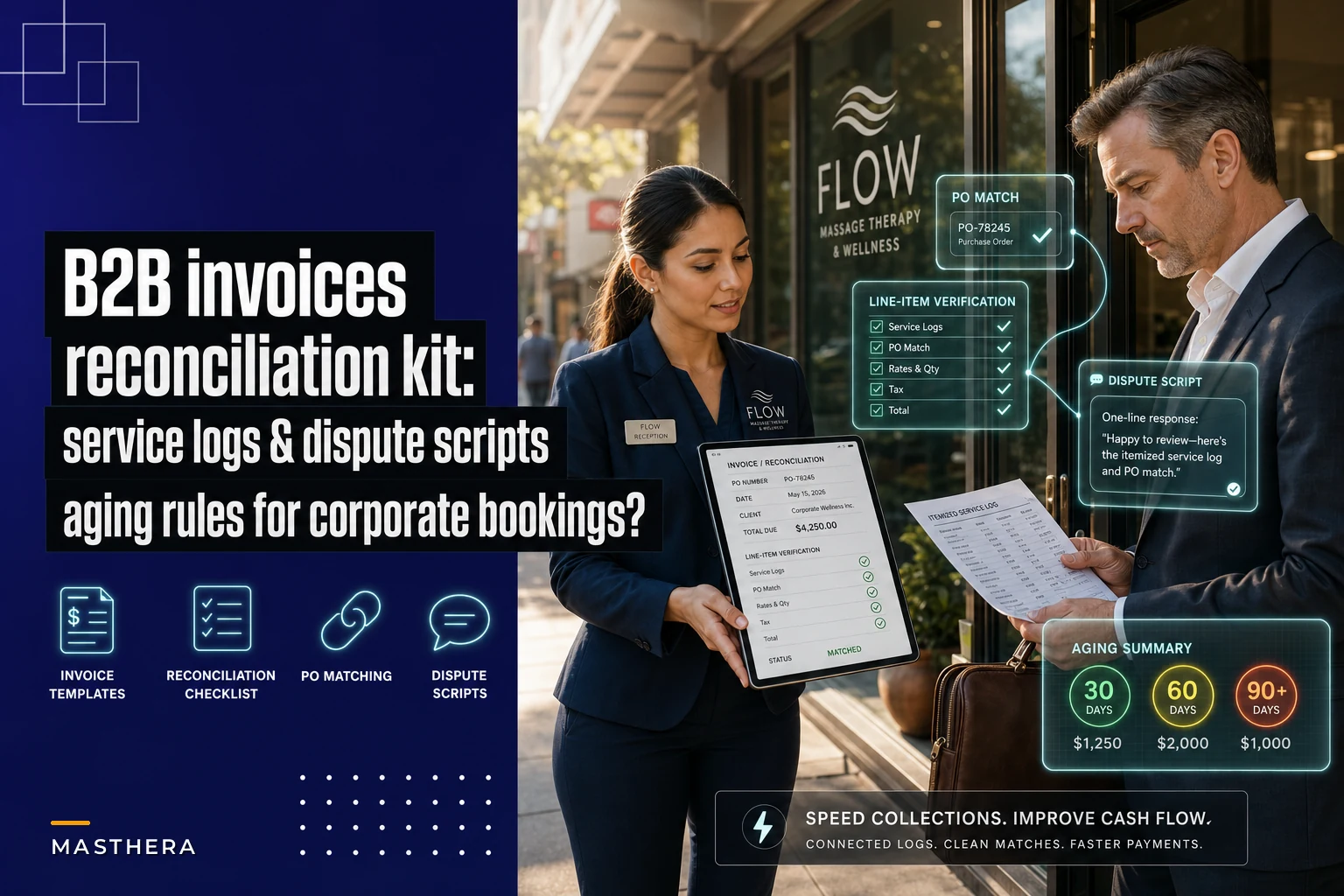
This post is a build guide for a B2B invoice template massage studio owners can actually use for corporate bookings — the service log that backs it up, the reconciliation checklist that catches errors before they go out, the dispute scripts that resolve pushback fast, and the aging rules that tell you when to escalate.
Why corporate invoices get stuck (and it's usually not the money)
The mistake most studio owners make is assuming a late corporate payment means the client is being difficult. In real operations, that's rarely what's happening.
Corporate AP departments run on matching. They have a purchase order or approved budget, a signed service agreement, and your invoice. When those three don't line up, the invoice gets kicked back — not maliciously, just automatically. The person processing it literally cannot approve a payment that doesn't reconcile against their records.
A typical example: your invoice says "Corporate Wellness Day — $1,800." Their approval says "8 hours of chair massage @ $200/hr." Those are the same number, but their system can't tell that. So it flags. And a flagged invoice can sit two or three weeks before anyone manually reviews it.
The other common source of stuck invoices is missing proof of delivery. For individual clients, delivery is obvious — they were in your room, they paid at checkout. For corporate work, the person who booked the service is almost never the person who received it, and almost never the person who pays for it. The booker is in HR, the recipients are employees, the payer is in finance. None of them witnessed the same thing. Your service log is the only document connecting all three.
The service log: the thing that actually gets you paid
Before we get to the invoice itself, we need to talk about the document that backs it — because this is where most studios fall short.
Never miss a booking or double-book again.
Masthera helps you schedule, confirm & manage every massage session with ease.
- Unified appointment management
- Automated client reminders
- Therapist calendar coordination
No credit card required
A service log is a per-visit record signed or acknowledged by someone on the client's side at the time of service. It's boring. It's also the single most powerful dispute-prevention tool you have, because it converts your word against theirs into a signed record dated the day the work happened.
-
Date and on-site window (arrival and departure, not just "morning")
-
Therapist name(s) who performed the work
-
Service type and duration (e.g., 15-min chair sessions x 22)
-
Location / department serviced
-
On-site contact name + signature or initials (or a quick digital acknowledgment)
-
Any deviations — client canceled 4 slots, ran 30 minutes over, requested an extra therapist
That last line matters more than people think. Deviations are where disputes are born. If your therapist stayed an extra 45 minutes because the client kept sending people over, and that's not logged the day it happened, you will not win that argument three weeks later. Log the deviation, get it acknowledged on-site, and it becomes billable without a fight.
Collect a same-day acknowledgment (even a brief text) so proof exists while everyone still remembers the visit.
Studios that collect a same-day acknowledgment — even something as simple as the office manager texting "confirmed, thanks" against a summary — get paid noticeably faster than studios that reconstruct everything at month-end. The proof exists while everyone still remembers the day.
What the invoice itself needs to contain
A consumer receipt and a corporate invoice are not the same document. AP needs specific fields, and leaving them off is a guaranteed delay. Here's the difference laid out:
| Field | Consumer receipt | Corporate B2B invoice |
|---|---|---|
| Invoice number | Optional | Required, unique, sequential |
| PO / reference number | Rare | Required if client uses POs |
| Billing entity | The person | The legal company name + AP address |
| Line items | Service + price | Service, quantity, unit rate, extended total |
| Service dates | Visit date | Each date serviced, itemized |
| Service log reference | None | Attached or referenced |
| Payment terms | Due now | Net-X, due date spelled out |
| Remittance details | Card on file | Bank/ACH info, accepted methods |
| Tax handling | Included | Broken out, tax-exempt status noted |
The two fields studios forget most often are the PO number and an explicit due date. "Net-30" is ambiguous — net-30 from invoice date or from receipt? Write the actual calendar date: "Payment due: November 14, 2025." That removes an entire category of "we thought we had more time" delays.
Also: match your line item language to their approval language. If their contract says "8 hours chair massage," your invoice line should say "Chair massage — 8 hrs @ $200 = $1,600," not "Wellness Day package." Mirror their words and the auto-matching passes. This is a small thing that makes a real difference.
The pre-send reconciliation checklist
Most disputes are self-inflicted. The invoice goes out with a wrong date, a missing PO, or a total that doesn't match the service log, and you've just handed the client a legitimate reason to delay. A two-minute check before sending prevents the two-week problem after.
-
Invoice total matches the sum of all service log entries
-
Every service date on the invoice has a corresponding signed/acknowledged log
-
PO or reference number is present and correct
-
Billing entity name matches the legal name on the contract exactly
-
Unit rate on invoice matches contracted rate
-
Any deviations (overtime, extra sessions) are logged AND acknowledged
-
Due date is a specific calendar date
-
Remittance / payment instructions are included
-
Correct AP contact is on the "send to" line (verify it's still that person)
-
Tax-exempt status applied if the client provided a certificate
The AP-contact check saves more invoices than almost anything else on that list. Corporate turnover is high, and an invoice emailed to someone who left the company simply vanishes. A 30-second confirmation of "still the right person?" prevents a payment from aging 45 days because nobody was reading the inbox.
Aging rules: when to nudge, when to escalate
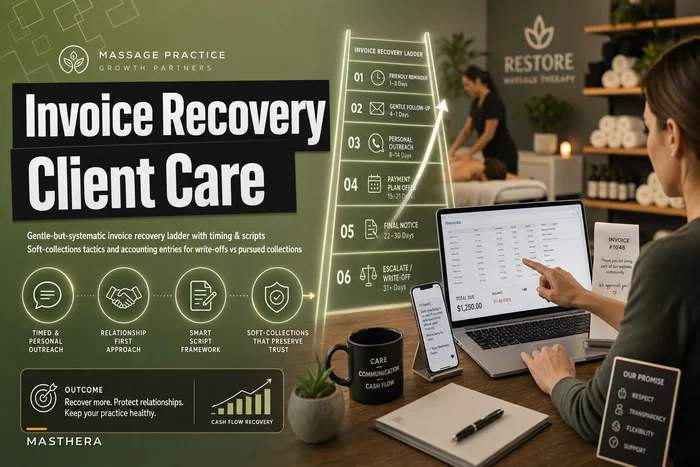
For consumer collections you can lean on relationship and gentle persistence — we've covered that in detail in the invoice recovery ladder for studios. Corporate is different. AP responds to process and predictability. You need rules that trigger on the calendar, not on your mood.
-
Day 0 (send) Invoice + service log delivered. Confirm receipt within 48 hours. An unacknowledged invoice is not "in process" — it's lost until proven otherwise.
-
Day 7 Soft confirmation. "Just confirming this is queued for the Nov 14 cycle — anything you need from me to process it?"
-
Due date If unpaid, same-day reminder. Reference the invoice number, PO, and amount. No apology, no softening.
-
Due + 7 Direct follow-up to your AP contact AND your booking contact. Cc'ing the booker creates helpful internal pressure.
-
Due + 15 Escalation email referencing the signed service log and contract terms. State next steps plainly.
-
Due + 30 Formal notice. Pause future bookings until the balance clears. This is your real leverage — a client that wants next month's wellness day will find your invoice fast.
Stop future service before you send to collections. For recurring corporate accounts, the threat of losing the service resolves aging balances faster than any legal language, because the booker inside the company suddenly has a reason to walk down to finance.
For recurring corporate accounts, the threat of losing the service resolves aging balances faster than any legal language, because the booker inside the company suddenly has a reason to walk down to finance.
Dispute scripts that actually resolve things
When pushback comes, it almost always falls into one of a few buckets. Having the response ready keeps a small disagreement from turning into a 60-day standoff.
"The hours don't match what we approved." > "Thanks for flagging. Attached is the signed service log for each date, including the on-site acknowledgment from [contact]. You'll see [date] ran 45 minutes over at [contact]'s request — that's the difference. Happy to walk through any line."
"We never received this invoice." > "No problem — resending now to [AP email]. Original was sent [date]; I've cc'd [booker] so it's on both radars. Can you confirm receipt today so we keep it in this payment cycle?"
"This needs a PO we don't have on file." > "Understood. The booking was authorized by [name] on [date] — I've attached that confirmation. If a PO is required retroactively, who on your side generates it? I'll supply whatever you need to match it."
"We're disputing the overtime charge." > "The extra time is logged and acknowledged on-site by [contact] on [date] — attached. Our contract bills additional on-site time at [rate]. If [contact] recalls it differently, I'm glad to get them on a quick call to confirm."
Every script points back to the service log and a name. You're never arguing opinion — you're referencing a dated, acknowledged record. That's the whole reason the service log exists.
A real scenario
A wellness studio running chair-massage programs for three corporate accounts — roughly $9k–$11k a month combined — had a pretty typical setup: basic PDF invoices with a package name and a total, no service log, no PO fields. Two of the three accounts routinely paid somewhere around 50–60 days out, and about one invoice a quarter got disputed over hours. Resolving those disputes meant reconstructing schedules from memory and calendar screenshots.
They changed three things. First, built a one-page service log the on-site therapist got initialed before leaving each visit. Second, rewrote invoice line items to mirror each contract's exact wording — PO fields, itemized dates, hard due dates. Third, set calendar-based aging triggers with a "pause future bookings at due+30" rule.
Within two billing cycles, average days-to-pay dropped from the mid-50s to roughly 30–35. More importantly, the disputes mostly stopped happening. Same clients, same rates — just better documentation, and the thing people used to argue about no longer existed as a question.
When this level of structure makes sense (and when it doesn't)
This whole system is built for recurring or high-value corporate work — accounts where a single dispute costs you real hours and a slow payer strains your month. If corporate bookings are a growing share of your revenue, the service-log habit pays for itself quickly.
When it's overkill: a one-off pop-up for a small office paying by card the day of service. If payment is collected on-site, you don't need net terms, aging rules, or dispute scripts. Don't wrap a $400 same-day job in a corporate collections process.
Who should not skip this: any studio where corporate AR is aging past 45 days, or where "how many hours were actually delivered" has ever been a live argument. If you've had that conversation even once, the service log isn't optional.
Where the whole system gets tighter is when booking records, service logs, and invoicing all live in one place instead of scattered across a calendar, a notes app, and a spreadsheet. When the on-site log feeds directly into the invoice — same dates, same hours, same rate — the pre-send reconciliation check mostly runs itself, and aging reminders fire on schedule without you manually tracking them across a dozen accounts. AI-assisted operational tools help here mainly by flagging mismatches before an invoice goes out: total vs. logged hours, missing PO, wrong AP contact. That's exactly the moment disputes are cheapest to prevent.
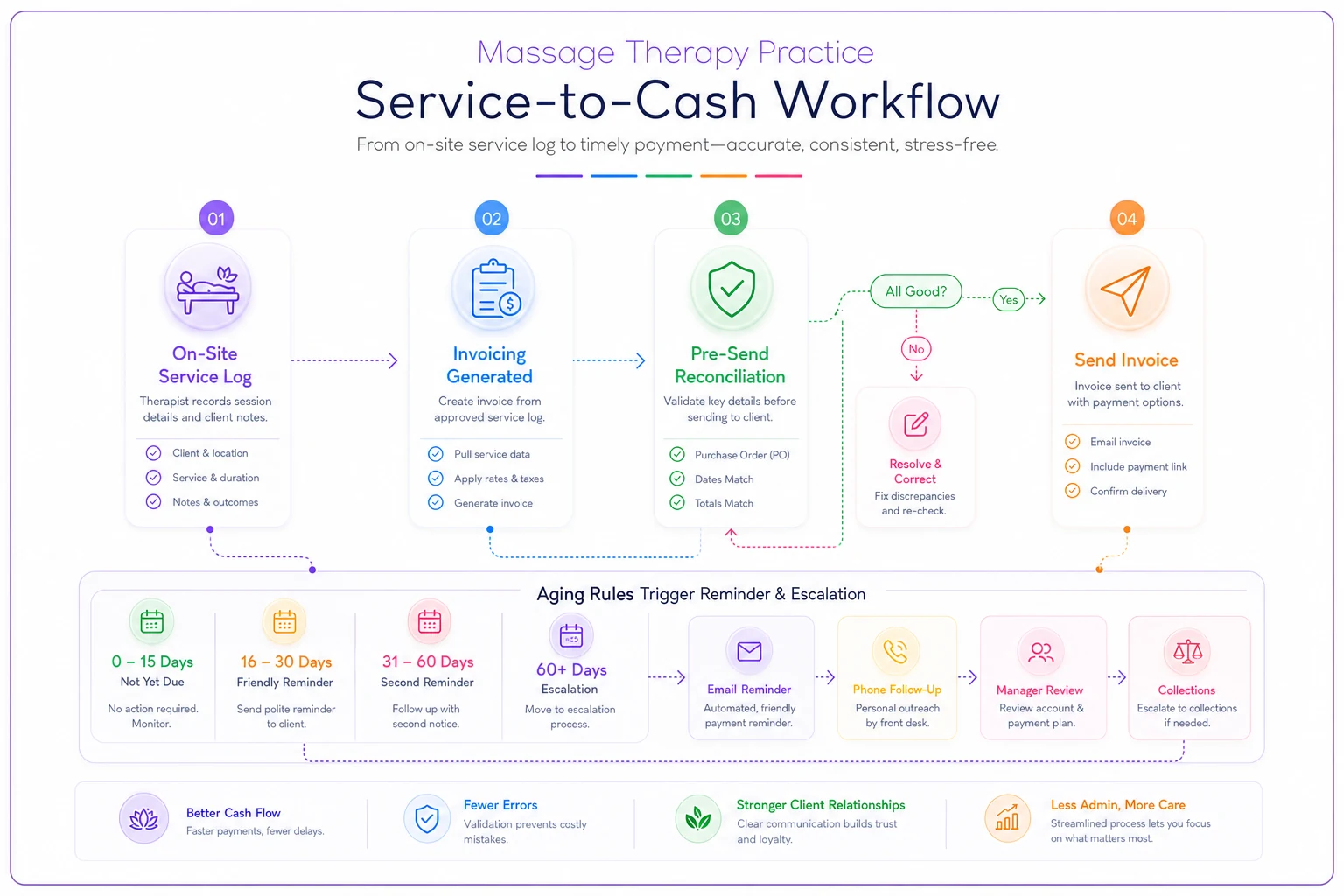
If you want to tie this into your broader close process, it fits naturally alongside a month-end reconciliation routine, where corporate AR aging becomes one of the numbers you review every cycle instead of something you notice only when cash gets tight.
The one thing to take away
Corporate clients don't pay late because they don't respect you. They pay late because your invoice doesn't answer their internal questions on its own. Build the service log, mirror their contract language, put a real due date on the page, and set aging rules that trigger on the calendar — and you stop chasing payments and start collecting them. The paperwork does the arguing for you, so you don't have to.
Ready to elevate your massage therapy business?
Join hundreds of therapists using Masthera to save time, reduce scheduling conflicts, and enhance client satisfaction.