



Month-end closes in massage studios are weird. You're balancing cash from walk-ins, processing membership charges that hit on different days, tracking gift card liabilities, and somehow trying to predict next month's revenue while your therapists' schedules keep shifting. Most studio owners end up with a scattered mess of spreadsheets, bank statements, and booking reports that never quite match up.
The studios that actually maintain healthy cashflow year-round run the same month-end routine every single time. Not because they love accounting, but because waiting until tax season to figure out your numbers means missing every chance to course-correct before things compound.
Why massage studios specifically struggle with month-end financials
Your revenue structure makes standard small business accounting templates basically useless. A typical month might include membership charges on the 1st, package sales throughout the month, gift card redemptions from purchases six months ago, retail product sales with different margins, and tips that flow through your payment system differently depending on whether clients pay cash or card.
Then there are the timing mismatches. Payroll hits every two weeks but your biggest membership billing happens monthly. Rent's due on the 1st but your busiest revenue days cluster around weekends. Product orders need to go out by the 20th to arrive before month-end but you won't know your actual retail sales until the 31st.
Most accounting software treats all revenue the same. In a massage studio, the difference between a membership payment, a package purchase, and a single-session booking completely changes your actual cash position. A $500 package sale looks great on paper, but if the client spreads those sessions over four months, that's not $500 in this month's operational cash.
Seasonal swings make everything worse. January might bring 40% more bookings than July, but rent, insurance, and base payroll stay flat. Without a real forecasting system, you're either sitting on too much cash in peak season or scrambling to cover payroll during slow months.
Building your core month-end checklist
Below is the checklist structure that actually works for massage studios. Studios that follow this routine consistently tend to catch problems around three weeks earlier than those doing quarterly reviews.
Never miss a booking or double-book again.
Masthera helps you schedule, confirm & manage every massage session with ease.
- Unified appointment management
- Automated client reminders
- Therapist calendar coordination
No credit card required
Week 4 of current month (pre-close):
-
Pull preliminary booking report for days 1-25
-
Run membership renewal report for next month
-
Check gift card liability balance
-
Review any pending refunds or disputes
-
Verify all tip-outs have been processed
-
Count petty cash and document any variance
Days 1-3 of new month (close):
-
Reconcile all payment processor deposits
-
Match booking system revenue to bank deposits
-
Record all gift card sales vs redemptions
-
Calculate actual service revenue (exclude future bookings)
-
Process all contractor payments if applicable
-
Categorize all expenses properly
-
Document any inventory adjustments
Days 4-7 of new month (analysis):
-
Calculate therapist utilization rates
-
Compare revenue to same month last year
-
Review expense variances over 10%
-
Update rolling 3-month forecast
-
Flag any concerning trends
-
Create action items for operations
Here's a simple workflow to visualize the month-end close process.
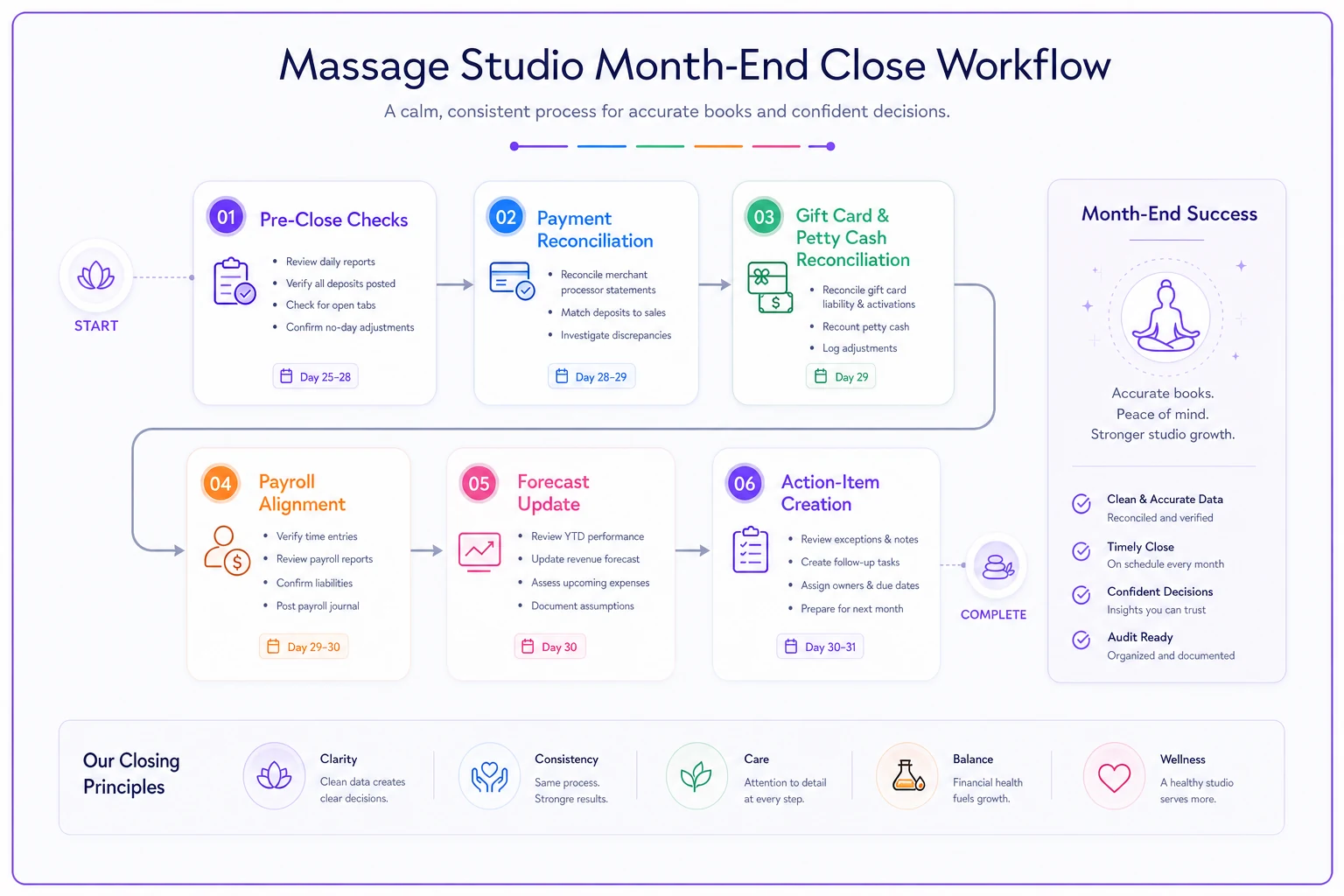
The trick isn't just having the checklist—it's understanding the dependencies. You can't accurately forecast next month until you've reconciled this month. You can't set therapist schedules without knowing utilization trends. Everything connects.
Session volume forecasting that actually predicts cashflow
Traditional forecasting for service businesses uses historical averages, but massage studios need something more nuanced. Your forecast needs to account for membership base, seasonal patterns, therapist availability, and shifts in booking behavior.
Start with your membership foundation. If you have 85 active members averaging 1.3 visits per month, that's a baseline of around 110 sessions. These are mostly predictable—members book their regular slots and rarely vary more than 15% month to month.
Layer in your non-member patterns. Pull the last 6 months of non-member bookings and identify where sessions concentrate. Most studios see 60-70% of non-member sessions fall on Thursdays through Sundays. If you averaged 180 non-member sessions monthly across 5 therapists, that's roughly 36 sessions per therapist per month outside your membership base.
Now apply seasonal adjustments. January typically spikes 25-35% above average as people burn insurance benefits and New Year motivation kicks in. July-August usually drops 20-30% below average. December varies wildly—corporate gifting might boost revenue but actual sessions often drop as clients travel.
Here's a simple forecasting table structure:
| Component | Calculation Method | January Example |
|---|---|---|
| Membership sessions | Active members × avg monthly visits | 85 × 1.3 = 110 |
| Non-member baseline | 6-month average | 180 sessions |
| Seasonal adjustment | Historical variance for this month | +30% = 54 extra |
| Therapist capacity | Available hours × utilization target | 720 hrs × 0.65 = 468 |
| Forecast sessions | Lower of demand vs capacity | 344 sessions |
| Avg session revenue | Weighted average of service prices | $95 |
| Gross revenue forecast | Sessions × avg revenue | $32,680 |
The key insight: forecast sessions first, then multiply by revenue. Most studios try to forecast dollars directly and end up missing the operational constraints entirely.
Timing your cashflow to payroll cycles
Payroll timing breaks more massage studios than anything except lease problems. Standard bi-weekly payroll means some months have three payroll runs, which completely destroys your usual expense ratios. But there's a bigger issue most owners overlook: the lag between service delivery and cash collection.
If you run payroll on the 1st and 15th, but membership charges hit on the 1st and most walk-ins cluster around weekends, you've got a fundamental timing mismatch. The therapist who worked the last weekend of the month gets paid on the 1st, but revenue from those sessions might not clear your bank until the 3rd or 4th.
Smart studios offset this by building a cash reserve target based on their payroll cycle. Take your average bi-weekly payroll, add 20% buffer, and multiply by 1.5. That's your minimum operating cash target. For a studio running $8,000 bi-weekly payroll, you'd want roughly $14,400 minimum in operating accounts at all times.
Membership billing date matters more than most owners realize. If you bill on the 1st and run payroll on the 15th, you maximize float time. Bill on the 15th with payroll on the 1st? You're constantly chasing cash. Some membership structures work better than others, but timing is just as critical as pricing.
Track your cash conversion cycle monthly. How many days between service delivery and cleared payment? Most studios run 3-5 days for credit cards, immediate for cash, 7-10 days for insurance if applicable. Weight that by payment method mix and you'll spot problems before they actually hit.
Petty cash rules that prevent month-end chaos
Petty cash seems minor until month-end when you're trying to figure out why you're $200 off and nobody documented what they spent on last-minute supplies. Studios need petty cash for laundry service, emergency supply runs, client refunds when systems are down, the occasional parking validation. But without clear rules, it becomes a black hole.
Keep exactly $300 in petty cash. Not $250, not $500. The amount matters less than consistency—you need the same starting point each month for reconciliation to work. Every withdrawal requires a receipt or written note immediately. No exceptions, including for the owner.
Designate specific categories for petty cash use:
-
Emergency supplies under $50
-
Client service recovery under $30
-
Parking/transport reimbursements
-
Laundry service payments
-
Nothing else
Log each petty cash withdrawal in a shared notebook immediately to avoid end-of-month surprises.
At month-end, count the cash, total the receipts, and the sum should hit $300. Any variance over $10 needs investigation. Replenish to exactly $300 from your main operating account, categorize the expenses properly, start fresh.
Studios that fail at petty cash try to use it as overflow operational funding. It's not. It's purely for immediate small-dollar needs that can't wait for normal purchasing processes. Once you blur that line, reconciliation becomes a guessing game.
Scenario planning for seasonal swings
Most massage studios experience 30-40% revenue swings between peak and slow seasons but budget like revenue stays flat. This creates predictable crises: can't make payroll in August, sitting on excess cash in January, therapists wanting more hours exactly when demand drops.
Build three scenarios every quarter, not just one budget:
Baseline scenario: Your most likely case based on current membership count, historical patterns, and confirmed therapist availability. This drives your standard operating decisions.
Slow scenario: 25% below baseline. What expenses could you cut? Which therapists would accept reduced hours? What's your minimum viable operation? This isn't pessimistic—it's your playbook for summer slowdowns or unexpected local economic hits.
Growth scenario: 20% above baseline. Where would bottlenecks appear? Which therapists could take extra shifts? What supplies would need advance ordering? This prevents you from leaving money on the table during unexpected busy stretches.
For each scenario, map out the critical numbers:
-
Sessions per week needed
-
Therapist hours required
-
Supply cost implications
-
Cash position by week
-
Marketing spend adjustments
The real value is in identifying trigger points. If bookings drop below 75% of baseline for two consecutive weeks, implement slow scenario tactics immediately—don't wait for month-end to realize you're in trouble.
Reconciliation patterns that catch expensive errors
Reconciliation feels tedious until you catch a $3,000 processing error or realize your booking system has been double-counting package redemptions for two months. The expensive mistakes hide in the gaps between systems.
Start with the three-way match: booking system, payment processor, and bank account. Your booking system shows what should have been collected. Your payment processor shows what was actually processed. Your bank shows what money actually arrived. These three numbers rarely match perfectly, but the variances should follow recognizable patterns.
Common variances to expect:
-
Processing fees (2.6-3.5% typically)
-
Timing delays (1-3 business days)
-
Chargebacks and disputes
-
Refunds processed differently across systems
-
Tips handled separately
The dangerous variances are the ones that grow month over month. A steady $50-100 variance might just be normal processing fees. A variance that went from $100 to $300 to $500 over three months? Something's systematically broken.
Document every variance over $25. Not to create paperwork, but to spot patterns. That weekly $30 discrepancy might be a therapist consistently applying unprogrammed discounts. Random $75 differences might be gift cards getting redeemed but not properly recorded.
When to adjust your forecast mid-month
Most studios create a forecast and ignore it until the next month. The whole point of forecasting is to enable adjustments when reality diverges from plan—the trick is knowing which variances actually matter and which are just noise.
If you're tracking 20% below session forecast by day 10, that's actionable. Maybe an email blast to inactive clients, or time to run that referral promotion you've been sitting on. But 20% variance on day 3? That could just be scheduling randomness.
Create clear adjustment triggers:
-
Day 10
Session count 15% below forecast → Launch recovery campaign
-
Day 15
Revenue 20% below forecast → Reduce variable expenses
-
Day 20
Payroll coverage at risk → Implement contingency scheduling
-
Day 25
Next month bookings under 50% → Aggressive forward booking push
The adjustments need to be specific and pre-planned. "Launch recovery campaign" means sending the template email you already wrote to the segment you already defined, offering the promotion you already structured. Without that preparation, you'll burn the adjustment window just debating what to do.
Technology and automation opportunities
The manual version of everything described here takes roughly 8-10 hours per month. That's a full day of work that could go toward growth activities instead of data entry and spreadsheet matching.
Modern booking systems can integrate directly with payment processing and accounting software, eliminating most manual reconciliation. AI-powered operational platforms now handle a lot of this automatically—flagging variances, surfacing seasonal patterns from your historical data, and prompting operational adjustments when forecasts go sideways. The real value isn't replacing human decision-making, it's freeing up time for actual analysis instead of data gathering. When your compliance and documentation systems automatically feed into financial reporting, you can spot trends weeks earlier than you would reviewing things manually.
Some studios now run their entire month-end process in under two hours with AI-assisted platforms handling routine reconciliation, variance flagging, and forecast updates. The owner reviews the exceptions, makes the strategic calls, and moves on. That's a meaningful chunk of time returned to the business every single month.
Moving from reactive to predictive financial management
The studios that thrive long-term don't just track what happened—they predict what's coming and adjust before problems surface. This month-end cadence builds that predictive capacity incrementally.
Month one, you're just trying to reconcile accurately. Month two, patterns start emerging. By month six, you can predict next month's cash position within 5-10% and spot problems three weeks before they'd normally hit. That's enough lead time to actually fix things instead of just surviving them.
Seasonal planning matters especially for massage studios. When you know August will be slow, you can schedule therapist vacations strategically, handle equipment maintenance, and reduce supply orders in advance. When you know January will be slammed, you can bring in temporary help, stock up, and make sure your systems can handle the volume.
More than anything, this routine creates operational confidence. Instead of wondering if you can make payroll, you know exactly where you stand. Instead of guessing about expansion timing, you have data showing whether you can support another therapist. The difference between studios that scale successfully and those that plateau around 3-4 therapists usually isn't marketing or service quality—it's whether they have financial operations that can support growth without breaking. This month-end cadence builds that foundation one month at a time.
More than anything, this routine creates operational confidence. Instead of wondering if you can make payroll, you know exactly where you stand. Instead of guessing about expansion timing, you have data showing whether you can support another therapist. The difference between studios that scale successfully and those that plateau around 3-4 therapists usually isn't marketing or service quality—it's whether they have financial operations that can support growth without breaking. This month-end cadence builds that foundation one month at a time.
Ready to elevate your massage therapy business?
Join hundreds of therapists using Masthera to save time, reduce scheduling conflicts, and enhance client satisfaction.