


Most massage studios don't have a real invoice problem until they suddenly do. You run a package deal for a corporate client, invoice at net-15, and three weeks later it's still sitting there. Or a regular client asks to "settle up next time" after a deep-tissue session, and next time never comes. The awkwardness stacks up faster than the money.
The tricky part is that the people who owe you money are often people you'll be putting your hands on again next month. A collections process built for a plumbing supply company doesn't work here. You need something softer, but still systematic — because "soft" without a system just means you never get paid and you quietly resent the client every time they book.
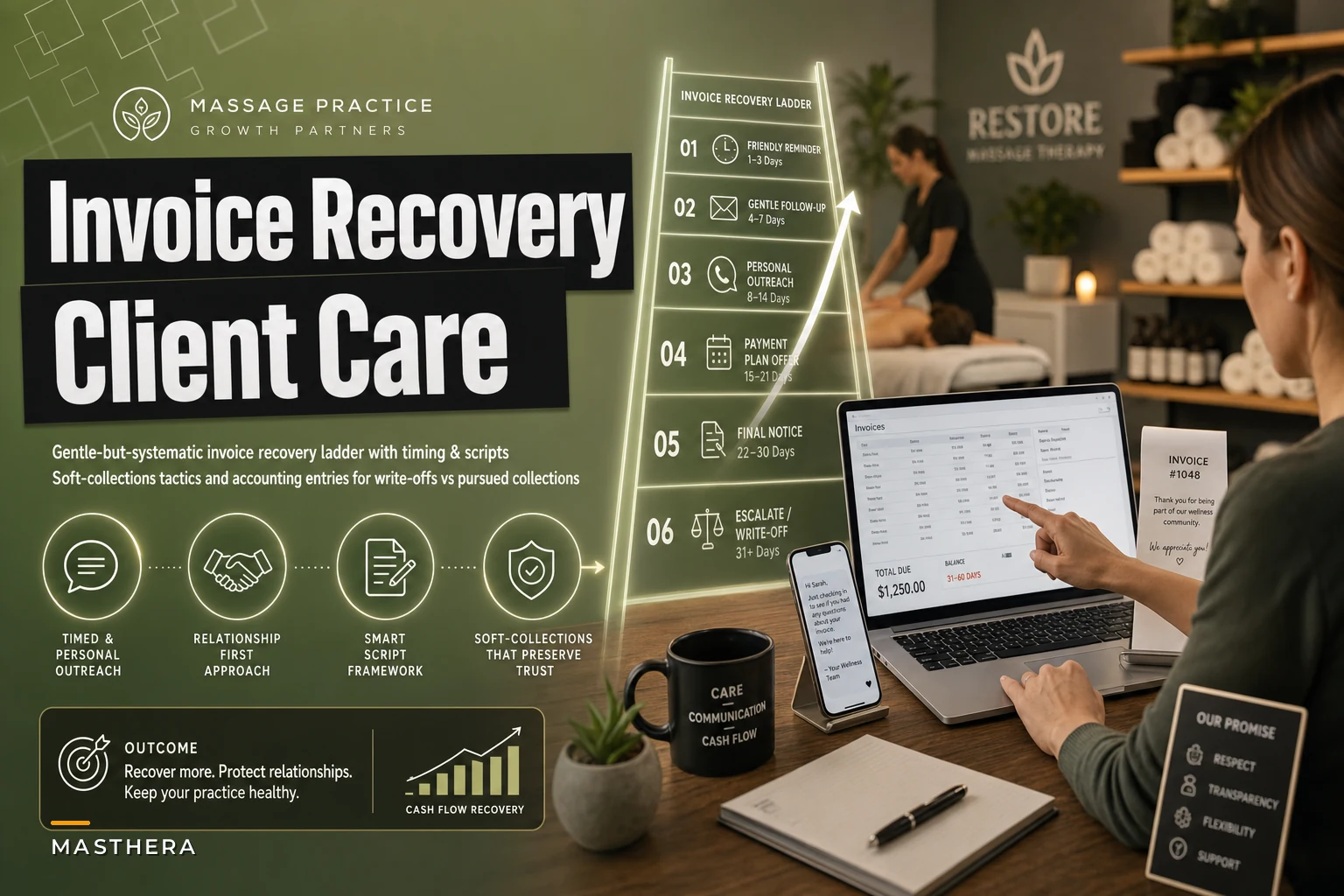
This is the ladder. Specific timing, actual scripts you can copy, and the accounting side that nobody really talks about — when to keep chasing versus when to write it off and move on.
Where studio invoices actually go unpaid
Regular walk-in clients who pay at checkout almost never become a collections issue. The unpaid balances tend to cluster in a few predictable places:
-
Corporate wellness contracts — you invoice HR or an office manager and it disappears into someone's approval queue
-
Package or series deals billed after the fact — client did four of six sessions, then ghosted on the balance
-
Insurance or superbill situations where the client expected reimbursement to cover it and it didn't come through
-
"I forgot my card" IOUs that felt fine in the moment and quietly aged into 60+ days
-
Membership shortfalls that spilled over into an invoice instead of a normal charge
That last one usually belongs in a dunning flow rather than an invoice ladder — the retry logic and card-recovery side of things is a separate process. If the missed money is a failed recurring charge, treat it there.
This distinction matters because the tone of your recovery depends entirely on which bucket the client falls into. A corporate contract that's late because of a bureaucratic AP department gets a firm, professional nudge. A loyal client of three years who hit a rough patch gets patience and a payment plan. Using the wrong tone on the wrong person is how you either lose the money or lose the client.
The ladder: timing and escalation
The whole idea of a ladder is that each rung is slightly firmer than the last, and the timing is predictable — not reactive. You're not chasing when you happen to remember. The message goes out at day 7, day 14, day 21, and the tone shifts each time.
Never miss a booking or double-book again.
Masthera helps you schedule, confirm & manage every massage session with ease.
- Unified appointment management
- Automated client reminders
- Therapist calendar coordination
No credit card required
Here's the structure most studios can run without feeling like a debt collector:
| Rung | Timing | Tone | Channel | Goal |
|---|---|---|---|---|
| 1 – Friendly reminder | Day 3–5 after due | Warm, assumes oversight | Email or text | "Just a heads up" |
| 2 – Direct nudge | Day 10–12 | Clear, still kind | Email + text | Make paying easy |
| 3 – Personal touch | Day 18–21 | Human, offers help | Phone or personal email | Understand the blocker |
| 4 – Formal notice | Day 30 | Professional, terms-based | Email (documented) | State consequences |
| 5 – Decision point | Day 45–60 | Firm or resolution | Call + written | Pay, plan, or write off |
A quick visual of the ladder workflow.
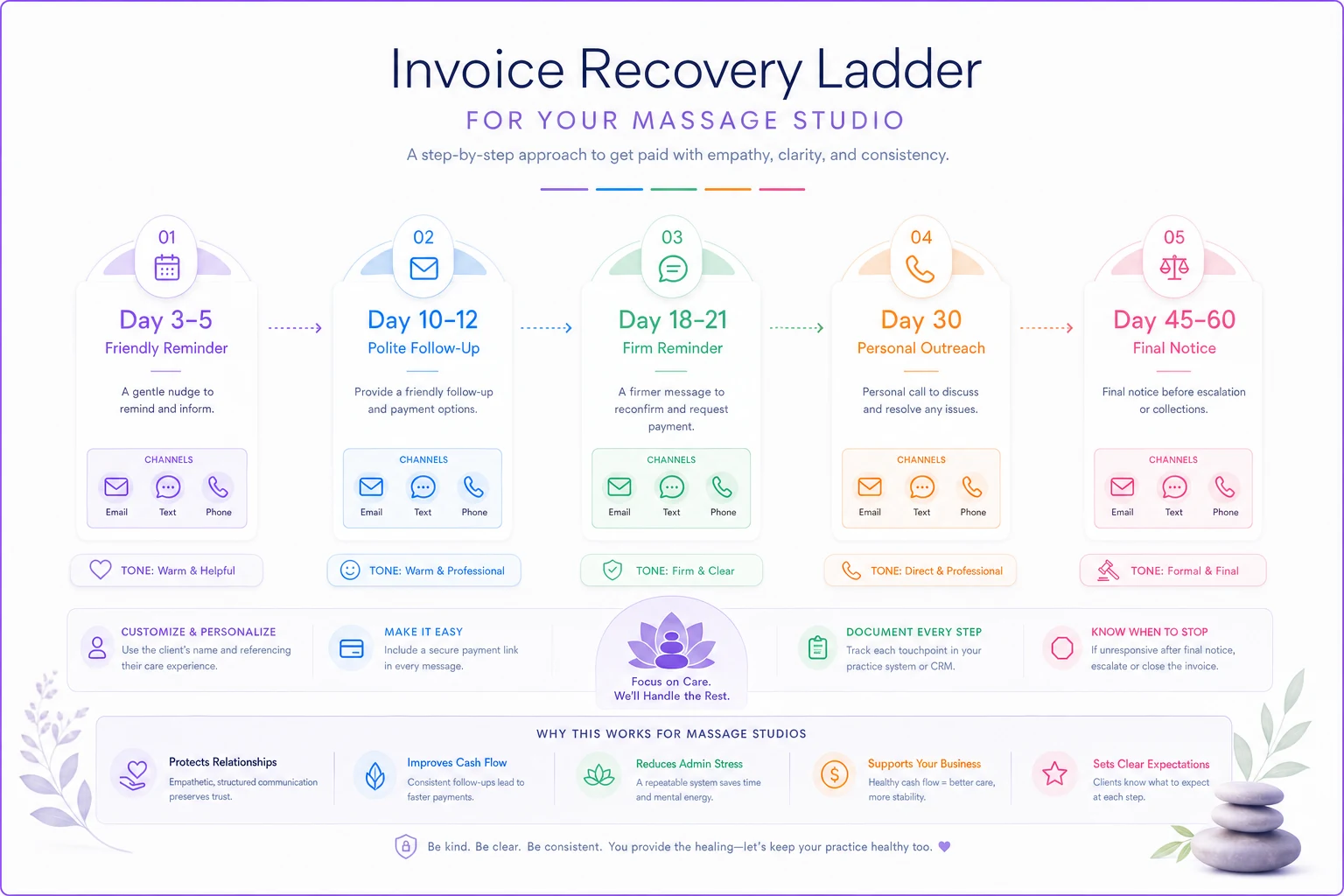
The most common mistake is jumping straight from Rung 1 to Rung 4 because the silence made you anxious. The tone whiplash confuses clients and makes the whole thing feel hostile out of nowhere. The rungs exist so pressure builds gradually — most invoices get resolved around Rung 2 or 3, before things get uncomfortable for anyone.
The scripts
Rung 1 — Friendly reminder (Day 3–5) > Hi [Name] — hope you've been feeling good after your last session. Quick note that invoice #[X] for [$amount] is showing as due. If you've already sent it, ignore me! Otherwise here's the link: [link]. Thanks so much.
Rung 2 — Direct nudge (Day 10–12) > Hi [Name], following up on invoice #[X] for [$amount], now about two weeks past due. Payment link is below if you need it. If something's holding it up on your end, just let me know and we'll sort it out. [link]
Rung 3 — Personal touch (Day 18–21) Make this one a phone call if you can. Voicemail script: > Hi [Name], it's [You] from [Studio]. Wanted to check in personally about the outstanding balance — it's been a few weeks and I want to make sure nothing fell through the cracks. If now's a tough time, we can figure out something that works. Give me a call back when you get a chance.
Rung 4 — Formal notice (Day 30) > Hi [Name], this is a formal reminder that invoice #[X] for [$amount] is now 30 days overdue. Per our terms, a late fee of [$/% if applicable] applies to balances past 30 days. Please arrange payment within 7 days to avoid this. Payment link: [link]. If you're facing difficulty, contact me directly and we can discuss options.
Rung 5 — Decision point (Day 45–60) > Hi [Name], your balance of [$amount] remains unpaid after multiple reminders. I'd genuinely rather resolve this than let it damage our relationship. I can offer a payment plan of [terms], or we can settle the full amount by [date]. If I don't hear back by [date], I'll need to close out the account. Please reach out.
The key difference at Rung 3 is that you're assuming the person has a reason, not that they're avoiding you. For a loyal client, that's usually the right assumption. Offering a payment plan before they have to ask is often what keeps the relationship intact.
The part most studios skip: what to do at the decision point
Once you hit Rung 5 and it's clear the original terms aren't happening, you've got three real options. Which one makes sense depends on the relationship and the dollar amount.
-
Payment plan — split the balance into 2–4 installments. Best for clients you want to keep who genuinely can't pay in one shot. Get it in writing; even a text confirmation is enough.
-
Discounted settlement — accept 60–80% to close it out. Makes sense when the full amount is unlikely and chasing further costs more than you'd recover.
-
Write-off — stop pursuing and record the loss. Right call for small balances, situations where the relationship is already done, or invoices where the admin time exceeds the invoice value.
Rough threshold: if an invoice is under around $75–$100 and it's aged past 60 days, the time you spend chasing it almost never pencils out. Write it off, note the client account, and require payment-at-service going forward. Chasing a $60 balance for six weeks costs more in stress and time than the $60 is worth.
The accounting side: write-offs vs. pursued collections
This is where studios get sloppy, and it actually matters at tax time.
If you're on cash-basis accounting (which most small studios are), you never recorded the unpaid invoice as income to begin with — you only book revenue when cash arrives. So a "write-off" isn't a deductible loss. You simply never received the income. You stop tracking it as receivable and move on. Don't let anyone talk you into deducting a bad debt you never counted as earned.
If you're on accrual-basis accounting, you booked the invoice as revenue when you issued it. Now that it's uncollectable, you record a bad-debt expense to reverse it:
-
Debit
Bad Debt Expense
-
Credit
Accounts Receivable
That entry removes the phantom revenue and gives you a legitimate expense.
The distinction between pursued and written-off also matters for how your books actually read. A pursued collection stays on your aging report — it's still money you expect. A write-off gets moved off receivables entirely so your reports stop reflecting money that isn't coming.
Studios that never write anything off end up with an aging report full of ghosts, then make staffing or pricing decisions based on money that doesn't exist. A real example: a small two-therapist studio running a couple of corporate contracts had about $2,800 in receivables on paper. Once they worked the ladder and reviewed what was actually collectable, roughly $1,900 came in within a few weeks, around $600 went onto payment plans, and a bit under $300 got written off. The important outcome wasn't just the recovered cash — their books finally reflected reality, and they stopped mentally counting that last chunk as income they'd "eventually" see.
Keeping it systematic without hovering over a spreadsheet
The reason the ladder breaks down in most studios isn't the scripts — it's the follow-through. You're between sessions, the day-3 reminder doesn't go out, and by the time you notice, the invoice is 40 days old and the tone is completely wrong for where you actually are.
The fix is getting the reminders out of your head entirely. Whatever booking or billing system you already use, set the ladder rungs as scheduled triggers tied to the invoice due date. Day 3, day 10, day 18 fire automatically, and only the phone-call rungs need you personally. Modern operational platforms handle the first two rungs on autopilot and flag you when a balance reaches the point where a real conversation makes sense. That's the sweet spot: automation handles the polite, repetitive nudges while you focus on the handful of accounts that actually need a human.
It's the same logic behind keeping clean session documentation — the SOAP-notes system we walked through works because it takes the memory burden off the therapist. Invoice recovery is no different. A system doesn't get awkward or forget; it just runs the ladder while you do the actual work.
When to reach for prepayment instead of recovery
The best invoice recovery is the one you never have to run. If a specific client type keeps ending up in your ladder — corporate contracts that pay 45 days late, series packages that stall halfway through — the answer usually isn't a better script. It's changing the payment structure so the money's collected up front.
Series and packages billed after sessions are the worst offenders. Prepaid packages, or a membership model, front-load the cash and eliminate the chase entirely. We laid out how to structure those in the piece on memberships that stabilize cashflow — the short version is: for repeat clients, recurring or prepaid billing removes the invoice problem at the root. You can't have an aged receivable on money you already collected.
When the ladder makes sense: corporate accounts you can't force to prepay, one-off large sessions, clients with a solid track record who occasionally slip.
When it's the wrong tool: anything you could have collected at point of service. If you're building an invoice ladder for individual walk-in clients, you've got a checkout problem, not a collections problem.
Closing thought
An invoice ladder isn't about squeezing people. It's about removing the emotion and guesswork from an inherently awkward situation so you can stay warm with clients and still get paid. The timing gives you permission not to panic at day 5. The scripts give you words when you'd otherwise freeze. And knowing when to write off $200 and move on is just as much a skill as knowing how to recover $2,000.
Set the ladder up once, let the early rungs run themselves, and save your personal attention for the accounts that genuinely need it. That's how you protect both the money and the relationship at the same time.
Ready to elevate your massage therapy business?
Join hundreds of therapists using Masthera to save time, reduce scheduling conflicts, and enhance client satisfaction.