


Most wellness studios don't fail because of one dramatic event. They wobble, lose clients quietly, and only realize how exposed they were after the fact. A lead therapist breaks her wrist. A pipe bursts in the treatment room over a long weekend. The person who knows the booking software password is suddenly unreachable for two weeks. None of these are "disasters" in the Hollywood sense, but each one can quietly bleed bookings, erode client trust, and put a dent in cashflow that takes months to recover from.
The frustrating part is that continuity planning gets treated like insurance paperwork — something you file away and forget. But a real business continuity wellness studio plan isn't a binder. It's a set of operating rules that tell everyone, in the moment, who does what, which clients get called first, and how you keep money coming in while the studio is running on fumes.
This is the whole-system view. Not "what to do if X happens," but how the pieces of your operation connect so that when one link breaks, the rest hold.
Why continuity breaks down in wellness studios specifically
Wellness is unusually fragile from a continuity standpoint, and it's worth being honest about why.
Your "product" is a person. A therapist isn't interchangeable like a retail shelf. Clients book their therapist. When that person is out unexpectedly, you're not just short a shift — you're short the exact thing the client paid for. A general plan that says "cover the shift" misses the point entirely.
Trust is the product too. People book massage and wellness services because they feel safe and consistent. One chaotic rebooking scramble, one missed appointment with no call, and the client quietly tries the studio down the street. The damage doesn't show up the same day. It shows up three months later when rebooking rates slip and nobody can explain why.
Then there's the money structure. Memberships, packages, and gift cards mean you've often already collected cash for services you still owe. If the studio can't deliver for two weeks, you're not just losing new revenue — you're sitting on liabilities you can't fulfill.
In real operations, continuity falls apart because the knowledge lives in one or two people's heads. The owner knows the vendor contacts. The front-desk lead knows which clients are "handle with care." The senior therapist knows the room setup for the mobility clients. None of it is written down, and all of it disappears the moment that person does.
What changes as you grow from one site to several
A solo or single-site studio can sometimes get away with improvisation. The owner is usually on-site, knows every client, and can patch things manually. It's stressful, but it works at small scale.
Never miss a booking or double-book again.
Masthera helps you schedule, confirm & manage every massage session with ease.
- Unified appointment management
- Automated client reminders
- Therapist calendar coordination
No credit card required
The moment you add a second location, improvisation stops working. The pattern that comes up repeatedly: a two-site studio hits a problem at Location B on a Saturday, and the owner is at Location A. Nobody at B has the authority to comp a client, reroute a booking, or call the plumber. So they freeze, or they make inconsistent calls. One manager refunds everyone. Another manager offers nothing. Clients talk. Now you've got a reputation problem on top of the original issue.
| Continuity element | Single-site reality | Multi-site reality |
|---|---|---|
| Decision authority | Owner decides everything | Each site needs clear delegated authority |
| Role backups | One person covers informally | Formal cross-site backup roster required |
| Client communication | Owner knows clients personally | Standardized scripts + segmented contact lists |
| Service rerouting | Walk-ins absorb overflow | Rules for routing clients between sites |
| Cash exposure | One set of liabilities to track | Package/gift-card liabilities split across locations |
The core shift is this: at one site, continuity is a skill the owner has. At multiple sites, it has to become a system that works even when the owner is asleep or on vacation. That transition is where most small chains stumble, because they try to scale the owner's instincts instead of writing them down.
The five building blocks of a usable continuity plan
Forget the 40-page template. A continuity plan that people actually use has five working parts.
1. A risk matrix you'll actually look at
The point of a risk matrix isn't to catalog every conceivable disaster. It's to force prioritization so you spend your prep time where it matters. Rate each risk on two axes: how likely it is, and how badly it hurts bookings and cash.
A simple version:
-
High likelihood, high impact — therapist sudden absence, booking software outage, payment processor failure. These get full plans.
-
High likelihood, low impact — a single no-show-heavy day, minor equipment failure. These get quick playbooks.
-
Low likelihood, high impact — fire, flood, extended power loss, a data breach. These get recovery plans and insurance review.
-
Low likelihood, low impact — note them and move on.
The mistake most owners make is spending an afternoon worrying about the fire (dramatic, rare) while ignoring the therapist-out-sick scenario (boring, constant, and far more damaging across a full year). Weight your matrix by what actually happens.
2. A recovery RACI so nobody freezes
RACI means: for each recovery task, who is Responsible (does it), Accountable (owns the outcome), Consulted, and Informed. In a crisis, the thing that kills you isn't lack of effort — it's four people all assuming someone else called the client.
-
Client rebooking — Responsible
front desk lead. Accountable: site manager. Informed: owner.
-
Vendor/repair contact — Responsible
site manager. Accountable: owner.
-
Staff notification — Responsible
site manager. Consulted: owner.
-
Refund/comp decisions — Accountable
owner (with pre-set limits delegated to managers).
The delegated limit part is critical. If your managers can comp up to $75 or offer one free add-on without calling you, decisions happen fast and clients stay calm. If every small decision has to climb the ladder, your recovery stalls exactly when speed matters most.
3. Role backups (the part everyone skips)
Every role that touches money, clients, or access needs a named backup. Not "someone will figure it out" — a specific person who has done the task at least once.
-
The one person who knows the booking system admin login
-
The only therapist trained on a specialized modality
-
The bookkeeper who understands your package liability tracking
-
Whoever holds the keys and alarm codes
Cross-training isn't glamorous and it's hard to prioritize when everyone's busy. But a backup who has shadowed the role twice is worth more than a detailed document nobody has ever used. This connects directly to how you structure roles and pay in the first place — getting your people operations and pay governance right makes it far easier to formalize backup responsibilities without creating resentment or confusion about who's covering what.
A backup who has shadowed the role twice is worth more than a detailed document nobody has ever used.
4. Temporary-service routing rules
This is the piece that protects revenue in the moment. When a therapist is out or a room is down, where do their clients go? Decide the rules before the scramble.
-
Offer the same time slot with a different qualified therapist at the same location.
-
If none, offer the client their therapist at a nearby sister location (multi-site advantage).
-
If neither works, offer priority rebooking within 72 hours plus a small goodwill gesture.
-
Only as a last resort, cancel with a personal call and a held slot for their return.
Written rules mean the front desk doesn't have to guess, and clients get consistent treatment whether the owner is there or not.
5. Revenue-protection timelines
Every hour of downtime has a cost, and your plan should spell out what happens at each stage. A rough timeline:
-
Hour 0–2 Confirm the problem, notify the accountable person, freeze new bookings for affected slots.
-
Hour 2–8 Contact affected clients in priority order — members and prepaid packages first, since they're your biggest liability and your most loyal revenue.
-
Day 1–3 Reroute what you can, document everything, keep cash flowing through unaffected services.
-
Day 3+ If recovery is longer, trigger communication to the wider client base and adjust forecasts.
Prioritizing prepaid and membership clients first isn't just good service — it's protecting the revenue you've already collected and are obligated to deliver.
A quick visual of how the five parts connect.
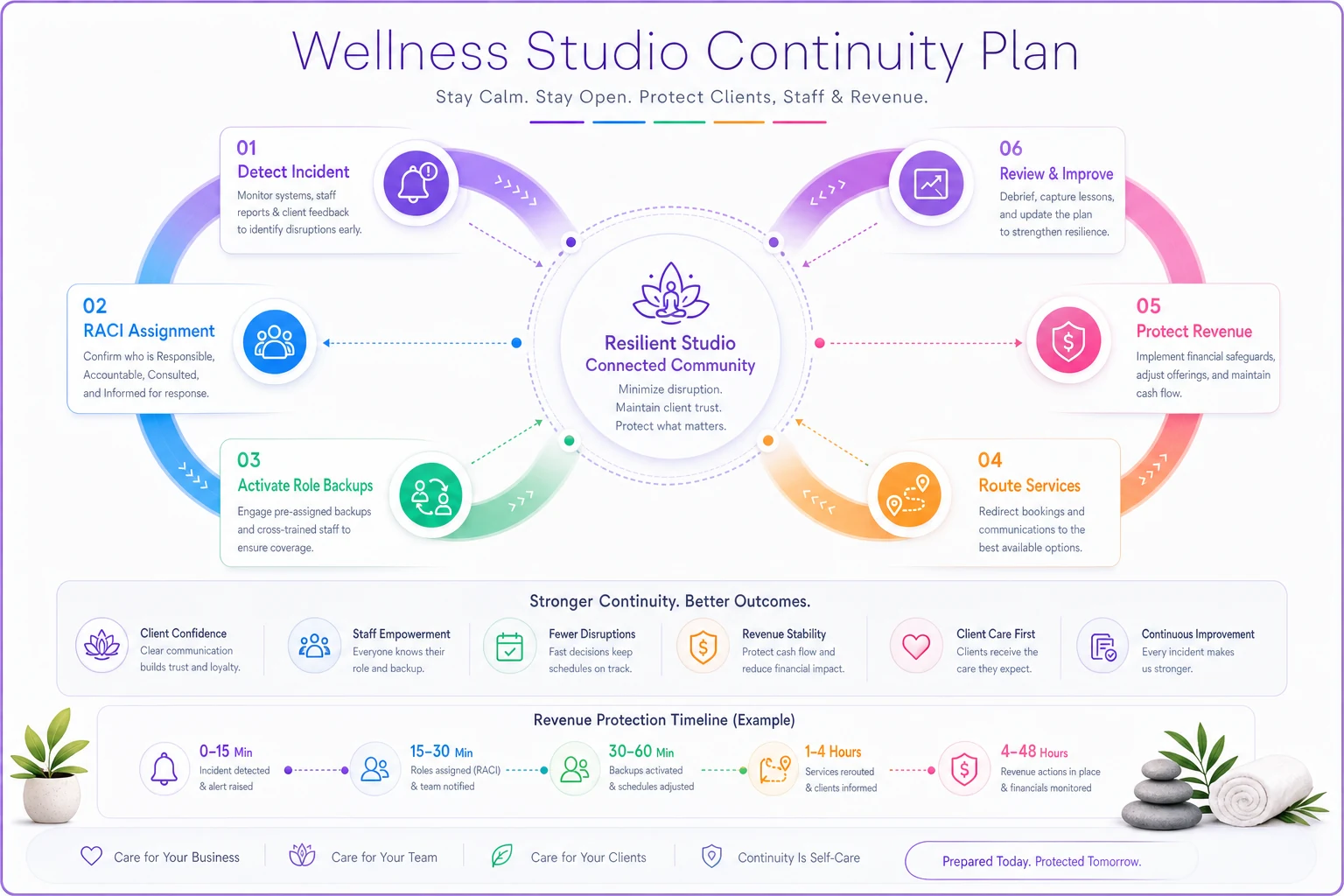
Use this workflow to map responsibilities and handoffs during an outage.
A workflow walkthrough: therapist out, two days' notice
A senior therapist at a two-site studio texts Friday night: she's injured and out for at least two weeks. She had roughly 24 booked appointments across the coming week, many of them regulars.
Here's how the system fires in order. The site manager (per the RACI) sees the message and doesn't panic, because the routing rules already exist. She pulls the affected bookings and sorts them — members and package clients at the top. The front desk lead, the named backup for client communication, starts calls Saturday morning using the standard script, not improvising.
For each client, she walks the routing hierarchy: same slot with another therapist, then the sister location, then priority rebooking with a free aromatherapy add-on as the goodwill gesture. Because managers have pre-set comp authority, nobody waits on the owner to approve anything.
Meanwhile the bookkeeper flags the prepaid obligations so nothing gets double-charged or lost. By Monday, instead of 24 confused clients and a pile of refund requests, you've rebooked most of them, lost a handful to scheduling conflicts, and kept the cash largely intact. The therapist's absence stung, but it didn't cascade.
Compare that to the no-system version: nobody calls until Monday, half the clients show up to a locked situation, three demand refunds, two leave bad reviews, and the owner spends the week firefighting instead of running the business.
A real scenario with numbers
A single-location studio — one owner, four therapists, somewhere around 330–360 appointments a month — had its booking software go down over a holiday weekend. No offline backup of the schedule. The owner couldn't remember who was booked, couldn't take new bookings, and spent the weekend fielding angry texts.
The direct hit was one thing: maybe 40 appointments disrupted, a chunk of them lost entirely. But the real damage was slower. Over the following two months, rebooking rates among affected clients dropped noticeably, and the studio quietly lost somewhere in the $3k–$5k range in repeat revenue from clients who just drifted.
After that weekend they built the boring version of a continuity plan: a weekly exported schedule backup, a printed emergency client-contact list kept securely, named role backups, and a one-page routing sheet at the front desk. The next time a problem hit — a shorter power outage the following season — they rebooked affected clients within hours and lost almost nothing. The plan paid for itself the first time it was needed.
Quarterly tabletop exercises (the habit that keeps it alive)
A plan you never test is a plan that quietly rots. Phone numbers change, staff turn over, the software gets replaced. The fix is a short tabletop exercise once a quarter — 30 to 45 minutes, no actual emergency required.
-
Pick a realistic scenario (last quarter's near-miss is a great source).
-
Walk through it out loud with the team
who does what, in what order.
-
Note every place someone says "wait, who handles that?" — those are your gaps.
-
Check that contacts, logins, and backups are still current.
-
Update the one-page plan and move on.
The goal isn't a perfect performance. It's surfacing the one broken assumption before a real crisis finds it for you. Teams have discovered during a tabletop that their "backup" for the booking system had quit three months earlier and nobody noticed.
Where this intersects with your data and privacy exposure
Continuity and data protection overlap more than people expect. A ransomware incident or a lost laptop isn't just a security problem — it's a continuity problem, because you may suddenly lose access to your schedule, client records, and payment history all at once. Your recovery plan and your breach-response plan should reference each other.
If you haven't already built the security side, it's worth pairing this with a proper incident-response and privacy playbook so a single bad day doesn't take out both your operations and your client data at the same time.
When a full continuity program makes sense — and when it doesn't
When it's worth the effort: You're running a second location, you carry meaningful prepaid liabilities (packages, memberships, gift cards), or you've already had one close call that scared you. At that point, improvisation is a liability, not a virtue.
When to keep it lean: If you're a true solo practitioner with no staff and no prepaid obligations, you don't need a RACI. You need three things — a schedule backup, a client-contact list, and a plan for who covers you if you're sick. Building a corporate-grade continuity binder for a one-person practice is wasted effort.
Who should not over-invest here: Studios that haven't nailed their basic daily operations yet. If your booking, intake, and billing flow is still chaotic on a normal day, fix that foundation first. Continuity planning assumes you have a stable operation to protect. Build the floor before you buy the fire extinguisher.
Pulling it together
The studios that survive bad weeks aren't the ones with the thickest binders. They're the ones where the right person knows the next move, the prepaid clients get called first, and the money keeps flowing even when the schedule doesn't. That comes from writing down what currently lives in your head, naming backups for the roles that touch clients and cash, and testing the whole thing a few times a year until it's muscle memory.
Continuity isn't about predicting the exact disaster. It's about building an operation that bends without breaking — so that when the inevitable bad Saturday arrives, your clients barely notice, and your cashflow holds.
The studios that survive bad weeks aren't the ones with the thickest binders. They're the ones where the right person knows the next move, the prepaid clients get called first, and the money keeps flowing even when the schedule doesn't. That comes from writing down what currently lives in your head, naming backups for the roles that touch clients and cash, and testing the whole thing a few times a year until it's muscle memory.
Continuity isn't about predicting the exact disaster. It's about building an operation that bends without breaking — so that when the inevitable bad Saturday arrives, your clients barely notice, and your cashflow holds.
Ready to elevate your massage therapy business?
Join hundreds of therapists using Masthera to save time, reduce scheduling conflicts, and enhance client satisfaction.