

Most massage studios treat add-ons like an afterthought. A therapist mentions hot stones as the client is putting their shoes back on, the client says "maybe next time," and that's the end of it. The owner quietly concludes that upsells "don't really work here" and moves on.
The problem isn't the offer. It's the timing, the framing, and the complete absence of any way to tell which add-ons actually move the needle. A well-built massage POS upsell flow isn't about pushing harder — it's about placing the right offer at the right moment in the client's decision-making, then tracking whether it earned you an extra $8 or an extra $40 per booking.
This post breaks down which add-ons convert at booking versus day-of, how pricing anchors quietly change what people pick, and a simple tracking method so you're measuring incremental revenue per booking instead of running on gut feel.
The core split: booking-time buyers vs. day-of buyers
There are two completely different psychological states your client moves through, and each one favors different add-ons.
At booking, the client is in planning mode. Future-oriented, haven't paid yet, mentally constructing the ideal version of their appointment. This is when premium upgrades convert — the 90-minute over 60, the CBD oil, the prenatal specialization. There's no friction of a second transaction because everything folds into one payment they haven't made yet.
On the day of — specifically that 10-minute window before or after the session — the client is in experience mode. Relaxed, present, physically feeling their body. This is when sensory, immediate-gratification add-ons land: aromatherapy, a scalp add-on, extra time on a problem area, a hot towel finish. Asking someone to commit to a 90-minute upgrade while they're half-asleep on the table almost never works. Offering them "15 more minutes on those shoulders that are clearly wound up" works really well.
The mistake studios make constantly is using one script for everything, usually the wrong-timed one. They pitch sensory add-ons at booking — the client can't feel anything yet, so it's totally abstract — and pitch big time upgrades day-of, when the client is too zoned out to commit to much. Flip those, and the same add-ons convert at a noticeably higher rate.
A quick breakdown of what converts where
| Add-on | Best timing | Why it works there | Rough attach rate |
|---|---|---|---|
| 60→90 min upgrade | Booking | Planning mode, single payment | 12–20% |
| CBD / premium oil | Booking | Feels like "the full experience" | 8–15% |
| Aromatherapy | Day-of | Immediate sensory choice | 25–35% |
| Hot stones | Booking or day-of | Works both, better at booking | 10–18% |
| Extra 15 min on problem area | Day-of (mid-session cue) | Tied to felt pain | 20–30% |
| Scalp / foot add-on | Day-of | Low commitment, feels indulgent | 30–40% |
| Cupping | Booking | Needs setup, client wants to plan | 6–12% |
Those ranges aren't laws. They shift with your clientele, your pricing, and how the offer is worded. But the pattern — sensory stuff day-of, commitment stuff at booking — holds up almost everywhere.
Pricing anchors: the quiet lever most studios never touch
Something that changes results without changing a single script: the order and reference point of your add-on prices.
Never miss a booking or double-book again.
Masthera helps you schedule, confirm & manage every massage session with ease.
- Unified appointment management
- Automated client reminders
- Therapist calendar coordination
No credit card required
A typical menu looks like this:
-
Aromatherapy — $10
-
Hot stones — $25
-
CBD oil — $15
-
Extra 15 min — $30
Nothing anchors anything. Every price gets judged in isolation, and $30 for 15 minutes feels steep on its own.
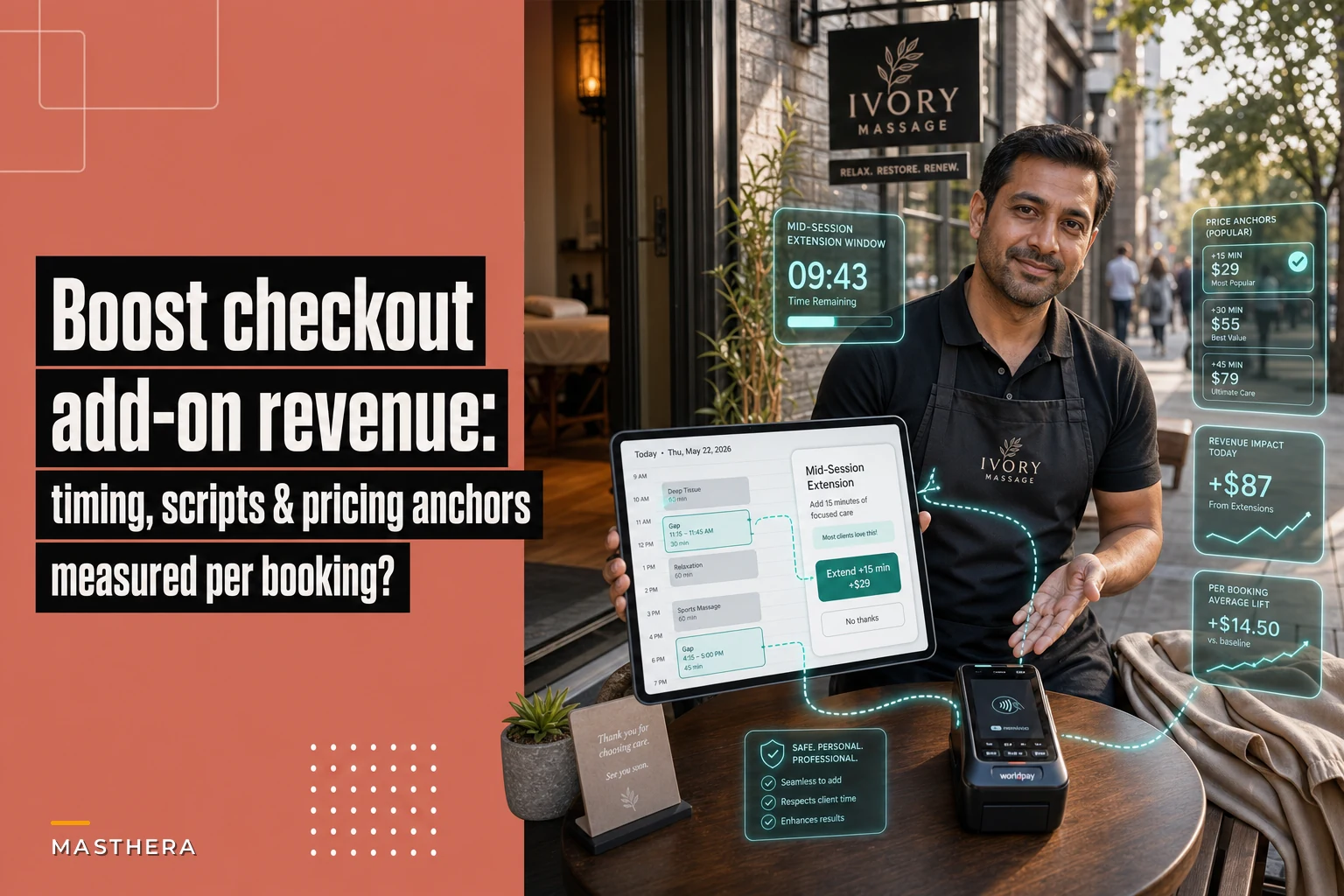
Now reframe it. On the booking page, show the 90-minute session next to the 60-minute one first. If your 60 is $95 and your 90 is $135, the client has just internalized that 40 extra dollars buys 30 more minutes. Suddenly "$30 for 15 more minutes" day-of feels reasonable — it's cheaper per minute than what they already considered. The 90-minute price becomes the anchor that makes everything smaller look fair.
Second anchor trick: bundle framing at booking. Instead of à la carte, offer one "Signature" upgrade that includes hot stones + aromatherapy + CBD for, say, $40 when the parts would total $50. People who'd never buy three separate add-ons will take the bundle because it reads as the complete choice and the discount is right there. A single well-priced bundle at booking tends to outperform four separate à la carte options — it removes decision fatigue before it starts.
One caution: don't anchor with a fake premium option nobody actually buys. Clients pick up on that faster than you'd expect. The anchor has to be a real thing a reasonable person might actually choose.
Staged scripts: the actual words, per moment
Scripts matter because the same offer phrased two different ways can convert at wildly different rates. Three moments matter most.
Stage 1 — Booking (self-serve or front desk)
Planning mode. Keep it about the experience they're designing.
Front-desk version: > "For the 60-minute deep tissue — a lot of clients doing deep tissue add the 90 so there's actually time to work the tension out instead of rushing. Want me to book the 90?"
Online version (one line under the service): "Most first-time deep tissue clients choose 90 minutes — it gives the therapist time to actually release the knots."
Notice it's not "would you like to upgrade?" It's social proof with a reason attached. "Would you like to add anything?" is the weakest sentence in the entire funnel and should be retired permanently.
Stage 2 — Intake / just before the session
Best for sensory add-ons that need a little prep.
> "Before we head in — a lot of people love adding aromatherapy on a stressful week, it's $10 and I've got a calming blend ready. Want it today?"
"Today" matters. It signals a one-time, low-stakes choice, not a commitment to anything ongoing.
Stage 3 — Mid-session cue (highest-converting, most ignored)
This requires no selling at all. The therapist notices something real and names it.
> "Your upper traps are really locked up — we're at about the 45-minute mark. I can spend the last stretch just on this, or if you want I've got room to add 15 minutes so we don't have to rush the rest. Totally your call."
This converts because it's tied to a sensation the client is feeling right now. Not a pitch — a clinical observation with an option attached. The catch is the therapist has to know how much room is in the schedule, which is exactly where most studios fall apart.
The operational gap nobody talks about
Mid-session upgrades fail for one reason: your therapist can't offer 15 extra minutes if they don't know whether the room and their schedule are actually free.
The highest-converting upsell — extra time, offered when the client physically wants it — is invisible to the person who could sell it. They'd rather stay quiet than promise time they might not have and blow up the next appointment.
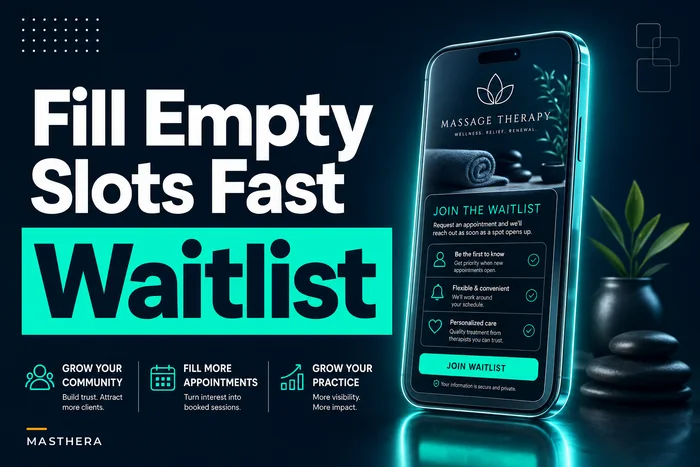
If you've built out any kind of same-day availability system, this problem shrinks considerably. The same logic that lets you fill empty slots with a waitlist and same-day booking funnel also tells your therapist, in real time, whether the next 20 minutes are open. When the schedule is visible at the table, mid-session extensions stop being a gamble and start being a genuine offer.
A quick workflow: how schedule visibility connects the booking calendar to checkout and the therapist at the table.
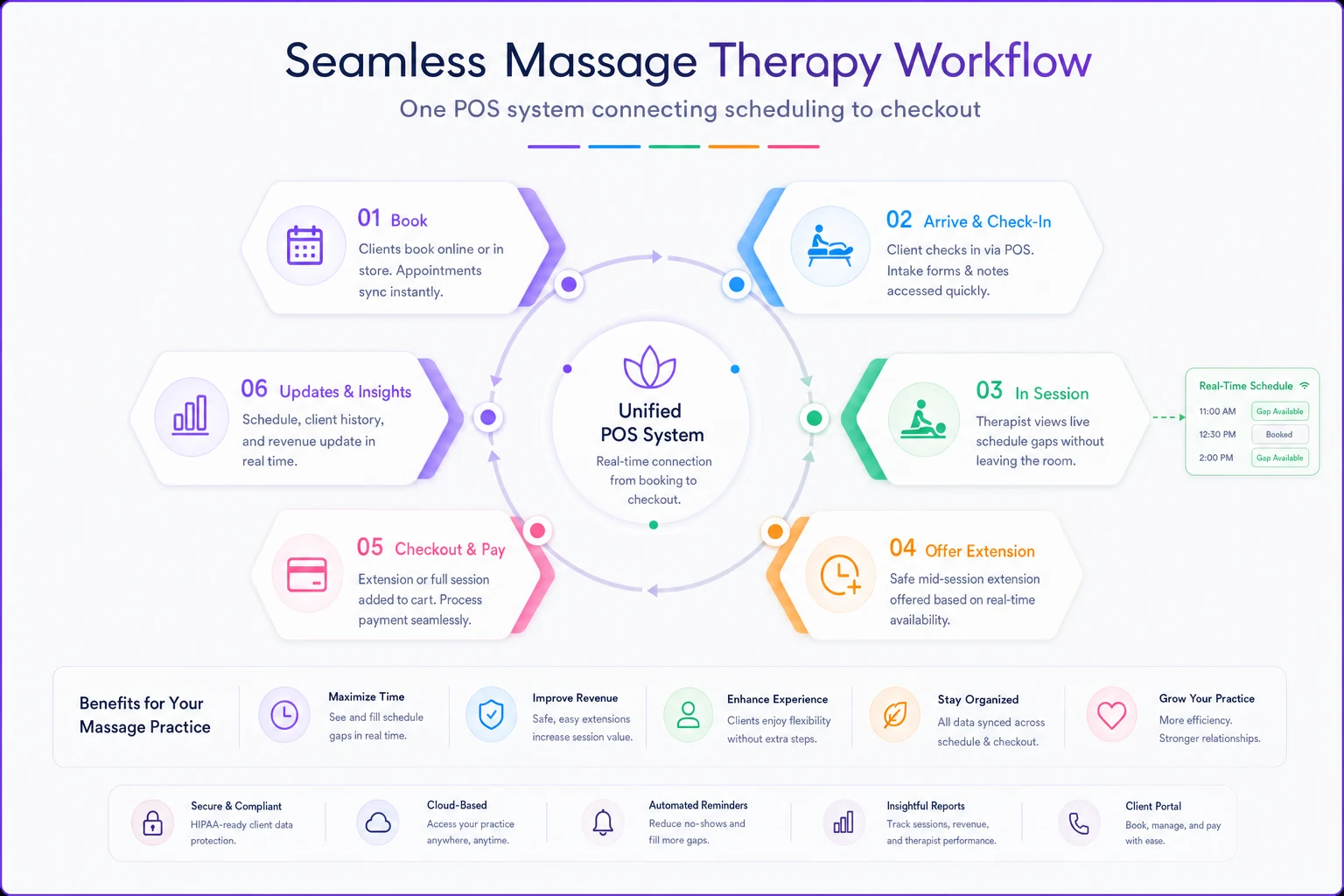
This is where a POS that connects the booking calendar to checkout actually matters — not as a fancy feature, but because the therapist needs to see the gap before they can sell into it. If your upsell lives in one system and your schedule lives in another, stage-3 conversions basically don't happen.
Tracking incremental revenue per booking (the part everyone skips)
Attach rate alone lies to you. If you offer a $10 aromatherapy to 100 clients and 40 take it, that's a 40% attach rate — but only $400. If you offer a $40 bundle to 100 clients and 12 take it, that's a "worse" 12% attach rate but $480. The metric that actually matters is incremental revenue per booking: total add-on revenue ÷ total bookings.
-
Tag every add-on with its timing. In your POS, create the add-on twice if you have to — "Aromatherapy (day-of)" and "Aromatherapy (booking)." Ugly, but it lets you see where the money came from.
-
Pull three numbers weekly
total bookings, total add-on revenue, and add-on revenue split by stage.
-
Divide. Add-on revenue ÷ bookings = incremental revenue per booking. That's your north-star number.
-
Segment by therapist. Some therapists convert stage-3 extensions at double the rate of others. That's a coaching opportunity, not just a personality difference.
-
Test one change at a time. Change the booking-page wording for two weeks, then watch the booking-stage number. Change three things at once and you'll never know what worked.
Create distinct POS items for booking vs day-of add-ons so reporting clearly shows timing impact.
A minimal weekly tracking table can live in a spreadsheet:
| Week | Bookings | Booking-stage $ | Day-of $ | Total add-on $ | Rev / booking |
|---|---|---|---|---|---|
| 1 | 128 | $410 | $520 | $930 | $7.27 |
| 2 | 141 | $505 | $610 | $1,115 | $7.91 |
Once you can see that number move week over week, upsells stop being a guessing game.
A real scenario
A two-therapist studio doing around 130 bookings a month had "upsells" that consisted of a printed menu at the front desk nobody read. Add-on revenue was maybe $250–$350 a month, mostly random hot-stone requests.
They made three changes: moved the 90-minute upgrade to a one-line social-proof prompt at booking, trained both therapists on the mid-session extension script tied to what they actually felt in the tissue, and made the schedule visible at the table so extensions were safe to offer. Then they tracked incremental revenue per booking every week.
Within about two months, add-on revenue was consistently landing in the $900–$1,100 range — incremental revenue per booking climbing from roughly $2 to around $7.50. Base pricing didn't change. They just stopped pitching the wrong things at the wrong moments and started measuring what actually happened.
When this is a bad idea
Not every studio should lean hard on upsells.
-
If your brand is clinical or rehab-focused, aggressive add-on offers can undercut trust. Stick to clinically-relevant time extensions and skip the aromatherapy-as-treat framing.
-
If your therapists are contractors on a flat session rate, they have no real incentive to offer add-ons and it'll feel forced. Fix the comp structure before the scripts, or tie a small cut of add-on revenue to the therapist directly.
-
If you don't have schedule visibility, don't roll out mid-session extensions. Broken promises to clients in the next slot cost more than any upsell earns.
Add-ons are the fastest revenue lever because they require no new clients and no new marketing — just better timing on people already on your table.
Where upsells connect to the bigger revenue picture
But they work best as one piece of a stable base. If your recurring revenue is shaky, no amount of aromatherapy fixes it.
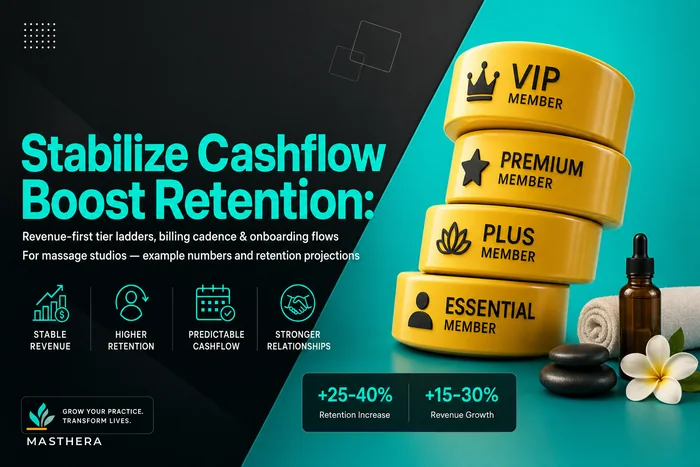
Getting your recurring model right first is usually the smarter move; designing memberships that stabilize cashflow and boost retention gives you the predictable foundation that add-ons then layer profit on top of.
The one thing to take away
Stop asking "would you like to add anything?" at checkout and calling it a strategy. Split your offers by the client's mental state — commitment stuff at booking, sensory stuff day-of, time extensions tied to what the therapist actually feels mid-session. Anchor your prices so the smaller add-ons feel fair relative to something bigger. Then track incremental revenue per booking every week so you're managing a real number instead of guessing at one.
Do that consistently, and the same clients you already have start spending meaningfully more per visit — not because you pushed, but because you finally offered the right thing at the moment they actually wanted it.
Do that consistently, and the same clients you already have start spending meaningfully more per visit — not because you pushed, but because you finally offered the right thing at the moment they actually wanted it.
Ready to elevate your massage therapy business?
Join hundreds of therapists using Masthera to save time, reduce scheduling conflicts, and enhance client satisfaction.