


Most studio owners don't get tripped up by the idea of contractor vs employee. They get tripped up three weeks after someone starts, when the paperwork doesn't match how that person actually works. The therapist has a set schedule you control, you told them which oils to use, you handle all the booking — but they signed a 1099 agreement. Now your onboarding folder says one thing and your daily operations say another.
This post isn't legal advice, and I'm not going to pretend to be your accountant. What I can walk you through is the operational side that rarely gets covered: what changes in your onboarding docs, how pay processing splits into two completely different flows, where benefits routing goes, and how the actual workflow of running your studio shifts depending on which path you choose. That's the stuff that either runs smooth or turns into a mess at month-end.
The contractor vs employee question isn't one decision — it's a fork that changes about six downstream systems.
The fork that decides everything downstream
Before the docs, before payroll, there's one operational reality that tends to predict the whole thing: how much control you exercise over the work.
Not the label you want. The control you actually have.
If you set the schedule, assign clients, require specific techniques, provide the table, linens, and products, and expect the person there Tuesday through Saturday — you're operating like an employer regardless of what the contract says. If the therapist rents your room, sets their own hours, brings their own clients, and uses your space more like a landlord relationship, that leans contractor.
> Are you going to control how, when, and with whom this person works?
-
Mostly yes → your operations should be built for an employee
-
Mostly no → your operations should be built for a contractor
The pattern that causes trouble: owners choose contractor because it feels cheaper and simpler on day one, then slowly start managing that person like an employee because that's how you run a tight studio. Six months later the onboarding docs, the pay flow, and the actual working relationship have quietly drifted out of alignment. That drift is where audits, disputes, and bad breakups live.
Everything below flows from that answer.
Onboarding docs: two different folders, not one with edits
A common mistake is keeping a single onboarding checklist and swapping a few lines depending on classification. That's how you end up with an employee handbook attached to a 1099 agreement. The two paths need genuinely different document sets.
Never miss a booking or double-book again.
Masthera helps you schedule, confirm & manage every massage session with ease.
- Unified appointment management
- Automated client reminders
- Therapist calendar coordination
No credit card required
Here's how the onboarding folders actually differ:
| Onboarding element | Employee path | Contractor path |
|---|---|---|
| Core agreement | Employment offer / at-will terms | Independent contractor / service agreement |
| Tax form collected | W-4 (withholding) | W-9 (info reporting) |
| Handbook & policies | Full handbook, schedule policy, dress code | Studio rules limited to shared-space conduct |
| Training requirements | Studio can mandate protocols & shadowing | Suggested, not mandated |
| Equipment & supplies | Studio provides | Often supplied by contractor |
| SOAP / clinical docs | Studio-owned system, required | Access negotiated, ownership defined in contract |
| Non-compete / scope | Sometimes included | Usually inappropriate or unenforceable |
The clinical documentation line is one people consistently underestimate. If you're bringing on an employee, your notes system is your system — they document into it, you own it. With a contractor, you have to spell out who owns the records, how they're stored, and what happens to them if the contractor leaves. If you're building or tightening that side of things, it's worth reviewing how to build a SOAP-notes system for small wellness practices so the ownership and access rules are set before someone starts, not after they walk out with client histories.
A useful onboarding rule: the documents should describe the relationship you're actually going to run. If you find yourself writing "contractor" at the top but the handbook underneath dictates hours and technique, stop. The folder is lying, and it'll cost you later.
Pay flows: the split most owners underestimate
This is where the two paths stop being paperwork and start being real operational work every single pay period.
Employee pay flow — the longer one:
-
Track hours or sessions worked, plus any tips routed through the studio
-
Calculate gross pay
-
Withhold income tax plus the employee share of payroll taxes
-
Add the employer share of payroll taxes on top — this is the cost people forget
-
Handle any deductions (benefits, etc.)
-
Issue net pay on a set schedule
-
Remit withholdings and file required reports
-
Produce year-end wage statements
Contractor pay flow — the shorter one:
-
Receive invoice or confirm agreed amount
-
Pay the full agreed amount, no withholding
-
Track total paid across the year
-
Issue a year-end information return if the threshold is met
The gap between these two flows is bigger than it looks. The employer-side payroll tax is the piece that surprises new studio owners most. A therapist you pay "$30 a session" as an employee doesn't actually cost you $30 — once you layer employer taxes, workers' comp in most states, and any benefits, the loaded cost typically runs somewhere in the range of 12–20% above the base wage before you even touch benefits.
-
As a contractor the studio pays roughly $10,880 for the quarter. Flat. Nothing extra.
-
As an employee that same base is still $10,880, but loaded costs push the real number closer to $12,400–$13,000 once employer taxes and comp are in.
That's not an argument for contractor status — the contractor number looks cheaper precisely because you're offloading responsibilities and giving up control. The point is that the pay flow itself is a different operational animal, and your month-end reconciliation has to account for it. If your books treat both paths the same way, your labor cost line will be wrong every month.
Benefits routing: where it actually goes
Benefits are the cleanest dividing line between the two classifications, and the one that quietly shapes retention more than most owners realize.
With employees, benefits route through the studio. Paid time off, any health contribution, retirement options, sick leave where required — these attach to the employment relationship and flow through your systems. That's real ongoing admin, but it's also a retention lever. Therapists who have PTO and some stability tend to stick around, and in a business where rebooking depends on the client seeing the same hands, that matters.
With contractors, none of that routes through you. They handle their own coverage, their own time off, their own retirement. Cleaner administratively, but it removes one of your strongest tools for keeping good people.
There's a subtler point here too. When your revenue is stabilized — through memberships or predictable recurring income — you can actually afford to offer employees real benefits, which changes the quality of people you can attract. Owners who've worked on designing memberships that stabilize cashflow tend to find the employee path becomes far more viable, because predictable revenue supports a predictable payroll and a real benefits offer.
Where the daily workflow actually diverges
Scheduling. With employees, you build the schedule and they work it. You can require Saturday coverage, block out training, and shift people to cover a no-show. With contractors, you're coordinating around their availability — you request, you don't assign. If your rebooking system depends on tight schedule control, the contractor model will fight you constantly.
Client ownership. Employees serve the studio's clients. Contractors, in many arrangements, bring or retain their own. That single distinction decides who "owns" the client relationship when someone leaves — and it's the fight that ends more studio partnerships than money does.
Standards enforcement. You can hold an employee to a specific intake process, a specific set of protocols, a specific way of documenting. With a contractor, you're limited to the standards you agreed to in the contract. Trying to enforce employee-level consistency on a contractor is both operationally awkward and a sign your classification might not match reality.
Coverage and continuity. Employees give you a reliable base to build capacity around. Contractors give you flexibility to scale during busy stretches without committing to fixed labor cost. Most healthy studios end up with a mix — a stable employee core plus contractors for overflow or specialized modalities.
A simple decision tree you can actually use
Run a prospective therapist through these questions in order. Stop at the first strong answer.
-
Will you set their schedule and require specific hours? Yes → employee lean. No → keep going.
-
Will you assign them clients from the studio's book? Yes → employee lean. No → keep going.
-
Will you require specific techniques, intake steps, and documentation? Yes → employee lean. No → keep going.
-
Do you provide the room, table, linens, and products? Yes → employee lean. No → contractor lean.
-
Does the person work for other studios or have their own client base? Yes → contractor lean. No → employee lean.
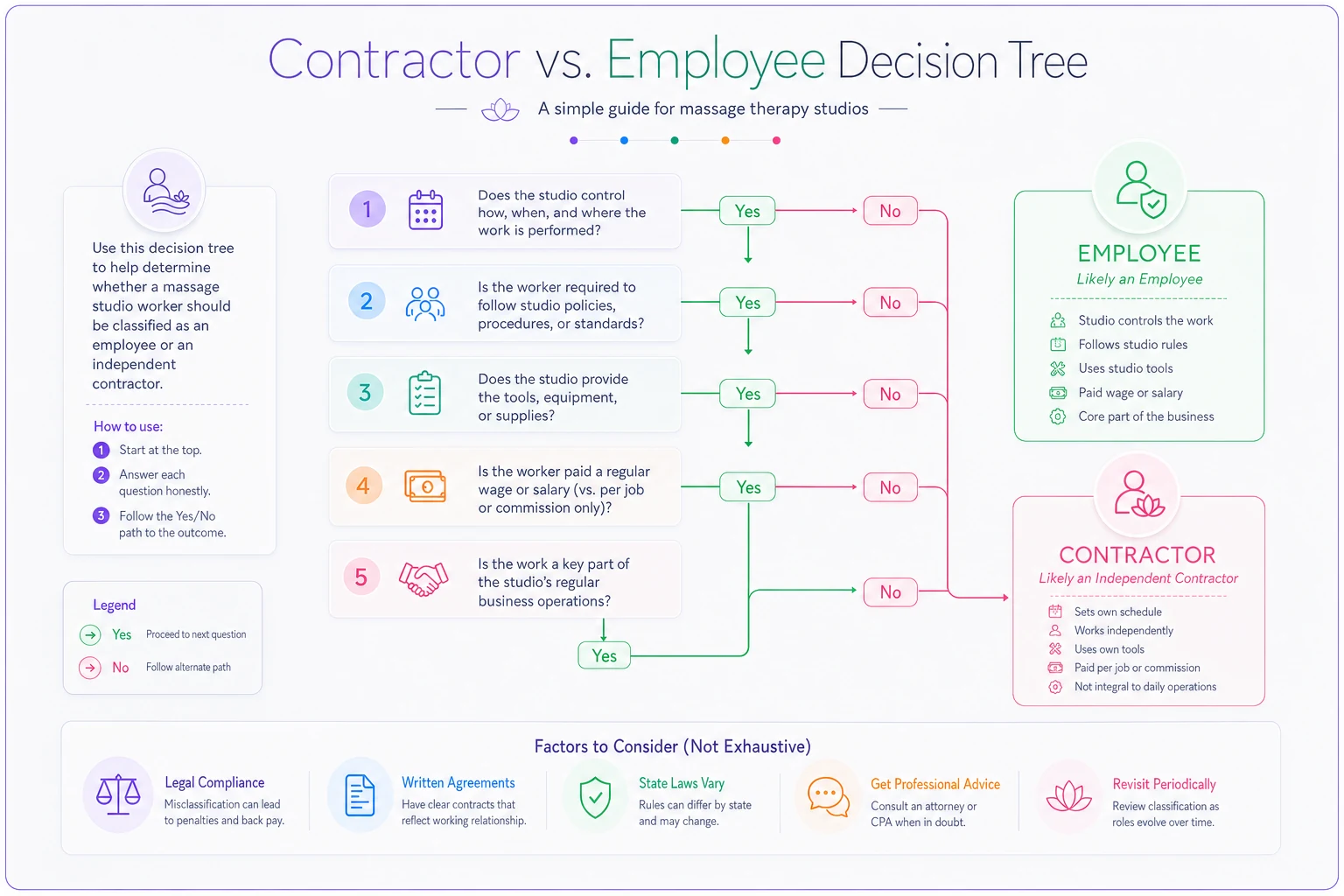
If you land on "employee" for questions 1–3 but wrote a contractor agreement, that's your warning sign. Fix the classification to match the operation, not the other way around.
When each path actually makes sense
Employee makes sense when:
-
You want consistent hours and reliable coverage
-
Client relationships belong to the studio
-
You care about enforcing standardized protocols and documentation
-
You want retention tools like PTO and benefits
-
Your revenue is stable enough to carry loaded labor cost
Contractor makes sense when:
-
You're offering space more than direction
-
The therapist genuinely runs their own practice
-
You need flexible overflow capacity without fixed cost
-
The person works across multiple studios
Who should not go contractor: any owner who plans to control the schedule, assign every client, mandate techniques, and expect employee-level reliability — while paying 1099 to save money. That's the exact mismatch that causes the drift described above. The savings are real until the day they aren't.
A quick onboarding checklist that keeps you honest
Before someone's first shift, confirm:
-
[ ] The agreement type matches how you'll actually manage them
-
[ ] Correct tax form collected (W-4 for employee, W-9 for contractor)
-
[ ] Pay flow set up correctly (payroll run vs. invoice-based)
-
[ ] Loaded labor cost calculated, not just the base rate
-
[ ] Benefits routing decided and documented (or explicitly none, for contractors)
-
[ ] SOAP/clinical record ownership and access defined in writing
-
[ ] Client ownership terms written down before day one
-
[ ] Schedule expectations match the classification
Before someone's first shift, confirm:
Real scenario: a two-room studio that fixed a classification drift
A two-room studio owner had brought on two therapists as contractors, mostly to keep things simple. Over about eight months, she'd started assigning them clients, setting a fixed Tuesday–Saturday schedule, and requiring her intake and note-taking process. Pay was still flat 1099 — clean invoices, no withholding.
The problem showed up at month-end. Her labor cost line kept looking artificially low, so her margins looked better than they were, and she couldn't figure out why one therapist felt underpaid while she felt she was paying fairly. The relationship had quietly become employment, but the pay flow hadn't caught up.
She reworked it. One therapist who genuinely wanted flexibility and worked at another studio stayed contractor — but she loosened the control to match, requesting availability instead of assigning it. The other, who worked only for her and wanted stability, moved to employee. Loaded cost on that person went up by roughly 15%, which stung on paper. But her month-end numbers finally reflected reality, the tension around pay disappeared once benefits and stability entered the picture, and rebooking rates on that therapist's clients climbed over the following quarter because the person stopped looking for other work.
The lesson wasn't "employee is better." It was that the classification, the docs, the pay flow, and the daily operation finally agreed with each other.
Getting the two flows to stop fighting your books
Once you've got a mix of contractors and employees, the operational headache shifts from deciding to tracking. Two pay flows, two document sets, two sets of month-end reconciliation. A lot of studios lose hours every pay period reconciling by hand, and classification drift tends to sneak back in unnoticed when you're managing it all manually.
A well-set-up operations platform helps here in a quiet, unglamorous way — keeping each therapist's onboarding docs, pay flow, and schedule rules attached to their actual classification so the folder can't silently drift from the operation. The more useful function is early detection: flagging when a "contractor" is being scheduled like an employee, or when loaded labor cost isn't being counted properly. That's not the exciting part of running a studio, but it's the part that keeps boring problems from becoming expensive ones.
Pick the classification that matches how you're actually going to run the relationship, then build the docs, pay flow, and daily workflow to agree with that choice — and revisit it whenever the way you manage someone starts to drift.
Ready to elevate your massage therapy business?
Join hundreds of therapists using Masthera to save time, reduce scheduling conflicts, and enhance client satisfaction.