
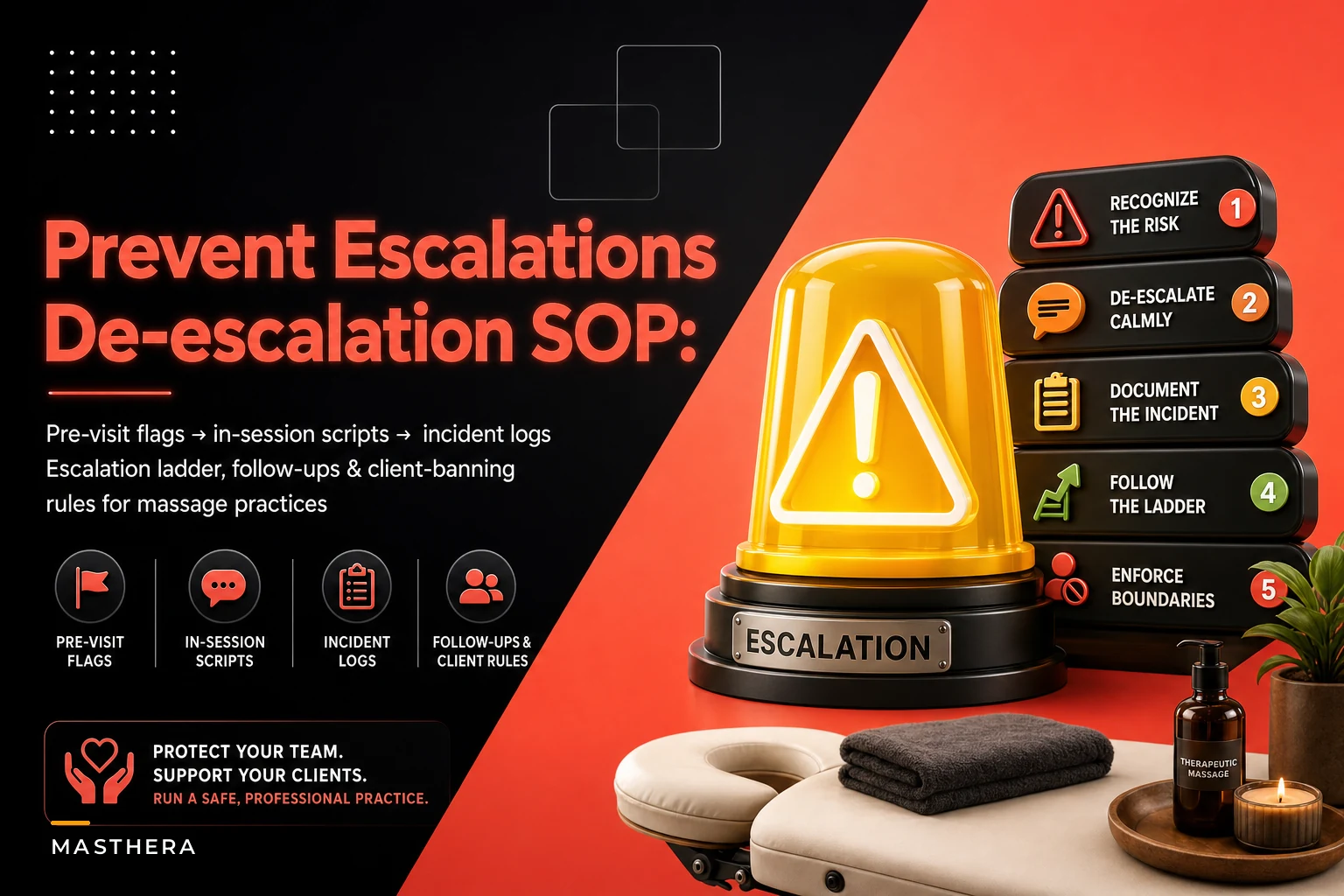

The massage therapy industry has a problem that rarely gets discussed at conferences. Between 30–40% of female massage therapists experience at least one inappropriate client interaction annually, based on state board complaint data across multiple jurisdictions. Most studios handle these situations reactively—scrambling after something happens, unclear on documentation requirements, worried about reviews, and unsure when termination is actually justified.
A properly structured de-escalation SOP changes that dynamic. Not the generic "trust your instincts" advice on industry forums, but an actual operational framework with screening protocols, scripted responses, and clear escalation triggers.
Pre-Visit Warning Signals Most Studios Ignore
Your intake system already collects warning signals—you're just not tracking them in any systematic way. The most reliable predictor of problematic behavior isn't what clients say during booking, it's how they interact with your process.
Late-night requests for immediate appointments correlate strongly with boundary issues. Not always, but consistently enough that tracking the pattern matters. Same with clients who repeatedly ask about draping policies before booking, who request specific therapists based solely on photos, or who push back on standard intake questions.
-
Time of booking request
-
Number of policy questions during scheduling
-
Resistance to standard procedures
-
Requests outside normal service parameters
-
Communication tone indicators
These aren't automatic disqualifiers. A construction worker booking at 11pm after a late shift is different from someone persistently asking whether therapists "work on glutes" during intake. The point is capturing patterns, not making snap judgments.
Building Your Three-Tier Response Framework
The de-escalation SOP needs clear tiers with specific triggers and responses. Ambiguity creates hesitation, and hesitation escalates situations.
Never miss a booking or double-book again.
Masthera helps you schedule, confirm & manage every massage session with ease.
- Unified appointment management
- Automated client reminders
- Therapist calendar coordination
No credit card required
Tier 1: Redirect and Document Minor boundary testing that needs immediate correction but doesn't require ending the session. Comments about appearance, requests to remove more draping than necessary, or questions about "extra services" fall here. Your response script: "I need to clarify our professional boundaries. This is a therapeutic service only. Comments like that aren't appropriate and make me uncomfortable. Can we continue professionally, or should we end the session?"
Document exactly what was said, when it occurred in the session, and your exact response. Use quotes, not summaries. Time stamps matter for potential board complaints.
Tier 2: Terminate Session Any physical boundary violation, repeated comments after a warning, or an aggressive response to redirection triggers immediate termination. Your script: "This session is ending now. Please get dressed. I'll wait outside and will process a partial refund for unused time." Don't negotiate at this point. Don't explain further. Leave the room immediately and have another staff member remain within earshot if possible. Process the partial refund to head off payment disputes that could make things worse.
Tier 3: Full Termination Plus Authorities Physical aggression, exposure, or refusing to leave triggers this level. Don't announce police involvement—just do it. Your script becomes minimal: "You need to leave immediately." Exit the room, lock yourself somewhere safe, call 911. Your safety overrides every other concern.
In-Session Verbal De-Escalation That Actually Works
Most de-escalation training focuses on keeping your voice calm. That's baseline. The real skill involves specific verbal techniques that redirect without escalating.
The broken record technique works particularly well in massage settings. Pick one phrase and repeat it exactly, without variation, regardless of what the client says: Client: "Come on, you're being uptight." Therapist: "This session is ending now. Please get dressed." Client: "I'm paying for a full hour!" Therapist: "This session is ending now. Please get dressed." Client: "Fine, whatever, I'm sorry." Therapist: "This session is ending now. Please get dressed." No explanations. No negotiations. The repetition shuts down the argument loop while holding the boundary.
The professional pivot handles ambiguous situations where intent isn't obvious: "I'm focusing on therapeutic work only. Let's continue with the treatment plan we discussed." This doesn't accuse anyone of anything but firmly redirects. If they persist, escalate to Tier 2. If they adjust, document and continue.
The witness announcement adds accountability without confrontation: "I'm going to have my colleague Sarah nearby for the remainder of this session." You're not asking permission—you're stating what's going to happen. This often corrects behavior immediately.
Documentation Templates That Protect Your License
State boards don't care about how a situation felt. They care about facts, timelines, and professional responses. Your documentation needs specific elements to hold up during investigations.
Incident Report Header:
| Incident Report Header |
|---|
| Date/Time (exact, not approximate) |
| Client name and ID number |
| Service type scheduled |
| Point in session when incident occurred |
| Staff members present or nearby |
Objective Description: Use exact quotes when possible. "Client said [exact words]" beats "client made an inappropriate comment." Describe physical actions specifically: "Client removed draped sheet from hip area" rather than "client exposed themselves."
Your Response: Document your exact words and actions. Include de-escalation attempts, any warnings given, and decision points. "I stated: 'This session is ending now. Please get dressed.' I then exited the room at 2:47pm."
Outcome: How did it resolve? Did the client leave voluntarily? Was a refund processed? Were authorities contacted? Include times for each action.
Follow-Up Actions: Is the client terminated, restricted to certain therapists, or flagged for special protocols on future visits?
This documentation does three things: protects your license during board investigations, supports insurance claims if situations escalate, and builds a record of patterns across multiple therapists that justifies permanent bans.
Clear Termination Triggers and Ban Protocols
Vague termination policies create legal vulnerabilities. Your cancellation system handles normal booking issues, but client bans need different documentation standards.
Immediate ban triggers:
-
Any physical assault or battery
-
Sexual assault or attempted assault
-
Refusing to leave when asked
-
Threats of violence or legal action
-
Bringing weapons into treatment rooms
Progressive termination triggers:
-
Boundary testing after a warning (two incidents)
-
Repeated inappropriate comments (two sessions)
-
Persistent requests for inappropriate services (two occurrences)
-
Aggressive behavior toward staff (two documented events)
The two-strike rule protects you legally while giving clients who genuinely misunderstood professional boundaries an opportunity to correct themselves.
Your termination letter needs:
-
A statement that services are terminated
-
The effective date
-
No detailed explanation (this avoids defamation exposure)
-
Any refund due for unused packages or memberships
-
A process for retrieving personal items if applicable
Keep it short: "Effective immediately, we're terminating our professional relationship. Your remaining package balance of $240 will be refunded within 10 business days. This decision is final."
Don't explain why. Don't list incidents. Your internal documentation handles that—the letter just ends the relationship.
Training Your Team Without Creating Paranoia
Teaching de-escalation without making therapists paranoid requires some balance. Focus on patterns and protocols, not fear-based scenarios.
-
January
Recognizing pre-visit warning signs
-
February
Tier 1 verbal redirects
-
March
Safe session termination procedures
-
April
Documentation requirements
Role-playing feels awkward but builds the muscle memory that matters. Pair experienced therapists with newer ones. Practice the exact scripts until they flow naturally—the broken record technique especially needs repetition to feel comfortable under pressure.
Pair newer therapists with experienced ones during role-plays to build confidence.
A buddy system for concerning appointments is worth implementing. If someone flags a client during intake, another therapist stays nearby during the session. Not hovering, just present in the facility. This simple protocol prevented several incidents at one studio I worked with last year. Most importantly, remove the shame around reporting. Therapists often blame themselves or worry about overreacting. Make it clear that documenting concerns protects everyone—even if nothing happens, the record matters. Your team also needs to understand the business logic here. A client spending $400 monthly but making therapists uncomfortable costs more than they generate. The turnover, stress, and potential legal exposure far exceed their revenue contribution. Your SOAP notes system already tracks clinical information—adding behavioral flags just extends what you're already doing.
Software Systems That Centralize Incident Tracking
Scattered incident reports in filing cabinets don't reveal patterns. You need centralized tracking that flags concerning behaviors across therapists and visits.
The operational challenge is that most booking systems weren't designed for incident tracking. You end up using paper forms, spreadsheets, or forcing data into fields meant for something else. That fragmentation means patterns only emerge after serious incidents—which is too late.
-
Incident type classification
-
Severity scoring
-
Response actions taken
-
Follow-up requirements
-
Cross-therapist pattern detection
When multiple therapists flag minor concerns about the same client, the system alerts management before things escalate. That proactive approach stops problems at Tier 1 instead of Tier 3.
Here's a workflow view showing how incident flags move from intake to resolution.
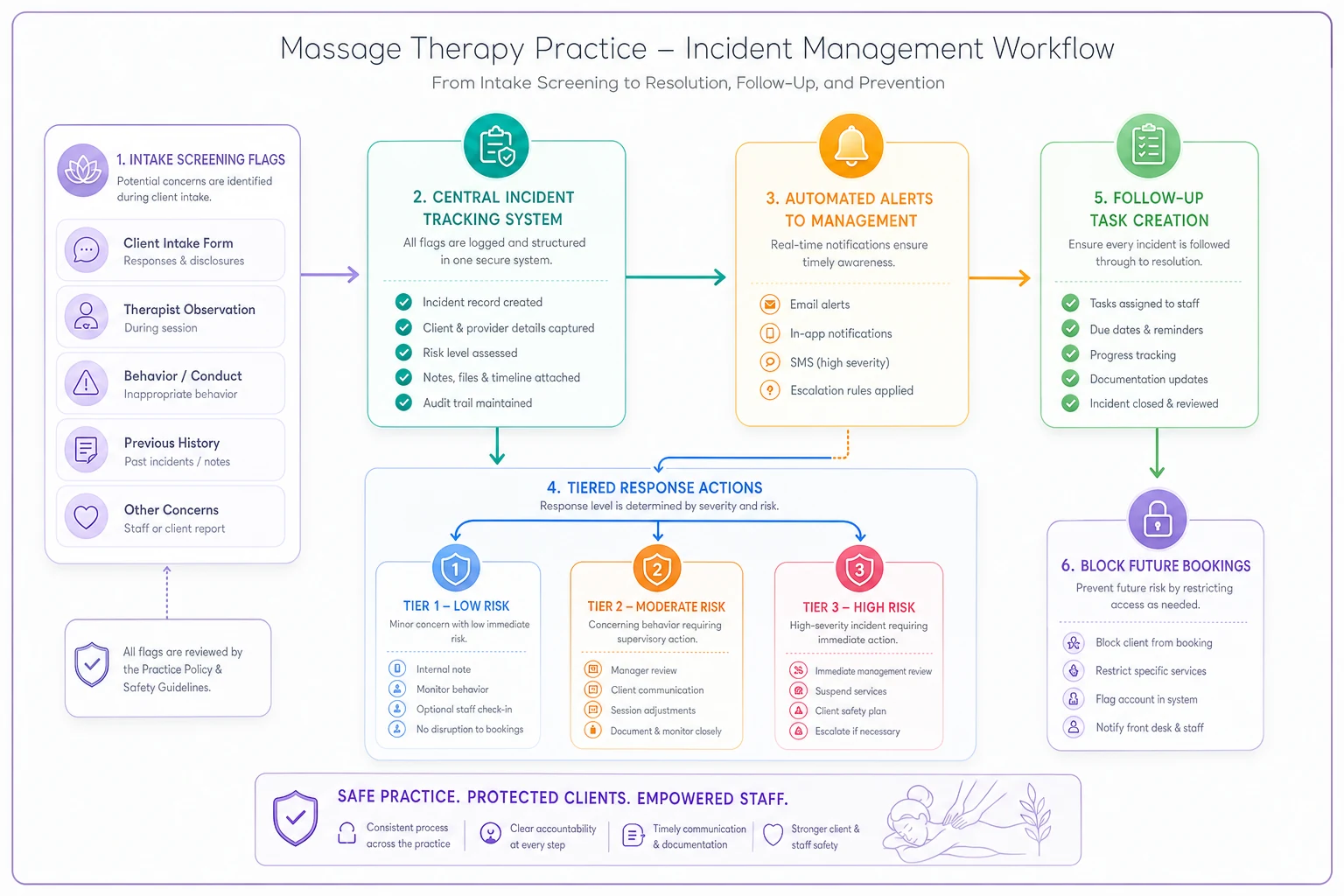
The automation side handles the administrative burden. Incident reports automatically generate required notifications, update client statuses, and create follow-up tasks. When you terminate a client, the system blocks future bookings, processes refunds, and generates the termination letter—while maintaining the documentation trail boards require.
That kind of systematic approach transforms de-escalation from a reactive scramble into a predictable operational process.
Making Safety Protocols Sustainable
The best SOP means nothing if it's not consistently followed. Sustainability requires embedding these protocols into daily operations, not treating them as a separate safety layer.
Start with intake. Every new client booking should automatically trigger your screening protocol—flag unusual booking patterns, resistance to policies, or concerning communication. This should happen during normal scheduling, not as an extra step.
Build documentation into your session notes workflow. A simple checkbox: "Any boundary concerns? Yes/No." If yes, a structured form appears. If no, move on. It takes seconds but creates consistent records over time.
Review incidents monthly, not just when something goes wrong. Look for patterns across therapists, time slots, and service types. Sometimes specific combinations create vulnerabilities—late evening appointments with new male clients booking deep tissue with female therapists, for example.
The protocols also need updates based on real incidents. Scripts that seemed perfect in training sometimes feel clunky during actual confrontations. Gather feedback from your team, adjust language, and refine responses based on what works in your actual treatment rooms.
Connect these protocols to your business metrics too. Track therapist retention before and after implementation. Measure how many concerning clients get successfully redirected versus terminated. Calculate the real cost of not having these systems—turnover, legal consultations, lost productivity from stressed therapists.
Safety protocols aren't overhead. They're operational infrastructure that protects your most valuable asset: your team's ability to work without fear.
The Real Cost of Not Having Clear Protocols
A single serious incident without proper documentation costs more than years of prevention systems. Legal consultations start around $300 per hour. Board investigation responses can require 20–40 hours of administrative time. Therapist turnover from feeling unsafe runs $3,000–5,000 per departure in recruitment and training.
The hidden costs hurt more, though. Therapists who don't feel protected start declining certain bookings. They avoid evening shifts. The best ones—the ones with options—leave first.
One studio owner discovered her most experienced therapist had been quietly referring male clients to competitors for six months. Not because of actual incidents, but because she didn't trust the studio's response if something happened. The lost revenue from those referrals exceeded $15,000.
Clear de-escalation protocols change that. Therapists book confidently when they know support exists. They handle minor boundary issues professionally instead of anxiously. They stay longer because they feel like the business actually has their back.
This SOP isn't about expecting problems—it's about professional operations. You have protocols for sanitation, booking, and payment processing. You need them for safety too. The businesses that last build these systems before they need them, not after.
Your team deserves to work without fear. Your business deserves protection from preventable incidents. And your clients—the vast majority who behave appropriately—deserve professional service delivered by confident, secure therapists.
Build the system now, while things are calm. Because when you actually need these protocols, there's no time to create them.
Ready to elevate your massage therapy business?
Join hundreds of therapists using Masthera to save time, reduce scheduling conflicts, and enhance client satisfaction.