



Insurer-directed and physician-referred massage work looks like free money on the schedule. A doctor sends the client, someone else is paying the bill, and you're doing work you already know how to do. Then three months later a denial letter shows up citing a missing prescription date, a service code the referring provider didn't authorize, or a therapist who wasn't credentialed for the treatment type. Now you're sitting on unpaid sessions you already delivered.
The frustrating part is that almost none of these denials are about quality of care. They're intake problems. The paperwork was incomplete, the wrong therapist got assigned, or the documentation didn't line up with what the referral actually authorized. Every one of those is fixable at the front door, before the client ever hits the table.
This post stays narrow on purpose: the intake template, the booking rules, the documentation checklist, and the triage mapping you need so referred visits don't quietly become write-offs.
Where referral reimbursements actually die
Denials rarely come from one dramatic mistake. They stack up from a handful of small gaps. A referral comes in over the phone, the front desk books it fast to be helpful, and nobody confirms the authorized visit count or the exact diagnosis code the insurer expects on the claim.
A typical scenario looks like this: a client is referred for post-surgical scar tissue work, six visits authorized. Your desk books them, they come in, everything seems fine. But visit one was billed under a general therapeutic massage code, visits four and five happened after the authorization window closed because nobody was tracking the 60-day limit, and the referring physician's NPI got transcribed wrong on the claim. That's three separate denial reasons on a single referral, and each one requires a different appeal.
The pattern that shows up repeatedly: studios treat insurer-directed visits like regular bookings with extra paperwork stapled on. They're not. They're a different workflow with hard rules, expiration dates, and a required paper trail. Run them through a normal booking flow and you'll bleed reimbursement every single month.
The referral intake template (capture this at first contact)
The biggest single fix is refusing to book a referred visit until you've captured the full referral record. Not "we'll get it at check-in." At first contact. Once the client is on the table, the leverage to collect missing information is gone.
Never miss a booking or double-book again.
Masthera helps you schedule, confirm & manage every massage session with ease.
- Unified appointment management
- Automated client reminders
- Therapist calendar coordination
No credit card required
Here's the minimum you need before the appointment is confirmed:
-
Referring provider full name, NPI, and clinic phone — you'll need the NPI on the claim and the phone number to verify anything ambiguous
-
Referral or prescription date — this starts the clock on many authorization windows
-
Diagnosis code(s) — the ICD codes that establish medical necessity
-
Authorized service type — manual therapy, myofascial release, therapeutic massage — referrals often specify this
-
Number of authorized visits — and whether it's per-week, per-month, or total
-
Authorization expiration or window — the date after which visits won't be covered
-
Insurer name, member ID, and claims address
-
Prior authorization number (if the plan requires one — many do for anything beyond a few visits)
-
Patient responsibility — copay, coinsurance, or deductible status confirmed with the insurer directly, not assumed
If any of these fields are blank, the referral is incomplete and shouldn't be treated as confirmed revenue. A missing authorization window isn't "probably fine." It's a future denial waiting on a date.
One thing studios miss constantly: verify that the authorized service type actually matches what your therapist plans to do. A referral for "manual lymphatic drainage" billed as general massage gets denied on a mismatch even when the visit count and dates are perfect.
Priority booking rules for referred visits
Referred visits have expiration dates that regular clients don't. That changes how you schedule them. If a client has six visits authorized in a 60-day window and you book them once every three weeks, you'll run out of calendar before you run out of authorized visits — and the last one or two fall outside the window and get denied.
Priority booking rules fix this by scheduling against the authorization math from the start.
-
Calculate the required cadence at booking. Authorized visits divided by weeks in the window tells you the minimum pace. Six visits in 60 days means roughly one every 9–10 days. Book to that pace, not around whatever slot happens to be open.
-
Book the full series up front, not one at a time. If you book visit-by-visit, no-shows and reschedules eat into the window. Lock the whole authorized series when the referral is confirmed.
-
Flag the expiration date on every appointment in the series. The last authorized visit should carry a hard warning so no one reschedules it past the window.
-
Prioritize referred clients for cancellation backfill. When a slot opens, a referred client with a closing authorization window should jump the general waitlist. Their visit has an expiration; a regular client's doesn't.
-
Stop the series when authorization is exhausted. Visit seven on a six-visit authorization is an out-of-pocket conversation, not an automatic booking. That needs to be an explicit rule so nobody books it by reflex.
Flag the authorization end date on the client's chart so booking staff see it when scheduling.
Studios that get this right treat the authorization window like a countdown, not a suggestion. Every referred booking references the window, and the last covered visit is scheduled with buffer days in case of a reschedule.
Triage mapping: match the referral to the right therapist
A denial reason that catches people off guard: the therapist wasn't credentialed or qualified for the treatment type the referral authorized. Some insurers — and some state rules — require specific certifications for certain modalities, and some referrals name a treatment the assigned therapist isn't trained in. Assign the wrong person and either the claim gets denied or, worse, you've delivered care outside scope.
Triage mapping is just a documented match between referral types and the therapists cleared to handle them. It doesn't need to be elaborate — it just needs to exist somewhere other than one manager's head.
| Referral / treatment type | Required qualification | Eligible therapists | Notes |
|---|---|---|---|
| Post-surgical scar / soft tissue | Advanced clinical / oncology or scar training | Therapists A, C | Confirm surgical clearance date |
| Manual lymphatic drainage | MLD certification | Therapist C | Insurer requires cert on file |
| Myofascial release (medical) | MFR training + clinical documentation | Therapists A, B, C | Match ICD code to notes |
| General therapeutic (referred) | Licensed, no special cert | Any licensed therapist | Standard SOAP required |
| Prenatal (referred) | Prenatal certification | Therapist B | OB clearance required |
The value isn't the table itself — it's that your front desk can look at an incoming referral and immediately know who can take it and what else needs confirming before booking. Without it, referrals get assigned by availability, and availability has nothing to do with credentialing.
Something worth watching: as your therapist roster changes, this mapping goes stale fast. A certified therapist leaves, a new one hasn't finished a required credential yet, and suddenly referrals are being booked to people who can't cover them. Review the mapping whenever staffing changes, not once a year.
The documentation checklist that survives an audit
Getting the referral right at intake is only half of it. You also need to prove, months later, that the care you delivered matched what was authorized. That proof is your documentation, and thin notes are one of the most common reasons a paid claim gets clawed back after review.
Notes for a referred visit need to do more than a regular session note. They need to tie the treatment to the diagnosis and the authorization. If you haven't built a solid clinical notes system yet, that's the foundation everything else sits on — our guide on building a SOAP-notes system for small wellness practices covers the structure, and the referral-specific items below layer on top of it.
-
The original referral or prescription, with a legible provider signature and date
-
The diagnosis code the visit is being billed against
-
Visit number in the authorized series (e.g., "visit 3 of 6")
-
Confirmation the visit falls inside the authorization window
-
Treatment notes that clearly connect to the referred diagnosis — not generic language about the client feeling relaxed
-
The service code billed, matching the authorized service type
-
Progress notes showing medical necessity is still being met across the series
That medical-necessity thread matters more than most people expect. Insurers reviewing a six-visit series want to see progression or ongoing clinical justification. If visit two and visit five have identical copy-pasted notes, that reads as no clinical reason for continued care — and it's a clawback risk even after payment has been made.
A real scenario
A three-therapist wellness studio was taking physician referrals for post-surgical and injury recovery work — somewhere around 15 to 20 referred visits a month on top of their regular schedule. On paper it looked like solid added revenue. In practice, they were writing off a chunk of it every quarter.
When they totaled the denials over about four months, roughly one in four referred claims came back for something fixable: expired authorization windows, service-code mismatches, or a missing prescription date. They were eating somewhere in the $2k–$3k range per quarter in delivered-but-unpaid sessions, plus the desk time spent chasing appeals that mostly went nowhere.
The fix wasn't dramatic. They built the intake template and made it mandatory before any referred visit could be marked confirmed. They started booking authorized series in full up front instead of one appointment at a time. They put the triage mapping on a shared document so the desk stopped assigning referrals by whatever slot was open.
The denial rate didn't drop to zero — a few still came back on insurer-side issues — but the fixable denials fell off sharply within two months. More importantly, the appeals workload shrank because they were catching problems at intake instead of three months later. The unpaid sessions that used to quietly become write-offs mostly got paid on first submission.
When this level of rigor makes sense (and when it doesn't)
If referred and insurer-directed visits are a real slice of your revenue — more than a handful a month — this structure pays for itself quickly in reduced write-offs. The paperwork discipline feels heavy at first, but it's cheaper than appeals and far cheaper than clawbacks.
If you take maybe one or two referrals a quarter, you don't need a full triage table and a formalized booking cadence. You need the intake template so you don't drop a field, and that's about it. Building elaborate systems around a trickle of referrals is just over-engineering.
And if you're taking referrals but nobody on the team is genuinely comfortable with insurance billing, be honest about that before you scale it. Referral work that gets denied isn't just unpaid — it ties up therapist hours you could've sold to cash clients. Sometimes the right move is to either get real billing support in place or keep referral volume small until you do.
Where software quietly helps
None of this requires fancy tools — a mandatory intake form and a shared mapping sheet already fix most of it. The two places things tend to break down at scale are tracking authorization windows across dozens of active series and making sure the wrong therapist doesn't get assigned to the wrong referral type.
That's where an AI-assisted operational platform does useful work — not by doing anything particularly clever, but by refusing to let a referred visit get booked without the required fields filled, flagging when an authorization window is about to close, and warning the desk when a referral type doesn't match the assigned therapist's credentials. It turns rules you'd otherwise have to remember into guardrails that run in the background. The goal isn't automation for its own sake — it's making the small, fixable mistakes that cause denials much harder to make in the first place.
Closing the loop
Referral reimbursement problems almost always trace back to the front door: incomplete intake, missed authorization windows, mismatched service codes, the wrong therapist assigned. Fix the intake and the rest gets a lot easier to manage.
Here's a simple workflow that ties intake, booking, triage, and documentation together:
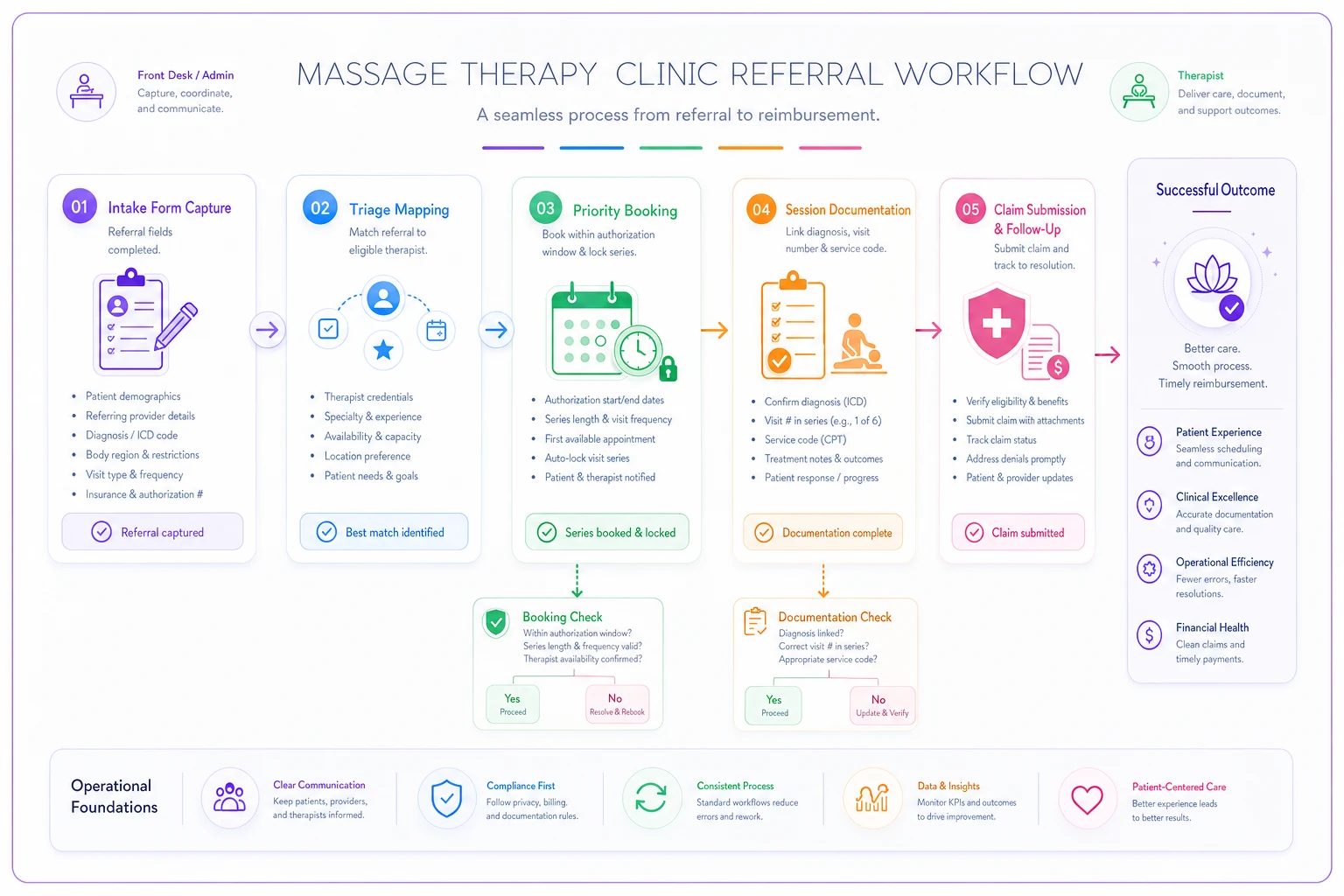
Get your intake template right, book referred series against the authorization math instead of open slots, keep your triage mapping current, and document each visit in a way that survives a review. When the money still doesn't show up on time, having a structured way to chase it matters — our invoice recovery ladder for studios walks through recovering unpaid balances without damaging the client relationship. Do the front-door work well, and you'll spend a lot less time on the back end chasing money you already earned.
Get your intake template right, book referred series against the authorization math instead of open slots, keep your triage mapping current, and document each visit in a way that survives a review. When the money still doesn't show up on time, having a structured way to chase it matters — our invoice recovery ladder for studios walks through recovering unpaid balances without damaging the client relationship. Do the front-door work well, and you'll spend a lot less time on the back end chasing money you already earned.
Ready to elevate your massage therapy business?
Join hundreds of therapists using Masthera to save time, reduce scheduling conflicts, and enhance client satisfaction.