



Duo sessions look like easy money on paper. Two clients, one time slot, double the revenue, same front-desk effort. But if you've run a multi-therapist studio for more than a season, you already know the catch: duos eat your schedule in ways that single sessions never do. They're the appointment type most likely to blow up your throughput, leave a room sitting empty when it shouldn't be, and quietly shave margin off a slot that looked profitable when you booked it.
The problem isn't the service itself. It's that most studios treat a duo like "two singles that happen to overlap," and that framing falls apart at almost every level — room assignment, therapist pairing, turnover timing, and pricing. This is an operational walkthrough of how to build a duo session scheduling and pricing SOP that actually protects the numbers.
Why duos break your schedule when singles don't
A single 60-minute session is a clean unit. One therapist, one room, predictable turnover, easy to slot around anything else.
A duo introduces a constraint that most booking software doesn't model: two resources must be free at the exact same moment, in two adjacent or compatible rooms, with two therapists whose skill levels match what each client actually booked.
-
A couple books a 90-minute duo at 2
00pm.
-
Your software reserves Room 1 and Room 2 and assigns your two available therapists.
-
But Therapist A does deep tissue and Therapist B only does Swedish/relaxation.
-
One client wanted deep tissue. Now you're either disappointing a client, swapping rooms last-minute, or pulling a third therapist off the floor.
Meanwhile, those two rooms are locked together for the full block. If turnover is staggered even slightly, you end up with dead space in both rooms instead of one. Two singles would've given you flexibility. The duo removed it.
The core issue: duos convert two flexible resources into one rigid block. Rigid blocks are where throughput dies.
Room + therapist pairing rules
Before you touch pricing, you need pairing rules that prevent the mess above. These are worth writing down and actually enforcing in your scheduling setup.
Never miss a booking or double-book again.
Masthera helps you schedule, confirm & manage every massage session with ease.
- Unified appointment management
- Automated client reminders
- Therapist calendar coordination
No credit card required
Room pairing
Not every pair of rooms works for a duo. The ones that do share three traits:
-
Adjacency or shared wall — couples booking duos usually want to be near each other, and therapists coordinating start and end times is far easier when rooms are side by side.
-
Comparable size and setup — if Room 2 is the cramped corner room with no space for a companion chair, it's not a duo room.
-
Matched turnover time — rooms with similar cleaning and reset requirements so both free up at roughly the same point.
A practical fix: designate specific duo-eligible room pairs rather than letting any two open rooms get grabbed. In a 4-room studio, you might only allow Rooms 1+2 and Rooms 3+4 as valid duo pairs. That single constraint eliminates most of the mismatched-turnover dead time.
Designate duo-eligible room pairs in your booking system to prevent mismatched turnover.
Therapist pairing
This is where the skill-level mismatch problem lives. The rule that fixes it:
A duo can only be booked when both assigned therapists can cover the modalities both clients selected — or the booking is restricted to modalities both therapists share.
In practice, your duo booking flow should either:
-
Restrict duo bookings to a limited menu most of your staff can perform (relaxation, prenatal-safe Swedish, light-to-medium pressure), or
-
Require manual pairing confirmation whenever a duo includes a specialized modality like deep tissue, sports, or anything medical-adjacent.
A clean way to think about therapist pairing:
| Therapist level | Can be paired in a duo with | Notes |
|---|---|---|
| Senior / specialist | Any level | Can absorb the harder client in a mismatched couple |
| Mid-level | Mid or senior | Pair carefully if deep tissue is requested |
| Junior / new | Mid or senior only | Never two juniors on a duo — no backup if something goes sideways |
The "never two juniors on a duo" rule matters more than it sounds. If one junior therapist runs into a client who's uncomfortable, dizzy, or needs a quick modality adjustment mid-session, you want an experienced person in the next room who can step in without collapsing the whole block. If you're still ramping newer staff, the pairing logic from ramping new therapists faster with structured SOPs and 30–60–90 goals ties directly into who's eligible for duo coverage and when.
Duration adjustments nobody plans for
One operational detail that trips up almost every studio: a duo doesn't turn over at the same speed as a single.
Two clients arriving together means a longer combined check-in, two intake reviews, two pressure and preference conversations, and — the big one — a coordinated finish. Therapists in a duo tend to wrap within a minute or two of each other so the couple leaves together. That coordination usually means the faster therapist waits, which costs real minutes.
Then there's the turnover. Two rooms to reset, two tables, two sets of linens. If your standard single turnover is 15 minutes, a duo turnover realistically runs 20–25 because of the doubled physical reset and the coordination overhead.
The mistake is scheduling duos back-to-back with single-session buffers. You book a 2:00 duo and a 3:30 single in the same room assuming a normal 15-minute gap. The duo runs four minutes long on coordination, turnover takes 22 instead of 15, and your 3:30 single starts at 3:38. Multiply that across a Saturday and the whole afternoon drifts.
The fix: a duo-specific turnover buffer — typically 5–10 minutes more than your single-session buffer. It feels like wasted slot time. It isn't. You're preventing the cascade that makes every later appointment late.
Pricing matrix for therapist levels
The most common duo pricing mistake is charging a flat "duo rate" that ignores who's actually in the room. If a senior therapist and a junior both get priced into the same bundle, your margin on that slot swings wildly depending on who gets assigned — and you have no real control over it.
A better approach: price the duo as two individual sessions priced to the therapist level delivering each half, with a small bundle adjustment — not a deep discount.
| Delivered by | Single rate | Duo per-person rate | Why |
|---|---|---|---|
| Junior therapist | $90 | $85 | Modest convenience adjustment, protects margin |
| Mid-level | $110 | $105 | Small bundle nudge |
| Senior / specialist | $135 | $130 | Minimal discount — demand is high, don't give it away |
The key principle: the duo discount is a convenience adjustment, not a volume discount. Couples book duos because they want to be together, not because they're hunting for the cheapest rate. A $5 per-person adjustment is enough. Discounting 15–20% off a duo — which a lot of studios reflexively do — is giving away margin on your most resource-intensive appointment type.
A mixed-level duo simply prices each half to its own row. One senior, one junior: $130 + $85 = $215. Margin stays honest regardless of who gets assigned, and a last-minute therapist swap doesn't quietly wreck the economics of the slot.
When a flat duo rate actually makes sense
If your staff is relatively uniform — say a small studio with three mid-level therapists and no specialists — a flat per-person duo rate is simpler and the margin variance is negligible. The tiered matrix matters most once you have real skill-level spread and your senior therapist's time is genuinely scarcer.
Front-desk scripts that protect throughput
Your front desk is where duo bookings get made or mangled. Two scripts worth drilling.
Booking a duo (phone or in person):
> "Happy to set up a duo for you two. Quick question so I pair you with the right therapists — is either of you looking for deeper pressure or working on a specific area, or is this more of a relaxation session for both?"
That one question routes the booking. Relaxation-for-both means any eligible pair, book it immediately. Specific pressure or injury means flag it for manual therapist assignment before it goes on the schedule.
Managing the duo-driven schedule gap:
> "No problem — since your partner can't make it, I'll switch you to a single session in the same time slot. Would your partner like to rebook for another day, and should I note your room preference?"
This immediately frees the second room and therapist for same-day rebooking instead of letting both sit idle.
A simple duo booking workflow
Pulling it together, here's the sequence a well-run duo booking actually follows:
-
Intake question at booking — relaxation-for-both vs. specialized request. This determines the pairing path.
-
Room pair check — assign only to a designated duo-eligible room pair.
-
Therapist pairing check — confirm both assigned therapists can cover both selected modalities; enforce the level-compatibility rules (no two juniors).
-
Duration + buffer applied — attach the duo-specific turnover buffer (standard single buffer + 5–10 min), not the default single buffer.
-
Pricing applied per therapist level — each half priced to its row, small convenience adjustment, no deep discount.
-
Confirmation + coordinated start note — flag both therapists that this is a coordinated-finish duo so they align end times.
Most practice-management systems can enforce the room-pair and buffer rules if you configure them deliberately instead of relying on defaults. If your booking-to-billing flow is still loosely defined, it's worth tightening the foundation first — the broader operations system for booking, intake, billing and follow-up is where duo rules slot in cleanly once the basics are structured.
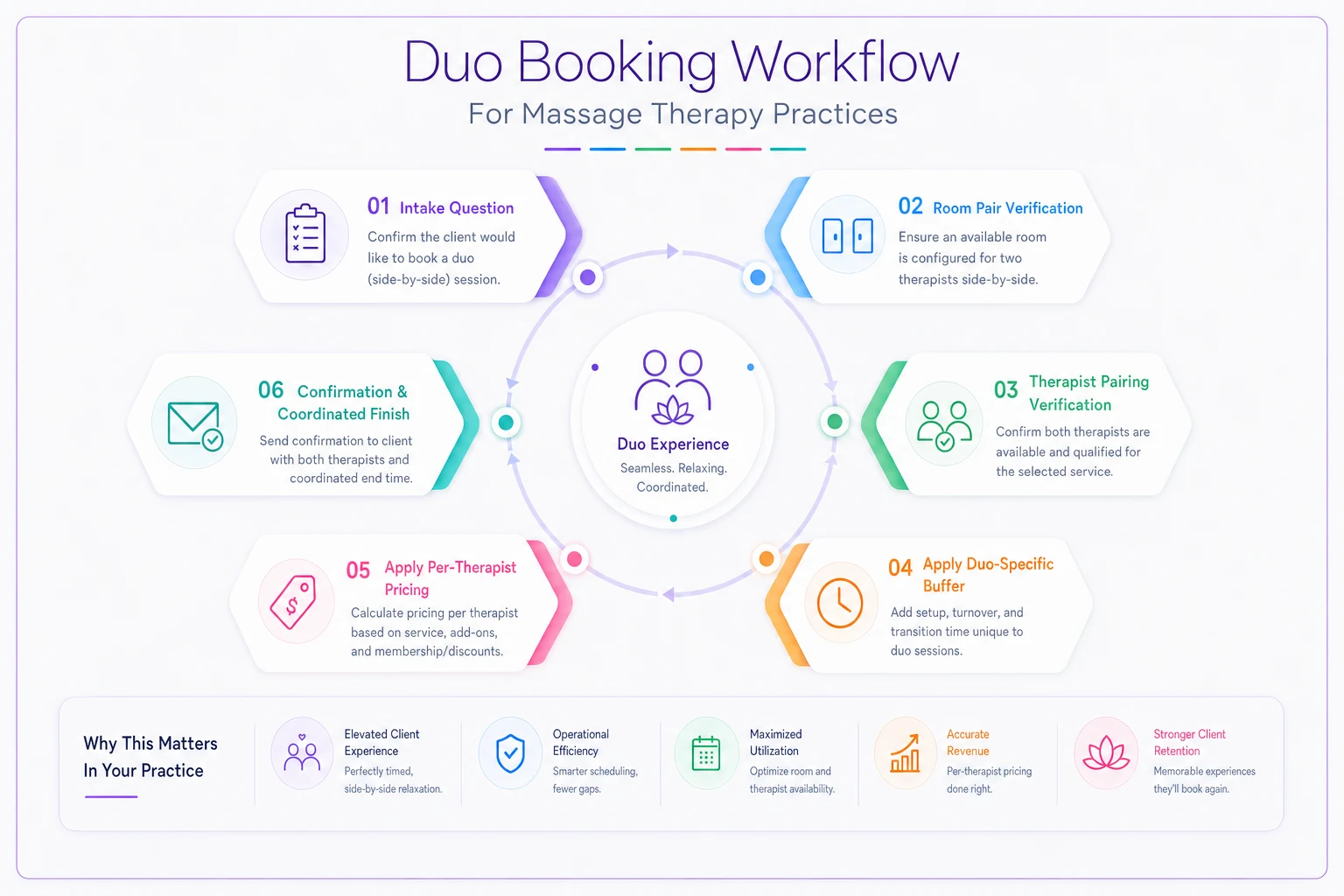
This diagram shows the booking steps and checks so staff can follow the sequence reliably.
A real scenario
A 4-room suburban studio with five therapists — two senior, two mid, one junior — ran duos at a flat $200/couple for 60-minute sessions, any two open rooms, any two available therapists. On busy Saturdays they were losing roughly 25–30 minutes of floor time per duo to turnover drift and coordination lag, and about one in six duos hit a modality mismatch that required a last-minute scramble.
They changed three things: designated two duo-room pairs, added a 22-minute duo turnover buffer, and moved to level-based pricing with a $5 per-person convenience adjustment instead of the flat rate. Average duo revenue came out around $215–$230 depending on therapist mix, the Saturday schedule stopped cascading by mid-afternoon, and the mismatch scrambles mostly disappeared because the intake question was routing specialized requests to manual pairing before they hit the schedule.
Nothing dramatic in isolation. But across a few months, the schedule ran noticeably calmer and there was a measurable margin bump on the appointment type that had been quietly costing them.
The takeaway
Duos aren't two singles. They're a single rigid block that demands matched rooms, compatible therapists, a longer turnover buffer, and pricing that reflects who's actually in the room.
Treat them with their own rules and they become one of your more profitable slots. Treat them like coincidental overlap and they'll keep eating your Saturday one late appointment at a time. The fixes aren't complicated — they just have to actually be written down and enforced, not assumed.
Ready to elevate your massage therapy business?
Join hundreds of therapists using Masthera to save time, reduce scheduling conflicts, and enhance client satisfaction.