



Somewhere between "we tried a new deal last month" and "let's redo the whole membership tier," studios start running experiments they never actually track. A front-desk lead offers a walk-in discount. A therapist starts blocking longer buffers between clients "to see if it helps." Marketing tests a new offer on Instagram. None of these get written down, none get a review date, and three months later nobody can tell you whether any of them made money or just ate into capacity.
That's the real risk — not one bad experiment, but the accumulation of a dozen undocumented ones, all pulling on the same fixed resource: therapist hours. Capacity isn't infinite in a studio, and margin is thin per slot, so every test you run competes directly against your best-selling appointments. Experiment governance is just the discipline that keeps that competition honest.
This isn't about killing experimentation. Studios that don't test anything stagnate. It's about making sure that when you test something, you know what it costs, who approved it, when you'll review it, and how you'll kill it if it's failing. Below is how that system actually works — and where it breaks when a studio grows past a couple of therapists.
Why unmanaged experiments quietly destroy margin
The pattern that shows up in most small studios: experiments are cheap to start and expensive to stop. Anyone can launch one — a discount, a schedule tweak, a new add-on script — but nobody owns the job of shutting it down. So they linger.
A typical example looks like this. A studio adds a "new client 60-minute intro at $59" to fill weekday mornings. Reasonable idea. But mornings were only 30% empty, and the offer converts across all time slots because the booking page doesn't restrict it. Now regulars who would have paid $95 are grabbing $59 sessions on Saturday at 11am — your most valuable slot. The experiment "worked" (more bookings!) while silently cannibalizing full-price demand. Nobody scored the downside because nobody was required to.
This is where the connection to slot-level revenue governance matters. If you already think about slots as having different values, then an experiment isn't a neutral event — it's a claim on specific inventory. Governance forces you to name which slots a test is allowed to touch before it goes live.
The second failure is capacity. Tests that add time — longer buffers, new intake steps, a "wellness consult" upsell — reduce how many clients a therapist sees per day. One therapist adding a 10-minute buffer across six sessions loses an hour of billable time daily. Across a four-therapist studio that's easily 15–20 lost slots a week, worth several thousand dollars a month, all from a change nobody registered as an experiment.
What breaks as you add therapists and locations
At one or two therapists, the owner is close enough to catch drift. You notice the schedule looks weird. You see the discount code getting overused. Informal control works because there's basically one brain in the loop.
Never miss a booking or double-book again.
Masthera helps you schedule, confirm & manage every massage session with ease.
- Unified appointment management
- Automated client reminders
- Therapist calendar coordination
No credit card required
-
Different people launching tests without knowing what others are running
-
No shared definition of "did it work"
-
Experiments that overlap and contaminate each other (you can't tell if rebooking went up because of the new reminder copy or the new intro offer)
-
No record of what you already tried and killed, so you repeat failed tests every year
The contamination point is underrated. If two experiments touch the same clients in the same window, your results are noise. A studio testing new reminder timing while also testing a new cancellation fee can't separate the effects. This is exactly why disciplined A/B testing of reminders and rebooking only produces trustworthy results when you control what else is running at the same time. Governance is what protects the cleanliness of every other test you care about.
The core idea: a registry with guardrails, not a bureaucracy
The goal isn't paperwork. It's a lightweight registry where every experiment gets logged before launch, scored for risk, and given a hard review date. The owner — or whoever holds the registry — can reject anything that violates the guardrails.
Two guardrails matter most for studios:
Capacity guardrail. An experiment cannot reduce billable capacity beyond a set threshold without explicit sign-off. Example rule: no test may cut a therapist's daily slot count by more than one without owner approval. This single rule stops the slow buffer-creep that quietly shrinks revenue.
MDE guardrail (minimum detectable effect). Before running a test, you decide the smallest result worth caring about. If your booking volume is too low to ever detect that effect, the test isn't worth running — you'll just get noise and make a decision based on a coin flip. A studio doing 300–400 bookings a month simply cannot detect a 2% conversion lift in two weeks. Setting an acceptable MDE up front kills vanity experiments before they waste capacity.
A simple risk-scoring model
You don't need anything fancy. Score each proposed experiment on three axes, 1–3, and add them up:
| Factor | Low (1) | Medium (2) | High (3) |
|---|---|---|---|
| Capacity impact | No change to slots | Minor buffer/time change | Reduces billable slots |
| Revenue exposure | Cosmetic / copy change | Affects one offer or segment | Touches core pricing or memberships |
| Reversibility | Instantly reversible | Reversible within a week | Hard to unwind (client expectations set) |
A score of 3–4 is low risk — let staff run it freely, just log it. A score of 5–6 needs a review date and defined kill criteria. A 7–9 requires a mandatory impact review before launch and owner approval. Simple, fast, and it stops the dangerous stuff without smothering the small stuff.
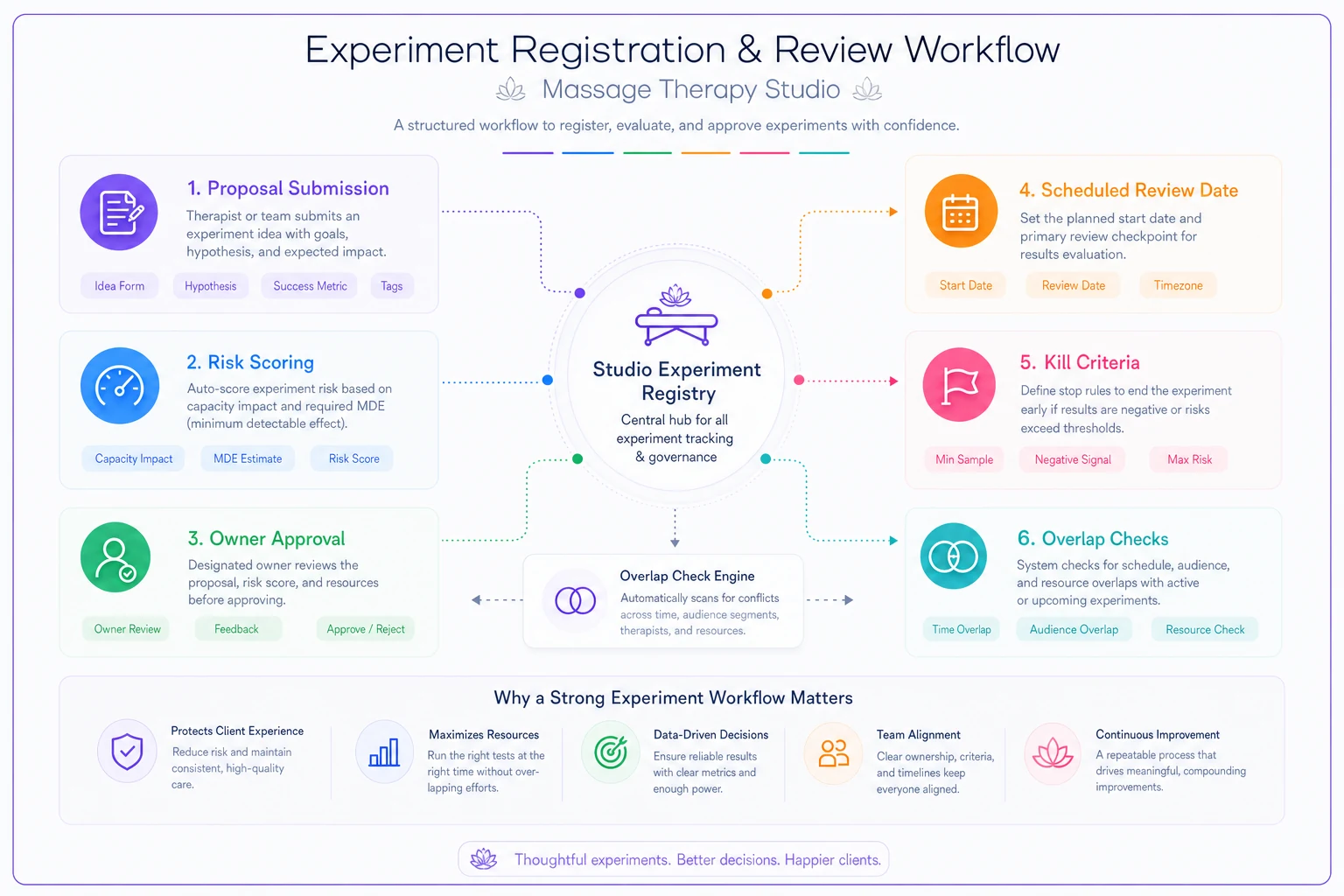
This diagram shows the registration-to-review workflow, including the guardrails and approval steps.
The registration template owners can enforce
The whole system lives or dies on one thing: making registration short enough that people actually do it. If it takes more than a couple minutes, staff will skip it and you're back to chaos. Here's the minimum set of fields worth enforcing:
-
Experiment name & owner — one person accountable, not "the team."
-
Hypothesis — one sentence
"We think X will change Y because Z."
-
What it touches — which slots, offers, segments, or workflows.
-
Capacity impact — does this reduce billable slots? By how much?
-
Acceptable MDE — the smallest result that would count as a win.
-
Risk score — from the table above.
-
Start date & mandatory review date — no open-ended tests.
-
Kill criteria — the condition that ends it early ("if no-shows rise above X, stop").
Eight fields. The review date is the one people skip, and it's also the one that saves you most — it converts "we're still kind of running that thing" into a forced decision.
Where a management platform helps
Most studios try to run this in a shared spreadsheet, and honestly that works fine at two or three therapists. The problem is a spreadsheet doesn't remind anyone. Review dates pass silently. This is the one place where an AI-powered operational platform earns its keep — it can flag experiments hitting their review date, surface which tests are touching the same client segments to catch contamination before it happens, and keep a permanent record of what you already tried so you stop re-running dead ideas every year. The value isn't automation for its own sake; it's that review dates and overlap checks actually get enforced instead of quietly ignored.
A real scenario: the discount that ate the weekend
A three-therapist wellness studio, roughly 340 appointments a month, decided to boost midweek volume with a $20-off code shared in their newsletter. No registration, no slot restriction, no review date. Classic informal launch.
Over about six weeks, bookings did go up — but when the owner finally sat down to look, the code had been used heavily on Friday evenings and Saturday mornings, the slots that were already selling out at full price. Rough math: around 55 discounted sessions, of which maybe 35 would have booked anyway at full rate. That's roughly $700 in margin handed back on demand they already had, plus displaced full-price clients who couldn't find a Saturday slot and eventually drifted to a competitor.
After that, they set up basic governance. The next discount experiment got a registry entry: restricted to Tuesday–Thursday before 3pm only, capped at 40 redemptions, with a two-week review date and a kill trigger if weekend availability dropped. Same idea, much smaller blast radius. It filled midweek gaps without touching the profitable weekend — and this time they could actually tell it worked, because the test was clean.
When this makes sense — and when it's overkill
When governance is worth it:
-
You have three or more therapists, or more than one location
-
Multiple people can launch offers, schedule changes, or campaigns
-
You've been surprised by results you couldn't explain
-
You keep re-trying things you're fairly sure you tested before
When it's overkill:
-
Solo practitioner running everything yourself — you are the registry
-
You run maybe one deliberate test a quarter
-
Your booking volume is too low for statistical testing anyway (in which case, just make careful judgment calls and skip the pseudo-science)
Who should not bother with a heavy version: any studio where enforcing the process would cost more attention than the experiments themselves. Governance should be proportional to how much testing you actually do. Two therapists running the occasional promo need an eight-field checklist, not a formal review board.
Building the habit without killing the culture
The trap is turning governance into a permission-gate that makes staff afraid to try anything. Low-risk experiments — a new upsell script, tweaked reminder wording, a different room setup — should be encouraged and simply logged. The registry exists to protect capacity and margin from the handful of high-risk changes, not to police creativity.
A practical way to introduce it: start by logging experiments you're already running, retroactively. Most owners are surprised to find five or six live experiments they'd forgotten about, some of which should have ended months ago. That first cleanup usually recovers capacity immediately, and it makes the case for the system better than any argument could.
Start by logging experiments you're already running; that first cleanup often recovers capacity immediately.
From there, the rule is simple. Anything that touches pricing, memberships, or billable slot counts gets registered and scored before it goes live. Everything else gets a one-line log and a review date. The review date does most of the work — it's the mechanism that turns a pile of forgotten tests into a series of clear decisions.
Experiment governance in a studio isn't about being cautious. It's about being able to run more tests, faster, because you finally trust your results and you're not quietly losing your best slots to changes nobody remembers approving.
Ready to elevate your massage therapy business?
Join hundreds of therapists using Masthera to save time, reduce scheduling conflicts, and enhance client satisfaction.