
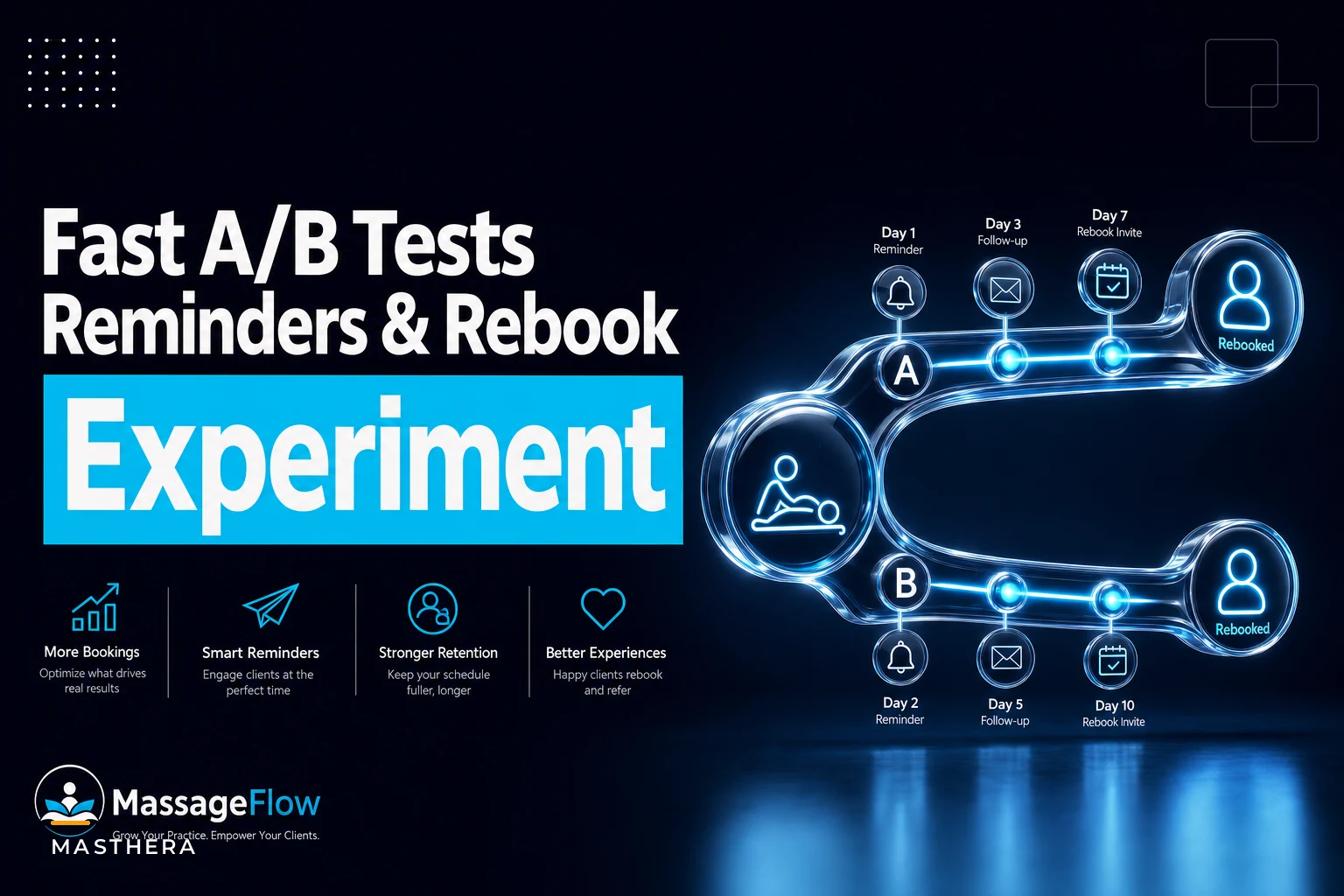

Most studios never test their reminder messages. They set up whatever the booking system suggested three years ago, and the copy has been sitting there quietly costing them rebookings ever since. The reason isn't laziness — it's that A/B testing sounds like something that requires dashboards, statistical significance calculators, and a marketing hire. It doesn't.
You can run a clean two-arm test on your reminder and rebooking messages in a week, using nothing but the list you already have and a spreadsheet. The trick is keeping the design boring. One variable, two versions, split evenly, measured on one number. Every time a studio tries to test five things at once, the results turn into mush and they give up.
This is a walkthrough of how to actually run a message A/B tests reminders massage studio setup that produces a usable answer — not a pile of vanity data.
Why one variable is the whole game
The most common testing mistake isn't picking the wrong metric. It's changing too much between versions. Someone rewrites the subject line, the greeting, the offer, and the send time, then sees Version B win and has no idea which change did the work. Now they can't repeat it.
A two-arm test means exactly two messages that differ in exactly one thing. If you're testing subject lines, both messages have identical bodies. If you're testing send timing, the message is word-for-word the same and only the clock changes. This is the difference between learning something and just watching numbers move.
There's a practical reason this matters for small lists too. Studios usually have somewhere between 400 and 2,000 active clients — that's not a huge sample. If you split the effect of a win across four simultaneous changes, none of them will look strong enough to trust. Concentrating everything on one variable gives it the best chance of showing a clear signal.
A typical example: a studio wants "better reminders." Instead of rewriting everything, they test one question — does adding the therapist's name to the reminder increase confirmed appointments? That's answerable in a week. "Better reminders" is not.
The metrics that actually mean something
Reminders and rebooking messages get judged on the wrong numbers constantly. Open rate feels satisfying because it moves fast, but nobody pays rent with opens. For this kind of test there are really only two outcomes worth measuring.
Never miss a booking or double-book again.
Masthera helps you schedule, confirm & manage every massage session with ease.
- Unified appointment management
- Automated client reminders
- Therapist calendar coordination
No credit card required
-
Reconfirmation lift — the share of reminded clients who actively confirm (tap confirm, reply Y, click the link). This tells you whether the message is doing its core job: getting the appointment locked in and reducing no-shows.
-
Rebook lift — the share of clients who book their next appointment after a post-visit nudge. This is the money metric for retention.
| Metric | What it tells you | Good for testing | Weak signal |
|---|---|---|---|
| Open rate | Subject line got attention | Subject line tests only | Says nothing about action |
| Reconfirmation rate | Reminder reduced no-show risk | Reminder copy + timing | — |
| Rebook rate | Message drove next booking | Post-visit rebooking copy | Slower to accumulate |
| Reply rate | Message felt human | Tone/personalization tests | Noisy on small lists |
| Revenue per message | Downstream value | Longer campaigns | Too slow for a 1-week test |
Pick one primary metric before you launch. Reconfirmation for reminder tests, rebook rate for rebooking tests. Everything else is a secondary note, not the decision-maker. The studios that stall are the ones that measure six things and then argue about which one "really" counts after the data is in.
Sample subject lines and copy worth testing
Most owners want a magic phrase at this point. There isn't one — but there are patterns that tend to separate cleanly in tests, which makes them useful because you'll actually see a difference.
Reminder subject line tests (identical body):
-
A
"Your appointment tomorrow at 2:00" vs B: "See you tomorrow, Maria — 2:00 with Devon" - Tests plain-logistics vs. personalized. Personalization usually wins on reconfirmation, but not always, and by how much matters.
-
A
"Reminder: massage tomorrow" vs B: "Quick confirm for tomorrow?" - Tests statement vs. question framing. Questions tend to pull more replies.
Reminder body tests (identical subject):
-
A
A single line with the time and location.
-
B
The same line plus one friction-reducer: "Need to move it? Reply RESCHEDULE and we'll sort it."
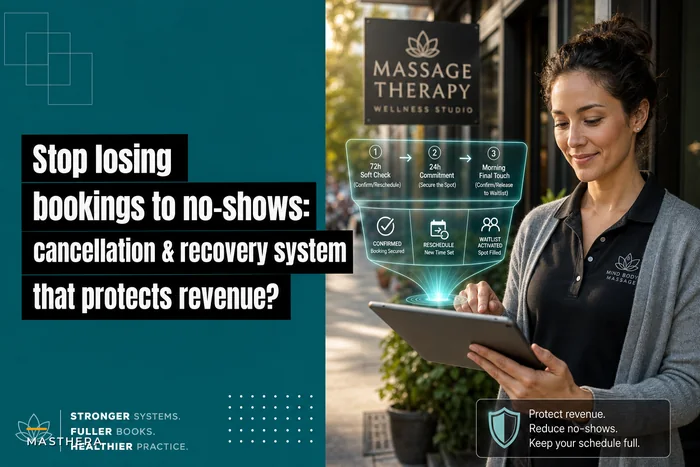
That second version deserves its own mention. A lot of no-shows aren't people who don't want to come — they're people who couldn't make it and didn't want the awkwardness of calling to cancel. Giving them a low-friction out often raises reconfirmation because the ones who stay actually mean it. This ties directly into building a proper cancellation and recovery system that protects revenue — a good reminder test feeds that whole machine.
Rebooking copy tests (post-visit):
-
A
"Thanks for coming in! Book your next session here."
-
B
"Most people feel best rebooking within 3–4 weeks — want your usual slot?"
Version B works because it removes the "when should I come back?" decision, which is the actual thing blocking a lot of rebooks. It's not pushier — it's more useful.
The send-window question nobody tests properly
Timing is the most under-tested variable, and often the one with the biggest payoff. Copy has a ceiling, but a message read at the right moment gets acted on.
For reminders, the two windows worth testing against each other are usually the 24-hour reminder vs. a same-day-morning reminder. Both have logic. The 24-hour version gives people time to reschedule; the morning-of version catches the ones who forgot overnight. Test which one drives more reconfirmations for your clientele — office workers and retirees respond very differently here.
Test 24-hour vs morning-of on a small segment first; different demographics often flip the result.
For rebooking, the window is the whole ballgame. Sending the rebook nudge at checkout captures intent while they still feel good. Sending it 2–3 days later catches them once life has resumed and the tension crept back. A two-arm test with the same message — one at checkout, one 48 hours after — often surprises people. On plenty of lists the 48-hour version quietly outperforms, because at checkout people say "I'll book later" and actually mean it.
How to size it: MDE without the math headache
Minimum Detectable Effect (MDE) is the smallest improvement your test can reliably catch. Here's the plain version: smaller lists can only detect bigger wins. If your list is small and the real improvement is tiny, your test physically cannot see it, and you'll get a "no difference" result that isn't true.
| Clients per arm | Realistic MDE you can detect | What that means |
|---|---|---|
| ~150 | ~12–15 percentage points | Only big, obvious wins show up |
| ~400 | ~8–10 points | Solid meaningful differences |
| ~800 | ~5–6 points | Most useful copy/timing gaps |
| ~1,500+ | ~3–4 points | Fine-grained tuning |
If you've got 300 clients total (150 per arm), don't test two subject lines that are 90% similar — you won't detect a 2-point difference. Test something bold enough to potentially move double digits. Save the fine-tuning for when your list is bigger or you can run the test over several weeks.
A quick honesty check: if your baseline reconfirmation rate is 60% and you're hoping to prove a jump to 62% on 200 people, walk away. That test can't answer that question. Pick a bigger swing or a bigger sample.
When this makes sense — and when it doesn't
Run it when:
-
You send reminders to at least a few hundred active clients.
-
You've got one clear question you actually care about.
-
You can split your list randomly (most systems can, or you alternate every other client).
Skip it when:
-
Your list is under ~200 and your question is subtle. You'll get noise dressed up as an answer.
-
You haven't fixed the basics. If your reminders go out inconsistently or land in spam, fix that first — deliverability beats wording every time.
-
You're changing your booking flow the same week. You won't know what caused what.
One more thing worth saying: don't peek at results daily and stop the moment Version B pulls ahead on day two. Early leads flip constantly on small numbers. Set your window, wait it out, then look.
A one-week run, start to finish
Here's the basic week plan in steps.
-
Monday — pick the question. One variable. Write it down as a yes/no: "Does the personalized subject line beat the plain one on reconfirmation?"
-
Monday — write both versions. Change only the one thing. Read them out loud to make sure they're genuinely comparable.
-
Tuesday — split the list. Random 50/50. If your tool can't randomize, sort by last name and alternate, or send A to odd client IDs and B to even.
-
Tuesday–Thursday — send. Same time of day, same channel. Don't send A in the morning and B at night unless timing is your variable.
-
Friday — pull the numbers. Count your one primary metric per arm. Reconfirmations divided by messages delivered (not sent — delivered).
-
Friday — decide. If the gap clears your MDE from the table above, you have a winner. Adopt it and start the next test. If not, it's a tie — keep the simpler version and test something bolder next round.
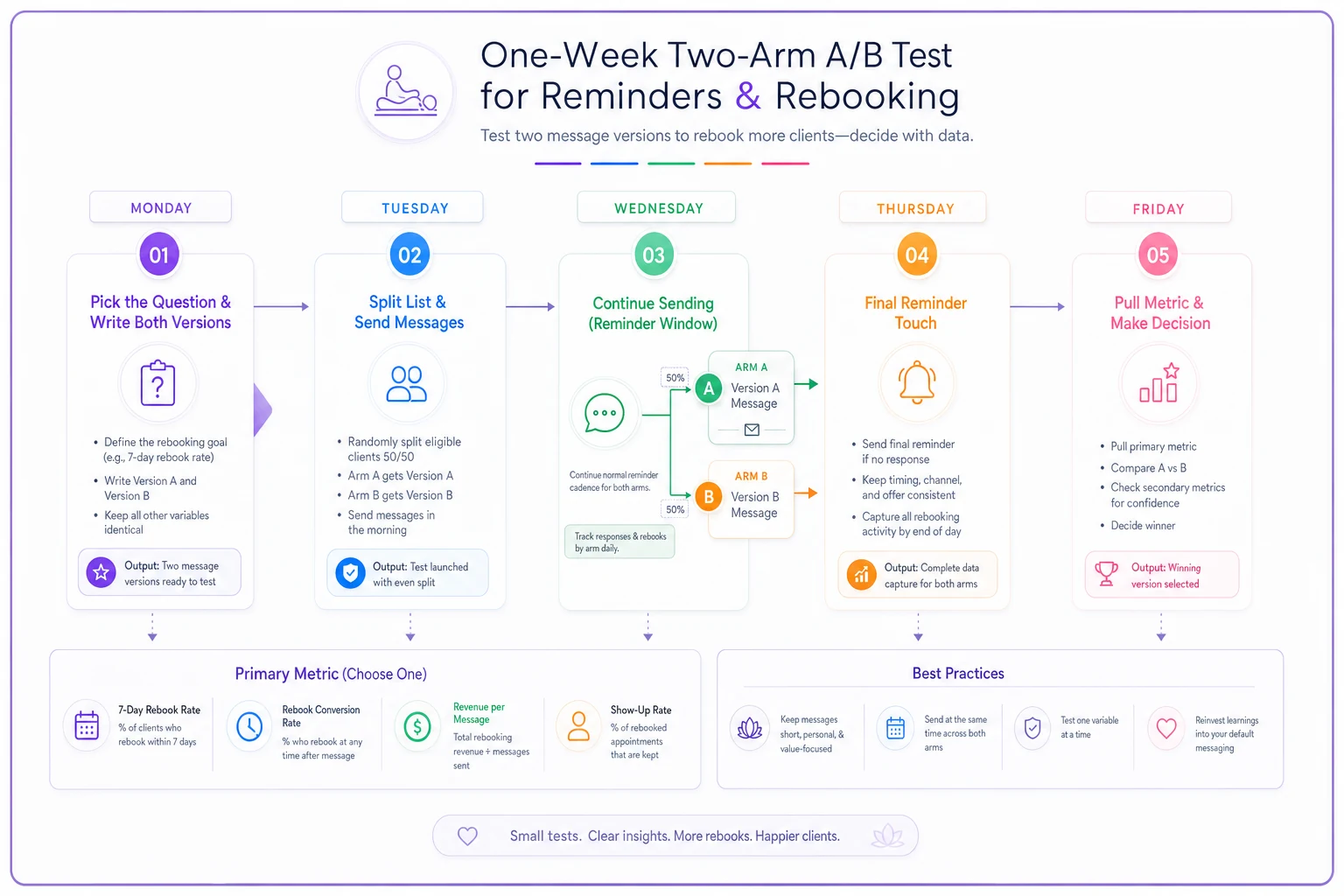
This visual summarizes the week-long flow so you can hand it to someone and have them run the test.
Reporting checklist: what to write down
Keep the record short and permanent. The value compounds only if you can look back and see what you already learned.
-
Test name and date range (e.g., "Reminder subject — personalization — Oct 6–10")
-
The single variable being tested
-
Both message versions, pasted in full
-
Messages delivered per arm (not just sent)
-
Primary metric per arm as a rate, with the raw counts beside it
-
The gap in percentage points, and whether it beat your MDE
-
Decision made and the winning version
-
One line of notes — anything weird that week (holiday, promo running, therapist out)
That last line saves you from false conclusions later. A rebook test run during a slow holiday week isn't comparable to a normal week, and you'll forget that in two months unless it's written down.
Real scenario
A three-therapist studio with around 700 active clients was sitting at a 58% reconfirmation rate on its 24-hour reminder. No-shows were eating roughly two or three slots a week. They ran a single two-arm test: the same plain reminder vs. the same reminder with one added line — "Can't make it? Reply RESCHEDULE and we'll find you a new time."
Split 350 per arm over one week. Version B came in around 67% reconfirmation — a 9-point lift that cleared the MDE for that sample size. More interestingly, cancellations went up slightly in Version B. Sounds bad. Wasn't. People who couldn't come were now telling them in advance instead of ghosting, which meant those slots could actually be refilled. Net no-shows dropped by roughly a third over the following month. They kept Version B and moved on to testing rebooking windows next.
Where the wins actually come from
The reason these tests pay off isn't clever copywriting. It's that reminder and rebooking messages are usually written once and forgotten, so almost any deliberate test beats the accidental default. The studios that pull ahead treat these messages as a living part of operations — the same way they'd treat their post-visit feedback loops — small, regular, measured adjustments rather than one big overhaul.
If your booking or messaging platform can split a list and log delivery and confirmation events, you already have everything you need. The systems that make this genuinely easy are the ones that handle the split automatically and track reconfirmation and rebook events in the background, so the Friday number is already sitting there instead of being reconstructed by hand. That's the part worth having help with — not the thinking, just the counting.
Run one test. Read one number. Keep the winner. Do it again next week. A year of that quietly beats any "best practice" template copied from someone else's studio.
Ready to elevate your massage therapy business?
Join hundreds of therapists using Masthera to save time, reduce scheduling conflicts, and enhance client satisfaction.