


Most studios treat pricing as a menu decision. You set a rate for a 60-minute deep tissue, a 90-minute Swedish, a membership tier, and move on until something feels off. Then you run a promo, discount a slow Tuesday, launch a package during the holidays, and hope the numbers shake out.
The problem is pricing doesn't happen on a menu. It happens in a slot — a specific therapist, on a specific day, at a specific time, with a specific fill rate. When you're not governing at that level, you end up with a menu that looks profitable while your actual booked hours quietly bleed margin.
This is what integrated revenue architecture actually means for a studio: pricing, memberships, packages, and promotions all wired into the same decision system, controlled at the slot level, with clear rules about who can change what and when. Not a spreadsheet. A governance layer.
Below is how this breaks down in real studios, and how to build a system that holds up as you add therapists, rooms, and locations.
Why menu-level pricing falls apart the moment you scale
A solo practitioner can price on instinct. You know your Tuesday 2pm is dead, so you take a walk-in at a discount without thinking twice. There's no coordination cost because there's only one person coordinating.
Add a second therapist and things start to drift. One offers a "friends and family" rate off the books. Another honors an expired promo because a regular asked. Front desk stacks a membership discount on top of a package rate because nobody wrote down that you can't. None of these are disasters on their own — but they compound.
What tends to happen in studios that grow past three or four therapists is a specific pattern: the effective price a client pays diverges more and more from the price on the menu. You look at your service list and think your average 60-minute session brings in $95. Then you run the actual math on booked slots and it's closer to $78 once you account for stacked discounts, comped add-ons, member rates, and promos nobody remembered to turn off.
That gap between menu price and realized price is exactly what slot-level governance is designed to close.
The unit of decision-making is the slot, not the service
Stop asking "what should a 60-minute massage cost?" Start asking "what should this slot earn?"
Never miss a booking or double-book again.
Masthera helps you schedule, confirm & manage every massage session with ease.
- Unified appointment management
- Automated client reminders
- Therapist calendar coordination
No credit card required
-
Time and day (peak vs. off-peak)
-
Therapist (their pay rate, booking demand, specialty)
-
Room/resource (is your hydrotherapy room sitting empty?)
-
Lead time (booked three weeks out vs. filling a hole tomorrow)
-
Current utilization of that time block
Two clients paying the same $110 for a 90-minute session can produce wildly different margins. One books your highest-paid therapist during peak Saturday hours when you could've sold that slot at full price. The other fills a Wednesday 11am that would've gone empty. Same revenue, completely different value to the business.
If your pricing rules can't tell those two situations apart, you're discounting the slots that need it least and leaving real money on the table. Unit economics has to sit underneath everything — if you haven't built a per-session cost model yet, start with why unit economics should drive your massage pricing, because slot-level governance assumes you already know your true cost per booked hour.
Utilization-trigger rules: pricing that responds to fill
The core of a working system is a set of rules connecting utilization to pricing action. Instead of a flat promo calendar, you tie discounts and offers to how full a slot type actually is.
A basic ruleset looks like this:
| Slot utilization (rolling 2-week) | Allowed pricing action | Who can trigger |
|---|---|---|
| Above 85% | No discounts. Consider peak surcharge or premium-therapist upcharge | Owner only |
| 70–85% | Standard menu pricing. Membership rates apply | Automatic / front desk |
| 50–70% | Off-peak rate or targeted micro-offer to waitlist | Front desk within preset band |
| Below 50% | Same-day fill offer, package promotion, or partner discount | Manager, logged |
The point isn't these exact numbers — yours depend on your cost structure and market. The point is that a discount stops being a gut call. It becomes a response to a measured condition, with a pre-approved ceiling on how deep it can go.
A realistic example: a studio noticed their weekday mornings ran around 45% utilization while evenings were routinely maxed. Under menu pricing, both charged the same $100. After building a trigger rule, mornings dropped to an $82 off-peak rate promoted to their waitlist and flexible-schedule clients, while three peak evening slots per therapist picked up a $12 demand upcharge. Net effect over a quarter was roughly a 6–8% lift in realized revenue per available hour — not from raising prices across the board, but from pricing each slot closer to what it was actually worth.
Pro-tip: Build the upcharge side as well as the discount side.
The mistake most owners make here is running discount logic without ever building the upcharge side. Governance cuts both ways. If you only ever adjust prices downward, you've built a discount machine, not a revenue system.
Who's allowed to change a price? RACI before you touch anything
The fastest way for slot-level pricing to collapse into chaos is unclear authority. When multiple people can approve a discount and nobody owns the outcome, you get promo sprawl — offers that overlap, contradict each other, and never get turned off.
You need a simple RACI (Responsible, Accountable, Consulted, Informed) for every pricing and promo decision:
| Decision type | Responsible | Accountable | Consulted | Informed |
|---|---|---|---|---|
| Standard menu price change | Manager drafts | Owner | Finance/bookkeeper | Front desk, therapists |
| New membership tier | Owner | Owner | Finance | All staff |
| Recurring promo (monthly) | Marketing/manager | Owner | Finance | Front desk |
| One-off slot discount within band | Front desk | Manager | — | Manager (weekly log) |
| Package or bundle launch | Manager | Owner | Finance | All staff |
| Deep discount below band | Manager requests | Owner | Finance | — |
The most important row is the last one. Below-band discounts should never be silently possible. They require a request and a sign-off — because that's exactly where margin quietly disappears, in the "just this once" exceptions that eventually become the norm.
Accountable means one person, always. Not a committee. If two names sit in that column, nobody actually owns it.
The finance-to-marketing approval workflow
Promos die in the gap between marketing and finance. Marketing wants to run an offer to drive bookings. Finance needs to know what it costs. In most small studios, that conversation either doesn't happen or happens after the promo is already live.
A workflow that closes that gap without turning every idea into a two-week approval process:
-
Proposal (marketing/manager) State the offer, target slots, expected fill lift, and duration. One page max.
-
Margin check (finance) Run the offer against slot-level cost. Does it stay above your minimum contribution margin after accounting for who's likely to redeem it?
-
Cannibalization check Will this promo mostly attract new fill, or will existing full-price and member clients switch down to it? This is the step everyone skips.
-
Decision gate Approve, approve-with-limits, or reject. If approved-with-limits, define the cap — max redemptions, expiry, which slots qualify.
-
Sign-off + kill date Owner signs. A hard end date goes on the calendar before launch, not after.
-
Post-promo review Actual fill vs. projected, actual margin vs. projected, and whether it cannibalized existing revenue.
Visualize the approval flow before you run it.
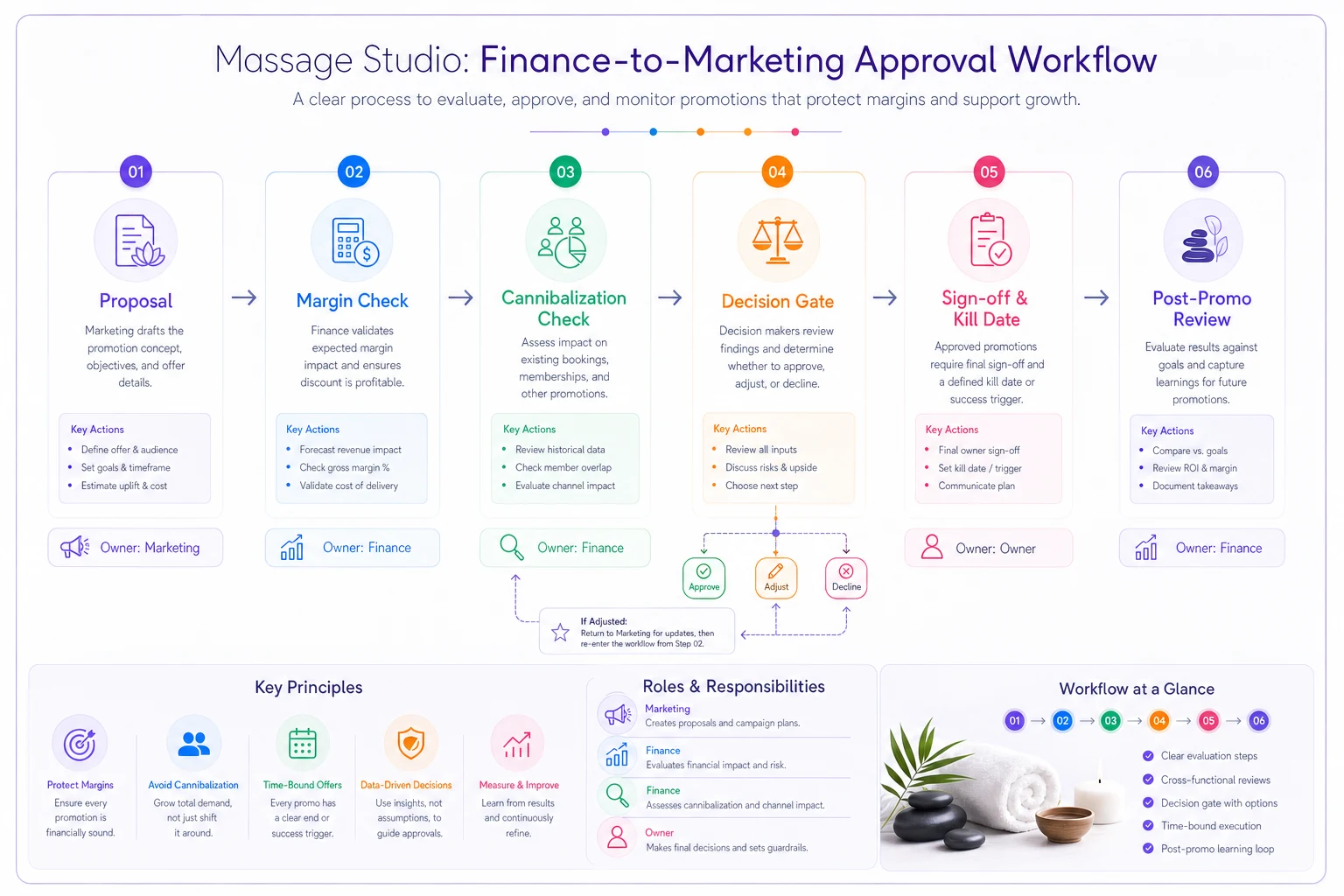
Step three deserves real attention. A studio ran a "$69 intro massage" and it looked like a hit — 40+ redemptions in two weeks. But when they checked, more than half were existing clients who normally paid full rate or used membership credits. The promo didn't grow the pie; it just discounted revenue they already had. That's a cannibalization failure, and it only surfaces if the check is built into the workflow before launch.
Sample slot-level impact tables: fill vs. margin
The tool that makes all of this concrete is a fill-vs-margin table. Before approving any pricing move, you model it at the slot level. Here's a simplified example for one off-peak weekday block:
| Scenario | Price | Slots filled (of 20) | Fill rate | Revenue | Est. margin/slot | Total margin |
|---|---|---|---|---|---|---|
| Current (menu) | $100 | 9 | 45% | $900 | $38 | $342 |
| Off-peak rate | $82 | 15 | 75% | $1,230 | $28 | $420 |
| Deep discount | $65 | 18 | 90% | $1,170 | $16 | $288 |
Look at what this reveals. The off-peak rate at $82 fills more slots and produces the highest total margin. The deep discount fills almost every slot but actually earns less than the moderate option — you gave up too much per session chasing a few extra bookings.
Without a table like this, most owners assume "more fill = more money" and cut prices reflexively. The table shows you where the curve peaks. Your job isn't to maximize fill. It's to find the price where fill and margin multiply to the highest total.
Membership pricing runs through the same logic. A member rate is essentially a permanent off-peak-style discount, so it has to be modeled against the slots members actually consume. If members mostly book peak hours at a discounted rate, your membership program is subsidizing your busiest times — the opposite of what you want. Structuring this properly pairs directly with slot-level governance, and designing memberships that stabilize cashflow covers exactly that.
Decision gates and sign-off templates owners can actually use
A decision gate is a checkpoint where an action can't proceed until conditions are met and someone signs off. The value is that it forces a pause at the exact moments money leaks.
-
Offer name & description
-
Target slots (day/time/therapist/room)
-
Current utilization of those slots
-
Proposed price / discount
-
Contribution margin after discount (must be above $___ floor)
-
Redemption cap
-
Cannibalization risk (low/med/high) + reasoning
-
Start date / hard kill date
-
Requested by
-
Approved by (Accountable owner)
-
Post-promo review date
And a one-off slot discount log, because these are the ones that slip through:
-
Date & slot discounted
-
Original price / discounted price
-
Reason
-
Authorized by
-
Within preset band? (Y/N — if N, requires owner sign-off)
Keep these lightweight. If a gate takes twenty minutes to complete, staff will route around it and you're back to chaos. The goal is friction at the right spots, not friction everywhere.
When slot-level governance makes sense — and when it doesn't
When it makes sense: You have three or more therapists, meaningful variation in utilization across your week, and you're running promos or memberships that discount off your menu. If your realized revenue per hour is drifting below your menu price and you can't fully explain why, this is your fix.
When it's overkill: If you're a solo practitioner booked at 90% with a waitlist, you don't need a RACI matrix. You need to raise prices. Governance overhead only pays off when multiple people are making pricing decisions and there's enough slot variation to optimize against.
Who should hold off: Studios that don't know their true cost per booked hour. If you can't fill in the "margin per slot" column with real numbers, you'll just build a governance system on top of guesses. Nail your unit economics first, then layer governance on top.
A real scenario: three-therapist studio, promo sprawl
A three-therapist wellness studio was running around $28k–$32k in monthly revenue but couldn't figure out why margins felt tight despite sitting at 70%+ booked. The audit found four active promos — two of which had technically expired months ago but were still being honored — membership discounts stacking on package rates, and front desk comping add-ons to smooth over scheduling mix-ups.
Their realized price on a 60-minute session had drifted to around $76 against a $98 menu price.
They didn't raise a single menu price. Instead they built utilization triggers, a two-tier discount band with anything deeper requiring owner sign-off, killed the zombie promos, and put a no-stacking rule in place. Within about two months, realized price recovered to roughly $89 — still below menu, but a meaningful recovery — and monthly revenue moved into the $34k–$36k range on essentially the same booking volume.
The lift didn't come from charging more. It came from stopping quiet leaks. This is the same principle behind aligning revenue operations decision rules with capacity — the money is often already in the building; governance is what keeps it from walking out.
Bringing it together
Slot-level revenue governance isn't about squeezing clients or turning your studio into a surge-pricing app. It's about matching each hour's price to what that hour is actually worth, and making sure the people touching pricing decisions are working from the same rulebook instead of improvising.
Studios that get this right stop treating pricing as a set-and-forget menu and start treating it as a live system — utilization triggers that respond to fill, clear authority over who changes what, a workflow that gets finance and marketing talking before a promo launches, and decision gates at the exact points where margin usually disappears.
The coordination cost of getting this wrong grows faster than the business does as you scale from one room to three, one therapist to eight, one location to several. Build the governance layer while it's still simple. Retrofitting it onto a studio already drowning in promo sprawl is a much harder job — and by then, you've usually been leaking margin for longer than you'd like to admit.
The coordination cost of getting this wrong grows faster than the business does as you scale from one room to three, one therapist to eight, one location to several. Build the governance layer while it's still simple. Retrofitting it onto a studio already drowning in promo sprawl is a much harder job — and by then, you've usually been leaking margin for longer than you'd like to admit.
Ready to elevate your massage therapy business?
Join hundreds of therapists using Masthera to save time, reduce scheduling conflicts, and enhance client satisfaction.