


Your post-visit survey massage studio setup probably looks like this: automated email goes out 24 hours after each appointment asking clients to rate their experience on a scale of 1-10. Maybe you include a comment box. The responses pile up in your inbox or booking software, you check them occasionally, feel good about the 9s and 10s, wince at the occasional 6, and... that's where it ends.
This broken feedback loop costs massage studios real money. Not because you're missing insights—everyone knows unhappy clients don't rebook. The problem is that feedback without operational routing becomes performative data collection. You're measuring satisfaction without creating recovery pathways.
The difference between studios that convert feedback into retention and those collecting digital dust comes down to three operational choices: simplifying to one contextual question, building automated routing rules, and creating measurable recovery loops. Most software makes this unnecessarily complex. You don't need sentiment analysis or dashboard gymnastics. You need triggers that turn a score of 6 into an immediate recovery attempt.
Why traditional satisfaction surveys fail massage practices
Traditional post-visit surveys fail because they're built for analysis, not action. The typical massage studio sends a five-question survey asking about therapist skill, ambiance, booking process, value, and overall satisfaction. By question three, completion rates tank. Even when clients finish, you get scattered feedback across multiple dimensions with no clear operational triggers.
The breakdown happens at three points. First, multi-question surveys create response fatigue—completion rates drop from around 35% on single-question surveys to below 12% when you ask five or more questions. Second, mixed feedback creates analysis paralysis. When someone rates their therapist a 9 but the booking process a 6, what's your recovery action? Third, the delay between feedback and response kills recovery opportunities. By the time you manually review surveys weekly, that disappointed client has already mentally moved on to another studio.
What actually works is stripping feedback down to one scored question plus two context prompts. Not because less data is better, but because focused data triggers specific operational responses. A client who scores you 6 or below gets immediate routing to recovery. A score of 7-8 triggers retention touchpoints. Scores of 9-10 activate referral requests. The simplification enables automation, and automation enables speed.
The context prompts matter more than the score. After the NPS-style rating, you ask: "What was the primary reason for your score?" and "Would you like us to address anything specific?" These open fields provide the texture that turns a number into an actionable recovery opportunity. The score triggers the routing; the context shapes the response.
Building the one-question system with contextual depth
The post-visit survey massage studio system that actually drives retention starts 90 minutes after checkout. Not 24 hours later when memories fade and emotions normalize, but while the experience is still fresh. The message is simple: "How likely are you to recommend [Studio Name] to a friend? (0-10 scale)."
Never miss a booking or double-book again.
Masthera helps you schedule, confirm & manage every massage session with ease.
- Unified appointment management
- Automated client reminders
- Therapist calendar coordination
No credit card required
-
"What influenced your rating most?" (optional, 250 character limit)
-
"Is there anything you'd like us to address?" (optional, 250 character limit)
Character limits matter. Unlimited text fields generate novels that require manual review. Tight limits force clients to identify the core issue: "Therapist seemed rushed" or "Room was cold" or "Parking was difficult." These snippets provide enough context for meaningful recovery without creating review paralysis.
| Bucket | Actions |
|---|---|
| Detractors (0-6): Immediate recovery pathway | - Auto-notification to manager within 5 minutes - Recovery email template triggered based on context keywords - Follow-up task created for personal outreach within 24 hours - Flag added to client record for next visit attention |
| Passives (7-8): Retention reinforcement | - Thank you message with specific benefit reminder - Targeted offer for next booking (not discount, but add-on or upgrade) - Enrollment prompt for membership if not already a member - Soft touch follow-up at 14 days |
| Promoters (9-10): Referral activation | - Immediate thank you with referral incentive details - Google Review request (only for 10s) - Social sharing prompt with pre-written message - VIP program invitation or points bonus |
This structure transforms feedback from measurement to mechanism. Every response triggers something, which means every client who takes time to respond sees immediate value in doing so.
Send the survey 90 minutes after checkout while the experience is still fresh.
Here's a visual of the one-question workflow.
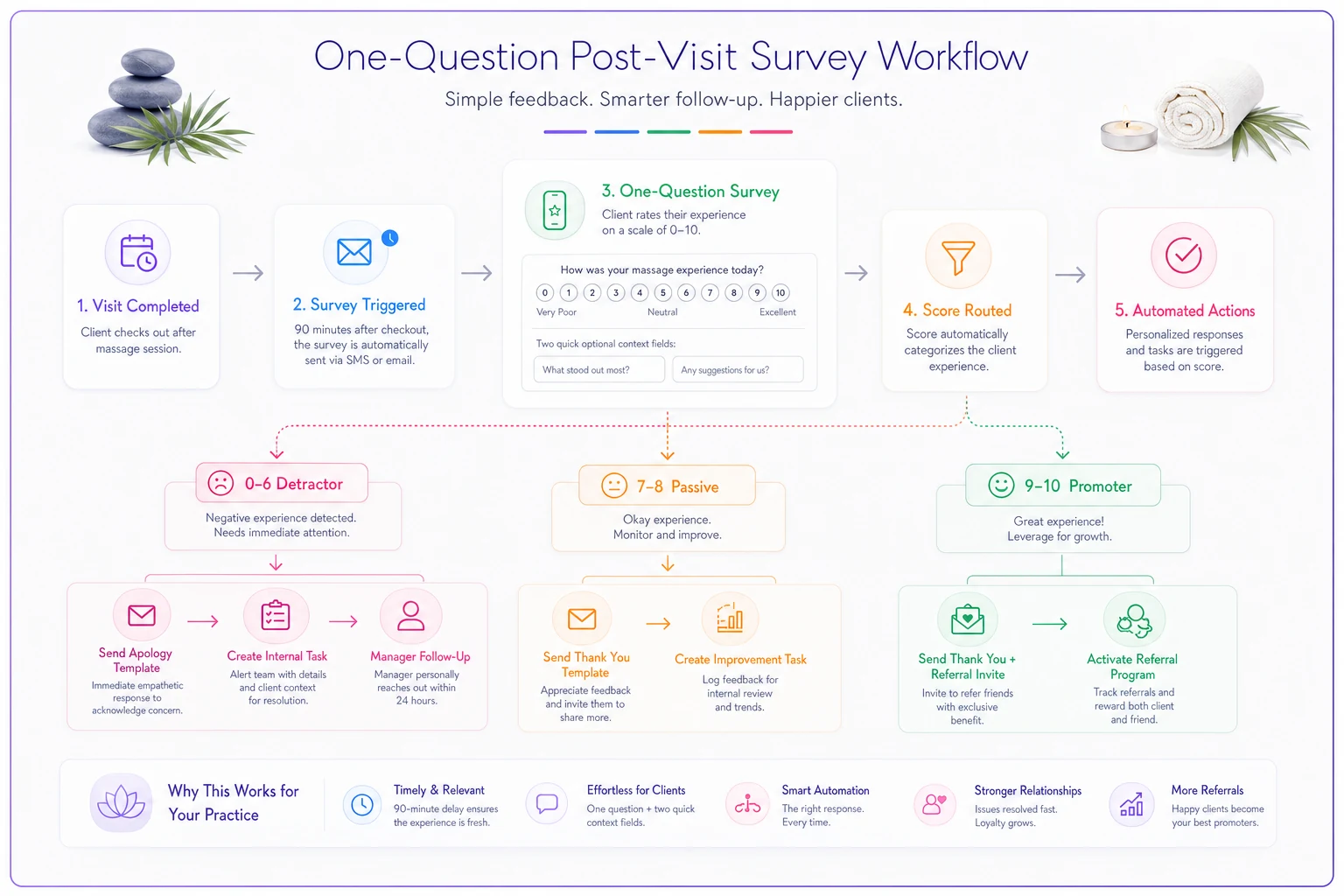
The visual maps timing, the single question, context prompts, and routing actions into a clear workflow.
Automated routing rules for negative scores
When a client scores 6 or below, speed determines recovery success. The routing system needs to bypass human review delays while maintaining personalization. This requires keyword detection and smart templating, not complex sentiment analysis.
Therapist-specific issues (keywords: therapist, pressure, technique, rough, gentle, rushed)
-
Routes to
Clinical manager
-
Response template
Acknowledgment + therapist feedback process + complementary session offer with senior therapist
-
Internal action
Flag on therapist record, review in next 1-on-1
Environment issues (keywords: cold, hot, noise, dirty, smell, ambiance)
-
Routes to
Operations manager
-
Response template
Apology + specific fix commitment + return incentive
-
Internal action
Maintenance ticket, pre-visit check protocol update
Service issues (keywords: late, waiting, booking, confusion, wrong)
-
Routes to
Front desk lead
-
Response template
Process acknowledgment + system improvement note + convenience credit
-
Internal action
Staff training flag, process review trigger
Value issues (keywords: expensive, worth, price, value, money)
-
Routes to
Owner/manager
-
Response template
Value reinforcement + membership option + loyalty discount
-
Internal action
Pricing review flag, segment for retention campaign
The automation handles the vast majority of negative feedback without human intervention, while escalation rules catch the cases that genuinely need personal attention. Any response containing profanity, legal terms, or injury mentions bypasses templates and triggers immediate human review.
Recovery workflows that prevent permanent losses
Recovery starts with acknowledgment speed. The automated response goes out within 10 minutes of survey submission, even if it's just: "We received your feedback and take your concerns seriously. [Name] from our management team will personally follow up within 24 hours."
Hour 0-1: Automated acknowledgment
-
Confirms receipt
-
Sets expectation for personal follow-up
-
Shows immediate responsiveness
Hour 1-24: Personal outreach
-
Manager reviews context and client history
-
Calls if phone preferred, emails if digital client
-
Offers specific resolution, not generic apology
Day 2-3: Resolution confirmation
-
Documents what was done
-
Confirms client satisfaction with resolution
-
Creates internal learning loop
Day 14: Re-engagement check
-
Soft touch to gauge sentiment
-
Booking reminder if appropriate
-
No pressure, just presence
The resolution offer matters less than the speed and specificity. A client upset about room temperature wants to know you've fixed the thermostat issue, not receive a 20% discount. Someone who felt rushed needs assurance about booking buffer times, not free add-ons.
Track recovery success through rebooking rates. Properly handled detractors should rebook within 60 days at roughly 40%—much higher than the 15% rate for unaddressed negative feedback. If your recovery rate stays below 30%, either your resolutions lack substance or your follow-up timing needs adjustment.
Converting feedback patterns into operational improvements
Individual recoveries stop bleeding; pattern recognition prevents future wounds. Every negative score represents both a recovery opportunity and an operational signal. The difference between reactive and proactive studios is systematic pattern analysis.
Monthly feedback analysis should track:
-
Issue category distribution (therapist, environment, service, value)
-
Therapist-specific score trends
-
Day/time correlation patterns
-
Service type satisfaction variance
-
New vs. returning client score gaps
When three or more clients flag the same issue within 30 days, it triggers a mandatory process review. Not a casual discussion, but documented analysis with specific changes and measurement windows.
A real example: a studio with four locations noticed scores at one site averaged 7.2 while the others held steady above 8.5. Digging into context responses revealed consistent "parking" mentions. The studio negotiated validated parking with the adjacent garage and scores jumped to 8.3 within six weeks. Without systematic review, they'd have kept losing clients to a completely fixable friction point.
The operational changes compound. Fix parking, scores improve. Better scores increase rebooking. Higher rebooking justifies premium pricing. Premium pricing funds better therapists. Better therapists generate better scores. The feedback loop becomes a growth engine instead of a vanity metric.
Building staff accountability without creating fear
Therapist-level feedback creates tension. Share scores and therapists feel attacked. Hide scores and you lose improvement opportunities. The solution is structured transparency with protection mechanisms.
Every therapist sees their rolling 30-day average score and percentile ranking within the team. They also see anonymized team distribution, so they understand where they stand without public shaming. Scores below 7.5 trigger support, not punishment:
-
Week 1
Self-assessment meeting to identify challenges
-
Week 2
Shadowing session with a high-scoring therapist
-
Week 3
Manager observation and coaching
-
Week 4
Technique workshop or training investment
The protection mechanism: no single score creates consequences. Only patterns trigger intervention. This prevents one bad day or one difficult client from creating fear. It also stops therapists from cherry-picking easy clients or avoiding challenging cases.
High scorers get different attention. Those consistently above 8.5 receive:
-
Priority scheduling for request-based bookings
-
First choice on shift preferences
-
Bonus pool participation
-
Training opportunities to become mentors
This creates positive pull toward improvement rather than negative push away from failure. The scoreboard exists, but the game emphasizes growth over competition.
The technology stack without the complexity
Most post-visit survey massage studio setups fail because they require three different systems talking to each other badly. Your booking software sends surveys, your email platform manages responses, your spreadsheet tracks patterns. The gaps between systems are exactly where feedback dies.
What works is consolidated feedback operations within your booking platform, enhanced by AI-assisted routing and response generation. Not complex orchestration, but practical automation that handles the 80% of standard cases while escalating the 20% that need a human.
The stack components:
-
Survey trigger from booking system (native or integrated)
-
Response routing engine with keyword detection
-
Template library with variable insertion
-
Task creation for follow-ups
-
Pattern analysis dashboard
-
Client record notation system
If your booking system can't handle this natively, tools like Typeform or SurveyMonkey integrate reasonably well with most practice management software through Zapier or direct API. The key is automatic data flow—manual exports and imports kill consistency.
For smaller practices, even Google Forms with automated email rules can work. The technology matters less than the operational discipline. A simple system executed consistently beats a complex system managed sporadically.
Measuring success beyond satisfaction scores
Satisfaction scores tell you how clients feel. Operational metrics tell you if those feelings convert to business results. The post-visit survey massage studio tracking that actually matters focuses on behavioral change, not emotional measurement.
Track these recovery metrics monthly:
-
Detractor return rate (target
40%+ within 60 days)
-
Time to first response (target
under 30 minutes automated, under 24 hours personal)
-
Recovery attempt rate (target
100% of scores 6 or below)
-
Pattern identification lag (target
issues flagged within 15 days)
Track these retention metrics quarterly:
-
Score-to-rebooking correlation
-
Membership conversion by score tier
-
Referral generation from promoters
-
Lifetime value by satisfaction segment
The correlation data reveals ROI. Studios running proper feedback loops see somewhere in the range of $200-$300 in recovered lifetime value per successfully addressed detractor. At a 40% recovery rate with 10 detractors monthly, that's $800-$1,200 in saved revenue—enough to justify the entire system's operational overhead.
Preventing future detractors through pattern fixes multiplies the impact further. Every operational improvement that raises average scores by 0.5 points increases rebooking rates by roughly 12-15%. On a base of 400 monthly clients, that's 48-60 additional rebookings, worth somewhere around $4,000-$6,000 monthly.
Common implementation failures to avoid
The most common failure: launching with too much complexity. Studios design elaborate 10-question surveys with branching logic and sentiment analysis, then wonder why completion rates stay below 8%. Start with one question, nail the operational response, then carefully add context fields only if genuinely needed.
Second failure: slow response times. Every hour of delay drops recovery success by roughly 5%. A 24-hour response lag means you're already 30% less likely to retain that client compared to someone who responded within four hours. Speed beats perfection in recovery operations.
Third failure: generic recovery offers. Throwing 20% discounts at every complaint trains clients to complain for discounts. Match resolution to issue type. Technical problems need process fixes. Service issues need service recovery. Value concerns need value demonstration, not price reduction.
Fourth failure: ignoring patterns while addressing individual issues. You successfully recover individual clients but miss the systemic problems creating dissatisfaction in the first place. Three parking complaints might seem like isolated incidents until you realize it's costing you 20 clients monthly.
Fifth failure: survey fatigue from over-surveying. Send after every single visit and response rates plummet. For regulars, survey quarterly. For membership clients, survey every sixth visit. For new clients, survey after visits one, three, and six, then shift to the regular cadence.
When simplified feedback systems make sense (and when they don't)
This streamlined approach works when you have enough volume to identify patterns—typically 150+ appointments monthly. Below that threshold, every piece of feedback is precious and might warrant longer surveys. It also assumes basic operational stability. If you're still figuring out your service model, you need richer qualitative feedback before optimizing response operations.
Skip this system if your studio runs on pure relationship-based rebooking where every client has been coming for years. Those businesses need annual relationship check-ins, not transactional scoring. Also avoid it if you're positioned as ultra-premium where visible systemization might cheapen a bespoke experience.
This system specifically solves for multi-therapist practices where standardization matters, new client acquisition is ongoing, and retention directly impacts profitability. If you're losing 20+ clients monthly to preventable issues, this feedback operations approach can cut that number significantly within 90 days.
Building competitive advantage through feedback velocity
Most massage studios treat feedback as reputation management—something to monitor but not operationalize. The competitive advantage comes from treating it as operational intelligence that drives immediate action.
The compound effect is real: you identify and fix issues faster than competitors. Your detractor recovery rate hits 40% while theirs stays in the single digits. Your promoter referral activation generates more new clients. Within six months, you're capturing their dissatisfied clients while retaining more of your own.
Velocity matters more than perfection here. A decent system executing daily beats a perfect system reviewed weekly. This is where AI-assisted routing and response generation genuinely helps smaller practices—you get operational feedback capabilities without needing enterprise-level staffing to manage them.
The real payoff happens when feedback loops become fast enough that clients feel heard before frustration fully sets in. They mention room temperature in their survey and receive thermostat adjustment confirmation before they've even reached their car. They note schedule confusion and get clarification before doubt becomes distrust. Speed builds trust, trust builds retention, retention builds profitability.
Your post-visit survey massage studio system should be the operational backbone that turns every client interaction into either a retention win or a learning opportunity. Not through complex analysis or perfect surveys, but through simple questions, fast routing, and disciplined recovery. The studios winning on retention aren't necessarily delivering perfect experiences—they're just fixing problems faster than clients can find alternatives.
Ready to elevate your massage therapy business?
Join hundreds of therapists using Masthera to save time, reduce scheduling conflicts, and enhance client satisfaction.