



Every studio owner eventually gets the itch to add something new. Cupping. Prenatal. Lymphatic drainage. A "stress reset" package with aromatherapy and a sauna add-on. Maybe a corporate chair-massage offering someone keeps asking about. The instinct is good — new services keep the menu alive and give regulars a reason to come back.
The problem isn't the idea. It's that most studios run these as vibes. Someone tries it for a few weeks, it feels busy, and suddenly it's a permanent menu item nobody ever actually evaluated. Six months later you've got three services eating your best therapist's schedule, confusing the front desk, and quietly dragging down your average revenue per hour — and no one can tell you exactly when or why you committed to them.
That gap, between "let's try this" and "we're keeping this forever," is where service pilot governance lives. It's not bureaucracy. It's just a simple, repeatable way to decide what gets tested, what gets measured, what survives, and what gets cut before it damages the economics of the whole studio.
Why service experiments go sideways in practice
The failure almost never looks like a disaster. That's what makes it dangerous.
A typical example looks like this. A studio adds a 90-minute "deep tissue recovery" session priced at a premium. It books up fast because your two senior therapists are good and clients love them. Everyone agrees it's a hit. What nobody notices for months:
-
Those 90-minute blocks are displacing two 50-minute appointments that would've generated more total revenue per chair-hour.
-
The premium price doesn't actually cover the extra laundry, the longer room turnover, and the therapist fatigue that shows up as more cancelled shifts.
-
The service only works because of those two specific therapists, which means it isn't really a service — it's a dependency.
None of that shows up in the "it feels busy" signal. Enthusiasm is not evidence. A new service can be fully booked and still be a bad decision, because it's cannibalizing throughput and concentrating risk on a handful of people.
The reason this keeps happening is that studios don't separate two very different questions. "Do clients want this?" and "Does this make us money without wrecking capacity?" Those are not the same question, and a pilot that only answers the first one is how you end up with a popular, unprofitable menu.
What breaks when you scale without governance
At one location with four or five therapists, a messy experiment is recoverable. You notice the problem, you have a conversation, you adjust. The whole operation fits in your head.
Never miss a booking or double-book again.
Masthera helps you schedule, confirm & manage every massage session with ease.
- Unified appointment management
- Automated client reminders
- Therapist calendar coordination
No credit card required
The moment you add a second room, a third therapist tier, or a second site, that informal control disappears. Here's the pattern that shows up:
-
Pricing drift. The pilot service got priced by gut at location one. Location two prices it differently "because our clients are different." Now you can't compare performance across sites, and your margin math is meaningless.
-
Capacity leakage. No single manager sees that the new service is soaking up prime-time slots across the whole roster. Each person just sees their own calendar looking full.
-
No kill authority. Everyone assumes someone else evaluated it. The service becomes load-bearing by accident — regulars now expect it, so pulling it feels like a betrayal even when the numbers are bad.
This connects directly to how you think about your menu overall. If you've already worked through rationalizing your service menu to protect margins, you know the pain of pruning something clients love. Governance on the front end is how you avoid planting those weeds in the first place.
The pieces of a real pilot governance system
A workable system doesn't need to be heavy. It needs five parts, and each one answers a question you'll regret not asking later.
A quick visual of the pilot workflow:
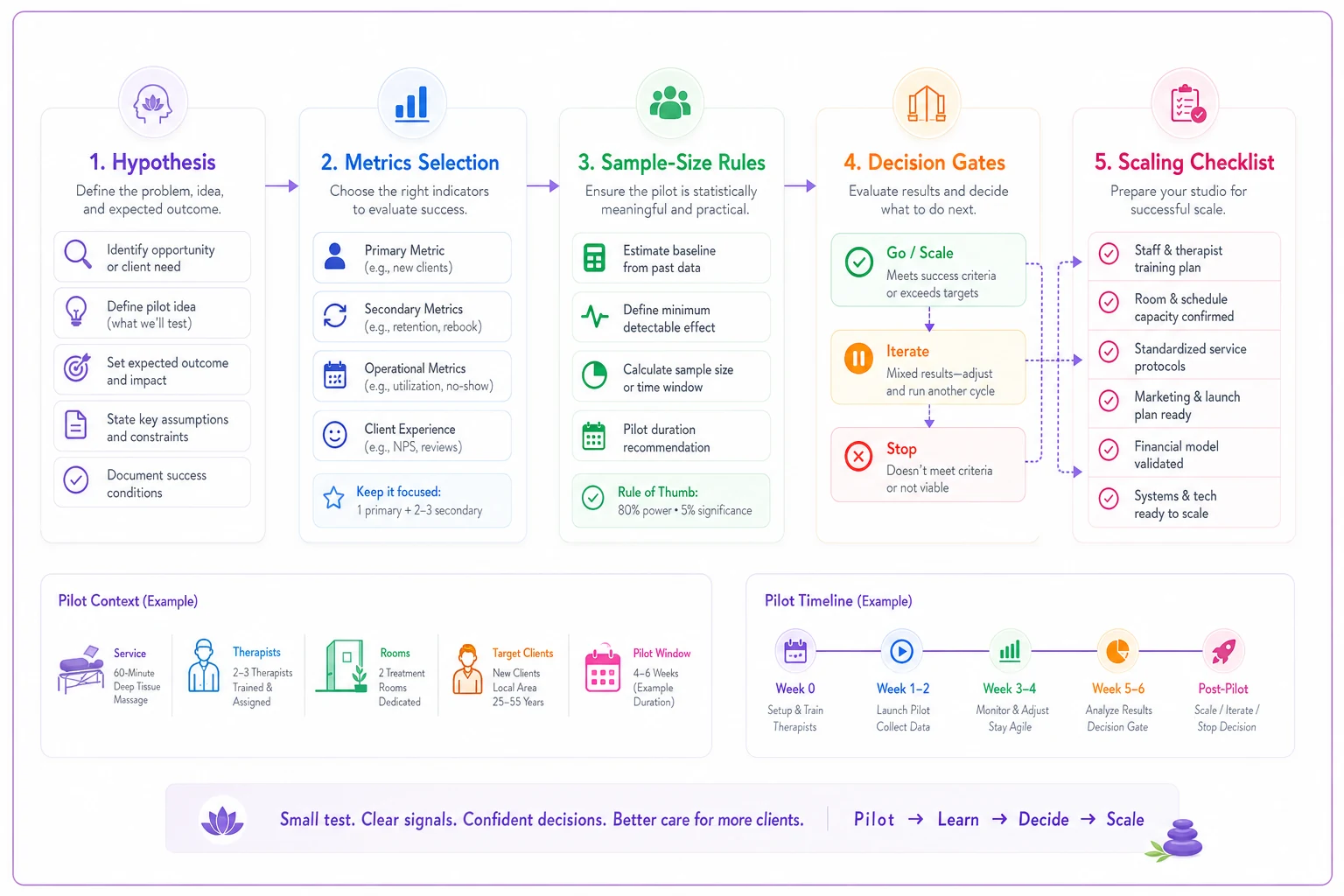
1. A hypothesis template (so you know what you're actually testing)
> We believe [new service] will [specific outcome] for [specific client segment], measured by [metric], within [timeframe]. We'll kill it if [threshold].
A real one might read: We believe a 60-minute prenatal session will attract new second-trimester clients and rebook at our studio average, measured by rebooking rate and revenue per chair-hour, within 8 weeks. We'll kill it if revenue per chair-hour stays below our 60-minute baseline after 6 weeks.
The important part is the kill condition. Writing it before you're emotionally attached to the service is the entire point. You will not think clearly about killing something once regulars are asking for it by name.
2. Minimum viable metrics (pick 3, not 12)
The temptation is to track everything. Don't. A pilot drowns in data and dies of indecision. For most service pilots, three metrics do the job:
-
Revenue per chair-hour — the only number that accounts for cannibalization. A premium-priced long session can lose to a cheaper short one here.
-
Rebooking / return rate — does the service create loyalty or is it a one-time novelty?
-
Therapist load signal — something simple like minutes of hands-on time per shift or a weekly 1–5 fatigue check-in.
That third one gets skipped constantly, and it's the one that protects the humans. A service can pass both financial tests and still be quietly destroying your best therapist. If you're grounded in per-session unit economics, you already have the baseline numbers you need to compare any pilot against your existing menu.
Track therapist load as diligently as revenue — it often reveals a service's real cost before the finances do.
3. Sample-size rules (so you don't decide on noise)
Small studios go wrong in both directions here. Some kill a service after four slow appointments. Others run it for a year "to be sure." Both are errors.
| Pilot type | Minimum before deciding | Why |
|---|---|---|
| New standalone service | ~25–40 completed sessions | Enough to see a real rebooking pattern, not one bad week |
| Add-on / upsell | ~50+ offers made | Attach rates are noisy; you need volume on the offer, not the sale |
| Premium-priced variant | ~4–6 full weeks | You need a couple of pay cycles to see if demand holds past novelty |
These aren't laws of physics — they're guardrails against deciding on a sample of eight. The underlying principle: decide on patterns, not anecdotes. One furious client or one raving regular is not a data point you can build a permanent menu decision on.
4. Roll / kill decision gates
A gate is just a scheduled moment where someone with actual authority looks at the three metrics and makes one of three calls:
-
Roll — it beat the thresholds, promote it to the permanent menu with standard pricing and training.
-
Kill — it missed, retire it cleanly and tell clients before they get attached.
-
Extend once — results are genuinely ambiguous (not "we feel hopeful"), run one more defined cycle with a tightened hypothesis.
The rule that saves you: you get exactly one "extend." Infinite extensions are how zombie services survive. If it can't prove itself in the pilot plus one extension, it dies. And someone has to own that decision by name — not "the team," an actual person.
5. A scaling playbook (for the ones that survive)
A service passing its pilot at one location does not mean it's ready to roll out everywhere. Promotion to the permanent menu needs its own checklist:
-
Standardized pricing locked across locations, documented, not improvised.
-
A written SOP — room setup, timing, turnover, products used — so it doesn't depend on the therapist who invented it.
-
At least two trained providers before it goes live anywhere. One-therapist services are a staffing emergency waiting to happen.
-
A capacity cap — how many prime-time slots this service is allowed to occupy before it starts cannibalizing higher-margin work.
-
A review date — even "permanent" services get re-checked, because client demand shifts.
That capacity cap is the quiet hero. It's the difference between a successful service and a successful service that slowly eats your schedule.
A short real scenario
A three-room suburban studio wanted to test a "90-minute therapeutic recovery" session at a premium rate. Under their old habits, they'd have added it to the menu, watched it book up, and called it a win.
Instead they ran it as a governed pilot. The hypothesis: it would beat their 60-minute revenue-per-chair-hour baseline within six weeks. They tracked three metrics and set a session floor of around 30 completed appointments.
What they found: the service booked beautifully — nearly always full — but revenue per chair-hour came in below their standard 60-minute sessions once they accounted for longer room turnover and the fact that it only ran during peak hours. Popular and margin-negative at the same time, which is exactly the trap that never surfaces in the "feels busy" signal.
They didn't kill it outright. They used their one extension, repriced it about 15% higher and capped it to off-peak slots. Second cycle, it cleared the baseline by a comfortable margin and stopped stealing prime-time capacity. A service they almost mispriced into a slow leak turned into meaningful additional monthly margin — and nobody's calendar got wrecked in the process.
The decision only looked smart in hindsight. In the moment, the governance process is what stopped them from keeping the first, worse version.
When this makes sense — and when it doesn't
Run a formal pilot when:
-
The service requires new training, equipment, or longer session blocks.
-
It's premium-priced and the margin case isn't obvious.
-
It leans on a specific therapist's skill (that's a risk flag, not a green light).
Skip the heavy process when:
-
It's a tiny add-on with near-zero cost (a hot-towel finish). Just track the attach rate casually.
-
You're in genuine survival mode and need cash this week — governance is for building durable menus, not firefighting.
Who should NOT do this: A solo practitioner with one chair and a stable book doesn't need gates and sample-size tables. Your whole operation fits in your head, and the overhead would cost more than it saves. This matters most once you're coordinating multiple therapists, rooms, or locations — the exact point where informal control stops working.
How this holds together as you grow
The real value isn't any single pilot. It's that governance makes your menu legible. When every service on your board went through the same hypothesis-metrics-gate process, you know why each one exists, what it's supposed to do, and when you last checked that it still does it.
That legibility is what lets you scale without decision drift. A new location opens and inherits a documented menu with known economics instead of a pile of inherited guesses. A therapist leaves, and the service they championed doesn't collapse because there's an SOP and a second trained provider. You can look at the whole board and say, with actual confidence, which services earn their slot.
The studios that scale cleanly aren't the ones with the most services. They're the ones that can tell you, for every service they offer, exactly why it's still there — and exactly what would have to happen for it to go.
Start with one written hypothesis on your next new service. Set the kill condition before you fall in love with it. That single habit will save you more margin than almost anything else on your menu.
Ready to elevate your massage therapy business?
Join hundreds of therapists using Masthera to save time, reduce scheduling conflicts, and enhance client satisfaction.