



Most massage menus grow like weeds. You add a hot stone service because two clients asked. You throw in a 90-minute prenatal option because a therapist has the cert. Then a cupping add-on, a CBD upgrade, a "wellness reset" package that somebody named on a whim. Five years in, you're staring at 22 line items and no idea which ones actually pay rent.
A bloated menu doesn't just confuse clients—it quietly drains margin. Every service you offer carries a cost even when nobody books it: staff training time, inventory sitting on a shelf, scheduling complexity, room setup differences, and the mental overhead of remembering how each one is priced and performed. A service portfolio strategy for wellness practices isn't about cutting things you love. It's about knowing, with real numbers, which offerings earn their place.
This is the framework I'd use to rationalize a menu from the ground up—utilization targets, throughput math, margin floors, skill requirements, and a lifecycle for testing, scaling, and retiring services without alienating your regulars.
Why menus bloat in the first place
The pattern is almost always the same. A menu starts lean—maybe three services—and every addition feels harmless in isolation. Nobody sits down and asks, "What does this cost us to keep alive, even when it's not booked?" So services accumulate one yes at a time until the whole thing is unmanageable.
What breaks at scale is coordination. With three services, any therapist can handle anything and your front desk can quote prices in their sleep. With fifteen, you've got services only one person can perform, add-ons that require specific supplies, and durations that don't tile neatly into your booking blocks. A 50-minute service followed by a 20-minute add-on turns your clean hourly grid into Swiss cheese. Rooms sit half-idle. Therapists get gaps they can't fill.
There's also a psychological cost that's easy to miss. Choice overload lowers booking conversion. When a new client lands on a menu with 20 options across four categories, a meaningful chunk of them stall out instead of booking. The menu meant to show range ends up costing you appointments.
The five lenses every service should pass through
Before you decide what stays, you need to evaluate each offering the same way—through a consistent set of measurements. These five lenses turn a fuzzy "I think this one does well" into something you can actually rank.
Never miss a booking or double-book again.
Masthera helps you schedule, confirm & manage every massage session with ease.
- Unified appointment management
- Automated client reminders
- Therapist calendar coordination
No credit card required
1. Utilization target. What percentage of available capacity does this service realistically fill? A signature 60-minute deep tissue might run at 70–80% utilization. A niche lymphatic drainage service might sit at 8%. Utilization tells you whether a service is pulling its weight against the room and hours it consumes.
2. Duration-driven throughput. How much revenue does a service generate per hour of chair time, including setup and turnover? This is where a lot of "premium" services fall apart. A 90-minute service priced at $150 sounds great until you compare it per-hour to a 50-minute at $95.
3. Margin floor. After therapist pay, supplies, and the allocated cost of the room and time, what's left? Every service needs a minimum acceptable margin. If it can't clear the floor, it either gets repriced or retired.
4. Therapist-skill requirement. How many of your staff can actually deliver it? A service only one person can perform is a scheduling liability and a single point of failure. If that therapist is out or leaves, the service dies overnight—and any clients loyal to it walk.
5. Lifecycle stage. Is this a test, a proven scaler, or a fading offering on its way out? Naming the stage stops you from treating an experiment like a core service and vice versa.
If you haven't nailed down the cost side of these yet, the per-session economics matter more than anything else here. It's worth working through a proper per-session unit economics model first, because every margin floor below assumes you actually know your true cost per service.
Building the throughput table
Throughput per hour is the number that cuts through menu debates fastest. Here's a simplified version of what the table looks like once you fill it in for your own services. Numbers here are illustrative for a mid-size studio.
| Service | Duration (incl. turnover) | Price | Therapist cost | Supplies | Revenue/hr | Margin/hr | Utilization |
|---|---|---|---|---|---|---|---|
| Signature deep tissue | 60 min | $95 | $38 | $3 | $95 | ~$54 | 78% |
| Relaxation Swedish | 60 min | $85 | $34 | $3 | $85 | ~$48 | 65% |
| 90-min therapeutic | 105 min | $150 | $60 | $5 | ~$86 | ~$48 | 40% |
| Hot stone | 75 min | $120 | $45 | $9 | ~$96 | ~$53 | 22% |
| Lymphatic drainage | 60 min | $100 | $45 | $2 | $100 | ~$53 | 9% |
| CBD upgrade (add-on) | +15 min | $25 | $6 | $7 | — | ~$12 | 14% |
A few things jump out once it's laid out like this. The 90-minute therapeutic, despite the highest ticket price, generates roughly the same revenue per hour as the plain Swedish—because the extra time eats the premium. Hot stone looks healthy on margin per hour but runs at 22% utilization, meaning the setup and specialized supplies rarely get used. Lymphatic drainage has decent margins but almost nobody books it, so it's consuming menu space and a skill slot for near-zero return.
This table won't tell you what to do by itself. But it stops the loudest opinion in the room from winning by default. When someone insists the 90-minute is your "premium flagship," the throughput column shows it's barely keeping pace with your basic service.
Setting margin floors that actually mean something
A margin floor is the line a service must clear or it triggers a decision. The mistake people make is setting one blanket floor and applying it to everything. Add-ons, core services, and premium experiences have genuinely different roles.
-
Core services
must clear your target margin per hour and hit utilization above roughly 50%. These are your engine. They don't need to be exciting; they need to be reliable.
-
Premium/differentiator services
can accept lower utilization (they're not meant to fill every slot) but must clear a higher margin per hour to justify the specialized skill or supplies.
-
Add-ons
judged on attach rate and incremental margin, not standalone throughput. A $25 CBD upgrade at 14% attach across your booking volume can add real money without occupying its own slot.
When a service breaks its floor, you have three moves, in order: reprice it, re-scope it (shorten the duration, cut the expensive supply), or retire it. Retiring is the last resort, not the first, because a service with loyal fans has retention value that doesn't show up in a throughput cell.
The skill-requirement bottleneck nobody plans for
Utilization and margin get all the attention, but the skill lens is where scaling quietly breaks. A service that only one therapist can perform behaves fine at small scale and becomes a scheduling nightmare as you grow.
Picture a studio with four therapists where hot stone and prenatal can each only be done by one person. Every time a client wants those services, the booking system has to route to a specific human. When that person is booked, on vacation, or sick, the service is simply unavailable. Worse, their schedule fills with specialty work while the other three carry the general load—creating uneven utilization across your team and a fairness problem in tips and hours.
The rule worth applying: any service you want to scale needs at least two qualified providers, ideally three by the time it's core. If a service can't clear that bar and can't justify the cross-training cost, it stays a niche offering with limited booking windows—or it sunsets. Cross-training isn't free, so you're really asking: is this service worth another therapist's certification time and practice hours? If the throughput doesn't support that investment, you have your answer.
The lifecycle playbook: test → scale → sunset
Services shouldn't live forever by default. Treating your menu as a living portfolio—where things enter as experiments and exit when they fade—is what keeps margins protected over time. Each stage has different rules and different metrics.
Test stage
-
Limit availability. Offer it in specific windows or with one or two providers only. Don't blow up your whole schedule for an unproven idea.
-
Set a decision date. Give it a fixed evaluation window—8 to 12 weeks is reasonable—so it can't quietly become permanent by inertia.
-
Define the pass bar upfront. Before launch, write down what "working" means: a minimum booking count, a minimum utilization, and clearing the margin floor.
-
Track it separately. Don't let test-service numbers blur into your general reporting or you'll never get a clean read.
The most common failure at this stage is skipping the decision date. A service gets tested, does okay-ish, and just... stays. Eighteen months later it's cluttering your menu and nobody remembers whether it ever earned its spot.
If you can, require a minimum booking count before moving from test to scale so demand isn't assumed based on a handful of enthusiasts.
Scale stage
-
Cross-train to at least two or three providers so it stops being a bottleneck.
-
Open it across your full schedule and booking channels.
-
Consider building it into packages or memberships if the retention data supports it. Services with strong repeat behavior are exactly what belong inside a recurring structure—there's real leverage in pairing your best-performing services with well-designed membership offers that stabilize cashflow.
-
Reprice with confidence now that you have real demand data.
Sunset stage
-
Flag the trigger. Utilization falls below your floor for two consecutive quarters, or margin breaks and can't be repriced.
-
Check the loyal-client tail. Who books this and only this? You need a plan for them before you pull it.
-
Announce with a runway. Give regulars 30–60 days and steer them toward the nearest equivalent service.
-
Remove cleanly. Pull it from the menu, retire the supplies, and reclaim the skill slot for something with a future.
The client-tail check is the step people skip, and it's the one that causes the damage. Yanking a service that a dozen loyal regulars love—without a migration plan—can cost you retention worth far more than the service ever earned.
Here's a simple visual of the lifecycle to keep the process clear when you review services quarterly.
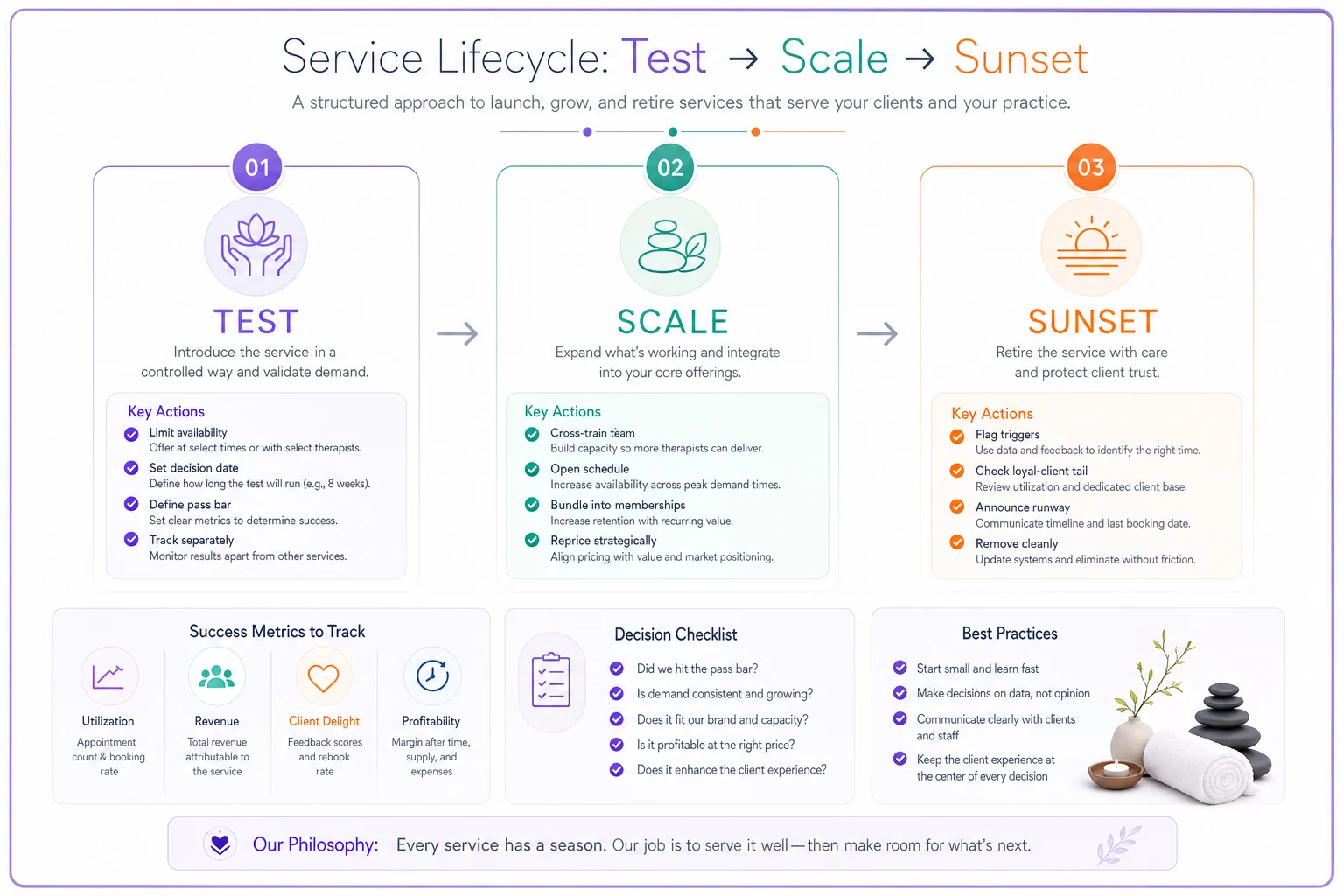
Sunsetting well means doing it deliberately instead of letting a dead service linger.
A decision table to guide the calls
When a service comes up for review, this gives you a fast, consistent read instead of relitigating everything from feelings.
| Utilization | Margin vs floor | Skill coverage | Decision |
|---|---|---|---|
| High | Above floor | 2+ providers | Scale / promote |
| High | Above floor | 1 provider | Cross-train, then scale |
| High | Below floor | Any | Reprice or re-scope |
| Low | Above floor | Any | Keep as niche, limited windows |
| Low | Below floor | 1 provider | Sunset |
| Low | Below floor | 2+ providers | Reprice once; sunset if no lift |
The table isn't a substitute for judgment—the loyal-client tail and strategic positioning still matter—but it forces the conversation onto the same four factors every time.
A real scenario
A three-room studio with four therapists had drifted to 19 menu items over about six years. Revenue was steady, somewhere in the $28k–$32k a month range, but margins had been sliding and nobody could say exactly why. Running the throughput table exposed the problem quickly: five services accounted for the bulk of bookings, while eight sat under 15% utilization and three of those were breaking their margin floor.
They sunset four low-utilization services (with a 45-day runway and a migration path for the handful of regulars affected), repriced the 90-minute service and trimmed it to a leaner 75-minute format that tiled better into the schedule, and cross-trained a second therapist on their best-performing specialty so it could actually scale. The menu went from 19 items to 11.
Within about a quarter, booking conversion on their site ticked up—fewer choices, less stall—and the schedule packed tighter because durations lined up cleanly again. Margin per hour improved by a noticeable amount, not because they raised prices across the board, but because the studio stopped burning capacity on services that weren't paying for themselves. The therapists were happier too; work spread more evenly instead of one person carrying all the specialty bookings.
When menu rationalization makes sense—and when it doesn't
When it makes sense:
-
Your menu has grown past roughly 8–10 items and you can't rank them by profitability off the top of your head.
-
You're seeing uneven utilization across therapists driven by skill-locked services.
-
Booking conversion feels soft and your menu is dense with options.
-
You're preparing to add locations or staff and need clean, scalable offerings.
When it's a bad idea to do aggressively:
-
You're brand new and still discovering what your market wants. Cutting too early kills experiments before they've had a fair test.
-
You're in a demand crunch and every booking counts—rationalize thoughtfully, but don't panic-cut services with loyal followings mid-slump.
Anyone who treats this as a one-time project will be back in the same mess within a couple of years. A menu rationalized once and never revisited just bloats again. This needs to become a quarterly habit, not a spring cleaning you do when things feel out of control.
Making it a repeatable habit
Once a quarter, pull utilization and margin per service, run each one through the decision table, and check what's sitting in the test stage past its decision date. This doesn't need to be elaborate—the same data lives inside your booking and payment records, and it's a natural extension of the numbers you're already watching in a lean KPI dashboard.
Running this review consistently is also where operational software starts earning its keep. When utilization, therapist scheduling, and revenue per service all live in the same place, you're not stitching together three different reports every quarter—the picture is just there. That makes it a lot easier to catch a fading service before it's been quietly dragging on margin for six months.
The studios that keep margins healthy over years aren't the ones with the most creative menus. They're the ones who treat their service list as a portfolio to manage—adding deliberately, measuring honestly, and letting go of what stops earning. A tight, well-understood menu is easier to price, easier to staff, easier to book, and far more profitable than a sprawling one that grew by accident. The goal isn't fewer services for its own sake. It's every service on your menu knowing exactly why it's there.
Ready to elevate your massage therapy business?
Join hundreds of therapists using Masthera to save time, reduce scheduling conflicts, and enhance client satisfaction.