


Pop-ups and corporate on-site days sell themselves as pure upside. A yoga studio invites you to their anniversary event. A tech company wants chair massage for "wellness week." A wedding planner books you for a bridal suite morning. You quote a number, someone says yes, and it feels like found revenue.
Then the day happens. You forgot the bolster. The venue had no accessible parking, so you carried your table three blocks. The company promised "15 people" and 31 showed up, so you either turned people away or blew past your hours for free. You got home at 9pm, unpacked, and realized you never actually figured out whether the day made money.
That gap — between the quote and the reconciliation — is where mobile work quietly bleeds. A tight mobile massage SOP for pop-up bookings isn't about being fancy. It's about making off-site work as predictable and profitable as the treatments you do in your own room, where everything is already where you left it.
This post covers the four things that actually determine whether a pop-up is worth doing again: the quote, the packing and insurance discipline, the on-site logistics, and the post-event reconciliation. Skip any one and you'll keep saying yes to events that lose money while feeling busy.
Start with a quote template that prices the friction, not just the hands
The most common mobile-pricing mistake is quoting your in-studio rate plus a vague "travel fee." That covers gas. It doesn't cover two hours of setup, the load-in, teardown, laundry, or the fact that you can't book studio clients on a day you're off-site.
A pop-up quote has to price the whole day, not the minutes your hands are working. Here's the breakdown that keeps you from underquoting.
| Line item | What it covers | Why people forget it |
|---|---|---|
| Treatment time | Actual billable massage minutes | This is the only part most people quote |
| Setup + teardown | Table, linens, sanitizing, packing out | Feels "free" but it's 60–90 min every event |
| Travel + load-in | Drive time, parking, carrying gear | Underestimated, especially in cities |
| Opportunity cost | Studio bookings you can't take that day | Almost nobody accounts for this |
| Supplies burn | Linens, oils, disposables, laundry | Adds up fast at volume |
| Deposit / minimum | Non-refundable floor for the booking | Protects you from same-week cancels |
A workable format: a flat event minimum that covers your fixed costs no matter what, plus a per-treatment or per-hour rate above that, plus a travel band based on distance. So instead of "$120/hour, 3 hours," you quote something like: "$450 minimum for up to 3 hours on-site, additional hours at $130, $40 travel within 20 miles."
The event minimum is what saves you. If a corporate client trims from 3 hours to 2 the day before, the minimum still holds the floor. Without it, every last-minute change eats directly into a margin that was already thin.
One more thing: spell out what "one hour" means. Does the client's "hour" include your setup? Are you paid from arrival or from first treatment? Vague language is where corporate coordinators quietly take 45 minutes of unpaid work per event. Write it down: "On-site time is billed from arrival. Setup and teardown are included in the event minimum."
The packing and insurance checklist (the boring part that ruins events)
Nothing tanks a pop-up faster than realizing you left something forty minutes away. And nothing exposes you legally faster than doing off-site work your policy doesn't actually cover.
Never miss a booking or double-book again.
Masthera helps you schedule, confirm & manage every massage session with ease.
- Unified appointment management
- Automated client reminders
- Therapist calendar coordination
No credit card required
Two separate problems, both solved by lists you build once and reuse forever.
Insurance first, because it's the one that can end your business. Before you accept off-site work, confirm three things with your insurer:
-
Your liability policy covers treatments performed outside your licensed premises
-
You're covered for the specific setting (corporate office, private home, event venue)
-
The venue or corporate client has their own coverage, and you have a copy of any required certificate
A lot of therapists assume their studio policy travels with them. It often doesn't, or it does only with a rider. The cost of adding off-site coverage is small. The cost of an incident at a corporate event with no coverage is the kind of number that closes practices.
Then the physical packing checklist. Build it as a laminated card or a phone note you tick through every single time — no exceptions, even when you're "sure" you have everything:
-
[ ] Table + carry case, checked for a working latch
-
[ ] Face cradle + cushion
-
[ ] Bolster and/or rolled towels
-
[ ] Fitted sheets, top sheets, face-cradle covers (count for the day's volume + 2 spares)
-
[ ] Oil/lotion + a backup bottle (leaks happen)
-
[ ] Sanitizer, disinfectant wipes, disposable gloves
-
[ ] Trash bags for used linens
-
[ ] Intake forms / tablet + charger for digital intake
-
[ ] Payment method (card reader charged, backup for signal issues)
-
[ ] Business cards / rebooking QR code
-
[ ] Water for you (dehydrated therapists make sloppy events)
-
[ ] Power strip + extension cord (venues never have outlets where you need them)
-
[ ] First-aid basics + any incident-report forms
The two items people forget most: spare linens and a charged card reader with an offline backup. Running out of clean sheets at treatment 9 of 14 is a scramble you only make once. Losing signal and being unable to take payment at a busy event means chasing money afterward that some people just never pay.
For repeat event types, keep a pre-packed portable kit that stays loaded between events. A "chair massage kit" and a "table event kit" that live ready-to-go remove the single biggest source of forgotten-gear disasters: packing while tired at 6am.
Keep dedicated, pre-packed chair and table kits that stay loaded between events.
A "chair massage kit" and a "table event kit" that live ready-to-go remove the single biggest source of forgotten-gear disasters: packing while tired at 6am.
Site logistics: the questions to ask before you arrive, not after
Setup problems almost always trace back to things nobody asked during booking. The venue seemed friendly, the client was excited, and everyone skipped the logistics because it felt awkward to interrogate them.
-
Where exactly do I set up? Room, corner, square footage. A chair-massage station needs less than you think; a table needs privacy and room to move around all four sides.
-
How do I get my gear in? Loading dock, elevator, stairs, distance from parking. This alone changes how much you can physically bring.
-
Is there parking, and is it free? "There's parking nearby" has cost therapists $40 in garage fees and a ten-minute haul more times than anyone wants to admit.
-
Power and lighting? Where are outlets? Can lights be dimmed? Fluorescent overhead in a break room is not a relaxing treatment environment.
-
Who's my on-site contact and what's their cell? The person who booked you is often not the person at the event. Get the day-of human.
-
How are clients scheduled? Sign-up sheet, walk-up, pre-booked slots? If it's a free-for-all, you'll get slammed in bursts and idle in gaps.
That last one matters more than the rest combined. An unmanaged sign-up flow is what turns a paid 3-hour event into a chaotic 4-hour one. Ask the client to run a simple time-slot signup before the day. If they won't, bring your own — a printed sheet with 15- or 20-minute slots taped to the wall keeps the line honest and gives you control over your actual hours.
If you already run structured booking in your studio, the logic here is identical to what's covered in designing an operations system that runs a small massage practice — booking, intake, and follow-up don't stop mattering just because you're off-site. They get harder, which means they matter more.
A simple on-site workflow that keeps you on time
Once you're set up, the day runs cleaner if you treat it as a repeating loop: Client arrives at their slot → hands you a completed intake (or fills a quick digital one) → you do a 15-second contraindication check → treat → sanitize the station → rebooking prompt or hand them a card → next slot.
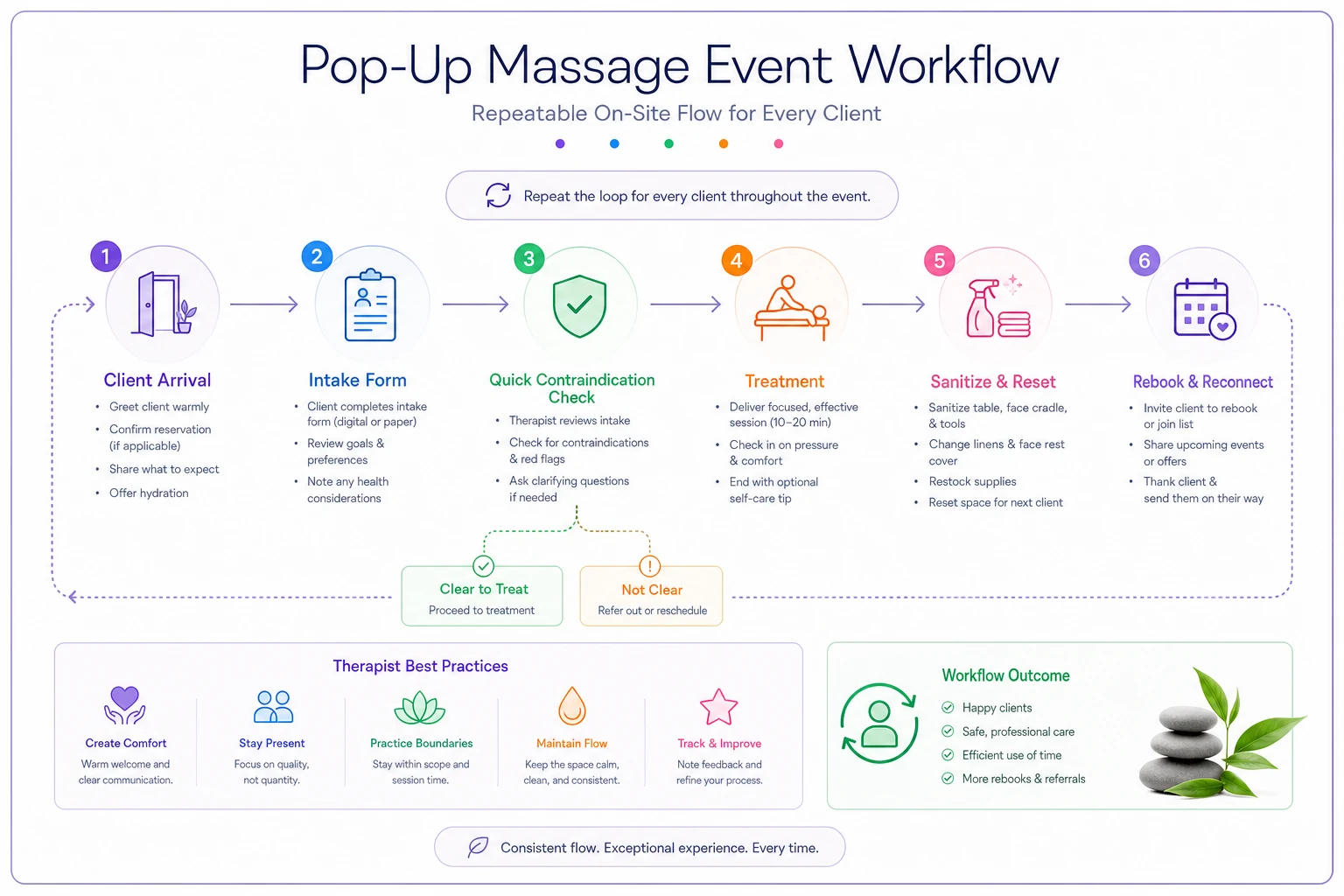
This visual lays out the repeating loop so each slot stays on time and the reset isn't skipped.
Post-event reconciliation: the step that tells you if any of this was worth it
Here's the discipline almost nobody actually has. You get home tired, dump the gear, and never run the numbers. So you keep saying yes to pop-ups based on feeling — "that one felt good" — instead of knowing which ones actually pay.
Reconciliation is a 15-minute habit that turns off-site work from guesswork into a real revenue line.
Run these numbers within 24 hours, while the day is still fresh:
-
Gross collected — total payments taken, tips separated out
-
Treatments delivered — count them, note no-shows in booked slots
-
True hours spent — from leaving home to unpacking, not just on-site time
-
Direct costs — travel, parking, supplies burned, any assistant pay
-
Effective hourly — (gross minus costs) ÷ true hours
-
Rebookings generated — how many event clients booked a studio visit
That last metric is the hidden value of pop-ups. A corporate day that barely breaks even on the day itself can still be worthwhile if it feeds four or five new studio clients into your regular schedule. But you'll never know unless you tag those clients and track what happens.
A real scenario, numbers and all
A solo therapist takes a corporate chair-massage day. Quote: $450 minimum for 3 hours, plus travel. She collects $520 including a slot she added on-site.
-
True hours (leave home to gear unpacked)
about 5.5 hours
-
Costs
$22 parking, ~$18 supplies, $15 gas ≈ $55
-
Net
roughly $465
-
Effective hourly
about $85/hr across the whole day
That's fine — but it's meaningfully below her $120 studio rate once you count the full day. The reconciliation reframes the decision: this event only makes sense if it feeds rebookings. She tagged event attendees and, over the next month, three booked studio appointments. Now the math works, because those clients are worth far more than the day's margin.
Without the reconciliation, she'd have either kept doing break-even events blindly or quit pop-ups entirely. With it, she knows the rule: take corporate days that convert to studio clients, pass on the ones that don't. That single insight is worth more than any quote template.
When pop-ups make sense — and when to walk away
When off-site work is genuinely worth it:
-
The event feeds your studio pipeline (corporate wellness days, community events near your location)
-
You can hit an effective hourly at or above your studio rate once fully loaded
-
It's a repeatable client relationship, not a one-off you'll never see again
-
The logistics are sane — accessible load-in, controlled scheduling
When it's a bad idea:
-
The venue is far, hard to load into, and the client won't budge on price
-
Scheduling is a free-for-all the client refuses to manage
-
It doesn't generate rebookings and barely breaks even
-
Your insurance doesn't cleanly cover the setting
Who should probably not chase pop-ups at all: a fully-booked solo practitioner with no open studio capacity. If you can't absorb the rebookings a pop-up generates, and the day itself only breaks even, you're trading a comfortable studio day for an exhausting off-site one at the same money. The math only works when off-site work either pays a premium or fills capacity you actually have.
This is the same logic behind stable recurring revenue in general — the goal is predictable, compounding relationships, not one-off bursts. It's why memberships that stabilize cashflow and pop-ups that convert to regulars are really the same strategy pointed in different directions: turn a moment into a relationship.
Build it once, reuse it forever
The reason pop-ups feel chaotic isn't the work itself — it's that most therapists rebuild the entire process from scratch every time. New quote pulled from thin air, gear packed from memory, logistics improvised on arrival, no accounting afterward.
Fix it once. Write the quote template with a real event minimum. Laminate the packing and insurance checklist. Keep a portable kit pre-loaded. Ask the six logistics questions before every booking. Run the 15-minute reconciliation within a day of the event. None of this is complicated, and after two or three events it becomes automatic.
The payoff isn't just less stress on event days. It's that you finally know which off-site work to keep saying yes to — the events that fill your studio and pay your rate — and which ones to politely decline. That's the whole game: turning pop-ups from a gamble into a reliable, profitable part of a practice you actually control.
Ready to elevate your massage therapy business?
Join hundreds of therapists using Masthera to save time, reduce scheduling conflicts, and enhance client satisfaction.