

Here's a problem that almost never shows up until something breaks: a client books through your online scheduler, pays through your POS, fills out intake on a tablet, and somewhere in that chain three different systems recorded three different answers to "can we text and email you?"
One says yes. One never asked. One defaulted to opt-in because that box was pre-checked two software versions ago. Now you've got a client receiving your Tuesday promo text who never actually agreed to marketing — and if they complain, report the message as spam, or live in a state with real teeth on consent laws, you've got exposure you didn't know existed.
Consent management for massage studios isn't a legal box you check once. It's an ongoing sync problem between systems that don't talk to each other cleanly. When consent records drift, two things happen simultaneously: your deliverability tanks and your compliance risk goes up. This post is about fixing both.
Why consent drifts across three systems that should agree
Most studios run some version of this stack: a booking tool, a point-of-sale, and a CRM or email/SMS platform. Sometimes two of those are the same product. Usually they're not, or they're loosely connected through an integration that syncs contact info but not consent state.
That gap is the whole problem.
-
Booking system
email on file, consent status unknown
-
POS
phone on file, no consent field
-
CRM/email tool
marketing flag set to "yes" by default on import
Nobody decided to break the rules. The systems just filled in blanks with assumptions. And assumptions about consent are exactly what regulators and inbox providers punish.
The sneaky part is that this looks fine on the surface. Your lists are growing. Campaigns are sending. Open rates seem okay-ish. The damage is invisible until a deliverability cliff or a complaint forces you to look — and by then you're reverse-engineering months of bad records.
What this actually costs you
Two separate costs, and studios usually only think about one.
Never miss a booking or double-book again.
Masthera helps you schedule, confirm & manage every massage session with ease.
- Unified appointment management
- Automated client reminders
- Therapist calendar coordination
No credit card required
The deliverability cost comes first and hits silently. When you email or text people who never clearly opted in, your complaint rate creeps up. Mailbox providers like Gmail and Yahoo watch complaint rates closely — cross a threshold (Gmail's guidance puts it around 0.3%) and they start routing your mail to spam for everyone on your list, including clients who actually want to hear from you. So a few dozen "who is this?" recipients can quietly degrade inbox placement across your entire file. No warning. Rebooking reminders just start underperforming and you blame the subject line.
The compliance cost comes second but hits harder. TCPA governs text messages in the US, and statutory damages run $500 to $1,500 per message sent without proper consent. CAN-SPAM penalties scale into the tens of thousands per message in serious cases. For studios in California (CCPA/CPRA) or anyone touching EU clients (GDPR), "we didn't track where consent came from" is the answer that turns a minor issue into a real one. You don't need to have done anything malicious. You just need to be unable to prove consent when asked.
A studio sending to around 2,000 contacts with even 3–4% of them improperly consented is sitting on both a deliverability problem and a legal one at the same time — and most owners can't tell you which contacts those are.
Map opt-in before you fix anything
Before touching lists or settings, you need a clear picture of what each system is actually capturing. This mapping exercise takes an afternoon and saves you from guessing.
| System | Captures email? | Captures phone? | Has marketing consent field? | Consent default | Timestamp recorded? | Source recorded? |
|---|---|---|---|---|---|---|
| Booking | Yes | Sometimes | No | Auto-add to list | No | No |
| POS | No | Yes (receipts) | No | N/A | Yes (txn date) | No |
| Intake form | Yes | Yes | Yes (explicit checkbox) | Unchecked | Yes | Yes (form name) |
| CRM/Email | Yes | Yes | Yes | Defaults to opt-in on import | Sometimes | No |
Fill this out and your problems get obvious fast. In the example above, the only system collecting clean, timestamped, sourced consent is the intake form — and it's the one most loosely connected to the tool doing the actual sending. Meanwhile the CRM defaults imports to opt-in, meaning every contact pushed in from booking or POS silently became a marketing subscriber without ever agreeing.
Two fields matter more than anything else and most systems skip both: timestamp (when did they consent) and source (what exact form or screen captured it). Without those, you can't defend a single contact. "They're on the list" is not consent. "They checked this box on this form on this date" is.
The consent schema every studio should standardize on
Pick one canonical set of consent fields and make every system either populate them or stay out of the way. At minimum:
-
Email marketing consent
true / false / unknown
-
SMS marketing consent
true / false / unknown (keep these separate — agreeing to email is not agreeing to text, and the law treats them differently)
-
Consent timestamp
date and time
-
Consent source
the specific form, page, or staff action that captured it
-
Transactional vs marketing
a client always gets transactional messages (appointment confirmations, receipts) regardless of marketing consent — don't accidentally suppress those
That "unknown" value is what most studios forget to allow, and it's the most important one. A contact with unknown consent should never receive marketing until someone resolves it to true or false. Treating unknown as a quiet yes is exactly how you end up texting people who never agreed. Treating unknown as a hard no until proven otherwise keeps you clean.
Export-safe list patterns
When you pull lists for a campaign — whether exporting a CSV or using built-in segments — the filtering logic is where studios accidentally re-import their own mistakes. A few patterns that keep exports clean:
-
Filter on consent = true explicitly, never "not false." "Everyone who hasn't opted out" sweeps in every unknown contact. "Everyone who opted in" doesn't. This one distinction prevents most accidental sends.
-
Separate your email-consented and SMS-consented segments. Don't maintain one "marketing list." Maintain two, because the consent is legally distinct and a contact might be yes on one and no on the other.
-
Always carry the timestamp and source columns in the export. Even if your sending tool ignores them, you want a paper trail attached to every send.
-
Suppress recent bouncers and complainers automatically. A hard bounce or spam complaint should remove a contact from your sending segment immediately — not next month when you remember to do it.
-
Revisit stale consent on sensitive channels. For SMS especially, a contact who opted in two years ago and hasn't engaged since is a risk. Consider re-confirming before including them in a blast.
Always include the consent timestamp and source in your exports so you have an audit trail.
The goal is that any list you can export is a list you'd be comfortable defending. If pulling a segment requires you to also remember to exclude the unknowns, the segment is built wrong.
The weekly reconciliation SOP
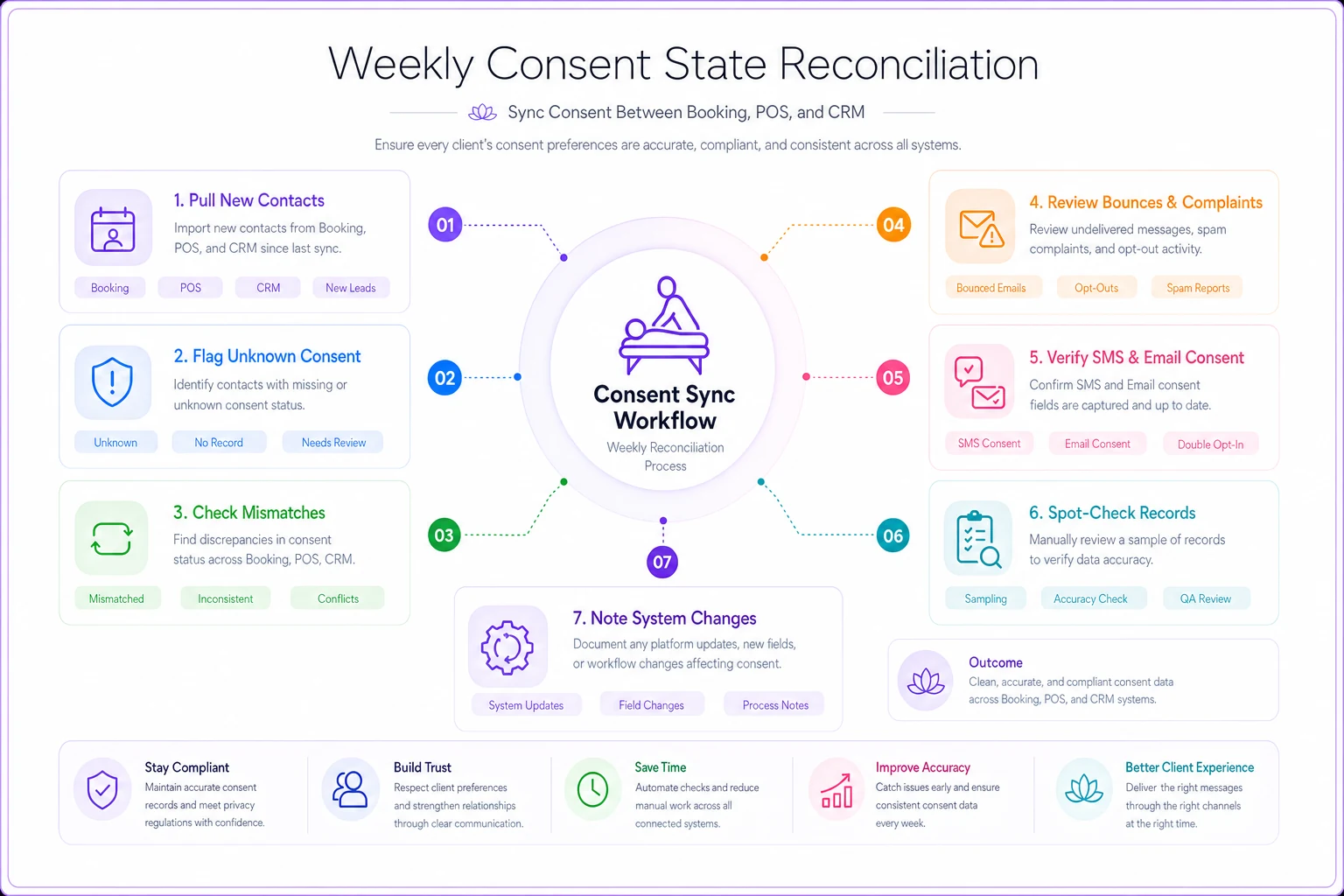
Mapping and schema fix the structure. Reconciliation keeps it from drifting again — because it will drift. New intake versions, new staff, a POS update, an integration that silently changes behavior. Fifteen minutes a week beats a four-hour cleanup every quarter.
-
- [ ] Pull new contacts added this week across all three systems
-
- [ ] Flag any contact with unknown marketing consent — these should not be in any sending segment
-
- [ ] Check for mismatches
contact marked opt-in in CRM but no matching consent record in the intake or booking source
-
- [ ] Review the week's bounces and spam complaints; confirm those contacts were suppressed
-
- [ ] Verify SMS and email consent are still stored as separate fields (integrations love to flatten these)
-
- [ ] Spot-check 5 random new contacts — can you trace each one to a timestamp and source?
-
- [ ] Note any new intake form version or system change that might affect consent capture
That last item catches the silent killers. A studio updates its intake form, removes the consent checkbox during a redesign, and three weeks of new clients come in with no consent recorded — but the CRM default quietly marks them opt-in anyway. The weekly spot-check surfaces that before it becomes 200 improperly consented contacts.
Visual guide to the weekly reconciliation workflow.
If you're running multiple locations or already thinking about how data flows across them, pair this with a broader data and reporting strategy for small wellness chains so consent isn't the one field nobody owns.
Where automation genuinely helps (and where it doesn't)
The reconciliation above is deliberately manual to start, because you need to see your own mess before you automate around it. Once the schema is standardized, though, this kind of repetitive cross-system checking is exactly where operational software earns its keep — syncing consent state between booking, POS, and CRM so the three systems stop disagreeing, flagging unknown-consent contacts before they land in a send, and keeping the timestamp-and-source trail intact on every record.
What automation should not do is decide consent on your behalf. No tool should be defaulting contacts to opt-in, inferring agreement from a booking, or treating silence as a yes. The value is in enforcement and syncing — making sure the consent a client actually gave is what every system reflects — not in manufacturing consent that was never there. If a platform's "convenience" feature quietly broadens your marketing list, that feature is what creates your liability.
A real scenario
A two-therapist studio running around 300 bookings a month had a marketing list of roughly 1,900 contacts and open rates that had slid from the high 30s into the low 20s over about six months. They figured their content had gone stale.
The actual problem: their CRM imported every booking and POS contact set to opt-in by default. Only about 1,300 of those 1,900 had ever seen a marketing consent checkbox. The other ~600 were getting texts and emails they never agreed to, generating a steady trickle of spam complaints that dragged inbox placement down for the whole list.
They did the mapping exercise, moved the ~600 unknowns into a suppression segment, and sent them a single re-permission email. Around 140 opted back in explicitly. The rest stayed suppressed. The list shrank to roughly 1,450 — but open rates recovered into the low 30s within a couple of send cycles because complaints stopped and sender reputation healed. Smaller list, better results per send, and no longer messaging people who never said yes.
That's the trade: a clean 1,450 beats a messy 1,900 on both deliverability and risk.
When to prioritize this now vs. later
Do this now if: you run SMS marketing, you've seen open or delivery rates sliding without an obvious content reason, you operate in California or serve any EU clients, or you've changed booking, POS, or CRM systems in the past year. Migrations are where consent data goes to die.
It can wait a few weeks if: you only send transactional confirmations and genuinely do no marketing. But confirm that's actually true — a lot of studios think they don't market until they look at what their "appointment reminder" emails actually contain.
Who should not skip the mapping step: anyone who can't currently answer "how do I prove this specific client agreed to marketing?" for a random contact on their list. If you can't answer it, you can't defend it.
Consent hygiene feels like paperwork until it's a deliverability crash or a demand letter. Get the schema straight, build lists you can defend, and run the fifteen-minute weekly check. Your inbox placement and your legal exposure both depend on the same thing — whether the yes you're relying on was ever actually given. And while you're tightening the systems clients flow through, it's worth making sure the top of that funnel is clean too; how you capture leads from your Google Business Profile is the first place consent either gets recorded right or gets skipped entirely.
Ready to elevate your massage therapy business?
Join hundreds of therapists using Masthera to save time, reduce scheduling conflicts, and enhance client satisfaction.