

Failed payment recovery for massage memberships isn't just about sending reminder emails. It's about understanding the psychological difference between someone who forgot to update their card and someone who's actively avoiding the charge. Most studios treat these the same way—which is exactly why they're losing $800–$1,400 per member who churns after a failed payment.
The real problem starts when studios mix membership recovery with package billing recovery. These are fundamentally different situations. A client with a prepaid 10-session package has already committed their money. A monthly member makes that decision every 30 days. Treating them identically guarantees you'll mishandle both.
Why payment failures spike right when you need stable revenue
Payment failures cluster around predictable patterns that most studios never notice until the damage is done. January brings expired cards from annual renewals. March sees NSF issues from tax payments draining accounts. September hits hard with back-to-school expenses.
What kills recovery rates, though, is messaging a premium spa member the same way you message someone on a basic maintenance plan. Or using the same urgent tone on a first failure that you'd use on a third attempt.
The operational reality gets messy fast. Your front desk coordinator discovers a failed charge while checking someone in for their appointment. Do they mention it? Wait for the automated system? What if the client is actively using their membership benefits while three months behind on payments?
These situations create a cascade of problems. Staff avoid awkward money conversations. Members feel blindsided when suddenly cut off. Receivables age past the point of collection. And the members who would have gladly updated their card if asked politely? They interpret the radio silence as permission to let it slide.
The three stages of dunning that actually match client psychology
Dunning isn't really about escalation—it's about diagnosis. Each stage reveals something about why the payment failed and what recovery approach will work.
Never miss a booking or double-book again.
Masthera helps you schedule, confirm & manage every massage session with ease.
- Unified appointment management
- Automated client reminders
- Therapist calendar coordination
No credit card required
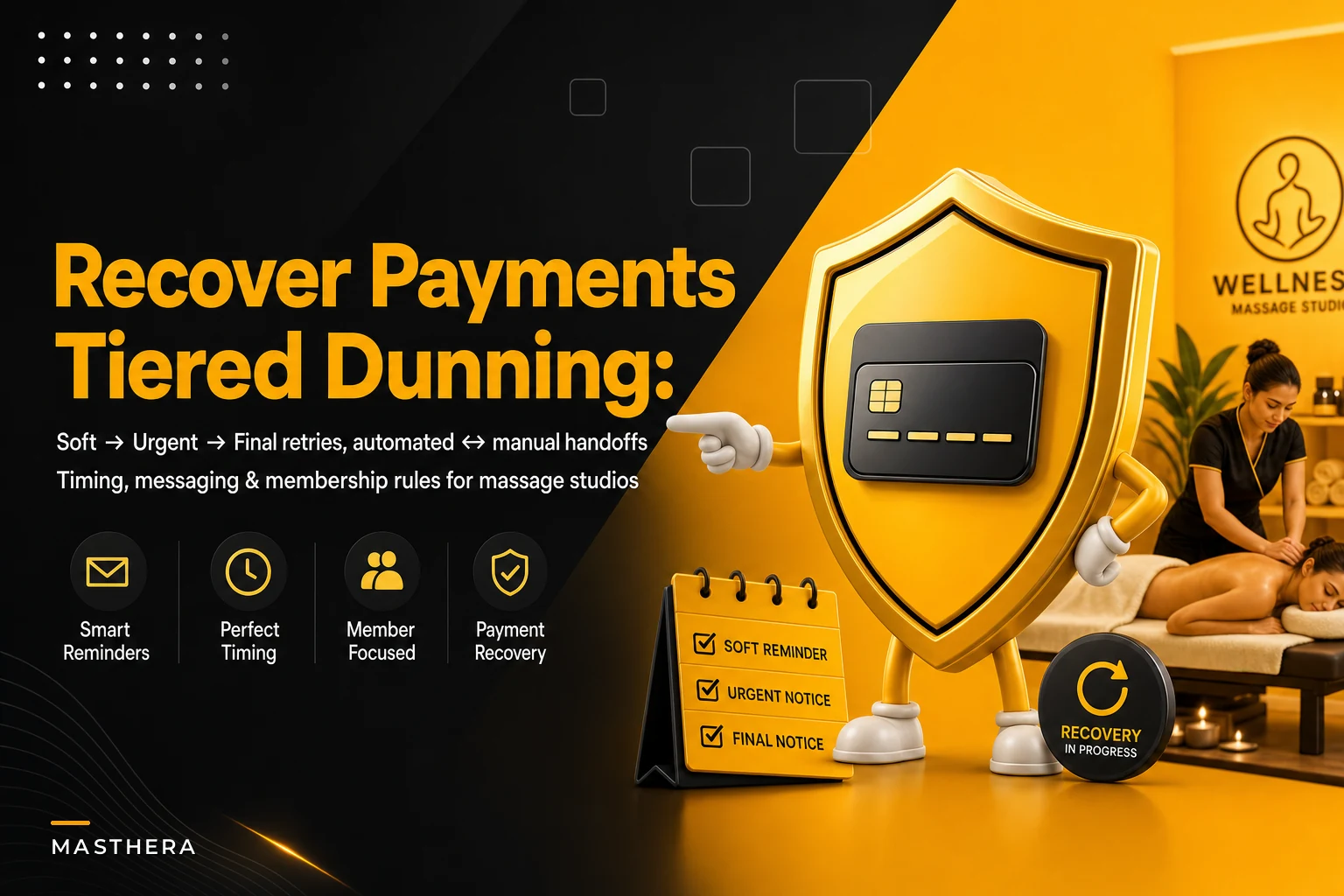
Soft touch (Days 1–3): This catches honest mistakes. Expired card. Bad timing on insufficient funds. New card not yet activated. These members want to fix it—they just need a heads up. Your message stays light, helpful, almost apologetic for the inconvenience.
Urgent nudge (Days 4–10): Now you're dealing with avoidance or genuine financial stress. Some members hoped you wouldn't notice. Others are juggling bills. The messaging shifts to consequences without threats—explaining what they'll lose, not what you'll do to them.
Final attempt (Days 11–14): Triage mode. You're identifying who's gone for good versus who needs a different payment arrangement. The tone becomes firm but leaves room for solutions. Payment plans. Downgrades. Pausing instead of canceling.
What most studios get wrong is the transition timing. They'll wait two weeks before the first touch, then blast three messages in 48 hours. Or they'll send soft touches for a month while the member racks up four sessions they haven't paid for.
The timing needs to match your billing cycle and service delivery model. Weekly unlimited massage memberships need tighter windows than monthly maintenance plans. A member coming in twice a week can't accumulate six unpaid visits. Someone who books quarterly can handle a longer recovery timeline.
Building retry logic that respects both revenue and relationships
Payment retry timing determines whether you recover the payment or push someone toward canceling permanently. Hit their account the day before payday? Likely a success. Retry during their mortgage payment window? Another failure that nudges them toward quitting.
| Attempt | Timing | Target Scenario | Success Rate |
|---|---|---|---|
| Initial | Billing date | Normal processing | 92–94% |
| First retry | +2 days | Weekend deposits clear | 35–40% |
| Second retry | +5 days | Mid-week balance refresh | 20–25% |
| Third retry | +10 days | Next pay cycle hits | 15–18% |
| Final retry | +14 days | Month-end cleanup | 8–12% |
The schedule means nothing without intelligent retry rules. Avoid Mondays—weekend spending hasn't cleared. Skip the 1st and 15th if those are common pay dates for your client base. And definitely don't treat a fraud-flagged decline the same as an NSF.
Manual retry triggers become necessary for special cases. A longtime member mentions they're switching banks. Your best client's company card got compromised. Someone's going through a divorce that froze joint accounts. These situations need a human making the call, not automated hammering.
There's also a useful distinction between retry attempts and dunning messages. You might retry payment five times but only send three messages. Or retry twice and send four increasingly specific communications. The payment processing and member communication don't need to run in perfect sync.
Crafting messages that recover payments without burning bridges
Failed payment messages walk a tightrope between confident and desperate. Most studios lean too far one direction—either cold and corporate, or so apologetic they signal that payment isn't really a big deal. Neither recovers payments well.
Your soft-touch message assumes positive intent while creating mild urgency:
"Hi Sarah, your Earth & Water Wellness membership had a small hiccup processing this month. This happens sometimes with bank updates or card renewals. Your upcoming Tuesday session is still confirmed—just update your payment method when you get a chance at [link]. Takes about 30 seconds."
No threats. No account suspension warnings. No payment amount spelled out in a way that might embarrass them if someone sees the message. Just a gentle nudge with a clear next step.
The urgent nudge shifts tone without becoming aggressive:
"Sarah, we've tried processing your membership a few times without luck. To keep your Tuesday 2pm slot and member pricing active, please update your card by Monday at [link]. If something's changed with your membership needs, just reply and we'll figure out the best option."
This introduces consequences while giving them a way out. Maybe they want to downgrade. Maybe they need to pause. You're opening dialogue instead of just demanding money.
The final notice requires firmness with some humanity left in it:
"Sarah, your Earth & Water membership will pause this Friday if we can't process payment. You'll lose your recurring Tuesday booking and return to drop-in rates. To keep your membership active: [update payment link]. To discuss other options, reply here or call us at [number]. We value having you as a member and want to find something that works."
Each stage serves a different psychological purpose. Soft touches preserve dignity for honest mistakes. Urgent nudges create loss aversion for procrastinators. Final notices force a decision from avoiders.
Why membership dunning and package billing need completely different playbooks
Membership billing creates recurring relationships that change the entire dunning dynamic. Package billing involves prepaid services with different recovery incentives. Mixing these approaches produces confused clients and unnecessary revenue loss.
Membership dunning is about relationship preservation. These clients chose ongoing commitment. They're part of your studio culture. A regular Wednesday morning group losing their fourth member, the prenatal massage cohort shrinking—these losses compound well beyond the monthly fee.
Package billing recovery is about protecting access to prepaid value. Someone bought a 10-session package with two sessions used. The money is already yours—you're just updating the payment method for auto-renewal. The urgency and the message are completely different.
The operational requirements diverge too. Membership failures need holds on booking privileges and member pricing. Package failures might only require an updated card for renewal. A membership holder accumulating unpaid sessions creates liability. A package holder with remaining sessions owns an asset.
This distinction drives different automation rules. Membership failures might trigger booking holds after one billing cycle. Package renewals might allow several months of manual booking before requiring a payment update. Your cancellation and recovery workflows need separate tracks for each billing type.
Recovery incentives change the conversation too. Offer a membership holder a free session for updating their payment? Too expensive. Offer a package buyer 10% off their next package for updating their card? That's a reasonable retention cost.
Setting up automated triggers without losing the human touch
Automation should handle the predictable while flagging the exceptional. Most studios either over-automate into robotic coldness or under-automate into operational chaos.
Start with clear trigger rules:
-
Payment failure → 24-hour wait → soft touch message
-
Second failure → immediate urgent nudge
-
Third failure → manual review before final notice
-
Successful update → confirmation and thank you
-
Permanent failure → membership pause, not cancellation
The exceptions matter at least as much as the rules. VIP members get personal calls. New members within their first 90 days get extra grace—they're still forming habits. Members who've been with you two or more years deserve a phone call before suspension, not an automated email.
Members who've been with you two or more years deserve a phone call before suspension, not an automated email.
Build override capabilities for real-world situations. Someone's in the hospital. There's a death in the family. Job loss. No automation handles these gracefully—nor should it.
Your front desk also needs clear protocols for in-person payment situations. A member arrives for their appointment with a failed payment on file. Do you turn them away? Process it manually? Let them complete the session and address it afterward? These decisions can't wait for manager approval in the moment.
The handoff between automated and manual is where most studios fall apart. Automated messages handle nights and weekends. Manual intervention covers special circumstances or when automation has run its course. But someone needs to own that transition—otherwise members fall through the gap between systems.
Creating payment recovery workflows that protect relationships and revenue
Payment recovery works when operations, communication, and finance stay aligned. Most studios treat these as separate functions, which creates exactly the gaps members fall through.
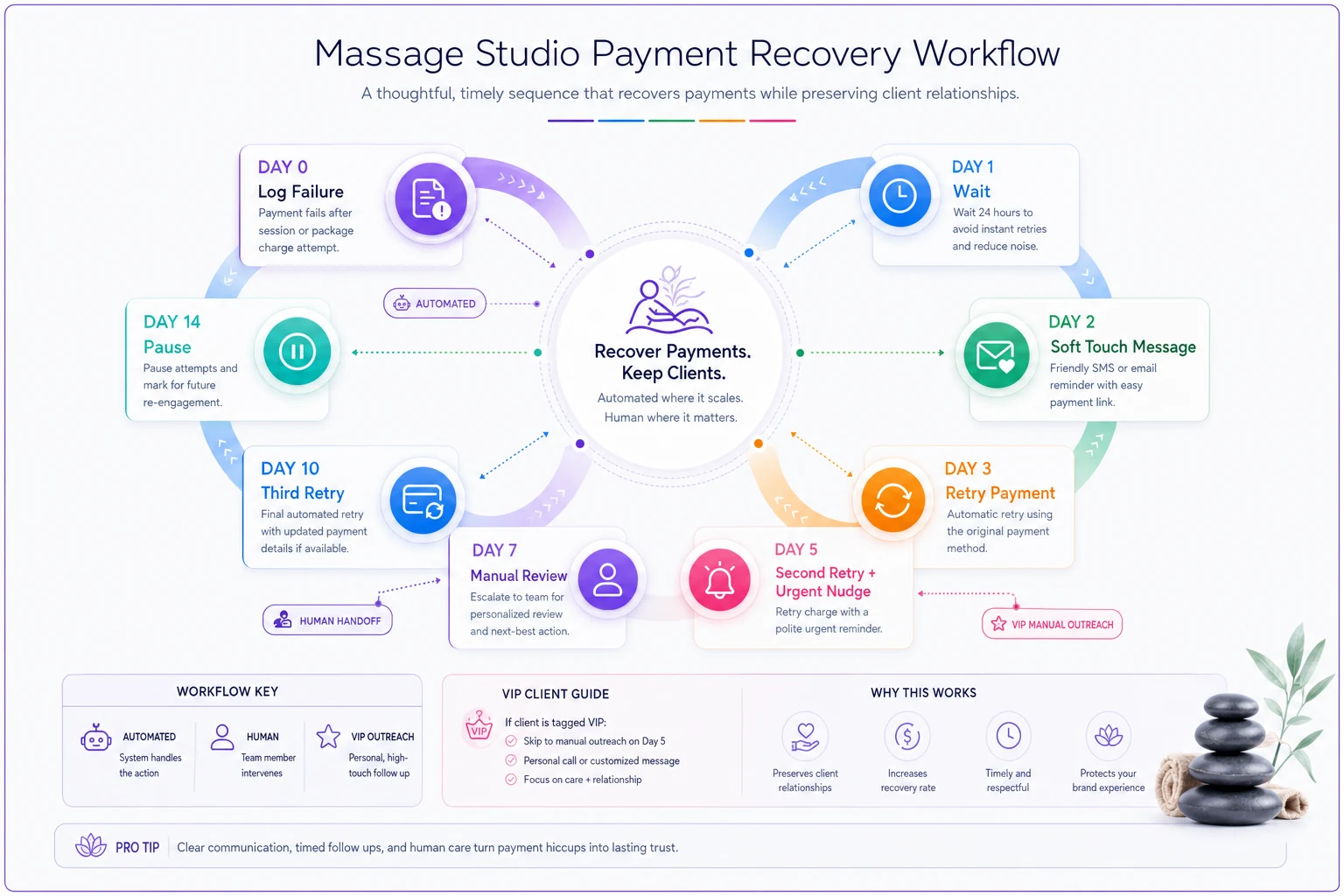
Day 0 (Payment fails): System logs failure reason. Temporary hold prevents new bookings but allows existing appointments to proceed.
Day 1: Wait period for bank clearing. No member contact yet.
Day 2: Soft touch message sent. First retry scheduled for Day 3.
Day 3: First automated retry. Successful? Send a thank you. Failed? Log the reason.
Day 5: Second retry. If failed, urgent nudge sent. Future booking privileges suspended.
Day 7: Manual review of account history. High-value members get personal outreach. Others continue automated flow.
Day 10: Third retry. Failed payments trigger final notice.
Day 14: Last retry. Failures move to membership pause—not cancellation. Option to reactivate within 30 days at the same rate.
This workflow prevents the disasters that happen when there's no process: members using services without paying, valuable clients lost to overly aggressive dunning, staff making inconsistent calls, revenue leaking through the cracks.
Here's a simple visual of this workflow your team can follow.
Workflows without measurement are just guesses, though. Track recovery rate by message stage. Monitor which retry days have the highest success. Identify members who repeatedly fail then recover—those patterns inform real optimization.
A studio with 200 monthly members should expect roughly 12–16 payment failures per month. Recovering around 70% of first failures and roughly 40% of second failures is a reasonable benchmark. Below that suggests a process problem. Significantly above it might mean you're being too aggressive with borderline clients who aren't actually committed.
A real studio's dunning transformation
Healing Hands Massage in Denver had 180 monthly members averaging $89/month. Their payment failure rate hit 9% monthly, with only 45% recovery—losing around $650 monthly to preventable churn.
Their original approach: one email after five days saying "payment failed, please update." Then nothing until automatic cancellation at 30 days. No retries. No escalation. No personal touch for longtime members.
The fix started with segmentation. Members under six months got gentler handling. Anyone over $150/month got personal calls. Everyone else entered a standard three-touch dunning sequence.
They adjusted retry timing to match local payroll cycles. Most clients worked for the university or hospital system, paid on the 1st and 15th. Retries moved to the 2nd and 16th. Success rate jumped roughly 20% from that change alone.
Message templates got some personality. Instead of "Dear Member," they used first names and mentioned specific benefits. "Hi Mark, your Sports Recovery membership payment didn't process. Your Thursday deep tissue slot is safe, but please update your card by Tuesday to keep your member rate."
After three months: recovery rate climbed to 68%, and monthly payment failure losses dropped to around $340. More importantly, members stopped ghosting after failed payments. They'd respond to messages, explain situations, ask about options.
The hidden benefit was operational clarity. Front desk staff knew exactly how to handle payment conversations. Therapists stopped wondering whether clients had active memberships. The owner stopped personally chasing payments.
Why fixing payment recovery fixes more than just payments
Failed payment recovery reveals a lot about how a studio is actually run. Studios with solid dunning processes tend to have clear membership terms, consistent communication, and staff who understand the business model. Studios with broken dunning usually have chaos in other places too.
Building tiered dunning forces other improvements. You clarify membership benefits to write better recovery messages. You learn enough about client psychology to time retries effectively. You connect billing, booking, and service delivery in ways you probably hadn't before.
Most importantly, you stop treating payment failures as client problems and start seeing them as process opportunities. That expired card isn't a deadbeat—it's someone who forgot to update after their bank sent a new card. That NSF isn't someone avoiding payment—it's bad timing you can retry around.
AI-powered operational software makes this orchestration manageable without requiring a full-time billing coordinator. Instead of manually tracking retry attempts, the system handles the timeline. Instead of remembering who needs personal outreach, automation flags VIP exceptions. Instead of guessing which messages work, you get recovery rate data broken down by template and timing.
Members who successfully come back after a payment failure often end up being longer-term clients. They remember how the situation was handled. They recognize a professional operation when they see one. That trust tends to generate referrals.
Start with one improvement this week
You don't need a perfect dunning system immediately. Start with one change that addresses your biggest recovery gap.
Not sending any failed payment messages? Draft a simple soft-touch template. Keep it friendly, assumptive, and action-oriented. Send it manually for two weeks and see how clients respond.
Sending messages but not retrying payments? Add one retry attempt four days after failure. That single change catches the majority of NSF issues that resolve with time.
Treating all members identically? Segment your VIPs for personal outreach. Anyone over $150/month or two-plus years tenure deserves a phone call before suspension.
Start somewhere instead of waiting for the perfect system. Payment recovery improvements compound. Each recovered payment represents months of additional revenue that otherwise walked out the door.
Payment failures aren't personal failings—they're operational opportunities. The studio that handles them well keeps members longer, maintains steadier cashflow, and builds the kind of trust that generates referrals and positive reviews. It feels like a back-office function, but it directly determines whether you're building something sustainable or constantly replacing members you never had to lose.
Ready to elevate your massage therapy business?
Join hundreds of therapists using Masthera to save time, reduce scheduling conflicts, and enhance client satisfaction.