


Your best referral source isn't the client who sends ten people for discounted first visits. It's the regular who sends one friend who becomes a monthly member.
Most studios get referrals backwards—they reward volume when they should reward quality
Studios that struggle to generate sustainable referral growth tend to fall into the same trap. They optimize for total referrals instead of referral lifetime value. They end up with discount-seekers bringing more discount-seekers, while loyal clients who could bring quality referrals stay quiet because the program doesn't really speak to them.
The math tells the story. A typical massage studio sees 15–20% of new clients come from referrals. Sounds decent until you dig deeper. When you track those referred clients over 12 months, maybe 8% book a second appointment. Compare that to organic clients from your Google Business Profile optimization efforts—those convert to repeat visits at nearly 35%.
Why standard referral programs attract the wrong crowd
The classic "$20 off for you, $20 off for your friend" structure creates a fundamental mismatch. Think about who actually responds to discount-driven referrals. They're already price-shopping, looking for deals, and planning to bounce after the intro offer expires.
Never miss a booking or double-book again.
Masthera helps you schedule, confirm & manage every massage session with ease.
- Unified appointment management
- Automated client reminders
- Therapist calendar coordination
No credit card required
A therapist in Denver showed me her referral data a while back. Out of 47 referrals from her "refer a friend" discount cards, only 3 became regular clients. The other 44 booked once and never returned. Meanwhile, she had four long-term clients who each brought in a couple of friends over the same period—friends who became weekly or bi-weekly regulars. Those organic referrals from loyal clients generated roughly $42,000 in annual revenue. The discount-card referrals? About $2,800 total, mostly from first visits.
The operational burden makes it worse. Processing discount codes, tracking who referred whom, handling disputes when someone claims they didn't get their credit—it adds up to real admin hours for minimal return. One studio owner figured she spent around 6 hours a month managing her referral program for an average monthly revenue bump of $450. That's not a great trade-off, especially before accounting for the margin hit from the discounts themselves.
Building tiers that filter for quality
Tier 1: The Testing Ground
Entry level should be accessible but not overly generous. A small account credit—$10–15—after the referred client completes their second visit, not their first. That one shift immediately filters out one-timers.
-
Referrer must have completed at least 3 visits themselves
-
Referred client books within 30 days
-
Credit applies after referred client's second appointment
Tier 2: Proven Value
Once someone refers 2 clients who each complete 3+ visits, they move up. Now the rewards get more meaningful—priority booking, 20% bonus credit on future referrals, or exclusive add-on services.
The qualification hurdle matters. Requiring multiple successful referrals—not just attempts—helps you identify clients who actually understand what kind of person fits your practice.
Tier 3: Brand Ambassadors
Your top tier—probably your top 5% of referrers—deserves something different. These are people who've brought in 5+ clients who stuck around. Their rewards should reflect that. Complimentary monthly add-ons, early access to new therapists, a personal thank-you that doesn't feel automated.
One clinic in Portland structures their top tier around experiences rather than discounts. Their "Wellness Partners" get quarterly aromatherapy consultations, first pick of appointment slots during busy seasons, and handwritten notes. The program costs maybe $200 per ambassador per year, but each one typically drives somewhere between $8,000 and $12,000 in referred revenue. That math works.
Timing triggers that actually work
Random referral requests get ignored. Strategic timing based on client behavior drives results.
The post-appointment window: 24–48 hours after a great session, clients are most likely to mention you to someone. Skip the generic "refer a friend" email. Tie the message to their specific experience. If they mentioned loving the hot stone add-on, your message should focus on sharing that service with someone who'd appreciate it.
Milestone moments: After someone's 10th visit, they've demonstrated real loyalty. That's when you introduce the referral program—not on visit one when they barely know you. Milestone-triggered referral invites convert at roughly 3x the rate of new-client invites.
Seasonal alignment: January brings resolution-makers. June brings wedding prep. December brings gift-givers. A "bring a friend to de-stress" push in early December captures holiday overwhelm in a way that generic year-round messaging never will.
Contextual opportunities: A client mentions their partner has back pain? That's a referral moment. They book a prenatal massage? They probably know other expecting mothers. These feel helpful rather than salesy because they actually are.
Onboarding hooks that separate long-term clients from discount hunters
The first referral interaction sets the tone. Make it too easy and you get volume without quality. Make it too complicated and nobody bothers.
Start with a few qualification questions that naturally self-select for fit:
-
How long have you been seeing [referrer's name] for massage?
-
What specific issue are you hoping to address?
-
Are you looking for regular maintenance or dealing with an acute problem?
These do double duty. They give you useful intake information while signaling that this isn't a discount massage chain. People looking for a quick deal often drop off here—which is fine.
The booking process itself should reinforce value over price. Instead of leading with the referral discount, lead with the consultation: "As a referred client, you'll receive a 15-minute consultation to design your optimal treatment plan." The discount becomes secondary to the experience.
Track early indicators carefully. If referred clients who book within 7 days show higher long-term retention, build urgency into your referral system. If those who book 60-minute sessions return at higher rates than 30-minute bookers, adjust your referral offers to encourage longer first visits.
Measuring what matters: LTV over volume
Most referral tracking stops at "how many referrals did we get?" That's like measuring a marathon by how many steps you took in the first mile.
| Metric | What Most Studios Track | What You Should Track |
|---|---|---|
| Success Rate | Total referrals made | Referrals that book 3+ sessions |
| Value | First visit revenue | 12-month client LTV |
| Source Quality | Number of referrers | Revenue per referrer |
| Program ROI | Discounts given | (LTV - acquisition cost) × retention rate |
Real measurement means connecting data points that most studios keep separate. You need to track:
-
Initial referral source
-
Booking patterns over time
-
Service preferences and upgrades
-
Retention compared to non-referred clients
-
Secondary referrals—referred clients who refer others
A massage therapist in Austin found that her best referral source wasn't her most frequent referrer. It was a client who only sent someone twice a year but consistently referred other professionals who became high-value members. Those two annual referrals generated more revenue than the client who referred eight discount-seekers.
The technology stack that makes complex referrals manageable
Manual tracking breaks down fast. Spreadsheets can't handle multi-tier rewards, qualification rules, and LTV calculations without constant maintenance—and they definitely can't catch edge cases reliably.
The operational load includes:
-
Tracking who referred whom
-
Calculating tier qualifications
-
Applying correct rewards
-
Monitoring referral quality over time
-
Sending targeted invitations
-
Preventing fraud
Studios that run these programs well use operational software that connects referrals to broader client management. When your booking system talks to your rewards tracking, tier upgrades happen automatically, referral requests go out at the right time, and long-term value gets measured without someone manually pulling reports every month.
AI automation helps most with pattern recognition—figuring out which clients are most likely to make quality referrals based on booking behavior, service preferences, and how they interact with your practice. Instead of blasting referral requests to everyone, you focus attention on the 20% most likely to bring in valuable clients.
Below is a rough picture of how a well-structured referral workflow flows from a client action through to a reward:
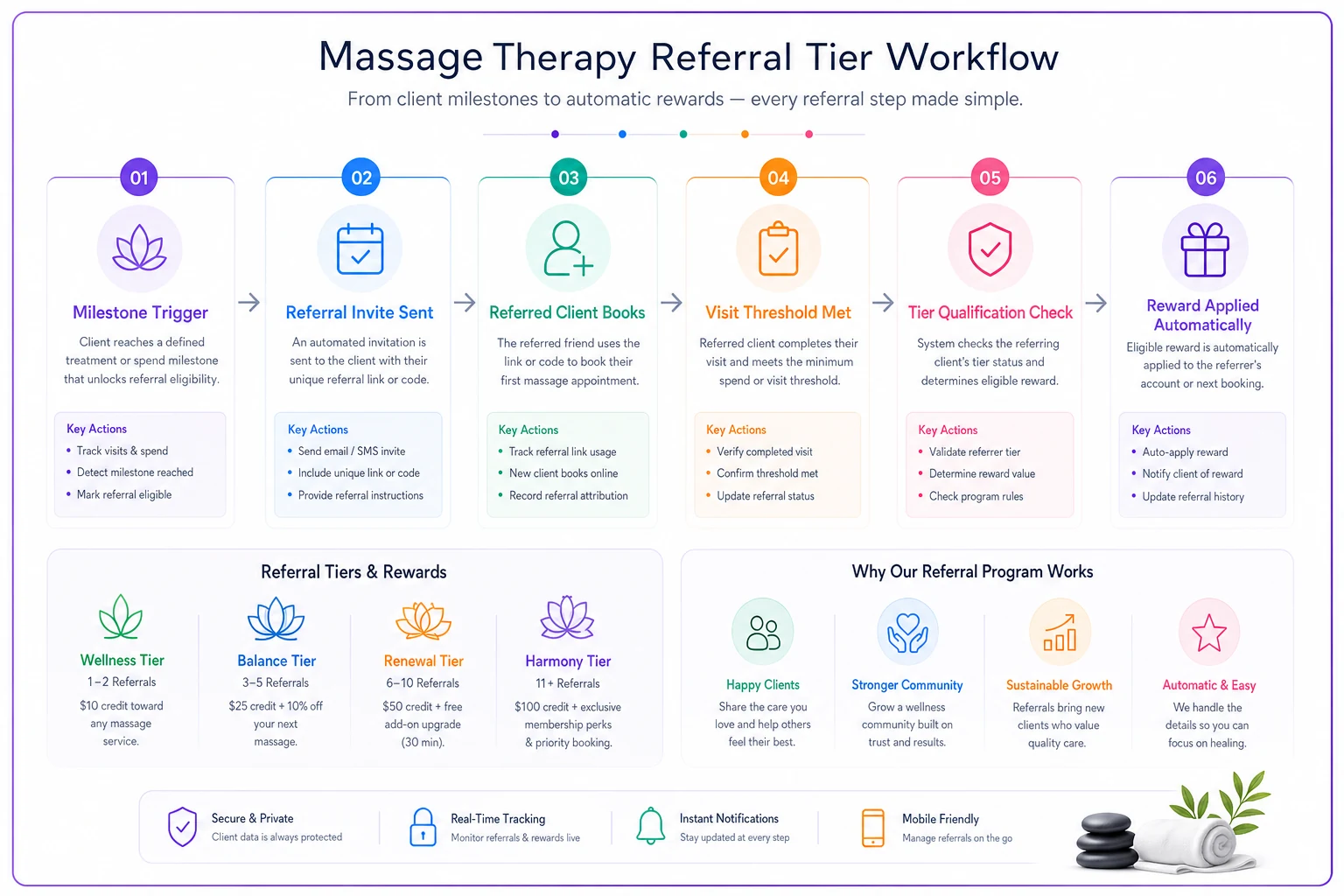
This illustrates the flow from trigger through tier qualification to an automated reward.
Common pitfalls that kill referral quality
Over-rewarding early: Big upfront bonuses attract coupon-collectors. A studio offering $50 credits for any referral found that 73% of referred clients never returned after their first discounted visit. They switched to smaller credits released after the third visit—referral quality improved significantly.
Ignoring channel differences: Social media referrals behave differently than word-of-mouth referrals. Instagram brings awareness-stage prospects who need more nurturing before they convert. Personal recommendations bring trust and readiness to book. Your rewards and onboarding approach should account for that.
Competing on price with discount-first studios: If neighboring studios are offering 70% off first visits, don't try to match them. You'll attract their price-sensitive overflow. Emphasize what discount-seekers won't get—personalized treatment plans, consistent therapists, actual therapeutic outcomes.
Forgetting the referrer: Most programs focus entirely on the new client and neglect the person who sent them. Simple touches matter—a thank-you text when their friend books, a small card with their next appointment, recognition that feels personal. These cost almost nothing but build real emotional investment in your practice's success.
When referral tiers make sense (and when they don't)
This system works when you have:
-
At least 100 active clients
-
40%+ repeat visit rate
-
A clear picture of who your ideal client actually is
-
Capacity to grow
-
Systems that can handle the added complexity
Skip it if you're:
-
Under 50 regular clients
-
Already at capacity
-
Serving mostly tourists or one-time visitors
-
Struggling with service consistency
A sole practitioner at 80% capacity gains nothing from aggressive referral programs. You'll frustrate loyal clients who can't get their preferred times because you've filled slots with discount-seekers. Focus on retention and rate increases first.
The operational reality of sustainable referrals
The best referral program isn't the most generous—it's the one most aligned with your business model and client base. A therapist specializing in injury recovery needs a different referral structure than one focused on relaxation massage.
Quality-focused referral tiers take roughly 3–4 months to show meaningful results. The initial drop in referral volume can spook studio owners, but the long-term math holds up. Would you rather have 20 referrals where 2 stick around, or 8 referrals where 6 become regulars?
The compound effect matters most here. Those 6 quality referrals don't just represent 6 new clients—they represent potential secondary referrals, membership conversions, service upgrades, and years of recurring revenue. One great referral who becomes a weekly client generates more value than a dozen deal-seekers combined.
Building this system takes real upfront work—defining tiers, setting up tracking, creating communication templates, training staff on the nuances. But once it's running, the right operational software handles most of the qualification logic and reward distribution automatically, without someone babysitting it every week.
Your referral program should work like your practice itself—focused on long-term outcomes, not quick fixes. Studios that understand that distinction build sustainable businesses. The ones still chasing volume through discounts are wondering why they're working harder for less profit, one referral at a time.
Ready to elevate your massage therapy business?
Join hundreds of therapists using Masthera to save time, reduce scheduling conflicts, and enhance client satisfaction.