



Most studios don't have a marketing problem. They have a timing problem between how fast leads come in and how fast the calendar can absorb them.
You run a Groupon push, or your Google Business Profile suddenly starts converting, and for two weeks it feels like everything is working. Then the therapists are double-booked, the good regulars can't get their usual Thursday slot, front desk is fielding angry calls, and three of the new clients you paid to acquire never rebook because their first visit felt rushed. You've spent money to bring people in and made the experience worse for the clients you already had. That's a lose-lose, and it happens because acquisition and capacity are treated as two separate conversations.
This article is about closing that gap with actual decision rules — the kind you can write down, hand to your manager, and apply the same way every month. Not "spend more on what works." That advice falls apart the moment "what works" fills slots you don't have.
If you've already read the decision model connecting acquisition channels to capacity and CAC, this is the next layer: the thresholds that tell you scale, constrain, or cut — and how to tie those decisions to slot-level capacity, CAC payback, and margin, without rebuilding the calculators you already have.
The core problem: channels don't fill "capacity," they fill *specific slots*
Almost everyone gets this wrong. When you look at capacity as one big monthly number — "we have 480 available appointment hours" — you'll conclude you have room when you actually don't.
Demand isn't smooth. A studio with 480 monthly hours might be 95% full on Tuesday–Thursday evenings and 40% full Monday mornings and midday. A new acquisition channel almost always brings people who want the already-full slots. Evening and weekend demand is what's scarce, and that's exactly what a discount promo attracts.
So the real unit of capacity isn't the month. It's the slot cohort: a bucket of similar time slots grouped by how in-demand they are. Something like:
-
Peak — weekday evenings, Saturday morning
-
Shoulder — weekday late afternoon, Saturday afternoon
-
Trough — weekday mornings/midday, Sunday
Once you think in slot cohorts, the whole acquisition decision changes. A channel isn't "profitable" or "unprofitable" in the abstract — it's profitable if it fills the cohort you actually need filled. A channel that reliably fills trough slots at a modest margin can easily be more valuable than one that "converts great" but only crams more people into peak, because peak was going to fill anyway.
That single reframe kills a surprising amount of wasted spend.
Why this breaks down in real studios
The averaging trap. You calculate blended CAC and blended margin across all channels and all slots. The numbers look fine. Meanwhile one channel is quietly buying you peak-slot bookings you'd have gotten for free, and another is bringing low-margin discount seekers who never return. The blend hides both.
Never miss a booking or double-book again.
Masthera helps you schedule, confirm & manage every massage session with ease.
- Unified appointment management
- Automated client reminders
- Therapist calendar coordination
No credit card required
No throttle, only on/off. Owners tend to treat channels as switches — on when it's slow, off in a panic when it's overwhelming. But channels have momentum. GBP rankings, ad learning phases, referral loops — slamming them off destroys that momentum. What you usually want isn't off, it's dialed down, or redirected toward slower slots.
Acquisition decisions made without looking at the roster. Marketing and scheduling live in different people's heads. Whoever runs promotions rarely checks whether there are therapist-hours to absorb the wave. If you've dealt with the whiplash of seasonal rostering and capacity planning, you already know demand and staffing rarely line up on their own.
Payback ignored entirely. Plenty of studios track cost-per-booking but never ask how long it takes to recover that cost. A $60 CAC on a client who spends $85 once and disappears is a very different animal than a $60 CAC on a client who becomes a monthly regular. Same acquisition cost, completely different decision.
The three thresholds: scale, constrain, cut
Instead of a vague "optimize the funnel," give every channel a monthly verdict against three gates. A channel needs to clear all three to earn a scale decision. Miss one and it drops to constrain. Miss the fundamentals and it's a cut.
The three gates:
-
Capacity fit — is there open room in the slot cohort this channel actually fills?
-
CAC payback — how fast does the acquisition cost come back?
-
Margin impact — what does this channel do to contribution margin per hour, after discounts and therapist pay?
Here's how the verdicts map out:
| Verdict | Capacity fit | CAC payback | Margin impact | What you actually do |
|---|---|---|---|---|
| Scale | Target cohort under ~80% full | Under ~60 days | At or above studio avg | Increase spend/effort 20–30%, monitor weekly |
| Constrain | Target cohort 80–95% full | 60–120 days | Slightly below avg | Cap spend, redirect offers to trough slots, tighten discount |
| Cut | Target cohort maxed, or channel only fills peak | Over ~120 days | Well below avg or negative | Pause, or strip the discount and let it run at full price only |
These thresholds aren't gospel — set your own based on your rebook rate and season. The point is that every channel gets a consistent, three-part verdict instead of a gut call.
A quick note on "constrain," because it's the one people skip
Scale and cut feel intuitive. Constrain is where the real money is, and it's the least used option.
Constrain doesn't mean spend less across the board. It usually means keep the volume but change what the channel sells. If a discount channel is jamming peak slots, you constrain it by making the discount valid only for trough slots. Same ad, same budget, different offer copy — and now it's filling the room you couldn't fill instead of crowding the room that was already booked. That's a throttling rule, not an off switch.
Working through the numbers on one channel
A realistic mid-size studio: four therapists, roughly 340–380 appointments a month.
Say you're evaluating a paid social campaign running an intro offer — first massage $59 (normal price $95). Last month it brought in about 28 new clients.
-
Cost ~$1,150 in ad spend → CAC of roughly $41 per new client
-
First visit contribution $59 revenue, minus ~$34 therapist pay and ~$6 in supplies/card fees = about $19 per first visit
-
After the first visit, you're still down about $22 per client on acquisition.
Now the part that decides everything: rebook behavior. Of those 28, about 9 booked a second full-price visit within 45 days. A full-price visit nets roughly $48 in contribution. So:
-
Payback on rebookers
recovered within ~2 visits, well under 60 days → good
-
But 19 of 28 didn't come back. Their CAC never gets recovered.
Blended, this channel is roughly break-even to slightly positive — only if those 9 rebookers keep coming. That's a constrain, not a scale. And the fix becomes obvious once you look at the slot data: most of those intro visits landed in Saturday and Tuesday-evening peak. You were paying to fill slots that had a waitlist anyway.
Redirect the $59 offer to weekday mornings only. Same spend. Now you're converting empty trough hours into $19-plus-a-chance-at-rebook, instead of displacing full-price peak clients. That one change can swing a break-even channel into a clearly profitable one without spending an extra dollar.
The monthly decision workflow
Here's the actual process, start to finish. It should take one person about 30–40 minutes a month once the data is in one place.
-
Pull last month's bookings tagged by channel and by slot cohort. Every appointment needs to know where the client came from and which cohort (peak/shoulder/trough) it filled.
-
Calculate current fill rate per cohort. This is your capacity gate — which cohorts are under 80%, which are 80–95%, which are maxed.
-
Calculate CAC per channel (spend + any staff time + discount cost ÷ new clients).
-
Pull rebook rate and days-to-second-visit per channel. This drives payback.
-
Estimate contribution margin per hour per channel, netting out discounts and therapist pay.
-
Assign each channel a verdict using the three-gate table.
-
Write the throttling action next to each verdict — not a vibe, an instruction. "Cap paid social at $900, restrict $59 offer to weekday AM." "Scale GBP posting to 3x/week." "Cut the reseller deal at renewal."
-
Set the review date and the trigger that would change the verdict early (e.g., "if peak fill drops below 85% mid-month, re-open the peak offer").
The reason to write steps 7 and 8 down is that verdicts without written actions quietly get ignored. Next month the same person makes the same gut call, and nothing compounds.
A quick visual of the workflow:
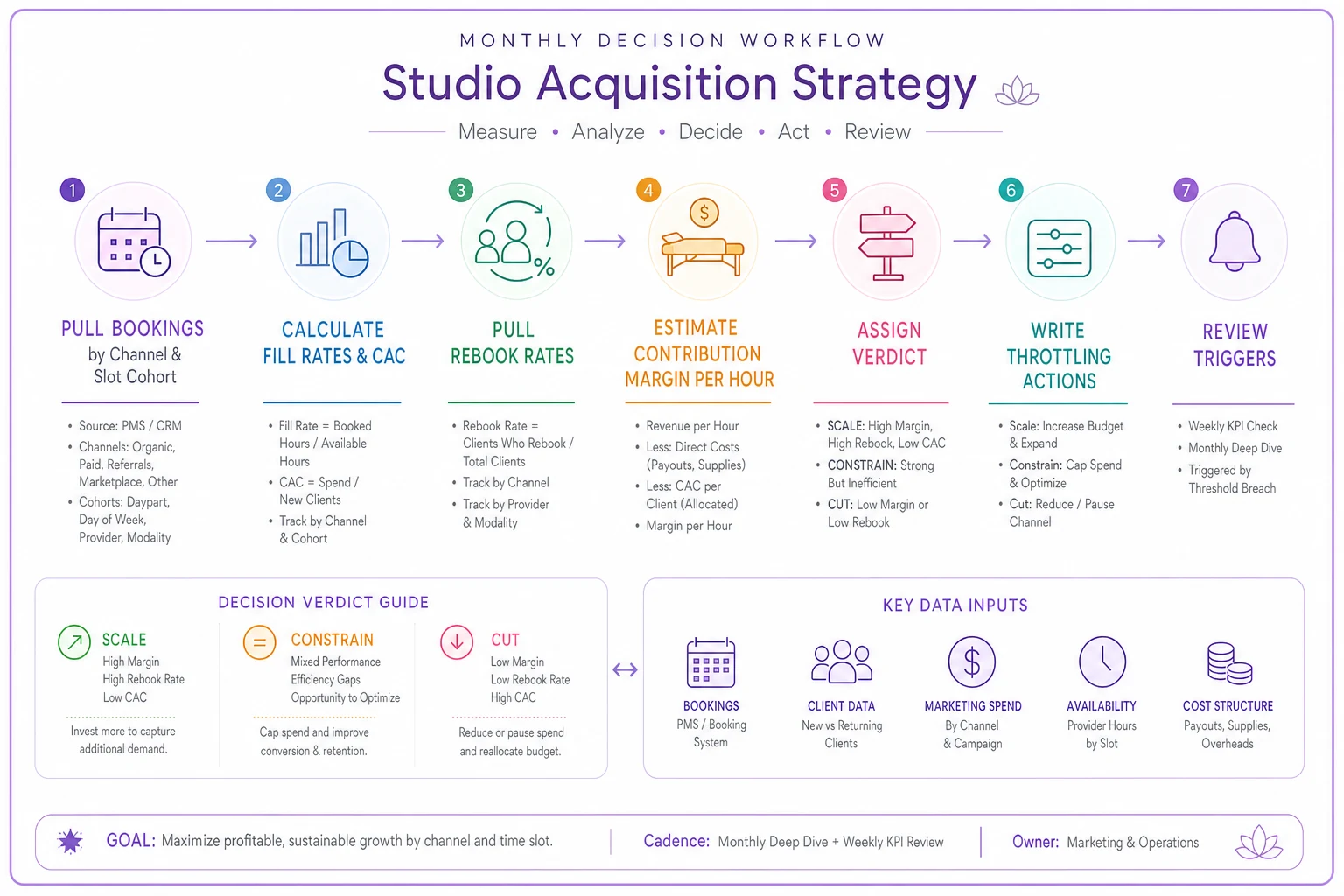
Automate the cohort and booking-source pulls so the monthly review stays quick and consistent.
The reason to write steps 7 and 8 down is that verdicts without written actions quietly get ignored. Next month the same person makes the same gut call, and nothing compounds.
A throttling-rules checklist you can adopt this week
Before you touch spend, make sure these are actually in place. Missing any one of them is why most studios can't operationalize this:
-
[ ] Every booking source is tagged at the point of booking (not reconstructed later)
-
[ ] Slots are grouped into 2–3 cohorts everyone agrees on
-
[ ] Fill rate is tracked per cohort, not just overall
-
[ ] Each channel has a rebook rate you actually trust
-
[ ] Discounts are logged as a cost against the channel that used them
-
[ ] There's a written cap for each active channel, not just a budget
-
[ ] Offers can be restricted to specific days/times
-
[ ] One named person owns the monthly verdict and the follow-through
That last box is the one that gets skipped. If nobody owns it, the review happens twice, then stops.
When scaling actually makes sense
Scale aggressively when a channel is filling trough or shoulder cohorts, paying back inside ~60 days, and holding margin near your average. That's found money — you're converting hours that would otherwise sit empty into revenue plus rebook potential. Push it until the target cohort approaches 80% full, then step down to constrain.
Also worth scaling: channels that bring clients who convert to memberships or packages, even at a higher upfront CAC. Payback logic changes completely when a client commits to recurring visits. A $70 CAC is fine if the client signs a monthly plan; it's terrible for a one-and-done discount visit.
When scaling is a bad idea
Don't scale a channel that only fills peak, no matter how good the CAC looks. You're not adding capacity, you're reshuffling it — and usually pushing loyal clients out of their preferred times. That's how you lose a $2,000-a-year regular to save $40 on acquisition.
Don't scale during a season when your roster is already stretched. Acquisition without therapist-hours to absorb it just manufactures no-shows and bad first impressions. If you can't add the hours, constrain instead.
And if you don't yet track fill rate by cohort and rebook rate by channel, you shouldn't be making scale/cut decisions on numbers at all — you're guessing. Get the tracking in place first. A minimal KPI dashboard with fill rate, CAC, and rebook rate is enough to start; nothing fancy required.
Where software quietly earns its keep
None of this requires a new tool. But the reason studios don't do this isn't that the math is hard — it's that pulling channel tags, slot cohorts, CAC, and rebook rates from four different places every month is a pain, so it doesn't get done.
This is where an AI-assisted operations platform helps without being flashy about it: the booking source, the slot, the discount, the rebook — all captured in one flow instead of stitched together after the fact. When those live in the same system, the monthly verdict becomes something you review rather than something you reconstruct. Some platforms will flag when a cohort crosses a fill threshold mid-month, so you can pull an offer back before the schedule jams instead of finding out from an angry regular. The value isn't automation for its own sake — it's that the data you need to make a good decision is already sitting there when you sit down to make it.
A short real scenario
A three-therapist studio in a suburban strip mall was spending around $1,300/month split across paid social and a local deals site. Blended it looked "okay" — CAC around $45, bookings steady. But peak evenings were slammed, mornings were dead, and their best regulars kept complaining they couldn't get Thursday 6pm anymore.
They broke it apart by cohort for the first time. The deals site was almost entirely filling peak, at a low margin, with a rebook rate under 15% — a textbook cut. Paid social was mixed: constrain, with the intro offer redirected to weekday mornings. And their GBP was quietly filling shoulder slots at full price with a rebook rate over 40% — an obvious scale they'd been ignoring.
They cut the deals site, redirected paid social to mornings, and put more effort into GBP posts and review responses. Over the next two months, morning fill went from around 40% to the mid-60s, peak stopped overflowing, and the complaints from regulars basically stopped. Total marketing spend actually went down a little. Revenue held and then climbed as the higher-rebook clients stacked into regulars.
Nothing exotic happened. They just stopped treating every channel the same and started matching each one to the slots it was actually good at filling.
The takeaway
Acquisition and capacity are the same decision, and most studios manage them as two. When you tie each channel to the slot cohort it fills, run it through capacity fit, CAC payback, and margin, and write down a scale/constrain/cut verdict every month — the guesswork disappears and the whiplash stops.
Start small. Tag your bookings by source and slot. Group your slots into two or three cohorts. Run the three gates on your top few channels this month. You'll almost certainly find one channel to cut, one to redirect, and one you've been underfeeding. Fixing just those three usually does more for the bottom line than any new campaign.
Ready to elevate your massage therapy business?
Join hundreds of therapists using Masthera to save time, reduce scheduling conflicts, and enhance client satisfaction.