



Corporate wellness looks like easy money until you've actually run a few quarters of it. One HR manager books a "wellness day," you send two therapists, and suddenly your Tuesday retail block is gutted, three regulars got bumped, and the invoice sits unpaid for 47 days because it got routed to the wrong AP inbox. The gross revenue looked great on the calendar. The actual contribution? A lot thinner than expected.
What most studio owners miss about corporate wellness operations for a massage studio is that it's a completely different operating model from retail. Retail is high-margin, flexible, and paid at point of sale. Corporate is lower-margin per hour, rigid on logistics, and paid on net terms — if you even set the terms. Run corporate work with retail habits and you lose on both sides.
This is a tight playbook for the five things that actually decide whether recurring corporate work makes you money: the intake checklist that catches problems before you sign, the block-booking rules that protect your calendar, the day-of logistics that keep a 6-chair event from becoming chaos, invoicing terms that get you paid, and capacity-protection guardrails so corporate never quietly eats your best retail slots.
Start with the intake, because this is where the money is won or lost
Almost every bad corporate engagement traces back to a vague first conversation. The HR coordinator says "we want chair massage for our team" and you say "great, we'd love to," and nobody nails down the twelve details that determine whether you make or lose money.
A corporate intake is not a vibe check. It's a qualification step. You're figuring out, before you commit anything, whether this is a clean recurring account or a logistics nightmare dressed up as a nice contract.
Here's the intake checklist worth running through on the first real call:
-
Headcount and session length. 40 employees at 15-minute chairs is a very different staffing math than 40 at 30-minute tables. Get the per-person session length locked.
-
Format. Chair vs. table changes everything — equipment, space, draping, staffing ratios, pace.
-
Frequency and commitment. One-off "wellness day" or recurring monthly? Recurring gets different pricing and different calendar treatment. One-offs should pay a premium.
-
Space and access. Private room? Open floor? Freight elevator? Loading dock? Where do therapists park and how far is the walk with a table?
-
Power and setup. Chair massage needs almost nothing; table work with warmers and music needs outlets and setup time you should be billing for.
-
Who schedules the employees. If employees sign up themselves via a shared link, no-shows are your problem unless you've written a fill-rule. If HR assigns slots, you still get gaps.
-
Decision-maker vs. coordinator. The person emailing you often can't approve the invoice. Find out who signs off on payment now, not at invoice time.
-
Billing contact and PO process. Does this company need a purchase order before work happens? Many enterprises won't pay an invoice that doesn't reference a PO. Finding that out after the event is how you end up chasing money for two months.
-
Net terms and payment method. They'll assume Net 30 or Net 60. You decide what you'll accept.
-
Cancellation and reschedule policy acknowledgment. Put it in the intake, not buried in the contract.
The pattern worth noticing: the questions that feel awkward to ask on a first call — PO process, who signs the invoice, cancellation terms — are exactly the ones that protect you later. The friendly-but-vague operators lose here. The ones who treat intake like qualification keep their margins.
Block-booking rules: protect the calendar before you protect anything else
The operational trap is pretty straightforward. A corporate client wants your two best therapists every second Thursday from 10am to 2pm. Sounds like steady revenue. But that's four prime retail hours, twice a month, pulled off your schedule for therapists your regulars specifically request.
Never miss a booking or double-book again.
Masthera helps you schedule, confirm & manage every massage session with ease.
- Unified appointment management
- Automated client reminders
- Therapist calendar coordination
No credit card required
Book that without rules and you're trading high-margin retail bookings for lower-margin corporate hours and calling it growth.
Block-booking needs explicit rules, written down, that everyone scheduling follows:
-
Corporate blocks go on a capacity cap. Decide what percentage of weekly therapist hours corporate is allowed to consume — a common starting point is somewhere around 20–30% during your strong seasons, higher in your slow months. This cap is the single most important guardrail you'll set.
-
Price the block, not the hour. A reserved recurring block carries a minimum charge whether or not every slot fills. If HR only gets 18 of 24 signups, you still invoice the reserved time (at a reduced per-slot rate you've pre-agreed). You reserved therapists; that reservation has value.
-
Reschedule windows are firm. A corporate block canceled with 48 hours' notice is a huge hole you can't refill with retail that fast. Set a cancellation fee that reflects the real cost of a gutted half-day — not a token $25.
-
Assign the right therapists, not your best ones by default. Corporate chair work doesn't need your most-requested table therapist. Protect your retail stars for the clients who pay retail prices and rebook at retail rates.
-
Season-aware caps. In December, when retail is slammed, corporate caps should tighten. In your slow stretch, open them up. Your capacity plan should drive this, not whoever emails first.
That last point connects directly to how you roster the rest of the business. If you're already doing capacity planning and seasonal rostering properly, corporate blocks just become another reserved category in that plan — you're not improvising them against retail every week.
The mistake that shows up constantly: studios say yes to a recurring corporate block during a busy quarter because the total dollar figure looks big, then spend three months watching their best retail clients get bumped to therapists they didn't ask for. Retention quietly drops. Nobody connects it to the corporate contract.
The economics most studios never actually run
Before the logistics, run the real math once. The comparison below makes the trap obvious.
| Metric | Retail hour (table) | Corporate chair block (per therapist hour) |
|---|---|---|
| Gross billed | ~$110–130 | ~$80–100 |
| Therapist pay | ~$40–55 | ~$40–55 |
| Travel / setup time (unbilled) | ~0 | ~20–40 min per event |
| Payment timing | Same day | Net 30–60 |
| Rebooking / upsell potential | High | Near zero |
| No-show risk | You, but refillable | Theirs or yours, hard to refill |
The gross looks close. The contribution doesn't. Corporate hours carry unbilled travel and setup, pay therapists roughly the same, generate almost no upsell, and tie up cash for a month or two. That's fine — corporate work still fills slow periods and opens doors to new clients — but only if you price for it and cap it. Run corporate at retail assumptions and you're basically subsidizing someone's HR department.
Most studios that do this math for the first time are surprised. The per-hour gap looks manageable until you add the non-billable time. At two events a month, that's several hours of therapist time you paid for but never invoiced.
Day-of logistics: where a good contract still falls apart
You can sign a clean contract and still lose the account because the day-of was a mess. HR remembers chaos. A smooth event is what gets the contract renewed.
The day-of problems are boringly predictable: therapists can't find parking, the "private room" turns out to be a conference room someone's still using, there's no sign-up sheet so people wander up randomly, the AP contact is in a meeting, and your therapists are standing in a lobby with tables not knowing where to go.
A workable day-of workflow:
The week before: Confirm headcount, final schedule, exact room and floor, parking and loading instructions, on-site contact name and cell number, and whether you need building check-in or a visitor badge. Send the employee sign-up link if self-scheduling, with the no-show rule stated plainly.
The day before: Text the on-site contact to re-confirm. Send therapists their call sheet — address, parking, contact cell, room, start time, equipment list, and the signup roster if you have one.
On arrival: On-site contact meets therapists, confirms the space, setup begins. Therapists log actual start time. This matters for invoicing accuracy and for disputes later.
During: One therapist (or you) owns the schedule board — tracking who's been seen, filling no-show gaps from a standby list, keeping the pace. Open floor without someone owning flow turns into a bottleneck fast.
At wrap: Log actual end time, total sessions delivered, any no-shows, and get a quick verbal confirmation from the on-site contact that the count looks right. That verbal confirmation is worth a lot when the invoice gets questioned later.
This workflow sketch lays out the key confirmations from week-before through wrap.
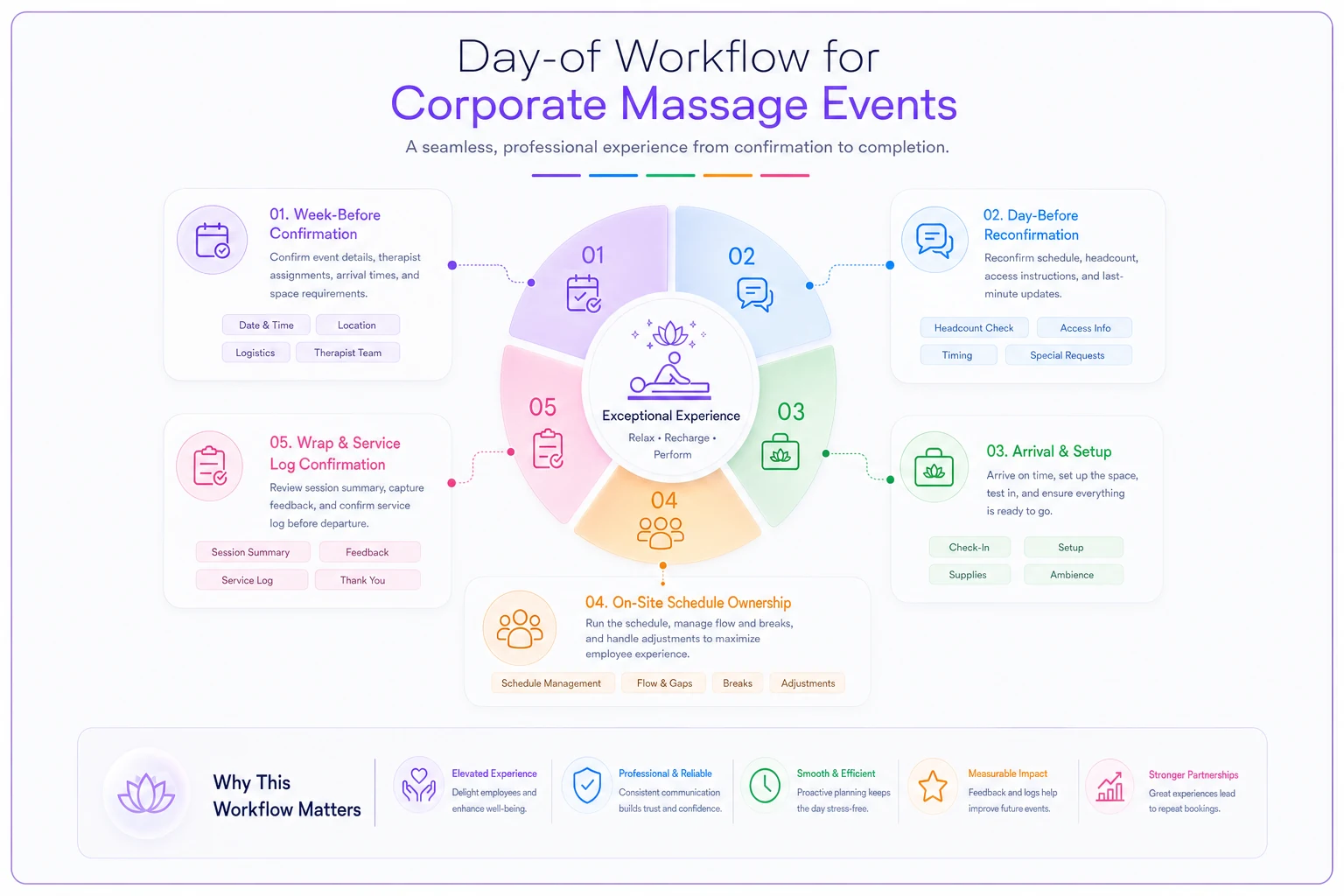
Capture a signed or texted confirmation of sessions before leaving the building.
The single cheapest thing you can do to protect a corporate account is capture an accurate, confirmed service log on-site, same day. Nine out of ten invoice disputes are really "we don't recognize this count" disputes. If you have a signed or texted confirmation of sessions delivered before you leave the building, those disputes mostly go away.
Invoicing terms and payment guardrails
This is where studios used to retail cash flow get burned worst. You delivered the service. Everyone was happy. Then the invoice disappears into an accounts-payable system and surfaces 50 days later, or not at all.
The guardrails that actually move payment:
-
Get the PO first, if they use one. For any company over a certain size, no PO means no payment, no matter how friendly the coordinator is. Confirm the PO process during intake and get the number before the event.
-
Put net terms in writing, and keep them short where you can. Net 15 is reasonable for recurring work with a known contact. Net 30 is the ceiling you should push for before it creeps to 45 or 60.
-
Deposit or prepay for first-time and one-off events. A new client with no track record shouldn't get full net terms. A 50% deposit at booking is completely normal to ask for.
-
Invoice same day or next day. The faster the invoice hits their system referencing an accurate, confirmed service log, the faster it clears. Invoices that arrive two weeks late get questioned and delayed.
-
State late terms up front. A modest late fee written into the terms isn't aggressive — it signals you run this like a business, and it gives you leverage when something ages past 45 days.
-
Separate the "who schedules" from "who pays." Your reminder sequence for an overdue invoice should go to the AP contact and cc the coordinator who hired you. The coordinator wants the service to continue and will often chase payment internally for you.
A simple aging rule keeps this from slipping: anything over 30 days gets a reminder, over 45 gets a direct call to AP, over 60 pauses future work until cleared. Writing the pause rule down — and meaning it — is what keeps a good client from drifting into a chronic slow-payer.
A real scenario
A three-room studio in a mid-size city took on recurring corporate chair work for two local employers — one monthly, one every second week. First quarter looked great: roughly $4k–$5k a month in added corporate revenue.
Three months in, the owner noticed retail rebookings had softened and two long-time clients had drifted to a competitor. The corporate blocks had been eating prime Thursday and Friday slots, staffed with the studio's two most-requested therapists. On top of that, one employer was paying on a rolling Net 50-something because nobody had set terms, and a December block got canceled with two days' notice — four gutted hours, no fee, no fill.
The fixes weren't complicated. Corporate got capped at around 25% of weekly hours and pushed toward the slower start of the week. Prime retail slots went back to protected. Corporate blocks moved to a reserved-minimum charge with a real 48-hour cancellation fee. Terms got reset to Net 15 with a deposit for anything new, and service counts got confirmed on-site before therapists left.
Over the next quarter, corporate revenue was slightly lower on paper, but contribution improved, retail rebooking recovered, and average days-to-payment dropped from the high 40s to the mid-teens. The business felt calmer, and the owner stopped dreading the corporate calendar.
When corporate work actually makes sense — and when it doesn't
It makes sense when: you have genuine slack capacity — slow mornings, a soft season — the account is recurring enough to justify the setup, the client has a clean PO and AP process, and you can staff it without pulling your most-requested therapists off retail.
It's a bad idea when: it only pencils out at retail-equivalent pricing, it forces you to bump regulars repeatedly, the client won't commit to terms or a deposit, or it lands squarely in your busiest season. A big one-off during December is almost never worth what it costs you in retail.
Who should probably skip it entirely: a solo therapist already booked near capacity with a strong retail rebooking rate. Corporate is a volume play on slack time. If you don't have slack and your retail hours are more profitable, you'd be trading your best revenue for your worst — and adding logistics on top.
Keeping it all straight
The thread running through all five areas — intake, blocks, logistics, invoicing, guardrails — is that corporate work fails when it's run reactively against your retail schedule. Every problem in this playbook comes from treating a corporate request as a one-off favor instead of a defined operating category with its own rules.
Studios that actually make money on corporate treat it like a second product line: capped capacity, its own pricing, its own terms, its own service log. It never silently competes with the retail base that's paying your bills.
If corporate recurring work is becoming a meaningful slice of revenue, it also changes how you think about predictable cash flow overall — which is worth reading alongside how you design memberships that stabilize cashflow, since both are about turning unpredictable bookings into something you can actually plan around.
Set the caps, write the terms, confirm the counts on-site, and corporate becomes what it should be: steady revenue that fills your slow slots without quietly costing you the clients you already have.
Ready to elevate your massage therapy business?
Join hundreds of therapists using Masthera to save time, reduce scheduling conflicts, and enhance client satisfaction.