



Buying or opening a massage studio is strange because the first few weeks feel calm right up until they don't. Bookings are still coming in from whatever the previous owner set up, therapists are showing up, the lights are on. Then week three hits and you realize nobody knows who approves refunds, two therapists think they're owed different pay rates, and your bank balance dropped $6k faster than you expected because a quarterly software bill and a payroll run landed in the same week.
The first 90 days are not about strategy. They're about not breaking anything while you figure out what you actually own. This is a week-by-week first 90 days massage studio owner checklist built around four things that keep new studios alive: cash visibility, staff stabilization, SOP audits, and watching a small set of KPIs closely enough to catch trouble early.
No vision-board stuff. Just the operational moves, in order.
Before you touch anything: the mindset for the first two weeks
New owners break things by moving too fast. They raise prices, swap the booking software, or fire the therapist everyone warned them about — all in month one, before they understand why things were set up the way they were.
Studios that stabilize well tend to follow the same boring pattern: observe and document first, change second. The previous owner's "weird" refund policy might exist because of a specific client who files chargebacks. That 90-minute gap in the schedule every Tuesday might be the only time the senior therapist does her clinical paperwork.
The early weeks are about mapping reality, not improving it. You improve once you understand it.
Weeks 1–2: Get cash visible and stop the bleeding you can't see
Most cash problems in a new studio aren't dramatic. They're small leaks nobody's tracking — unredeemed packages sitting as liabilities, a card reader fee you didn't know about, a monthly subscription for software the last owner stopped using but kept paying for.
Never miss a booking or double-book again.
Masthera helps you schedule, confirm & manage every massage session with ease.
- Unified appointment management
- Automated client reminders
- Therapist calendar coordination
No credit card required
Your week 1–2 cash checklist:
-
Pull the last 90 days of bank statements and list every recurring charge. Cancel what's dead.
-
Find out how much is sitting in outstanding gift cards and prepaid packages. This is money you already owe in service.
-
Confirm exactly when payroll runs, how much it is, and what day it clears.
-
Identify your merchant processor and the real effective rate (not the advertised one — add up fees ÷ volume).
-
Get a simple 13-week cash view going. Doesn't need to be fancy. A spreadsheet with weekly inflows and known outflows is enough.
A typical example: a new owner of a three-room studio assumed roughly $40k/month in revenue meant comfortable cash. But around $9k of that month's "revenue" was package redemptions — work already paid for months ago. Actual new cash coming in was closer to $31k, and payroll plus rent plus supplies ate most of it. She wasn't broke, but she was a lot tighter than the top-line number suggested.
The thing most people miss: revenue and cash are not the same thing in a studio that sells packages and memberships. You can be fully booked and cash-starved at the same time.
Weeks 2–3: Stabilize the staff before they stabilize themselves (by leaving)
Staff turnover in the first 90 days of new ownership is brutal and usually self-inflicted. Therapists are anxious. A new owner means uncertainty about pay, hours, clients, and whether their work environment is about to get "corporatized."
If you say nothing, they fill the silence with worst-case assumptions. The quiet therapist who's been there six years starts taking calls from a competitor.
Your job in weeks 2–3 is simple: remove uncertainty wherever you can, even if your answer is "nothing is changing right now."
The staff stabilization sequence:
-
Short 1-on-1 with every therapist. Fifteen minutes. Ask what's working, what's annoying, what they're worried about. Mostly listen.
-
Confirm pay in writing. Rate, split, commission structure, how tips flow. Ambiguity here is the #1 trust-killer.
-
Clarify schedule expectations — who owns which shifts, how time-off requests work, who covers no-shows.
-
Name the decision-makers. Who approves a refund? Who can comp a session? If it's only you, say so.
-
Make one small visible improvement they asked for. Fix the broken heating pad, reorder the good lotion. Small, fast, builds credibility.
Put pay rates and splits in writing to avoid ambiguity.
The mistake here is treating staff stabilization as an HR formality. Your therapists are the product. If your best one walks in month two, you don't just lose a person — you lose their rebooking rate, which in a lot of studios means 40–60% of their clients drift away within a couple months.
If you're bringing on new therapists during this period, lean on structure rather than improvising. A clear onboarding path matters even more when the owner is new too — this breakdown on ramping new therapists faster with SOPs and 30-60-90 goals is worth working through before you hire.
Weeks 3–5: Audit the SOPs that are actually running (not the ones in the binder)
Every studio has two sets of SOPs: the written ones nobody reads, and the real ones living in people's heads. Your job is to find the gap between them.
This usually surfaces through a mistake. A client gets double-booked. A refund gets issued twice. Someone cleans a room "their way" and it takes 25 minutes instead of 12, blowing the whole afternoon schedule. These aren't people problems — they're missing or inconsistent processes.
How to run a fast SOP audit without drowning in documentation:
| Stage | Question to answer | Common gap you'll find |
|---|---|---|
| Booking | Who takes bookings, across which channels? | Phone bookings never make it into the system |
| Intake | Where do intake forms live? Who reads them? | Forms collected but never reviewed before session |
| Session | Any standard for room setup and turnover? | Each therapist does it differently, timing varies wildly |
| Checkout | Who handles payment, tips, rebooking ask? | Rebooking prompt is inconsistent or skipped |
| Follow-up | Is there any post-visit contact? | Nothing happens after the client walks out |
Pick the two or three gaps that cost the most money or cause the most chaos, and fix only those first. Trying to document everything in month one is how new owners burn out.
The most expensive SOP gaps are almost always at checkout and follow-up, because that's where rebooking and retention live. A missed rebooking ask isn't a minor thing. If 15 clients a week leave without rebooking and even a third of them would've said yes, that's real recurring revenue walking out the door every single week.
Weeks 5–8: Lock in the 8 KPIs you'll watch for the rest of your ownership
By now the fires are smaller and you can start measuring instead of reacting. You don't need a 40-metric dashboard. You need a handful of numbers that tell you, at a glance, whether the studio is healthy.
The eight that matter most for a stabilizing studio:
-
Utilization rate — booked hours ÷ available therapist hours. The single best health signal.
-
Rebooking rate — % of clients who book their next appointment at or near checkout.
-
New client count — how many fresh clients came in this week/month.
-
Average ticket — revenue per visit, including add-ons.
-
No-show / late-cancel rate — the silent margin killer.
-
Membership / package balance — outstanding liability and redemption pace.
-
Revenue per available hour — ties pricing and utilization together.
-
Therapist retention — turnover is a lagging KPI you can't afford to ignore.
Don't try to optimize all eight at once. In the first 90 days you're establishing baselines — you can't improve what you haven't measured for a few weeks. For a deeper build-out of how to wire these into a usable dashboard with decision rules, this walkthrough of the 8 metrics and a minimal KPI dashboard covers the structure well.
Worth sitting with: utilization and no-show rate together explain most of a studio's financial pain. High no-shows plus mediocre utilization means you're paying for therapist availability you can't sell. Fix that combination before you touch pricing or marketing.
Where software quietly earns its keep here
Pulling these eight numbers by hand every week is miserable and you'll stop doing it by week three. Studios that actually sustain KPI tracking are the ones where the booking and payment system surfaces these numbers automatically — utilization, rebooking, no-shows — without someone exporting spreadsheets on a Sunday night. Operational platforms that handle reporting in the background aren't about being fancy; they just remove the friction that causes owners to fly blind. The goal is simply that checking your numbers takes two minutes, not two hours.
A simple weekly check workflow looks like this.
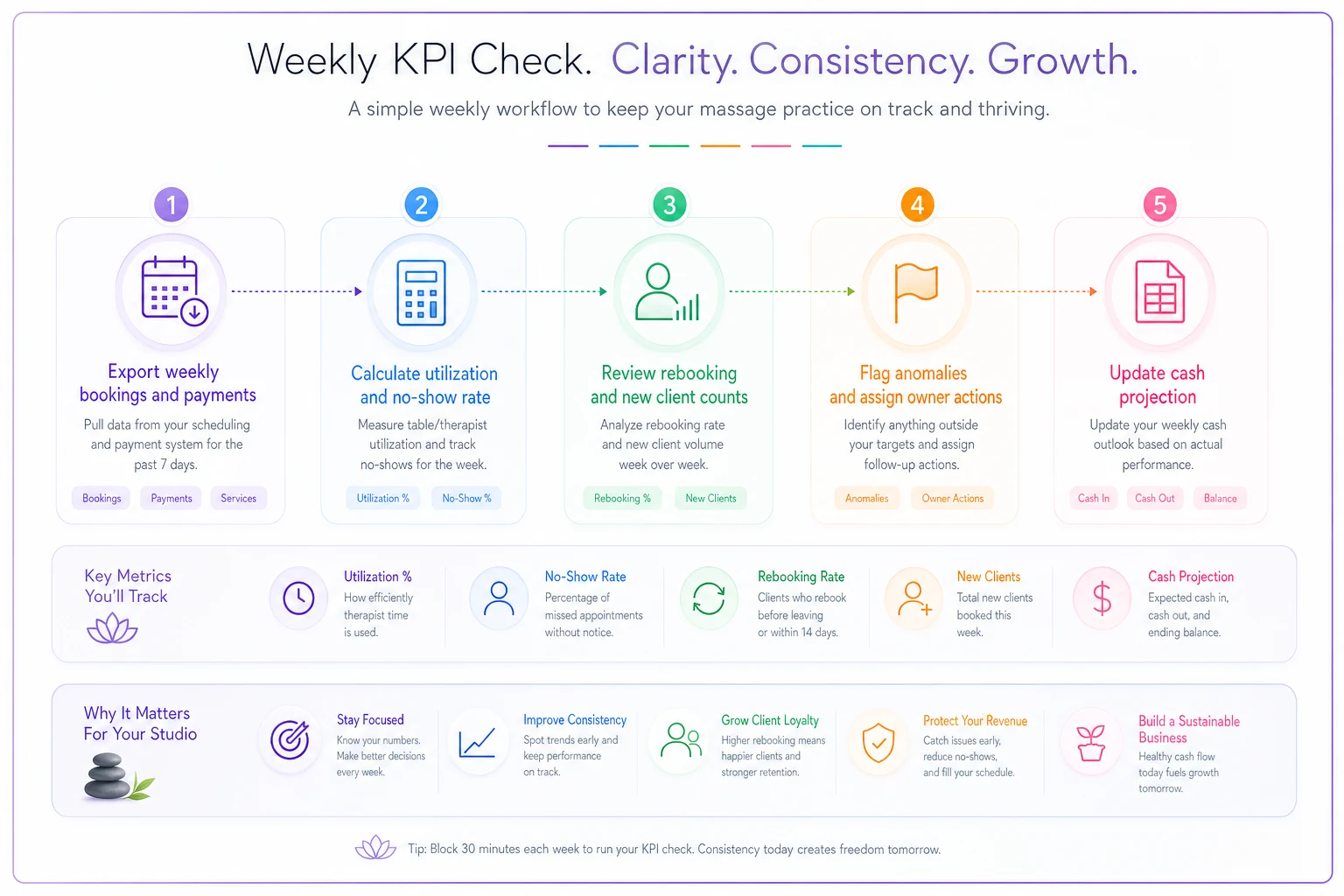
Operational platforms that handle reporting in the background aren't about being fancy; they just remove the friction that causes owners to fly blind. The goal is simply that checking your numbers takes two minutes, not two hours.
Weeks 8–12: Make your first *deliberate* changes
Now you've earned the right to change things, because you understand why they were the way they were. Owners who waited beat the ones who rushed — pretty consistently.
Good first changes in this window:
-
Tightening the no-show policy now that you have data to back it up with staff.
-
Standardizing room turnover timing so the schedule stops slipping.
-
Fixing the checkout rebooking gap you found in your SOP audit.
-
Cleaning up package and gift-card liability — clear redemption rules, expiry where legal.
-
Adjusting one or two underpriced services based on actual utilization.
Notice what's not on that list: a full rebrand, a software migration, a price hike across the board. Those can come in months 4–6 once you're stable. Doing them in the first 90 days is how you destabilize the thing you just finished stabilizing.
A real scenario: what the first 90 days actually looks like
A therapist bought a small two-room studio doing roughly $28k–$32k a month. It looked fine on paper. In her first two weeks she found three dead software subscriptions (around $180/month combined), a no-show rate running near 18%, and about $11k in unredeemed packages on the books.
She didn't overhaul anything. She:
-
Killed the dead subscriptions immediately.
-
Had honest pay conversations with both therapists and put the splits in writing — both stayed.
-
Audited checkout and found the rebooking ask was being skipped roughly half the time.
-
Started tracking utilization and no-shows weekly.
By day 90, no-shows were down to around 11% after a clearer cancellation policy, rebooking had improved noticeably just from making the ask consistent, and she had a real cash picture instead of a guess. Revenue didn't explode — it moved up modestly — but the studio stopped feeling like it was leaking, and both therapists were still there.
That's a win in the first 90 days. Stability first, growth later.
When to slow down even more than this playbook suggests
If you inherited a studio with serious staff tension, messy books, or a client base that's already shrinking, stretch these phases out. Trying to hit all four pillars on schedule while putting out a staffing fire just means you'll do all of them badly.
And if you're walking into a healthy, well-run studio — resist the urge to put your stamp on it early. The fastest way to break a good studio is to improve it before you understand it.
The 90-day throughline
Cash visibility, staff stability, honest SOPs, and a small set of KPIs you actually watch — that's the whole job for the first three months. Everything else can wait.
New owners who treat the first 90 days as a stabilization period consistently end up in a stronger position than the ones who come in swinging. They're building on something they actually understand instead of guessing at what's wrong. Get through this checklist and you won't have a perfect studio. You'll have a stable one — and a stable studio is the only thing you can actually grow from.
Ready to elevate your massage therapy business?
Join hundreds of therapists using Masthera to save time, reduce scheduling conflicts, and enhance client satisfaction.