


The ugliest version of this problem shows up on a Tuesday morning when your front desk realizes one of your therapists has been booked solid for the next three weeks — and her license technically expired on Sunday. Nobody flagged it. The renewal notice went to an old email. Now you've got roughly 18 appointments sitting on a schedule you legally shouldn't be running, and every one of them is a rebooking headache or a refund.
Credential lapses are one of the most predictable operational failures in a wellness studio, and yet almost nobody builds a real system around them. People rely on memory, on the licensing board's reminder email, or on the therapist "handling their own stuff." That works right up until it doesn't.
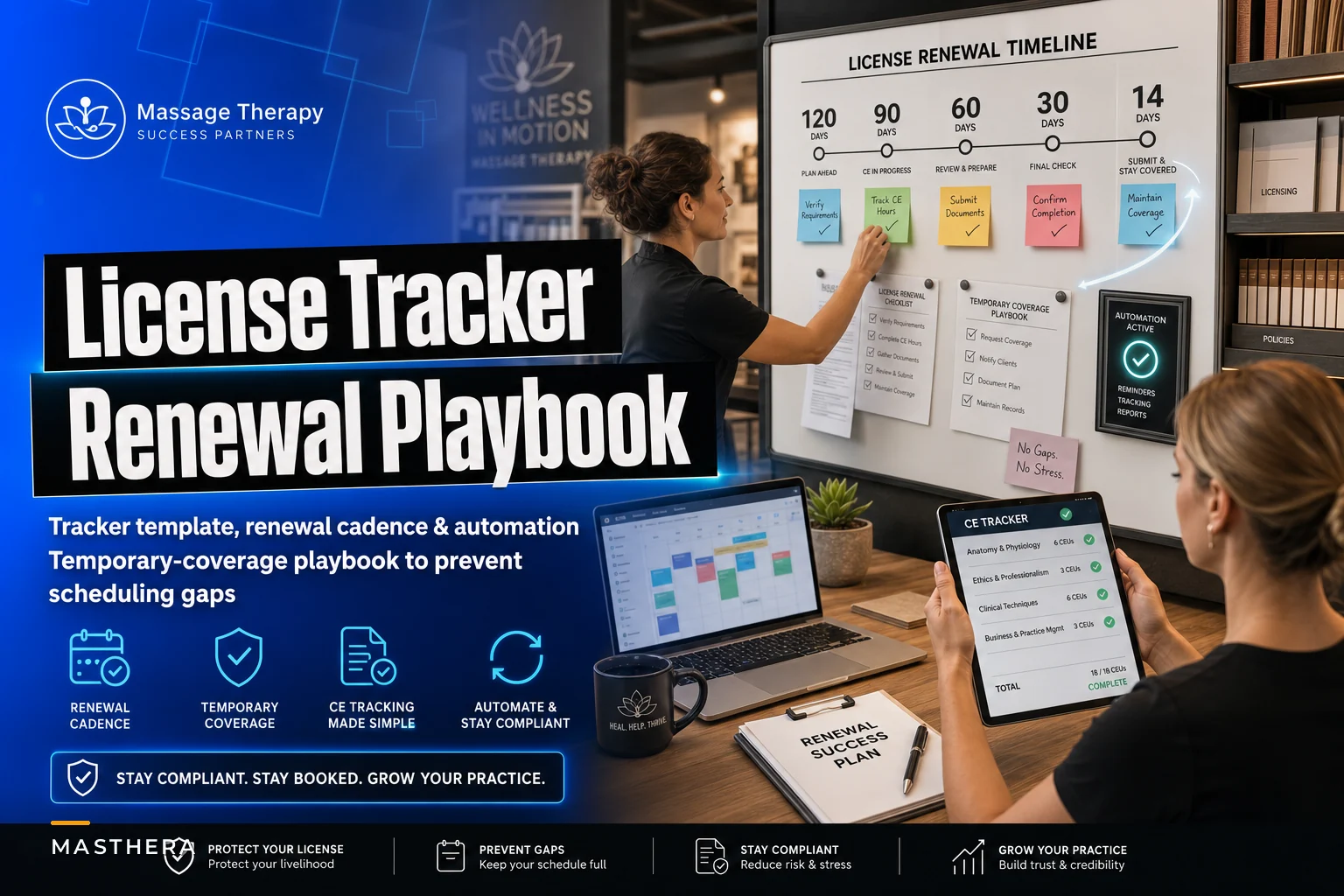
This post is narrow on purpose. It's about one thing: building a therapist license tracker studio owners can actually maintain, setting a renewal cadence that triggers before anything lapses, and having a temporary-coverage playbook ready so a gap never turns into empty rooms or cancelled clients.
Why credential lapses sneak up on well-run studios
The frustrating part is that lapses rarely happen because someone is disorganized. They happen because the renewal timeline is weirdly long and quiet.
A massage license might renew every two years. CE requirements accumulate across that whole window — say 24 hours of continuing education due before the renewal date. Because the deadline is so far out, nobody thinks about it for 20 months. Then the last eight weeks become a scramble: finding CE courses, completing them, submitting proof, waiting on the board to process the renewal.
-
CPR certifications expire on a different cycle than the license (often every two years, but offset).
-
Liability insurance renews annually, on yet another date.
-
A therapist who works at two locations might assume the other studio is tracking it.
-
Independent contractors handle their own credentials, so owners feel they have no visibility — until the contractor's lapse becomes the studio's legal exposure.
The problem isn't the renewal itself. It's that there are four or five separate expiration dates per therapist, all on different cycles, scattered across emails and PDFs, with no single place showing "here's what's due in the next 90 days."
The real cost when a credential lapses mid-schedule
Say a therapist with a full book averages around 25–30 sessions a week at an average ticket of $95. If her license lapses and you have to pull her off the schedule for even five business days while the board processes a late renewal, you're looking at:
Never miss a booking or double-book again.
Masthera helps you schedule, confirm & manage every massage session with ease.
- Unified appointment management
- Automated client reminders
- Therapist calendar coordination
No credit card required
-
Roughly 25 appointments that need to be rebooked or covered
-
Somewhere around $2,300–$2,800 in sessions at risk if you can't cover them
-
Front-desk time absorbed by calling clients, apologizing, reshuffling
-
The harder-to-measure cost
a few of those clients book elsewhere and don't come back
That's the mild version. If an insurer-directed or medically-referred client was treated during a lapse window, you're now dealing with a documentation and liability problem that's far more expensive than lost session revenue. The same care you'd put into your SOAP-notes and compliance system falls apart if the person creating those notes wasn't legally licensed on the date of service.
The lapse itself is usually only a few days. The cleanup is what hurts.
The lightweight tracker: what it actually needs to contain
You don't need elaborate software to start. You need one source of truth that answers a single question at a glance: what expires in the next 90 days, and who owns fixing it?
Here's a minimal structure that covers almost every studio:
| Field | Example | Why it matters |
|---|---|---|
| Therapist name | J. Okafor | Obvious anchor |
| Credential type | Massage license / CPR / Liability / CE hours | Different cycles, different owners |
| Issuing body | State board / Red Cross / Insurer | Where renewal actually happens |
| Expiration date | 2026-03-14 | The number everything triggers off |
| CE hours required | 24 by renewal | Track accumulation, not just the date |
| CE hours completed | 11 | Shows the gap early |
| Renewal lead time | 60 days | How long the board takes to process |
| Status | On track / Action needed / At risk | Quick scan column |
| Owner | Front desk / Therapist / Owner | Kills the "I thought you had it" problem |
The two columns people skip — and shouldn't — are CE hours completed and renewal lead time. Tracking only the expiration date tells you when the license dies, not whether the therapist can realistically renew in time. If someone needs 24 CE hours and has done zero with 10 weeks left, the date looks fine but the situation is already a problem.
A quick note on contractors: even if they technically manage their own credentials, you still keep a row for them in the tracker. You're not doing their renewal — you're protecting your studio from booking someone who's lapsed. This distinction matters, and it connects to the broader question of how you treat contractor versus employee responsibilities operationally.
A renewal cadence that triggers before the scramble
A tracker that nobody looks at is just a spreadsheet graveyard. The cadence is what makes it work. The goal is to turn one far-off deadline into a series of small, boring checkpoints.
-
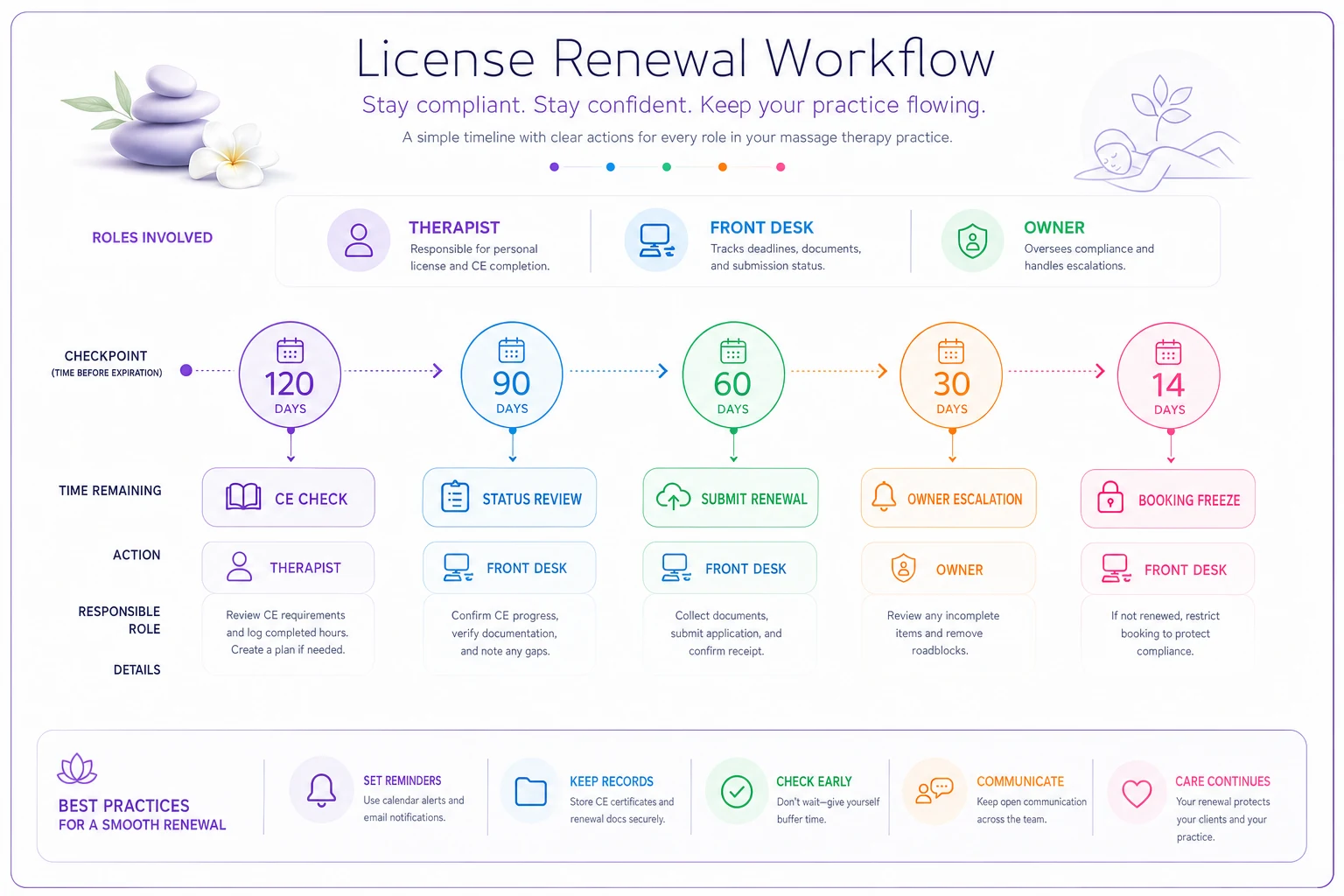
120 days out — First flag. Confirm the exact expiration date and the board's processing time. Check CE progress. If CE is under halfway done, the therapist gets a specific plan: which courses, by when.
-
90 days out — Status review. CE should be at least 60–70% complete. Insurance and CPR dates get checked in the same pass, since they're easy to forget.
-
60 days out — Action window opens. CE must be finished. Renewal application should be submitted around here if the board's processing is slow. This is the last comfortable moment.
-
30 days out — Hard checkpoint. If the renewal isn't submitted or confirmed, this is now an owner-level issue, and the temporary-coverage playbook goes on standby.
-
14 days out — If still unresolved, you stop booking that therapist past the expiration date. No exceptions. It's much easier to reopen slots than to unwind illegal ones.
Configure your scheduling software to block out bookings automatically at the 14-day freeze to remove manual judgment calls.
The discipline that matters most is step five. The temptation to "just keep booking, the renewal is in process, it'll be fine" is exactly how lapses happen. A hard stop at 14 days with the slots fenced off removes the judgment call entirely.
Automated notifications so the cadence runs itself
Nobody reliably remembers to check a spreadsheet at 120, 90, 60, 30, and 14 days for every therapist. This is the one place where a little automation earns its keep — not as some grand overhaul, just as a quiet reminder layer sitting on top of your tracker.
The idea is simple: your tracker has dates, and a scheduled notification fires off the right message to the right person at each checkpoint. Modern operational platforms can watch the expiration fields and send these automatically, so the cadence doesn't depend on a human remembering to look.
120-day CE check (to therapist): > "Hi [Name] — your [license] renews on [date]. You've logged [X] of [Y] required CE hours. To stay comfortable, aim to finish CE by [60-day date]. Reply if you want help finding approved courses."
60-day action alert (to therapist + owner): > "[Name]'s [credential] renews in 60 days ([date]). Renewal submission window is open now given the board's processing time. CE status: [complete/incomplete]."
14-day booking freeze (to front desk + owner): > "ACTION: [Name]'s [credential] expires [date] and renewal is not yet confirmed. Do not book [Name] for appointments on or after [date] until confirmed. Flag existing bookings past that date."
Confirmation close-out (to owner): > "[Name]'s [credential] renewed through [new date]. Tracker updated. Bookings reopened."
The point of templates is that the message is already written. When the alert fires, nobody has to compose anything or decide what to say. The automation handles the when and the who; the template handles the what. For contractors especially, an automated nudge that doesn't require you to personally chase anyone down is the difference between a system that holds and one that quietly rots.
The temporary-coverage playbook
Even with a clean cadence, things go sideways. A board takes longer than usual. A therapist has a medical issue mid-renewal. A CPR cert lapses because the class got cancelled. You need a plan that protects client appointments when a credential gap appears anyway.
Coverage options, roughly in order of preference:
-
Reassign to an available licensed therapist. If another therapist has open slots and the client is flexible, this is the cleanest fix. Keep a simple internal note of who's cross-trained for which modalities.
-
Shift the schedule into open capacity. Move affected appointments to days where you have slack rather than squeezing them into an already-full book.
-
Proactive reschedule with a goodwill gesture. Reach out before the client arrives. A proactive "we need to move your appointment" call with a small credit lands far better than a day-of cancellation.
-
On-call relief therapist. Some studios keep a relationship with one or two licensed therapists willing to pick up occasional shifts. Worth building before a crisis.
What the playbook needs to specify:
-
Who makes the coverage decision (owner or lead therapist, not front desk solo).
-
The script for contacting affected clients, so messaging is consistent.
-
The order in which you try coverage options.
-
The cutoff where you simply cancel-and-credit rather than keep scrambling.
-
How reassigned clients get their intake and history to the covering therapist cleanly.
That last point matters more than it seems. When you reassign a client, the covering therapist walks in blind unless your notes and intake travel with the appointment. Studios that have already invested in solid onboarding and documentation habits — the kind you build when you ramp new therapists with real SOPs and checklists — find coverage reassignments much less disruptive, because the covering therapist isn't starting from zero.
When a hard freeze is the right call — and when it isn't
When the freeze makes sense: Any time the renewal isn't confirmed. "Submitted and pending" is not confirmed. If the board hasn't issued the renewal, treat the therapist as unavailable for dates past expiration. The downside of freezing slots early is small and reversible. The downside of booking through a lapse is not.
When you can hold off on the freeze: If a credential like CPR has a documented grace period, or your state explicitly allows practice during a pending renewal, you may have more room — but only if you've confirmed that in writing, not assumed it. Don't rely on "I think it's fine." Pull the actual rule.
Who should not improvise here: Front desk staff should never be the ones deciding whether to book a therapist whose credential status is unclear. That's an owner-level decision with legal weight. The whole point of the tracker and cadence is to remove that judgment from the counter and settle it weeks in advance.
A real scenario
A three-room wellness center with four therapists — two employees, two contractors — kept credentials in a mix of the owner's inbox and each therapist's memory. Over about a year and a half, they had two near-misses and one actual lapse: a contractor's license expired and she worked four days before anyone noticed, including two sessions that should've been documented more carefully given one was a referred client.
They built a single tracker with every credential, every date, and an owner column. They set the five-checkpoint cadence and wired up automated reminders off the expiration dates. They wrote three notification templates and a one-page coverage playbook.
Over the next renewal cycle, the change wasn't dramatic in a flashy way — it was just quiet. The 120-day and 60-day nudges meant CE never became a scramble. One contractor's renewal ran slow at the board, but because the 14-day freeze kicked in, those slots were reassigned a week ahead instead of cancelled day-of. Roughly 20 appointments that would've been at risk under the old approach simply got moved cleanly. No refunds, no legal gray area, no front-desk firefight.
The owner's description of the difference was telling: not "we saved X dollars," but "I stopped thinking about it." That's the real win. Credential tracking should run in the background and only surface when there's actually a decision to make.
The takeaway
Credential lapses aren't a knowledge problem — every therapist knows their license has to stay current. They're a visibility and timing problem. The dates are far apart, the cycles don't line up, and nobody owns the overview until something breaks.
A plain tracker with the right columns, a renewal cadence that triggers months early, a few pre-written notification templates, and a coverage playbook you've already thought through — that's the whole system. It's not complicated. It just has to exist and actually run. Build it once, let the reminders do the nagging, and you turn a recurring fire drill into a non-event.
Credential lapses aren't a knowledge problem — every therapist knows their license has to stay current. They're a visibility and timing problem. The dates are far apart, the cycles don't line up, and nobody owns the overview until something breaks.
A plain tracker with the right columns, a renewal cadence that triggers months early, a few pre-written notification templates, and a coverage playbook you've already thought through — that's the whole system. It's not complicated. It just has to exist and actually run. Build it once, let the reminders do the nagging, and you turn a recurring fire drill into a non-event.
Ready to elevate your massage therapy business?
Join hundreds of therapists using Masthera to save time, reduce scheduling conflicts, and enhance client satisfaction.