


Most studios don't have a cleaning problem. They have a timing problem that masquerades as a cleaning problem.
A therapist finishes a 60-minute deep tissue session, walks the client out, grabs water, and now has maybe 8 minutes before the next person is on the table. In those 8 minutes they're supposed to strip linens, wipe the face cradle, sanitize the bolster, re-lay fresh sheets, deal with any oil residue, reset the music, and wash their hands properly. If the last client used a lot of lotion or had a cold, add more. If it was a routine relaxation massage on a dry client, way less is actually needed.
But almost every studio treats all of these turnovers the same. One checklist. One assumed time. And because the checklist assumes the worst-case every single time, therapists either rush it and skip steps, or fall behind and the schedule drifts. Neither is good.
A tiered sanitation SOP fixes this by matching the cleaning effort to the actual risk of the session that just happened. Low-risk turnovers get a fast reset. High-risk turnovers get the full protocol and a bigger time buffer. The whole point is to stop pretending a dry-skin relaxation massage and a post-injury session with an open wound nearby require identical turnover work.
Why a single flat SOP quietly breaks down
When every room turnover follows the same long checklist, one of two things happens — and usually both, over time.
The first is silent step-skipping. Therapists are not lazy — they're under time pressure. When the checklist says 14 steps and they have 8 minutes, they start making private judgment calls about which steps "don't really matter today." Those calls are invisible. You have no idea which steps are getting dropped, by whom, or how often. The SOP exists on paper but not in the room.
The second is schedule creep. Therapists who do follow the full checklist every time run late. A 7-minute overrun on the first appointment becomes a 20-minute overrun by mid-afternoon. The front desk is apologizing, clients are annoyed, and you've effectively lost throughput to a cleaning standard that was overkill for most of those sessions anyway.
The flat SOP also makes training miserable. New therapists get handed one enormous list and told "do all of this between every client." There's no framework for understanding why certain steps matter more after certain sessions. So they memorize instead of understanding, and memorized checklists are the first thing to collapse under pressure.
The studios with the cleanest rooms aren't the ones with the longest checklists. They're the ones who've sorted their turnovers into tiers so the right amount of effort goes to the right session.
The three-tier model
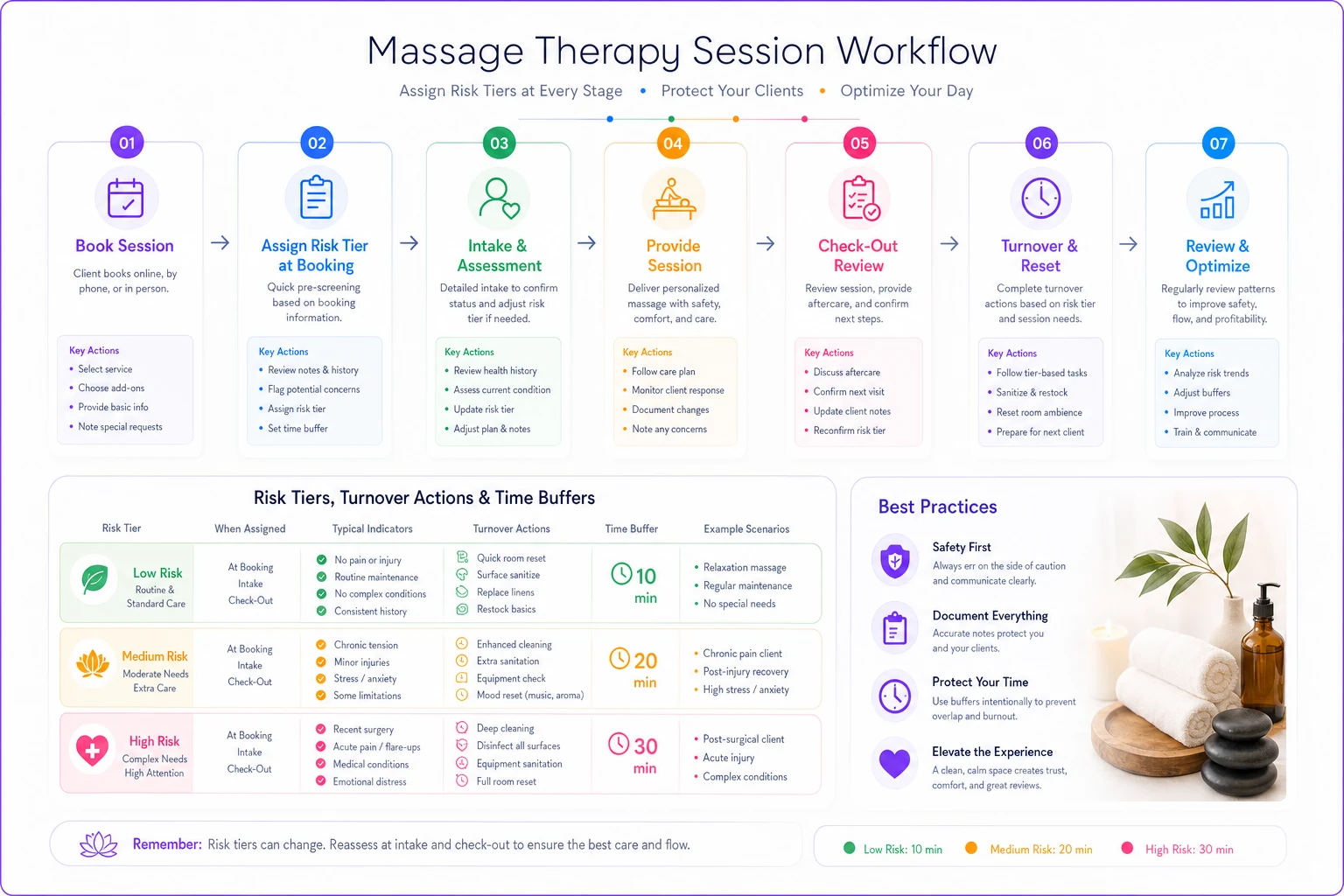
The core idea is simple. Every session gets a risk tier assigned when it's booked or at check-out, which determines the turnover protocol and the time allowance for that room.
Never miss a booking or double-book again.
Masthera helps you schedule, confirm & manage every massage session with ease.
- Unified appointment management
- Automated client reminders
- Therapist calendar coordination
No credit card required
| Tier | Typical sessions | Core cleaning actions | Target turnover time |
|---|---|---|---|
| Low risk | Dry relaxation massage, short chair sessions, reflexology with minimal product | Fresh linens, wipe face cradle + contact surfaces, sanitize hands, quick visual reset | 6–8 min |
| Medium risk | Deep tissue, heavy oil/lotion use, aromatherapy, longer sessions, first-time clients | Everything in low-risk + full equipment wipe-down (bolsters, bottles, stool), oil residue cleanup, door handles/light switches, linens bagged separately | 12–15 min |
| High risk | Clients with skin conditions, post-surgical/medical referrals, cupping/gua sha, anyone visibly unwell, blood or bodily fluid exposure | Full medium protocol + disinfectant dwell time on all surfaces, single-use items discarded, tools disinfected or set aside for deep clean, room flagged if needed | 18–25 min |
The time allowances are the part most studios skip, and they're the part that makes the whole thing actually work. A tier means nothing if the schedule doesn't give the therapist the minutes to execute it. If you're booking a high-risk cupping session back-to-back with a 10-minute gap, you've built a tier system that's guaranteed to fail before anyone even tries it.
Here's a quick visual of the assignment and turnover flow.
A note on dwell time
The step people get wrong most often is disinfectant dwell time — the number of minutes a surface has to stay visibly wet for the product to actually kill what it claims to kill. Spraying and immediately wiping does almost nothing. Most hospital-grade disinfectants need somewhere between 1 and 10 minutes of contact, depending on the product.
This is the reason high-risk turnovers need real time buffers, and it's worth printing the exact dwell time of your specific product right on the SOP card.
How to assign the tier before the room ever needs turning over
The trick is deciding the tier earlier than the turnover itself. If the therapist only figures out "oh, this was a high-risk session" after the client leaves, it's too late — the schedule is already built.
A simple assignment flow:
-
At booking, the service type sets a default tier. Cupping, medical referrals, and deep tissue carry a higher default automatically.
-
At intake, flags bump the tier up. Skin conditions, recent surgery, open wounds, or a client who mentions feeling under the weather all push a session toward high-risk. This is also where your accessible intake workflows earn their keep — the same conditional questions that help you set up the room properly also surface the sanitation risk flags before anyone's on the table.
-
At check-out, the therapist can override upward if something happened mid-session — a nosebleed, heavy product use, anything unexpected.
The result is that the schedule knows the tier before the gap exists. A booking flagged high-risk automatically gets a longer buffer behind it. A low-risk session can be booked tighter without guilt.
This is also where practice-management software quietly helps — not by doing anything fancy, but by carrying the tier from booking through to the schedule gap automatically, so the front desk isn't manually padding times and the therapist isn't guessing. If your scheduling tool can attach a cleaning buffer to a service type, you've solved most of this without any heroics.
Sign-off templates that people will actually use
A sign-off that takes 90 seconds to fill out will be faked. That's just reality. The goal is a record that proves the turnover happened at the right tier, in under 15 seconds, without turning your therapists into clipboard clerks.
Keep it to three questions per turnover:
-
Tier executed Low / Medium / High
-
Full protocol completed Yes / No (if No, one-line reason)
-
Initials + time
That's it. You're not auditing every step every time. You're creating a simple trail that tells you which tier was run and whether it was completed. Over a week, patterns show up: if a therapist is logging "No — ran out of time" repeatedly on medium-risk turnovers, that's a scheduling problem you can see and fix, not a cleaning lecture you need to give.
For high-risk turnovers, add two extra fields — these are the ones that matter most for liability:
-
Disinfectant dwell time observed Yes / No
-
Single-use items discarded + tools set aside for deep clean Yes / No
A paper card on a clipboard works fine for a single room. Once you're running three or more rooms, a shared digital log is worth it — mostly because it timestamps automatically and you stop losing cards. The automatic timestamp also tells you your real turnover times versus your target times, which is useful data when you're trying to fix the schedule later.
Training checklists built around tiers, not one giant list
New therapist training usually fails because it front-loads everything. A tiered approach lets you teach in layers.
Week 1 — Low-risk mastery. They only run low-risk turnovers under observation. You're checking linen handling, hand hygiene technique, and contact-surface wiping. Simple, repeatable, builds muscle memory.
Week 2 — Medium-risk. Add equipment wipe-down, oil cleanup, and separated linen bagging. Now they understand why heavier product use changes the protocol.
Week 3 — High-risk + judgment. Not whether they can clean, but whether they can recognize when a session is high-risk and escalate. Walk them through scenarios: a client mentions a rash, a nosebleed happens, someone shows up with a cough. Can they correctly bump the tier and claim the time they need?
A training checklist worth signing off on:
-
[ ] Demonstrates correct hand hygiene (timed, before and after)
-
[ ] Strips and re-lays linens without contaminating fresh sheets
-
[ ] Knows the dwell time for your specific disinfectant by memory
-
[ ] Can name three triggers that push a session to high-risk
-
[ ] Completes a medium-risk turnover within the time allowance, unassisted
-
[ ] Completes a high-risk turnover correctly, even if slow
-
[ ] Fills out a sign-off accurately in under 20 seconds
-
[ ] Knows the escalation step if a room needs to be pulled from service
The last few are about judgment and documentation, not scrubbing. That's the part that actually protects you.
A real scenario
A three-room studio running roughly 320–360 sessions a month was constantly running late in the afternoons. Therapists blamed cleaning. The owner assumed people were slacking.
What was actually happening: they had one 10-minute turnover gap hardcoded into every appointment. For the dozen or so relaxation sessions a day, that was too much — therapists had idle time. For the deep tissue and the occasional cupping client, 10 minutes was nowhere near enough, so those turnovers ate into the next appointment and the delay snowballed.
They split turnovers into three tiers, attached buffers to service types in their booking system (6 min low, 13 min medium, 20 min high), and switched to the three-field sign-off. Within about six weeks the afternoon drift mostly disappeared. They actually gained a little capacity because low-risk sessions could be booked tighter, which roughly offset the extra time handed to high-risk turnovers. The sign-off logs showed "ran out of time" notes on medium-risk sessions drop to almost nothing once the buffer matched reality.
The cleaning standard didn't go down. It went up on the sessions that needed it, because therapists finally had the minutes to do dwell time properly instead of spray-and-wipe.
When tiered SOPs make sense — and when they don't
When this works well: Multi-room studios, anyone offering a mix of session types (relaxation plus deep tissue plus modalities like cupping or gua sha), and studios taking medical referrals where risk genuinely varies session to session.
When it's overkill: A solo therapist running one room with one or two service types probably doesn't need three tiers. Two is plenty — a standard turnover and a "something happened" protocol. Don't build bureaucracy you'll never use.
Who should not do this casually: If you take insurer-directed or post-surgical referrals, don't improvise your high-risk tier. Anchor it to your local health code and, where relevant, infection-control guidance from the referring provider. The tier structure is yours to design; the high-risk minimums usually aren't.
The quiet connection to no-shows and schedule integrity
One thing that surprises owners: tiered turnovers make the rest of the schedule more honest. When buffers are realistic, the front desk stops over-apologizing, clients stop sitting in the waiting area while a room gets frantically reset, and your stated appointment times actually mean something.
That reliability feeds into the systems you've probably already built for protecting bookings. A schedule that holds together is far easier to defend than one that's always 15 minutes behind — the same way a solid cancellation and recovery system only works when the underlying schedule is trustworthy in the first place. Sanitation timing and schedule integrity are really the same problem wearing two different hats.
Getting started this week
You don't need a project. You need an afternoon.
-
Pull last month's appointments and rough-sort them into the three tiers. You'll probably find most are low or medium, with high-risk being a small but important minority.
-
Time three real turnovers in each tier. Use the actual numbers, not the aspirational ones.
-
Set service-type buffers in your booking tool to match.
-
Print the three-field sign-off and the per-tier cleaning card for each room.
-
Run it for two weeks, read the sign-off logs, and adjust the time allowances where reality disagrees with the plan.
The studios that get this right aren't cleaning harder. They're cleaning proportionally — and buying back the schedule they lost to a one-size-fits-all SOP that never fit anyone.
The studios that get this right aren't cleaning harder. They're cleaning proportionally — and buying back the schedule they lost to a one-size-fits-all SOP that never fit anyone.
Ready to elevate your massage therapy business?
Join hundreds of therapists using Masthera to save time, reduce scheduling conflicts, and enhance client satisfaction.