


The studio that made you money isn't a formula you can photocopy. It's a bundle of things you personally hold together: the way you greet regulars by name, the therapist you trust to close on Fridays, the mental math you do when someone books a 90-minute deep tissue and you know instinctively whether the schedule can absorb it. When owners try to scale, they assume the profitable part is the treatment room and the pricing. It usually isn't. The profitable part is you, quietly patching gaps all day.
That's the real problem with a scaling playbook for multi-location studios: what you're trying to replicate is invisible. Site #1 runs at a healthy margin because a hundred small decisions happen correctly without anyone writing them down. Open site #2 and suddenly every one of those undocumented decisions is a coin flip made by someone who wasn't there when you figured it out.
So this isn't a "grow your empire" pep talk. It's a staged model — pilot, replicate, centralize — with the boring cutover mechanics for systems, HR, and finance that actually determine whether location two makes money or slowly bleeds location one dry.
What actually breaks when you go from 1 to 2
People expect scaling problems to be dramatic. A lease falls through, a star therapist quits. Those happen, but they're not what kills margin. What kills margin is drift — small inconsistencies that compound because there's no longer one person seeing everything.
-
Pricing drifts. Site #2 starts "adjusting" package prices to compete locally, and within a quarter your two locations have different rate cards, different discount habits, and no clean way to compare performance.
-
Scheduling logic diverges. At the original studio you never double-book a deep tissue back-to-back because you know it burns out the therapist. The new manager doesn't know that rule because it lived in your head.
-
Cash gets messy. Two bank feeds, two sets of gift-card liabilities, two petty-cash drawers, and a month-end that now takes twice as long and reconciles half as cleanly.
-
Client experience splits. Regulars who visit both locations notice the intake feels different, the follow-up is slower, the vibe is off. That inconsistency quietly raises churn.
None of these are catastrophic on day one. That's the trap. They're 2-3% leaks each, and you don't feel a 2% leak until four of them stack and your second location is running at breakeven while consuming all your attention.
The core insight: you cannot centralize what you never standardized. Owners try to jump straight from "one intuitive studio" to "a small chain with head-office controls." There's a middle stage — deliberate replication — that most people skip, and skipping it is why the third location is usually a disaster even when the second one limped along fine.
The three-stage model
Think of it as three distinct phases, each with a different job. Rushing through any of them is where profitability goes to die.
Never miss a booking or double-book again.
Masthera helps you schedule, confirm & manage every massage session with ease.
- Unified appointment management
- Automated client reminders
- Therapist calendar coordination
No credit card required
| Stage | Primary goal | What you're building | Biggest risk if skipped |
|---|---|---|---|
| Pilot (Site 1) | Turn intuition into documented process | Written SOPs, unit economics, a "known-good" operating baseline | You replicate chaos, not success |
| Replicate (Site 2-3) | Prove the documented process works without you | Cutover templates, a repeatable launch checklist | Each site becomes a custom snowflake |
| Centralize (Site 3+) | Pull shared functions into one back office | Central finance, HR, and systems layer | Overhead grows faster than revenue |
The mistake owners make is treating these as sizes — "I have 1 store, I have 3 stores" — instead of capabilities. You're not ready to replicate because you have money for a second lease. You're ready to replicate when site #1 can run a full week correctly while you're on vacation and unreachable. That's the real graduation test.
Stage 1 — Pilot: make site #1 boringly documented
Your original location is your R&D lab, and most owners never actually use it that way. They just run it. The pilot stage means running it while capturing how it runs so the process can survive being handed to someone else.
Three things need to exist on paper before you're allowed to think about site #2.
A clean unit-economics model per session and per site. Not a vibe about whether you're profitable — an actual per-session contribution figure that accounts for therapist pay, room turnover time, product cost, card fees, and your share of fixed overhead. If you haven't nailed this down for one location, doing it for two just multiplies the fog. This is worth building carefully because it becomes the trigger mechanism for the whole plan — the logic behind why unit economics should drive your massage pricing is the same logic that tells you whether a second site can survive its ramp period.
A capacity and rostering baseline. You need to know, in numbers, how full your rooms run, when your peaks hit, and how you staff around them. When this only lives in your head, the new location's manager will overstaff slow mornings and understaff Saturday afternoons for months. The mechanics behind capacity planning and seasonal rostering become the template you hand to site #2 — not a lesson they have to relearn the hard way.
Documented core workflows. Intake, session flow, checkout, follow-up, incident handling. If a competent stranger can't run a shift from your written process, it's not documented — it's implied. Implied processes don't replicate.
A useful test during the pilot stage: pull yourself out for a two-week stretch and let a lead therapist run it against the SOPs. Whatever breaks is your documentation gap list. Fix those before you sign a second lease, because every gap you find now costs you one studio's worth of stress instead of two.
The one-page unit-economics trigger
Owners open a second location because it feels like time — the current place is busy, there's a waitlist, a nice space came up nearby. Feelings are terrible replication triggers. You want a small set of numbers that either give you a green light or tell you to wait.
Keep this on a single page and check it monthly:
-
Site-1 contribution margin is stable at or above your target for 3+ consecutive months. If margin still bounces around, you don't have a stable thing to copy yet.
-
Utilization is consistently high enough that you're turning away demand. A rough rule: if you're regularly above ~75-80% booked during peak blocks and pushing people to a waitlist, real demand exists. If you're sitting at 55%, a second location mostly just splits the same clients.
-
You have cash to fund the new site's ramp without starving site #1. Assume the new location loses money or breaks even for the first few months. Budget for roughly 4-6 months of soft revenue while it fills. If that runway would drain your original studio's operating cushion, you're not ready.
-
Owner-hours at site #1 have dropped below a set threshold. If the place still needs 40+ of your hours a week to hit its numbers, you have nothing left to give a second location.
The point of writing these as hard triggers is that they protect you from your own optimism. The busiest month is exactly when a second location feels obvious — and is often the worst time to split your attention. Numbers on a page argue back.
Stage 2 — Replicate: cutover templates that keep each site consistent
Once the triggers go green, replication is a launch process, not an improvisation. This is where cutover templates earn their keep. A cutover template is the checklist for standing up one functional area of the new site so it matches the known-good baseline instead of getting reinvented by whoever happens to be setting things up.
Here’s a simple workflow showing the cutover steps for systems, HR, and finance.
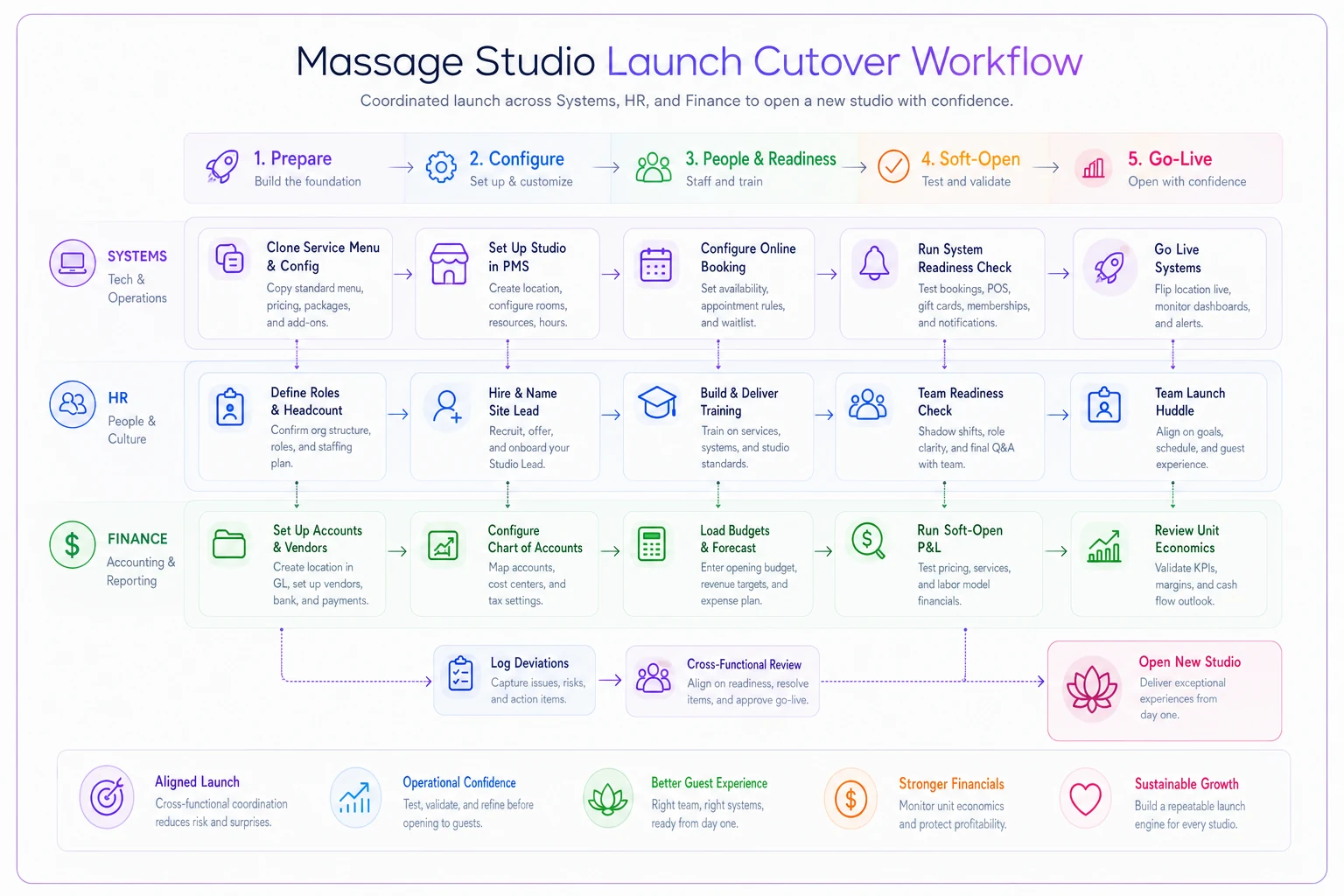
You want three of them: systems, HR, and finance.
Systems cutover template
The new location should run on the same practice-management setup, configured the same way, with the same rules — not a fresh account someone builds from scratch with their own preferences. Divergent software config is how two locations end up unable to share data or compare reports.
-
Clone the service menu, pricing, and package definitions from site #1 exactly.
-
Replicate booking rules
buffer times, session-length caps per therapist, double-booking constraints.
-
Set up intake and consent forms identically so client experience matches across sites.
-
Configure reporting so both locations feed a single, comparable view.
-
Migrate or connect data cleanly — this is precisely where studios corrupt records or lose history if they wing it. The practice-management selection and migration runbook matters twice as much when you're replicating, because a mistake now propagates to every future site.
The systems piece sounds straightforward but it's where most replication attempts quietly go sideways. Someone sets up the new account in a hurry, eyeballs the config rather than cloning it, and three months later the two sites can't produce a comparable report.
HR cutover template
-
Use the same offer letter, pay structure, and classification logic across sites. Mixing contractor and employee rules per location creates compliance risk and pay confusion.
-
Run the identical onboarding and shadowing sequence you use at site #1, including the same 30-60-90 ramp expectations.
-
Assign a named site lead before opening, not after — the most common HR failure is opening without a clear decision-maker on the floor.
-
Set the roster template from your capacity baseline, then adjust to local demand only after 6-8 weeks of real data.
Finance cutover template
-
Open the new location's accounts with the same chart-of-accounts structure so numbers roll up cleanly.
-
Standardize the payment processor, fee handling, and gift-card/package liability tracking to match site #1.
-
Set the same month-end close process and calendar. Two locations closing on different schedules with different methods is a reconciliation nightmare.
-
Define, in advance, how shared costs — marketing, software, your salary — get allocated between sites so per-site profitability stays honest.
The whole spirit of the replicate stage is copy the config, adapt only the location-specific reality. Local demand, local staffing levels, local hours — those flex. Pricing logic, workflows, and back-office structure do not.
A staging checklist owners can run per site
This is the sequence to run for each new location, in order. Don't parallel-track it; the ordering matters because finance decisions depend on systems config, and staffing depends on both.
-
Confirm triggers are green (the one-page check above). No green light, no lease.
-
Lock the systems config — clone site #1's setup, verify booking rules and forms, run test bookings.
-
Set up finance rails — accounts, processor, chart of accounts, cost-allocation rules, month-end calendar.
-
Hire and name the site lead — before any other staff, so someone owns the launch.
-
Staff to the capacity baseline, not to hope. Understaff slightly and add, rather than overstaff and cut.
-
Run a soft-open week with limited hours, real clients, and you or a trusted lead observing every shift.
-
Log every deviation from the SOP during soft-open — these are your documentation gaps, same as the pilot test.
-
Fix gaps, then go full hours.
-
Review unit economics at week 6 and week 12 against the site-1 baseline. Investigate any function running more than a few points off.
The soft-open week is the step everyone wants to skip and shouldn't. A limited soft open surfaces the mismatches — the ones your templates missed — while the cost of fixing them is still small. It also gives the site lead a chance to build confidence on a forgiving schedule before things get real.
Stage 3 — Centralize: only when the overhead pays for itself
Centralizing means pulling shared functions — finance, scheduling oversight, HR, marketing — into one back office that serves all locations. Done at the right time, it removes duplicated work and gives you one clean view of the whole business. Done too early, it adds head-office cost before you have enough sites to spread it across.
The signal you're ready is friction, not headcount. When each site manager is separately reconciling books, separately posting jobs, separately reinventing the same promotion — and you're spending your week reconciling their reconciliations — that duplicated effort is now more expensive than a central function would be.
A sane centralization order:
-
Finance first. One close process, one set of books rolling up per-site P&Ls. This is where fragmentation costs the most and centralization pays back fastest.
-
Scheduling and capacity oversight next. A central view of utilization across sites lets you shift demand and staffing intelligently instead of each location optimizing in isolation.
-
HR and hiring after that. Standard pipelines, standard onboarding, one place that owns classification and compliance.
-
Marketing last, once you have enough locations that shared campaigns beat local efforts.
This is also the stage where the manual approach genuinely stops scaling. Running three or four sites off spreadsheets and separate logins means information lives in silos and nobody has the whole picture. A workflow platform that centralizes booking, client records, and per-site reporting into one system isn't a luxury at this point — it's what lets a small team oversee multiple locations without hiring a full back office for each one. The goal isn't fancy technology; it's making sure the second, third, and fourth locations run on the same visible rails as the first, so drift can't hide.
A real scenario: how replication protects margin
A two-room studio doing roughly 320-360 sessions a month at a solid contribution margin decided to open a second location eight minutes away. First instinct was to sign the lease during their busiest quarter and figure out operations as they went.
Instead they ran the pilot discipline first: documented the intake and checkout flow, pinned down per-session economics, and pulled the owner off the floor for two weeks to expose gaps. That test revealed the whole "Friday close" routine — how the lead therapist handled walk-ins and upsells — existed nowhere in writing. They wrote it down.
When they opened site #2, they used cutover templates instead of improvising. Same software config, same pricing, same roster logic scaled to the smaller space. They soft-opened at limited hours for a week and caught two things the templates missed — a broken buffer-time setting that was letting deep-tissue sessions stack, and a payment-processor fee setup that would have quietly understated margin.
The outcome wasn't a hockey-stick revenue story. Site #2 ramped to breakeven in about four months and to a healthy margin by month six — roughly what the runway budget assumed. The real win was quieter: because both sites ran identical config and finance rails, month-end still reconciled cleanly, the owner's hours didn't double, and site #1's margin never dipped while attention shifted next door. That's what "not losing profitability while scaling" actually looks like — undramatic, and entirely because of the boring prep.
When replication is a bad idea
Not every profitable studio should become two. Some things worth being honest about:
-
The margin is you. If the studio's profit depends on you personally treating clients or personally closing sales, a second location doesn't scale that — it dilutes it.
-
Demand isn't real yet. If site #1 runs at moderate utilization, a nearby second location mostly cannibalizes your own clients and splits fixed costs across the same revenue base.
-
The books aren't clean at one site. If your current month-end is a scramble, two sites won't fix it — they'll double the mess.
-
You're opening to escape a problem. A second location never fixes a broken first one. It inherits every unsolved issue and adds new ones.
There's nothing wrong with staying at one excellent, high-margin studio. Plenty of the most profitable wellness businesses are single locations run tight. Replication is a strategy, not a status symbol, and the owners who treat it that way are the ones who don't get burned.
The through-line
The reason a scaling playbook for multi-location studios works or fails comes down to sequence. Pilot until the process survives without you. Replicate with templates so each site copies the known-good version instead of a manager's best guess. Centralize only when duplicated effort costs more than a shared back office. Skip a stage and you're not scaling a business — you're cloning your own workload while your margins quietly slide.
The studios that grow well aren't the ones with the boldest expansion plans. They're the ones patient enough to make site #1 boringly documented, disciplined enough to wait for the triggers, and honest enough to run the soft open even when they're sure it'll be fine. Do the unglamorous parts right, and location two makes money. Skip them, and it slowly eats location one.
The studios that grow well aren't the ones with the boldest expansion plans. They're the ones patient enough to make site #1 boringly documented, disciplined enough to wait for the triggers, and honest enough to run the soft open even when they're sure it'll be fine. Do the unglamorous parts right, and location two makes money. Skip them, and it slowly eats location one.
Ready to elevate your massage therapy business?
Join hundreds of therapists using Masthera to save time, reduce scheduling conflicts, and enhance client satisfaction.