



Most massage and wellness owners I talk to don't have a cashflow problem in December or June. They have a cashflow problem three months after December or June, when they either overhired going into a slow stretch or underhired heading into a busy one. The season didn't sink them. The lag between what they saw and what they did about it sank them.
Seasonal studios live and die on this lag. Bookings swing, payroll doesn't. Membership dues trickle in on the same day every month while walk-in and package revenue jumps around like it's on a trampoline. And the two biggest levers you have — hiring and cash reserves — both take weeks to adjust. That mismatch is the whole game.
This piece is about building a scenario model that actually respects that timing. Not a spreadsheet that spits out one hopeful number, but a best/base/worst structure tied to the three variables that move first: booking volume, payroll cadence, and membership churn. And more importantly, the triggers that tell you when to act, not just what might happen.
Why single-number forecasts quietly wreck seasonal studios
The default forecast most owners run is one line. Take last year's revenue, add a growth percentage, subtract expenses, look at the number at the bottom. It feels responsible. It's basically useless for a seasonal business.
A seasonal studio doesn't have one future — it has a range, and the range is wide. A studio doing roughly $28k in a strong month might do $16k in a soft one. That's not noise, that's the actual shape of the business. When you forecast with a single blended number, you're planning for a month that never actually happens. Every real month is either meaningfully above or below your average, which means your staffing and cash buffer are wrong in alternating directions all twelve months.
What breaks first is payroll. It's the most rigid cost you carry and the slowest to change. You can drop marketing spend in a week. You cannot un-hire a therapist you brought on for a season that turned out soft — at least not without damaging morale, your reviews, and the therapist who told two friends your studio was hiring. The single-number forecast tempts you into staffing for the average, which means you're understaffed during peaks and overstaffed during troughs.
The fix isn't a better average. It's modeling three futures at once and knowing which one you're currently living in.
The three scenarios, and what each one is actually for
The point of best/base/worst isn't to be pessimistic or optimistic. Each scenario answers a different operational question.
Never miss a booking or double-book again.
Masthera helps you schedule, confirm & manage every massage session with ease.
- Unified appointment management
- Automated client reminders
- Therapist calendar coordination
No credit card required
-
Base case answers
What staffing and cash level do I plan around by default?
-
Best case answers
At what point do I add capacity — and can I actually deliver if bookings surge?
-
Worst case answers
How long can I survive if the season underperforms, and what's my first cut?
Most owners build the base case and stop. The worst case is the one that saves the business, and the best case is the one that lets you grow without overcommitting. Skipping either leaves you reacting instead of deciding.
Here's a realistic version for a two-room studio with four therapists (mix of employee and contractor), a membership base, and seasonal swings. Numbers are illustrative but proportioned the way real studios actually move.
| Driver | Worst case | Base case | Best case |
|---|---|---|---|
| Monthly bookings | ~240 | ~320 | ~400 |
| Avg revenue / booking | $78 | $85 | $92 |
| Monthly membership churn | 6% | 3.5% | 2% |
| Active members | ~110 | ~145 | ~175 |
| Monthly revenue | ~$19k | ~$27k | ~$37k |
| Fixed + payroll costs | ~$21k | ~$22k | ~$24k |
| Monthly cash delta | –$2k | +$5k | +$13k |
Notice what the worst case reveals: it's not that the studio loses a fortune, it's that it bleeds roughly $2k a month. That's slow enough to ignore for a while and deadly if you ignore it for two quarters. The whole value of the model is naming that number before you're in it.
If you haven't nailed down your per-session economics yet, the scenario model will be built on sand. It's worth getting that foundation right first — the logic in why unit economics should drive your massage pricing feeds directly into the "avg revenue per booking" and cost rows above.
Payroll cadence is the variable everyone underweights
Booking volume gets all the attention because it's the fun number to watch. But what actually causes cash emergencies is the timing of payroll against the timing of revenue.
The mismatch in plain terms: membership dues hit around the same date each month — predictable, smooth. Package and walk-in revenue arrives unevenly, clustered around promotions, holidays, and weekends. Payroll goes out every two weeks regardless of which kind of month you're having. So you can have a "profitable" month on paper that still produces a cash crunch in the second half, simply because two payroll runs landed before the big booking weekend cleared.
A typical example: a studio runs biweekly payroll of about $9k per run. In a normal month that's manageable. But a five-therapist January — where the holiday package rush already got paid out in December and the new-year rebound hasn't started yet — can drop three payroll runs into a stretch where revenue is at its annual low. That's roughly $27k of payroll against maybe $19k of revenue in a four-week window. The month "recovers" by March, but the studio needed cash it didn't have in week six.
This is why runway planning has to be built on payroll cadence, not calendar months. A payroll-aligned runway template looks like this:
-
List every payroll date for the next 90 days. Not months — actual pay dates.
-
Assign expected revenue to the weeks between them, using your base case first.
-
Calculate running cash balance after each payroll run, not at month-end.
-
Flag any point where the balance dips below one full payroll run. That's your danger line.
-
Re-run the whole thing with the worst-case booking numbers and see how many pay dates you can cover before you hit zero.
A simple visualization helps make the payroll-aligned runway steps clear.
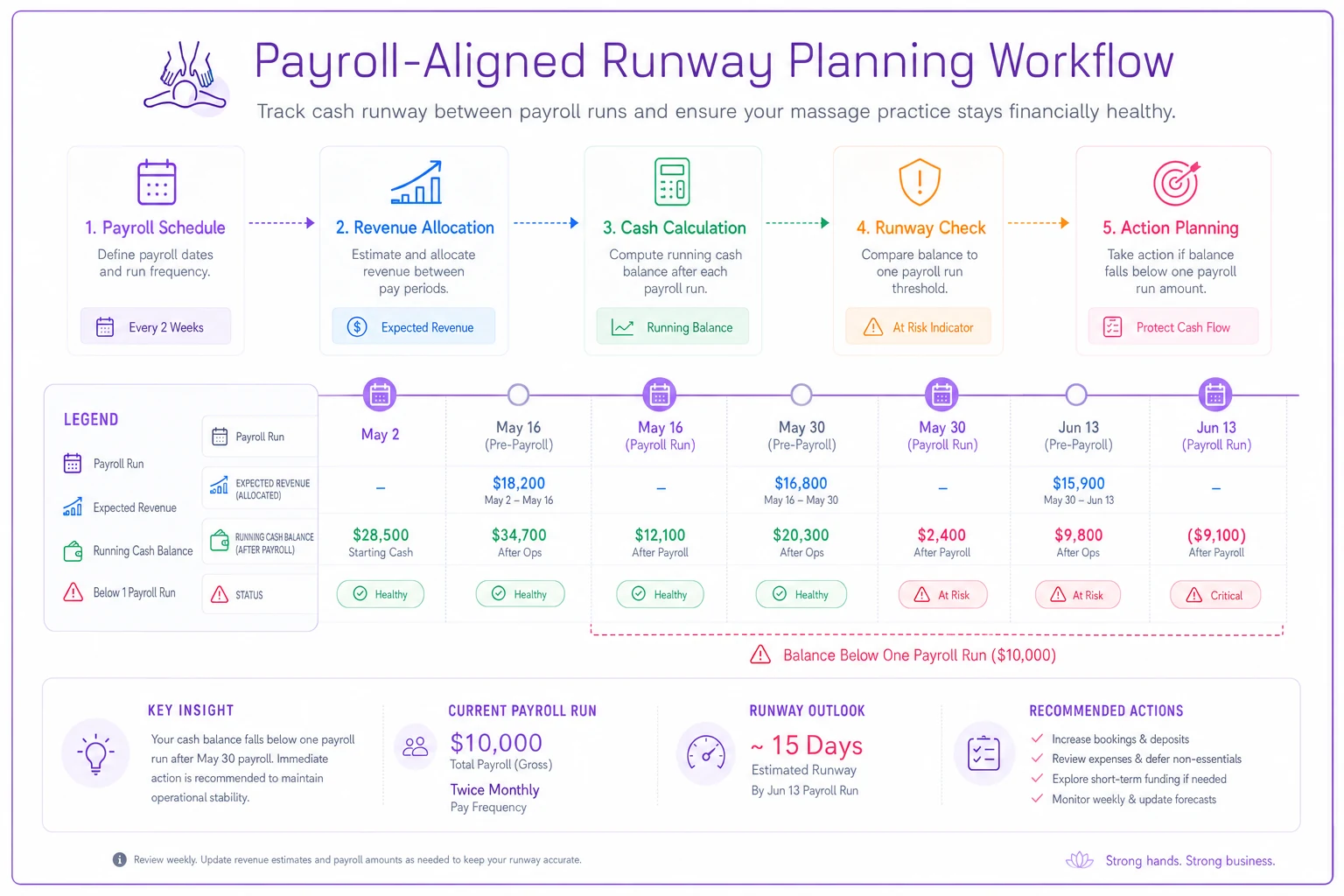
Use it as a checklist when mapping pay dates to revenue.
The number you're looking for is simple: how many payroll runs can I cover if bookings come in at worst-case? If the answer is fewer than three, you don't have a forecasting problem — you have a reserve problem, and it needs solving before the season turns.
The month-end cashflow playbook covers the reconciliation side of this well. The scenario model here is what you run forward; the month-end checklist is what you use to check whether reality matched the plan.
Membership churn: the slow leak that changes every other number
Churn is sneaky because it doesn't show up as a dramatic event. Nobody storms out. Members just quietly don't renew, and because dues are automatic, you often don't notice until three or four have lapsed.
The reason churn belongs in your scenario model — and not just a retention report — is that membership revenue is the only stable leg of a seasonal studio's income. It's the floor everything else sits on. When churn rises from 3.5% to 6%, you're not just losing dues. You're making the whole business more seasonal, because you've thinned out the predictable base and left yourself more exposed to swingy walk-in revenue.
Run the math on the table above. At 3.5% monthly churn on ~145 members, you lose about 5 members a month and need to replace 5 just to stand still. At 6%, you're losing closer to 8 or 9. That's not a huge difference in a single month. Over a slow season of four or five months, it compounds into a materially smaller base heading into your next busy period — meaning you enter peak season weaker than you left the last one.
The operational insight most owners miss: churn and seasonality feed each other. Slow seasons cause churn (people cancel when they're using the studio less), and churn deepens the next slow season (smaller stable base). If your worst-case scenario doesn't bump the churn number up, it's not actually a worst case — it's just a base case with lower bookings.
Turning the model into hiring and expansion triggers
A scenario model that just sits in a spreadsheet is a diary, not a tool. The value comes from attaching triggers — pre-decided rules that tell you when to act, so you're not making emotional staffing calls in the moment.
Hiring triggers (add capacity):
-
Rebooking requests exceeding available slots for three consecutive weeks — not one busy weekend.
-
Trailing 4-week bookings holding at or above your best-case line.
-
Cash reserve above three full payroll runs after accounting for the new hire's ramp cost.
Slow-down triggers (protect cash):
-
Trailing 4-week bookings dropping to worst-case for two consecutive weeks.
-
Churn ticking above 5% for two months running.
-
Cash reserve dipping below two payroll runs on your forward template.
The reason to use trailing weeks and consecutive periods is to filter out noise. A single dead week around a holiday isn't a signal. Three in a row is. What kills studios isn't making the wrong decision — it's making the right one a month too late.
When adding staff actually makes sense
Add capacity when your best-case line is being hit consistently and your cash can cover the ramp period. A new therapist rarely fills their book on day one. Budget six to ten weeks of partial utilization. If your worst-case runway can't absorb that ramp, the honest answer is: not yet, even if bookings look great right now. Growth that outruns cash is how profitable-looking studios fail.
When it's a bad idea
Adding staff off a single strong month is the most common expansion mistake. So is hiring to chase demand you created with a discount promotion — that demand often evaporates when the promo ends, leaving you with a full payroll and a half-full schedule. If your booking surge came from a one-time offer, wait and see whether it holds at full price before you commit.
Who should not run aggressive expansion triggers at all
If your membership churn is above 5% and climbing, fix retention before you add capacity. Hiring to serve a leaky base just raises your fixed costs while the floor keeps dropping. Stabilize first, then grow. The sequencing matters — it's the same logic behind the staged playbook to replicate a profitable studio: you don't scale a model until the model is stable.
A real scenario: a two-location studio that stopped panicking in Q1
A wellness studio running two small locations kept hitting the same wall every winter. Strong November and December, then a brutal January and February where cash felt like it was disappearing. Every year the owner made the same two reactive moves — cut therapist hours mid-January in a panic, then scramble to rehire and retrain in March when spring picked back up. The retraining alone was eating real money, and a couple of good therapists left because the hours got unreliable.
They built a payroll-aligned scenario model going into the following winter. The worst-case run showed the crunch clearly: with holiday payouts landing in December and the January dip, they'd hit their danger line — under one payroll run in reserve — around the second week of February. Knowing that in October instead of February changed everything.
Instead of cutting hours reactively, they set aside roughly $12k during the strong months specifically to cover the two soft payroll runs they now knew were coming. They shifted one therapist to a reduced-but-guaranteed winter schedule by agreement, not by surprise. And they moved a membership renewal push into early January to blunt the seasonal churn spike before it started.
The season still dipped — that's seasonality, you can't model it away. But they covered every payroll run without a scramble, kept both therapists, and skipped the March retraining cost entirely. That alone saved a few thousand dollars. The difference wasn't better bookings. It was seeing the crunch three months early and having a pre-decided plan instead of a panic.
Building this without living in a spreadsheet
The honest friction with scenario modeling is maintenance. A model built once in October is stale by December. The variables that drive it — bookings, churn, cash position — move weekly, and updating three scenarios by hand every week is exactly the kind of task that gets abandoned by February.
This is where pulling numbers directly from your operational system matters more than the model design itself. When booking volume, membership status, and payroll dates already live in one platform, the scenario model can refresh off live data instead of you re-entering it manually. The trailing 4-week booking trend, the current churn rate, the forward cash position against upcoming pay dates — your scheduling and payment systems already know all of this. The value of an AI-assisted operational platform isn't fancy prediction; it's keeping the model current without manual reconciliation, and flagging when a trigger condition gets crossed so you notice in week one instead of week five.
The model is only as good as how fresh it is. A worst-case scenario you last updated two months ago won't warn you about a churn spike that started last week. Whatever you use to run it, the goal is the same: the numbers stay live, and the triggers surface on their own so the decision lands on your desk while you still have time to act on it.
Pulling it together
Seasonal cashflow runway planning isn't about predicting the future accurately — nobody can. It's about pre-deciding how you'll respond to each of the three futures that are actually possible, and tying those decisions to payroll timing rather than tidy calendar months.
Build the three scenarios. Anchor the runway to your actual pay dates, not month-ends. Put churn in the worst case, not just the retention report. Set your hiring and slow-down triggers while you're calm, and then trust them when the season turns. The studios that handle seasonality well aren't the ones with the smartest forecast — they're the ones who saw the crunch coming early enough to make a boring, planned decision instead of a scared one.
Build the three scenarios. Anchor the runway to your actual pay dates, not month-ends. Put churn in the worst case, not just the retention report. Set your hiring and slow-down triggers while you're calm, and then trust them when the season turns. The studios that handle seasonality well aren't the ones with the smartest forecast — they're the ones who saw the crunch coming early enough to make a boring, planned decision instead of a scared one.
Ready to elevate your massage therapy business?
Join hundreds of therapists using Masthera to save time, reduce scheduling conflicts, and enhance client satisfaction.