



Nobody warns you about this when you open your second location: your first studio doesn't stay the same. You think you're just copying what already works. But the moment your attention gets split, both sites start drifting in slightly different directions — different discount rules, different intake habits, different ideas about what "we're fully booked" actually means.
That drift is quiet. It doesn't show up as a crisis. It shows up six months later when you realize Site A gives out free upgrades like candy, Site B is turning away walk-ins because a front-desk lead decided that's the policy now, and neither manager can tell you why. Nobody made a bad decision on purpose. The problem is nobody agreed on who decides what — and once you have more than one location, that gap becomes the single most expensive thing in your business.
Multi-site governance for wellness studios isn't corporate paperwork. It's the plumbing that keeps decisions consistent when you can't personally be the tiebreaker anymore. Most owners try to solve this with more meetings and longer text threads. That's not governance. That's you becoming a bottleneck with a phone.
Why decision drift happens even when everyone means well
Drift isn't a discipline problem. It's a clarity problem.
When you run one location, almost every non-trivial decision routes through you. Refund a client? Ask the owner. Comp a session because a therapist ran late? Ask the owner. Reorder the good table oil or the cheaper one? Ask the owner. You are the operating system, and it works fine because you're physically there.
Add a second site and something breaks that most people don't see coming: the number of decisions per day doesn't double — it grows faster than that, because now there are cross-site questions too. Can a Site A membership be used at Site B? Who covers a no-show gap when one location is slammed and the other is dead? Whose pricing wins during a promo?
What tends to happen across studios scaling past one location is that owners keep answering these one at a time, in the moment, over text. And every time you answer in the moment, you're setting an undocumented precedent that only you remember. Your managers are guessing at the rules by watching your reactions. That's how two locations end up with two different rulebooks that were never written down.
The deeper issue: there's a difference between a decision that should be made once and applied everywhere and a decision that should be made locally, every time. Studios that drift never sorted their decisions into those two buckets. Everything gets treated as ad hoc, so everything drifts.
The two buckets: central policy vs. local judgment
Before any RACI chart or dashboard, you need this split clear in your own head. Every recurring decision in your studio falls into one of two categories, and mixing them up is the root cause of most multi-site chaos.
Never miss a booking or double-book again.
Masthera helps you schedule, confirm & manage every massage session with ease.
- Unified appointment management
- Automated client reminders
- Therapist calendar coordination
No credit card required
Central decisions are things where inconsistency directly costs you money, brand trust, or legal exposure. Pricing structure. Membership terms. Refund thresholds. What services you offer and how they're described. Data handling. These need to be identical across every site, full stop. A client who pays $95 at one location and $110 for the identical service at another — and finds out — doesn't think "different market." They think you're playing games.
Local decisions are things that depend on what's happening in that room, that day, with that team. Which therapist covers a gap. Whether to hold a room open for a regular who's running late. How to handle a specific upset client in the moment. These shouldn't be centralized, because forcing them up to you just slows everything down and demoralizes competent managers.
The mistake almost everyone makes: they centralize the local stuff (micromanaging room-level calls) and localize the central stuff (letting each site improvise on pricing and refunds). It should be the exact opposite.
| Decision type | Should be central | Should be local | Common failure |
|---|---|---|---|
| Service pricing & packages | ✅ | Managers offer "friend rates" that spread | |
| Refund / comp above a set $ threshold | ✅ | Each site invents its own generosity | |
| Membership terms & cross-site usage | ✅ | Client uses membership fine at one site, blocked at another | |
| Same-day discounting to fill gaps | Set the rule centrally | Apply within limits locally | Either total chaos or zero flexibility |
| Covering a no-show / gap coverage | ✅ | Owner gets texted about every schedule hiccup | |
| In-session client accommodation | ✅ | Therapists wait for permission, service suffers | |
| Vendor / supply reordering | Approved list central | Reorder timing local | Random product quality across sites |
The point of this table isn't the specific rows — yours will look a little different. The point is that you have to actually decide which bucket each recurring decision lives in, and write it down where your managers can see it. That written line is what stops drift.
RACI for recurring decisions (without the corporate baggage)
RACI gets a bad reputation because consultants turn it into a 40-tab spreadsheet nobody reads. For a wellness studio, you only need it for the handful of decisions that come up over and over and cause friction. Ignore everything else.
RACI just answers four questions for each recurring decision:
-
Responsible — who actually does the work / makes the call
-
Accountable — who owns the outcome (only ever one person)
-
Consulted — who gets asked before it happens
-
Informed — who needs to know after
The magic isn't the acronym. It's the rule that Accountable is always exactly one person. The reason your locations drift is usually that two people quietly think they're in charge of the same decision, or nobody does. When a client asks a Site B lead for a partial refund and she's not sure if she's allowed, that's an "Accountable is unclear" problem, not a "she needs training" problem.
| Recurring decision | Responsible | Accountable | Consulted | Informed |
|---|---|---|---|---|
| Refund under $75 | Site lead | Site lead | — | Owner (weekly summary) |
| Refund $75–$200 | Site lead | Regional/owner | Site lead | Bookkeeper |
| Adding a promo discount | Owner | Owner | Site leads | All staff |
| Rescheduling a fully-booked day | Front desk | Site lead | — | Owner |
| Hiring a new therapist | Site lead | Owner | Existing lead therapist | Bookkeeper |
| Firing / removing a client | Site lead | Owner | Therapist involved | All staff |
Notice the refund row is split by dollar amount. That's the single highest-leverage thing on this whole page. A delegated authority threshold — "you can decide up to $X on your own, above that it comes to me" — removes the two most common problems at once: managers being afraid to act on small things, and managers making expensive calls they shouldn't. Set the number, write it down, and stop being asked about $40 comps.
Delegated authorities: the number that changes everything
The refund example above is really about a bigger idea. Delegated authority means you decide, in advance and in writing, how far each role can go before they need a sign-off. Money, scheduling, staffing, client relationships — each gets a ceiling.
-
Front desk / therapist can comp or adjust up to ~$40 to fix a same-day service issue, no approval needed. Just log it.
-
Site lead refunds and comps up to ~$150–$200, schedule changes for their own site, first-line client conflict resolution.
-
Regional / senior lead (if you have one) anything above the site lead's ceiling, cross-site coordination, vendor swaps within the approved list.
-
Owner pricing, new services, membership terms, hires/fires, anything that sets a precedent across locations.
Two things people consistently get wrong here.
First, they set the ceiling too low, so managers still funnel everything up and you're right back to being the bottleneck. If your site lead has to text you about a $50 comp, you didn't delegate — you added a delay. The ceiling should be high enough that 80%+ of daily decisions never reach you.
Second, they set it once and never revisit it. As a manager proves they make good calls, the ceiling should rise. As a new site finds its footing, it might start lower. Delegated authority is a dial, not a switch.
Log every comp immediately so the dashboard reflects real behavior.
There's a related trap worth naming: giving someone accountability without the matching authority. If your Site B lead is "responsible for hitting the utilization target" but can't approve a same-day discount to fill an empty slot, you've set her up to fail and then blamed her for it. Authority has to match the outcome you're holding someone to. This connects directly to how you think about capacity planning and rostering across multiple therapists — the person accountable for filling the schedule needs the actual power to fill it.
What breaks specifically at scale
The failure points shift as you grow, and it helps to know what's coming before it arrives.
At two sites, the break is usually informal precedent. You're still involved in almost everything, so the rules live in your head and your reactions. Your second manager learns by watching. The drift is small but starts here.
At three to four sites, the break is conflicting local optimization. Each site starts optimizing for its own numbers in ways that hurt the whole. One location aggressively discounts to hit booking targets, which trains local clients to wait for deals and quietly undercuts the sites that hold price. Nobody's wrong from their own seat — the incentives just aren't aligned across sites.
At five-plus sites, the break is invisible variance. You genuinely can't see what each site is deciding day to day, and by the time a bad pattern shows up in the financials, it's been running for months. This is where a lot of small chains stall out — not because demand dried up, but because the operating model that worked at one or two sites was never rebuilt for many.
The through-line across all of this: the more sites you have, the more you need decisions to be systematized rather than supervised. You can supervise two locations. You cannot supervise seven. The whole point of governance is to replace your presence with clear rules and visible information. If you haven't thought through the sequencing of how a location gets stood up and standardized, the staged playbook for replicating a profitable studio pairs closely with this — governance is what keeps the replicated sites from diverging after launch.
The one-page owner dashboard of delegated KPIs
Once you've delegated authority, you need a way to know it's being used well without re-inserting yourself into every decision. That's what the owner dashboard is for. Not a data project — one page, refreshed weekly or daily, that tells you whether each site is inside its lane.
The mistake is building a dashboard of activity instead of a dashboard of exceptions. You don't need to see every booking. You need to see the handful of numbers that would signal drift, and specifically the moments a site steps outside its delegated limits.
-
Utilization % — are the rooms actually being used, compared to the site's target
-
Average discount % — the single best early-warning sign of pricing drift
-
Refund/comp total & count — is anyone quietly living above their authority ceiling
-
Rebooking rate — the health signal that survives across every location
-
Membership sign-ups vs. cancels — recurring revenue direction
-
Exceptions flagged — any decision made outside delegated authority, and by whom
The last line is the important one. A good governance dashboard doesn't just show performance — it surfaces where the rules got bent. If Site C's average discount is creeping from 8% to 15% while everyone else holds at 9%, you've caught drift before it becomes a norm. If one site logs three above-ceiling comps in a week, that's a conversation, not a catastrophe — because you saw it in week one, not quarter three.
Keeping this genuinely to one page forces discipline. The temptation is to add "just one more metric" until the dashboard is a wall of numbers nobody reads. If it doesn't fit on a page and take under two minutes to scan, it won't get looked at, and an unread dashboard governs nothing. For the deeper build-out of what data infrastructure this sits on top of, the practical data and reporting strategy for small wellness chains covers the underlying plumbing this dashboard pulls from.
This is where operational software earns its place. Pulling utilization, discounts, and refund logs from each site by hand every week is exactly the kind of task that gets skipped by week three. A platform that centralizes each location's booking, billing, and comp data — and flags when a decision falls outside a set authority threshold automatically — turns "governance I intend to do" into governance that actually happens. The goal isn't fancy reporting. It's that exceptions find you instead of you having to go hunting for them.
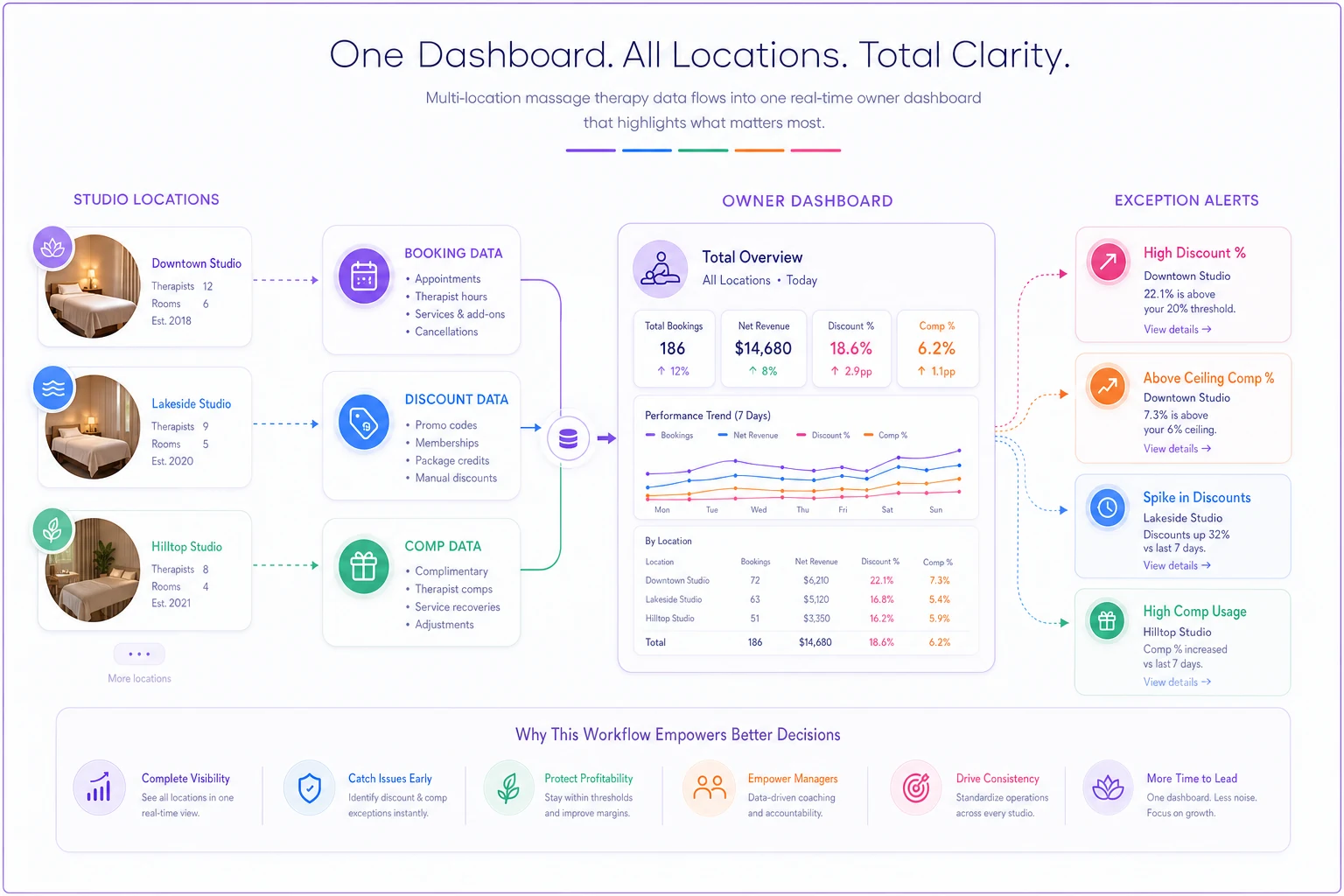
A quick visual of how site data feeds into a single exceptions-focused dashboard.
A short real scenario
A two-location massage studio, running somewhere around 330–360 sessions a month combined, ran into the classic version of this. The owner opened the second site and kept approving everything by text. Within about four months, the newer location's average discount had drifted to around 14% while the original held near 8% — the new manager had been comping generously to build a client base and nobody had told her not to. Refunds at the second site were running noticeably higher too, mostly small comps that individually looked harmless.
The fix wasn't dramatic. They wrote a two-bucket split (central pricing, local scheduling), set a delegated comp ceiling of $150 for site leads with anything above coming to the owner, and put a one-page weekly dashboard in place showing discount % and comp totals per site.
The discount at the second site settled back toward 9–10% within two months — not from a crackdown, but because the manager finally had a written number to work against instead of guessing. Small comps dropped by more than half once they had to be logged against a threshold. The owner stopped getting a dozen "is it okay if I…" texts a day. Nothing about the numbers was miraculous. It was just consistency where there'd been drift.
When this level of governance actually makes sense — and when it doesn't
When it makes sense: the moment you commit to a second location, even before it opens. Building the two-bucket split and delegated authorities before the second site launches is far easier than untangling a year of divergent habits. If you're at two or more sites now and you're still the tiebreaker on daily decisions, you're overdue.
When it's overkill: a single location with a small, tight team where you're present most days. Don't build a RACI chart for a studio you can walk across in ten seconds. Formal governance solves a coordination problem you don't have yet.
Who should be careful with this: owners who use governance as a way to avoid trusting their people. The purpose of delegated authority is to let managers act, not to build a cage of approvals. If your instinct is to set every ceiling low so you stay in control, you'll get the paperwork of governance with none of the benefit — you'll still be the bottleneck, just with more forms.
The real test of whether your governance is working is simple: can you take a two-week vacation and come back to find both sites made roughly the decisions you would have made? Not identical — you want local judgment on local calls. But consistent on the things that must be consistent, and free to move on the things that shouldn't wait for you.
Get the two buckets right, put one accountable name on each recurring decision, set authority ceilings your managers can actually work with, and watch a single page that flags the exceptions. That's the whole system. It's less about control than most owners expect, and more about making the rules visible so your team doesn't have to guess at them — and so your locations stop quietly becoming different businesses.
Ready to elevate your massage therapy business?
Join hundreds of therapists using Masthera to save time, reduce scheduling conflicts, and enhance client satisfaction.