
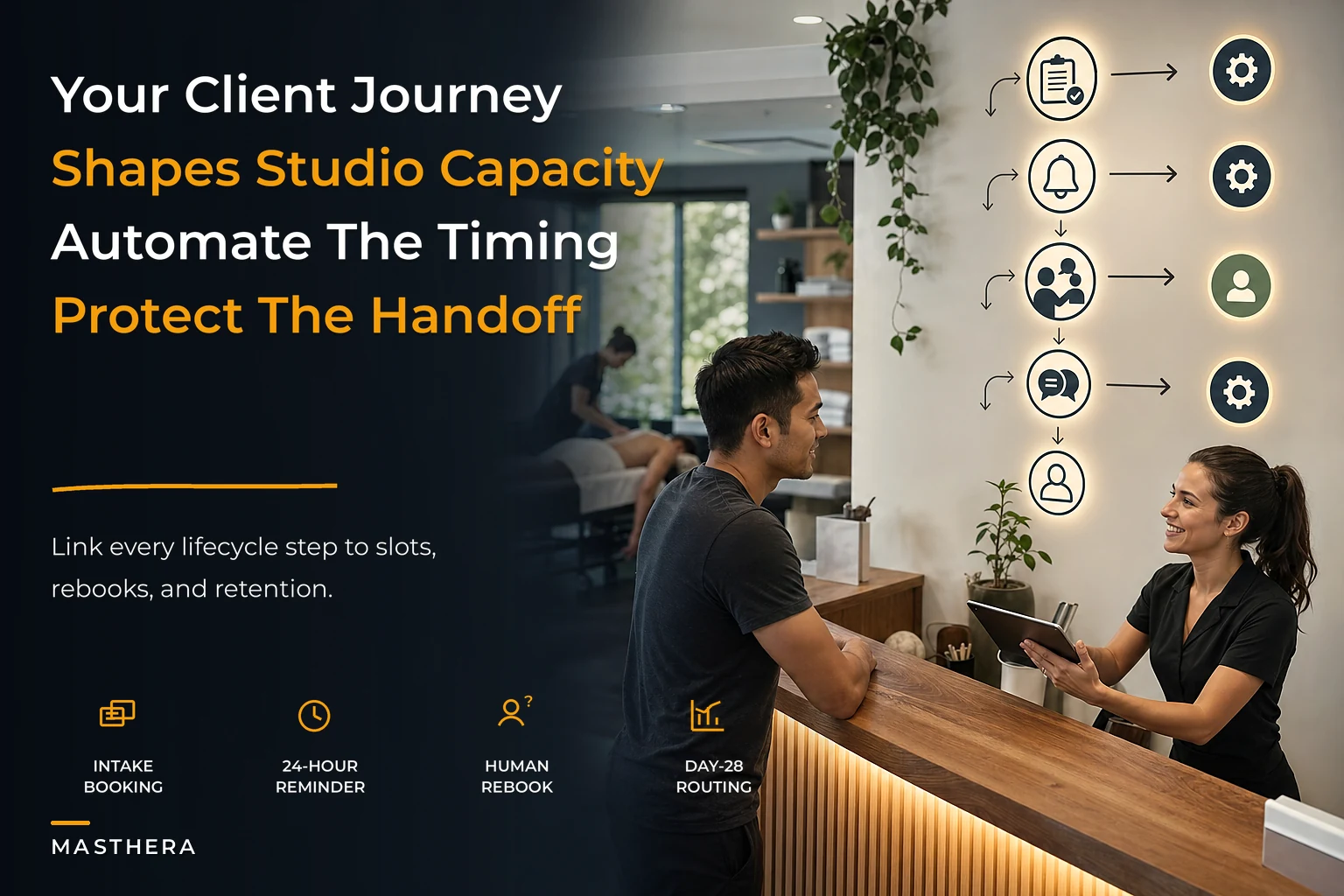

Most wellness owners treat their customer journey and their schedule as completely separate things. Marketing lives in one folder, the roster lives in another, and the two only meet when someone panics because next Tuesday has four therapists and eleven booked slots.
That gap is where growth quietly dies. A studio spends money filling the top of the funnel, retention improves, rebooking climbs — and then service quality drops because there literally isn't room for all those loyal clients at 6pm on a Thursday. The journey worked. The capacity didn't. And now the same clients you fought to keep are hearing "nothing available this week," which is exactly how retention starts reversing.
So this isn't a customer journey 101 post. The interesting problem for a practice-level customer journey framework for a wellness studio isn't the four stages themselves — everyone knows acquisition, onboarding, rebook, advocacy. The interesting problem is connecting each stage to slot supply, so you can tell which flow to push and which to hold based on what your roster can actually absorb.
The four stages, tied to capacity from the start
Think of the lifecycle as a pipe. Each stage feeds the next, and each stage either consumes or generates slot demand. If you only optimize for conversion, you'll flood a stage that has no room downstream.
| Stage | Primary KPI | Secondary KPI | Slot/roster impact |
|---|---|---|---|
| Acquisition | First-visit conversion rate | Cost per booked first visit | Creates new demand, usually off-peak flexible |
| Onboarding | First→second visit rate (28 days) | Intake completion before arrival | Determines how much demand becomes recurring |
| Rebook | Rebook-at-checkout rate | Avg days between visits | Highest predictable demand, clusters at peak |
| Advocacy | Referrals per active client | Review/UGC rate | Demand multiplier — but with a lag |
What owners consistently miss: rebook and advocacy generate the demand that's hardest to schedule. New clients from acquisition are flexible — they'll take a Tuesday 2pm because they have no habit yet. A loyal rebooking client wants "same time, same therapist, every three weeks," which all lands in your two busiest windows. Scale advocacy aggressively and you don't get evenly distributed growth. You get a spike concentrated exactly where you have the least room.
That's the core tension the framework has to solve.
Why the journey breaks as you grow
At one or two therapists, none of this is a real problem. The owner is the system. They remember who's due to rebook, they eyeball the week, they text the regulars themselves. It works because it all lives in one head.
Never miss a booking or double-book again.
Masthera helps you schedule, confirm & manage every massage session with ease.
- Unified appointment management
- Automated client reminders
- Therapist calendar coordination
No credit card required
The break happens somewhere around three to five therapists, or when a second location opens. A few patterns show up almost every time:
-
Onboarding gets inconsistent. One therapist rebooks 70% of first-timers at checkout. Another rebooks 20% because they "don't like to be pushy." Nobody's tracking it, so the studio never notices it's leaking half its new clients through one chair.
-
Rebooking becomes reactive. Instead of booking the next visit before the client leaves, front desk waits for the client to call. They mostly don't. The gap between visits stretches from 3 weeks to 6 weeks to "haven't seen them since spring."
-
Advocacy is completely unmanaged. Happy clients would refer if asked at the right moment. They're never asked, because the moment passes and nobody owns it.
-
Capacity is invisible until it hurts. Nobody sees the collision coming between "we're pushing referrals hard this month" and "our best therapist is fully booked for three weeks."
This usually happens because each stage is owned by a different person — or nobody — and no single view connects the money spent at the top to the slots consumed at the bottom.
Sequencing: the order matters more than the tactics
There's a correct order to strengthening these stages, and doing it out of order wastes money.
Rule 1: Never scale acquisition before onboarding converts. If your first→second visit rate is under roughly 40%, you have a leaky bucket. Pouring more first-timers in just means paying more to lose people faster. Fix the handoff from first visit to second before you touch ad spend. Getting found is only step one — turning Google Business Profile views into actual booked visits means nothing if those visits never come back.
Rule 2: Never scale advocacy before you have slack in the roster. Referrals are the highest-quality demand you can get, but also the least controllable in timing. If you're already at 85%+ utilization on peak windows, a referral push just creates waitlists and disappointed newcomers. Build capacity headroom first, then open the referral tap.
Rule 3: Rebook is the stage you protect above everything else. This is where LTV actually lives. A client who rebooks at checkout is worth 3–5x one who doesn't, because visit frequency stays tight and never has to be re-earned. If you can only fix one stage, fix this one.
The sequence almost always runs: onboarding → rebook → capacity headroom → advocacy → acquisition. Most studios do it exactly backwards — they start with acquisition because it feels like "growth," then wonder why nothing compounds.
Orchestration: what to automate, what stays human
Every stage has moments that should be automated and moments that must not be. Get this wrong and you either burn out your front desk or make your studio feel like a call center.
-
Automate the reminders, nudges, and tracking. Appointment reminders, intake form delivery, "you're due for a visit" nudges, review requests timed after a good session — all of this is repetitive and predictable. This is exactly where AI-assisted workflow platforms earn their keep: firing the right message at the right point in the lifecycle without someone needing to remember to do it.
-
Keep the judgment human. The rebook conversation at checkout. The recovery call after a bad session. The personal referral ask to your best client. These are relationship moments, and clients can tell the difference between a person and a template.
Let automation handle the memory and timing, and keep humans for the conversation and repair.
The mistake that comes up constantly: studios automate the wrong half. They send a canned "we miss you!" blast to a client who had a genuinely bad experience last visit — which lands like an insult. Or they leave front desk to manually track who's due to rebook, a job humans are genuinely bad at, while personally writing every reminder text.
The right pattern is automation handling the memory and timing, humans handling the conversation and repair. A good post-visit feedback loop is a clean example of this: the survey goes out automatically, but a low score routes to a human for a real recovery call, not another automated apology.
A sample onboarding flow (the highest-leverage stage)
Since onboarding is usually where the leak is, here's a concrete flow worth stealing. This covers a first-time client from booking through to their second visit:
-
At booking Intake and consent form sent automatically, before arrival. Goal is form completion before they walk in, so the first session isn't eaten by paperwork.
-
24 hours before Reminder with parking, arrival time, and what to expect. First-timer anxiety is real, and this cuts no-shows.
-
At checkout (human) Therapist or front desk offers to book the next visit right then, framed around the treatment plan. "For what we worked on today, I'd want to see you again in about three weeks — want me to grab that slot?"
-
If they book Confirmation and calendar invite, done. They're now a rebooking client.
-
If they don't book Automated nudge at day 10 and day 21, with an easy one-tap rebook link. Only escalate to a human touch if they were flagged as high-value or had a strong first session.
-
Day 28, still no rebook Route to front desk for a personal follow-up. Last cheap chance to save them.
Visualizing this flow can help teams follow it consistently.
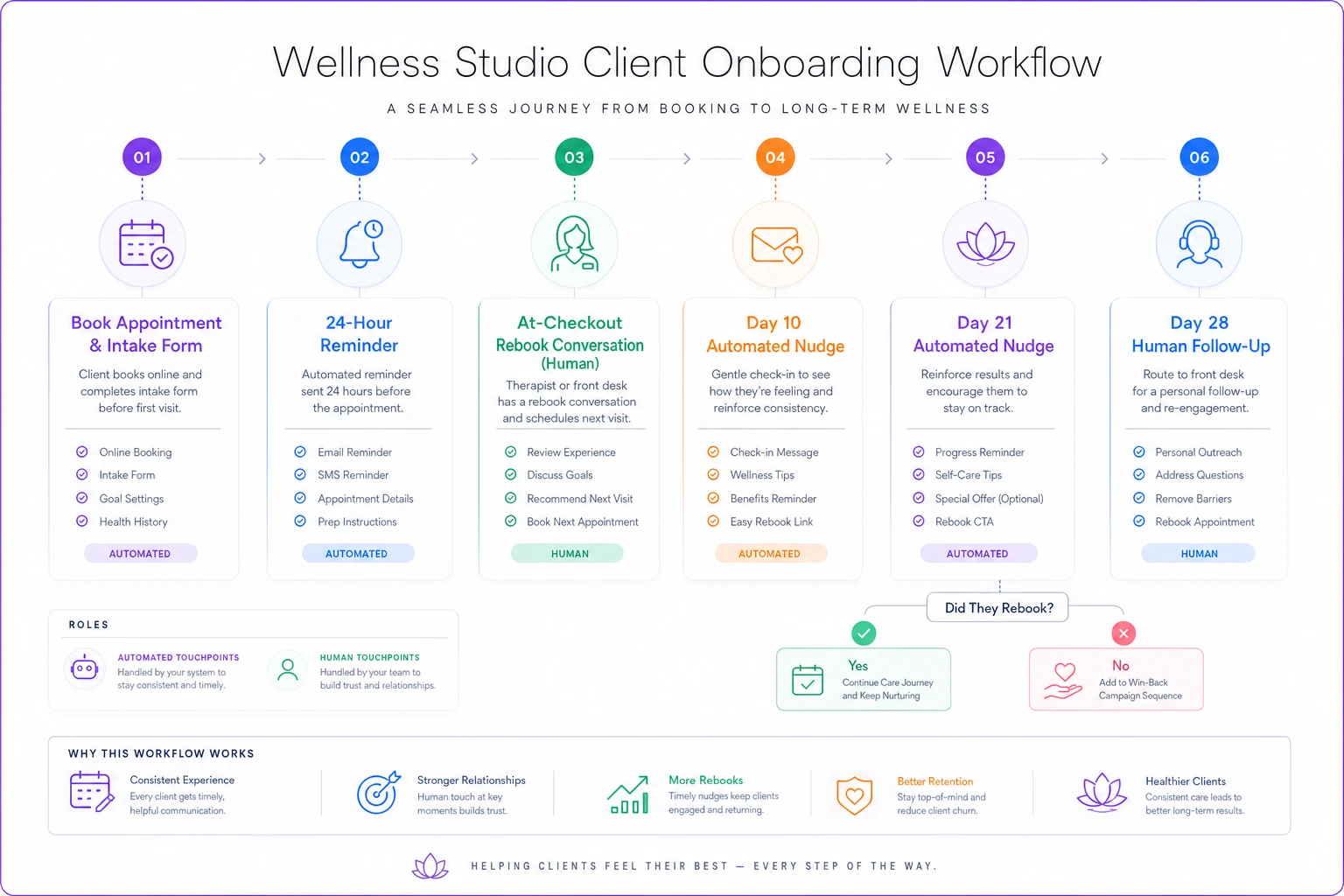
The single number that moves the most money here is step 3 — the at-checkout rebook. Studios that make this a consistent habit across every therapist routinely lift their first→second visit rate from the low 30s into the 50–60% range, without spending anything on marketing.
KPI dashboards, stage by stage
You don't need a data team. You need one view per stage that answers "is this healthy, and what's it doing to my roster?"
Acquisition dashboard
-
First-visit bookings this month
-
Cost per booked first visit
-
Off-peak vs peak distribution of new bookings (tells you if new demand is helping or hurting your crunch)
Onboarding dashboard
-
First→second visit rate, broken out by therapist (this is the one that exposes the inconsistent chair)
-
Intake completed before arrival %
-
Avg time to second visit
Rebook dashboard
-
Rebook-at-checkout rate by therapist
-
Average days between visits (creeping up is a bad sign)
-
% of active clients with a future appointment already booked
Advocacy dashboard
-
Referrals per active client per quarter
-
Review rate
-
New clients attributed to referral vs paid
The therapist-level breakouts matter more than studio averages. Averages hide problems. A 45% studio-wide rebook rate might be one person at 70% and two people at 25% — and you can't fix what the average quietly buries.
LTV and roster forecasting: connecting the two folders
The point of this exercise is forecasting slot demand, not just revenue.
-
Estimate LTV by cohort. Take a cohort of new clients. Track their average visit frequency and how long they stay active. A client visiting every 3 weeks for 14 months is worth dramatically more than one visiting every 8 weeks for 5 months — and consumes far more slots.
-
Convert LTV into slot demand. This is the step everyone skips. If rebook improvements push average frequency from every 5 weeks to every 3.5 weeks, that's not just more revenue — it's roughly 40% more visits per client per year, landing mostly in peak windows.
-
Project forward against roster hours. Lay forecasted demand against actual available therapist hours by day-part. Now you can see the collision before it happens.
-
Decide which flow to throttle. If the forecast shows peak windows hitting 90%+ while off-peak sits at 50%, the answer isn't more marketing. It's shifting demand — steering flexible new clients into off-peak, adding roster hours to peak, or pacing the advocacy push until headroom exists.
A quick realistic example: a four-therapist studio doing around 340 visits a month improved their at-checkout rebook rate over one quarter. Retention looked great, repeat visits climbed. But within about eight weeks, their two evening slots were booked solid three weeks out while midday sat half empty. They hadn't grown capacity; they'd concentrated demand. The fix wasn't more clients — it was shifting one therapist's hours later two days a week and steering new, flexible clients toward midday. Same roster, roughly $2k–$3k more monthly, and the waitlist frustration disappeared.
That's the whole point of forecasting slots instead of just dollars.
When to push each flow — and when not to
Push acquisition when: onboarding converts above roughly 45%, and you have off-peak slack to absorb new, flexible demand.
Push rebook always. There's basically no scenario where a higher at-checkout rebook rate hurts you, as long as you're watching for peak concentration and adjusting the roster accordingly.
Push advocacy when: you have genuine capacity headroom and your rebook engine is already running well. Referrals compound, but they compound into your busiest windows. How you structure the ask matters — a real referral tier structure with the right timing beats a vague "tell your friends" every time.
Don't push anything when: peak utilization is already above ~85% and you can't add roster hours. Every new flow just manufactures disappointment at that point. Fix supply first.
Who can ignore most of this: a solo therapist at 90% booked with a happy client base. You don't have a journey problem, you have a capacity ceiling. This framework earns its weight once multiple people and multiple stages start drifting out of sync.
The system view
The reason to treat this as one connected framework — rather than four separate marketing tactics — is that every stage quietly changes the demand on your schedule, and your schedule is the one thing that's genuinely finite.
Acquisition creates flexible demand. Onboarding decides how much of it becomes recurring. Rebook concentrates that demand into your busiest hours. Advocacy multiplies it with a lag you can't fully control. Optimize any one in isolation and you'll eventually break another.
The studios that scale retention without wrecking service quality are the ones watching all four stages and the roster together, and who understand the sequencing — fix the leak before you open the tap, build the room before you invite the crowd. Get that order right, keep the human moments human, let automation carry the memory and timing, and the journey stops fighting your calendar. That's when retention actually compounds instead of colliding with your own capacity.
The studios that scale retention without wrecking service quality are the ones watching all four stages and the roster together, and who understand the sequencing — fix the leak before you open the tap, build the room before you invite the crowd. Get that order right, keep the human moments human, let automation carry the memory and timing, and the journey stops fighting your calendar. That's when retention actually compounds instead of colliding with your own capacity.
Ready to elevate your massage therapy business?
Join hundreds of therapists using Masthera to save time, reduce scheduling conflicts, and enhance client satisfaction.