


Why unit economics should drive your massage pricing: a per-session model to set profitable rates
Walkthrough of a per-session unit-economics worksheet, therapist-pay vs margin scenarios, price bands, and decision rules for add-ons vs base price.

Actionable insights on client retention, scheduling optimization, therapy techniques, business growth strategies, and operational best practices for massage therapy professionals and wellness centers.
Walkthrough of a per-session unit-economics worksheet, therapist-pay vs margin scenarios, price bands, and decision rules for add-ons vs base price.

A compact, action-focused KPI set (8 metrics), sample dashboard wireframe, reporting cadence and decision rules tied to staffing, pricing and marketing actions.

Operational referral design: tiered rewards, qualification rules, timing triggers and onboarding hooks to prioritize high‑LTV referrals over one-off discount-seekers.

Clinic-specific onboarding with competency checklists, shadowing milestones, 30/60/90 goals, mentor pairing schedules and client-feedback loops to speed ramp and ensure quality consistency.
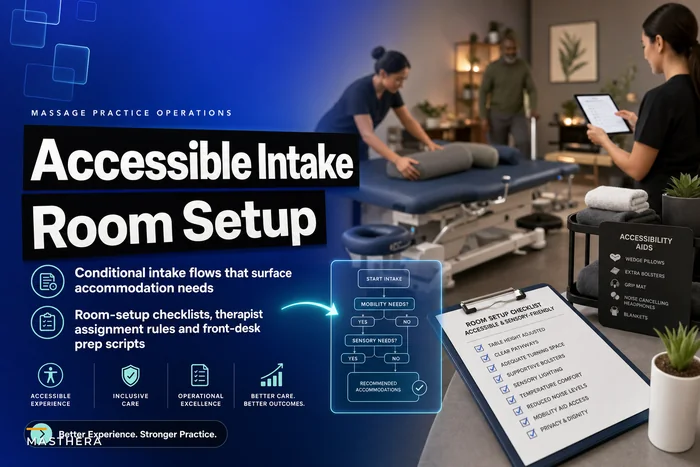
Conditional intake flows to surface accommodation needs, room-setup checklists, therapist assignment rules and front-desk prep scripts to operationalize accessibility.

Pre-visit signals, in-session de-escalation scripts, post-incident documentation templates and a clear escalation ladder including client-banning rules.

Systems-focused playbook to map end-to-end workflows, define handoffs and role-level SOPs, plus decision tables and sample diagrams tailored to massage session rhythms.
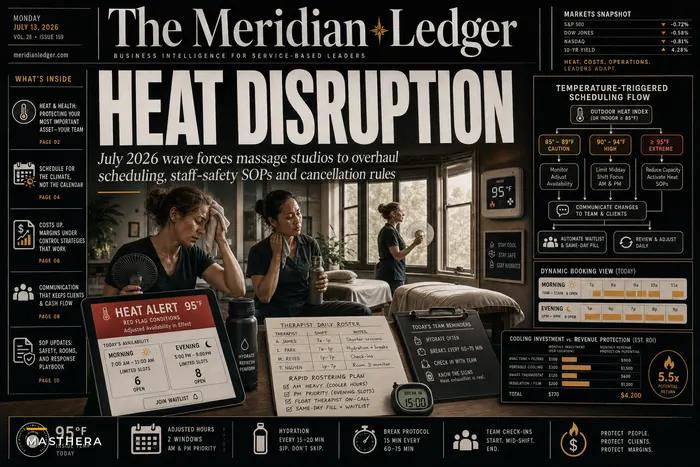
A short tactical playbook that links the July 2026 heat wave to concrete actions: update heat-safety SOPs for therapists (hydration, shortened/more frequent breaks, symptom checks), create heat-specific booking windows and dynamic availability (morning/evening priority), implement simple heat-related cancellation and refund rules plus messaging templates, automate same-day fill and waitlist flows to recapture lost revenue, and monitor HVAC/cost mitigation steps to protect margins.
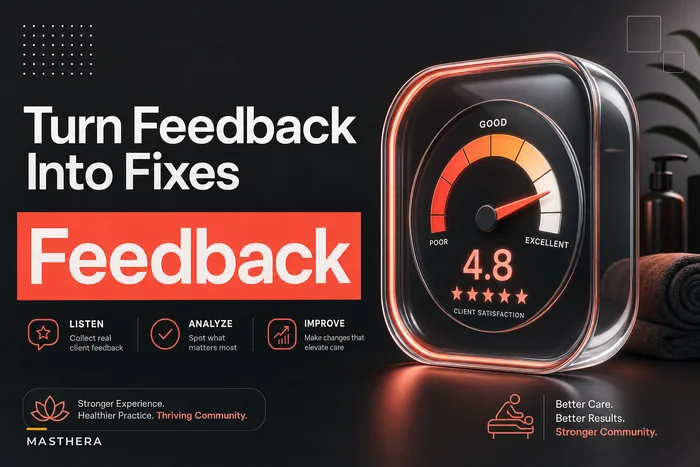
One-question NPS-style plus two context prompts, automated routing for negative feedback, and operational loops that convert feedback into measurable fixes and recoveries.